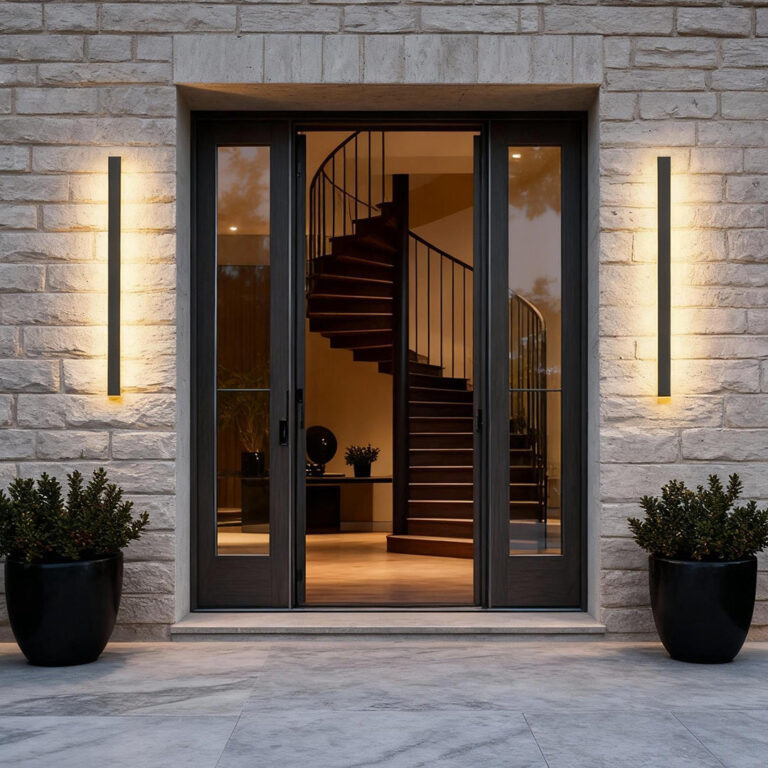
MEIKEE sells far more than one kind of outdoor light. Its range falls into four families, and each is built for a different job, so the wattage printed on the box tells you less than the family does.
A mismatch between family and job tends to show up as unused features or dark patches in the wrong places. This guide covers each family, the specs that separate them, how to install and look after them, and how to buy from a source you can trace.
I haven’t handled these lights myself. Everything here comes from the brand’s own descriptions and spec sheets, and I write “the brand says” wherever a claim can’t be checked independently.
Who MEIKEE Is
By its own account, MEIKEE is the factory rather than a middleman. The brand’s materials describe a Shenzhen LED lighting manufacturer that has been making fixtures for nearly twenty years.
According to the brand, it handles raw materials, machining and final assembly itself. If that is true, a design tweak or quality fix wouldn’t have to pass through a separate factory relationship. A product page can’t confirm it, so I read it as positioning and judge the lights by their specs instead.
The range runs past 20 products. Flood lights and motion-sensing security fixtures make up the largest share, and low-voltage landscape lights, solar spotlights and color-changing lights fill in the rest. MEIKEE also operates its own direct-to-consumer store alongside its Amazon storefront.
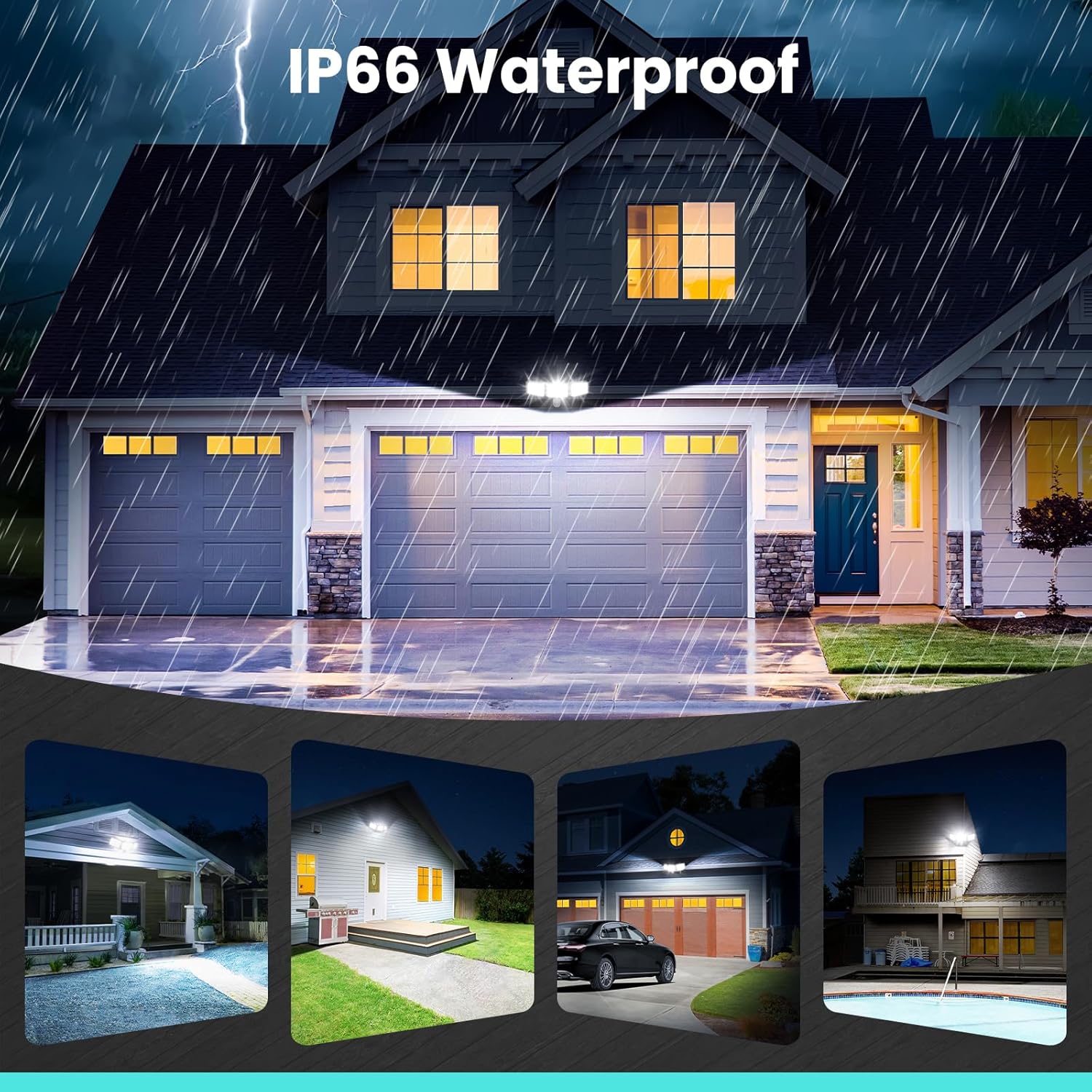
MEIKEE’s marketing mentions in-house testing that includes submersion checks to IP67, which is stricter than the IP66 or IP65 printed on its finished products. Whatever the factory tests to, the figure to rely on is the rating listed for your exact model, since a warranty or water-damage claim would refer to that number.
The Four Families of Light
Flood and Security Lights
Flood and security lights are the biggest family, from about 30W to 150W. Across the motion-sensor models you’ll find three recurring traits: a sensor range you can change, heads that swivel independently, and brightness and hold-time settings reached either by remote or by controls on the fixture.
Output climbs with wattage: 3,600 lumens for the 42W, 6,580 for the 70W and 9,600 for the 100W. All three are hardwired, which points them to garages, driveways and porches that already have power or can get it.
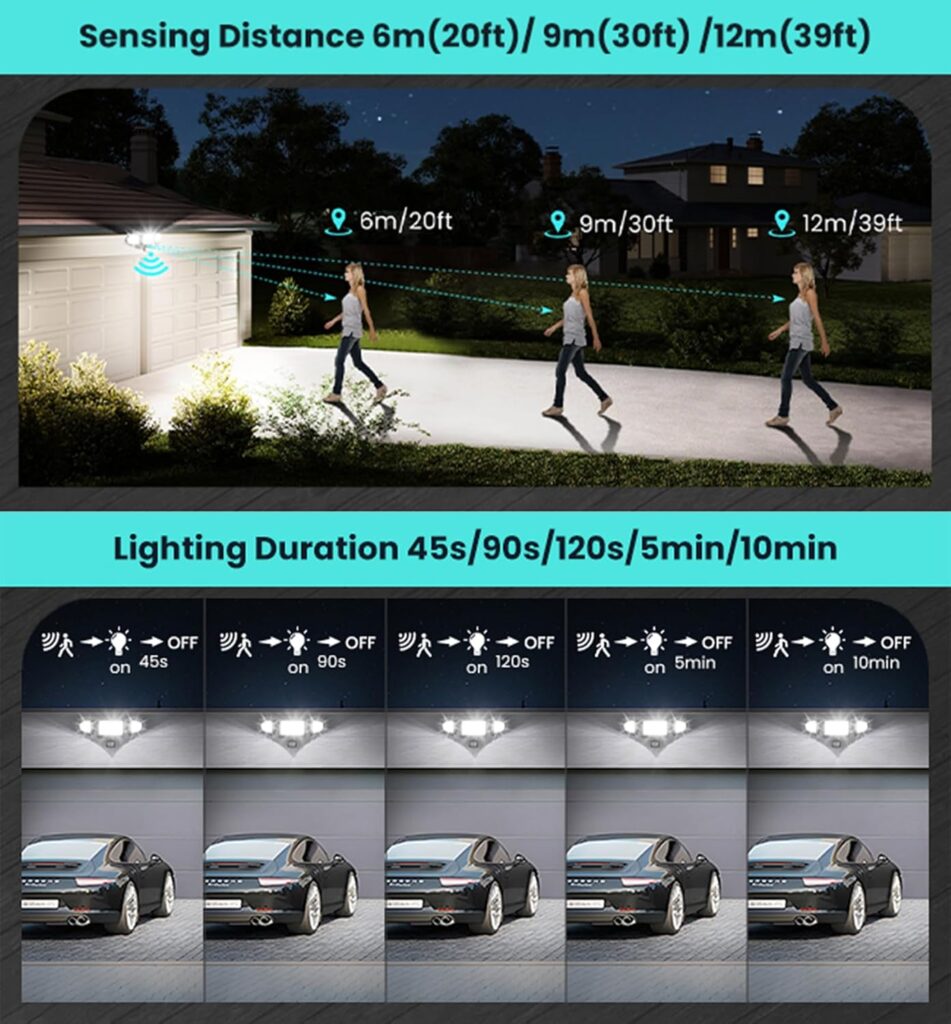
The top-output security model is the 100W Motion Sensor Flood Light. Our full verdict on the MEIKEE 100W Motion Sensor Flood Light goes through its spec sheet line by line, and you can browse the range on MEIKEE’s storefront on Amazon.
At the top of the wattage range, the 150W RGBW models are decorative wall washers rather than security lights.
Low-Voltage and Plug-In Landscape Lights
Power for this family steps down to 12V or 24V through a transformer, so nothing runs at household voltage. Fixtures are modest at 3W to 20W each and are sold in sets whose connectors let one transformer feed a whole path or bed.
Before buying, note two points. Most low-voltage packs ship without the transformer, which you buy separately. MEIKEE also offers 120V plug-in landscape lights in 12W and 20W versions that go straight into an outdoor outlet and need no transformer. Because the two systems can’t be swapped for each other, read each listing closely.
The brand’s 7W, 800-lumen 2-pack is the entry-level option. It gives warm 2700K light from a head that adjusts through 270 degrees, which suits walkways, and MEIKEE quotes about five minutes of installation per fixture.
Solar Spotlights
Solar is the family with no wiring at all. In the 6-in-1 Solar Spotlight, a 6W/6V panel charges a built-in rechargeable battery, and the brand rates a full charge at 8 to 12 hours of runtime.
It offers three color temperatures, 2700K warm, 4000K neutral and 6500K cool white, plus adjustable brightness and a remote with a 12-meter range. The panel has an aluminum frame, and the control box is sealed to IP66. Most models switch on at dusk and off at dawn by themselves.
Sunlight is the limit. Panel quality can’t make up for a shaded spot, because the same spotlight charges less behind a fence than in open sun, and that shows in its nightly output.
Color-Changing RGB and RGBW Lights
The last family is about color rather than coverage: color-changing floods, wall washers and landscape spotlights designed for holiday displays, parties and stage-style effects.
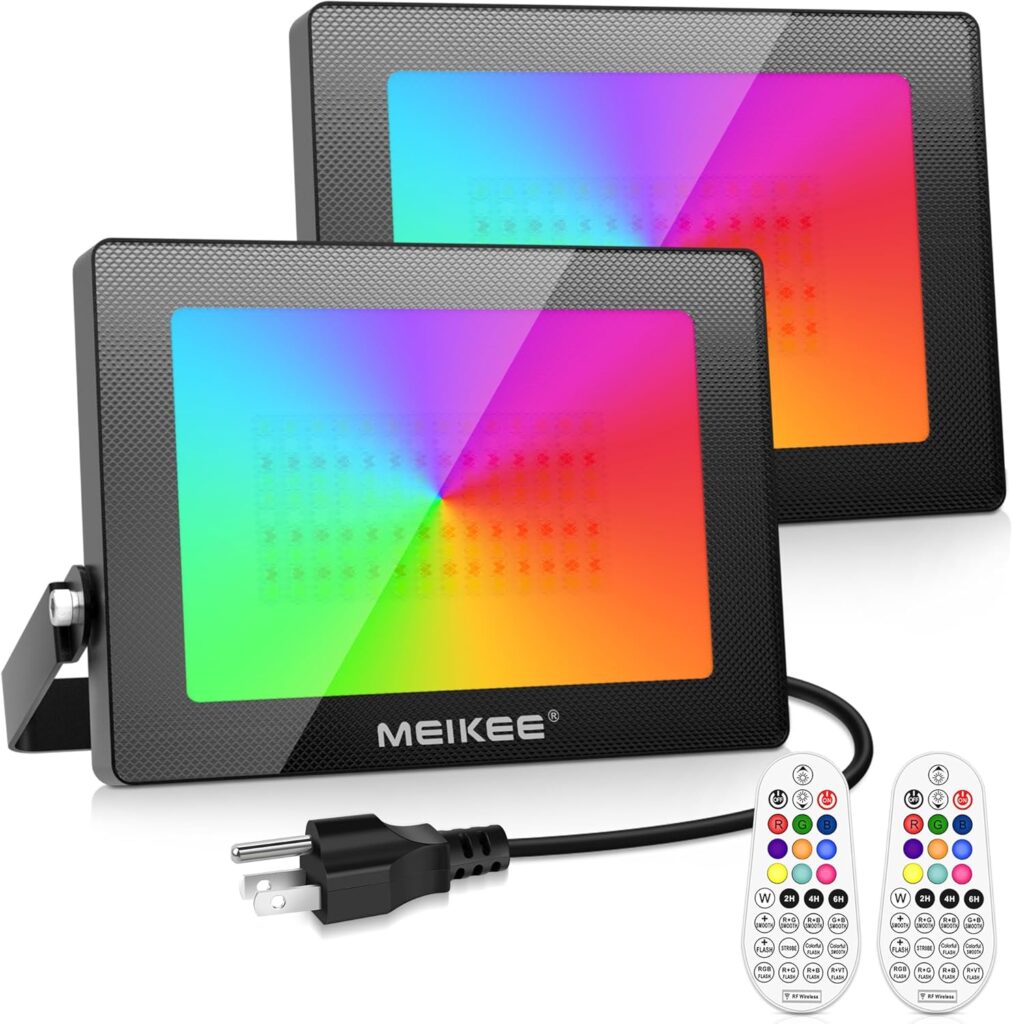
These lights come with a remote holding color presets, along with timer and memory functions; the memory restores the previous setting when power returns. RGBW versions mix in a dedicated white channel, and a 60W, 6,000-lumen RGBW flood is sold in a 4-pack aimed at whole-house displays.
They work as decoration; the other three families should handle everyday lighting.
Choosing by Job
Start with the job, not the product. Walk the yard after dark, note where you want light and where power already exists, and let those two things narrow the field.
If Security Is the Priority
Sensor reach separates the models. The 42W is quoted at a 40-foot detection range, while the 70W and 100W offer 6, 9 and 12-meter steps. The 42W suits a single door or side yard, and a long driveway or wide yard belongs to the other two. All three have three heads that aim independently.
Every security model is hardwired; none runs on battery or solar. Where wiring can’t reach, skip to the solar family instead.
If You Want Curb Appeal
Landscape lighting is the family to look at, in one of two forms. Low-voltage sets link several fixtures to a single transformer. Plug-in lights drop the transformer but need an outdoor outlet nearby.
If You Don’t Want to Run Wire
Solar spotlights avoid wiring but need a spot with direct sun for much of the day. The alternative is the rechargeable wall sconce, which runs on a 10,000mAh battery and a dimmable remote, with no dependence on sun.
MEIKEE positions the sconces for porches and covered spaces, indoors or out, not for open yard.
If It’s About Mood
The color-changing lights are the only family built for ambiance. Use them alongside plain white lighting for everyday needs, not instead of it.
Combining families is perfectly workable. A motion-sensor flood can cover the garage or front entry while low-voltage or solar lights mark a walkway. Because each has its own power arrangement, the two don’t interfere with each other.
Do not join the two kinds of wiring. Lengthening a 120V plug-in fixture with 12V low-voltage cable would mix systems that are designed to stay separate.
Reading the Spec Sheet
A handful of numbers on the listing do most of the work. Here is what each one tells you.
Lumens and Wattage
Wattage tells you how much power a fixture draws. Lumens tell you how much light it gives off, so lumens are the better guide to brightness when you compare models. MEIKEE’s 42W, 70W and 100W lights list 3,600, 6,580 and 9,600 lumens, so output rises with each step.
Color Temperature
Color temperature is shown in kelvins. Lower figures look warmer and more golden, while higher ones look cooler and bluer. MEIKEE lists its landscape fixtures in warm 2700K white and its flood lights in 6500K daylight white, and its solar line lets you switch between warm, neutral and cool white.
IP Ratings
An IP rating pairs dust protection with water protection. IP66 covers dust and powerful jets of water such as rain or a hose, and IP65 sits one step below on the water side. MEIKEE lists most outdoor fixtures at IP66 on the housing, with IP65 on some sensor heads. Neither rating covers sitting underwater.
Detection Range, Angle and Hold Time
Motion-sensor lights have three separate settings to understand. Range is how far the sensor looks, angle is how wide it looks, and hold time is how long the light stays on after it fires.
On most MEIKEE models, range steps through 6, 9 and 12 meters, and the sensing angle is 180 degrees. The heads can spread light across up to 270 degrees, and on the 100W the hold time runs from 45 seconds to 10 minutes.
Control method differs by tier. Entry-level models can rely on physical switches, while the higher-wattage floods, security lights and solar spotlights mostly add a remote for brightness, mode and timer. The mode menu typically includes detection around the clock, detection after dark only and constant light, and some models add timer modes.
MEIKEE Against LEPOWER
LEPOWER is one comparable brand: it also makes motion-sensor flood lights with adjustable heads aimed at homeowners.
| Spec | MEIKEE | LEPOWER |
| Output range | 3,600 lumens at 42W up to 9,600 at 100W | 3,000 lumens at 28W up to about 4,800 in the standard range |
| Sensor reach | 6, 9 and 12 meters on the 70W and 100W | Up to 72 feet, about 22 meters, on the 38W |
| Controls | Remote for brightness, timer and mode on the higher-wattage models | Switch-based mode control, with a full remote not on every model |
| Weather rating | IP66 housings, IP65 on some sensor heads | Generally IP65 for sensor and housing |
LEPOWER’s lineup begins with a 28W light at 3,000 lumens. Next comes a 42W unit that delivers 4,200 lumens and adds anti-glare optics, and a 45W version delivers 4,800 lumens across three operating modes.
Controls are where the two diverge most. A remote gives MEIKEE’s higher-wattage models more settings to adjust, whereas LEPOWER’s switch-based units have no remote to misplace. Pick the MEIKEE 100W for output and adjustability; LEPOWER’s 38W and 42W suit a simpler setup.
Whichever you choose, run each mode once while the fixture is still within reach.
Installing and Aiming Lights
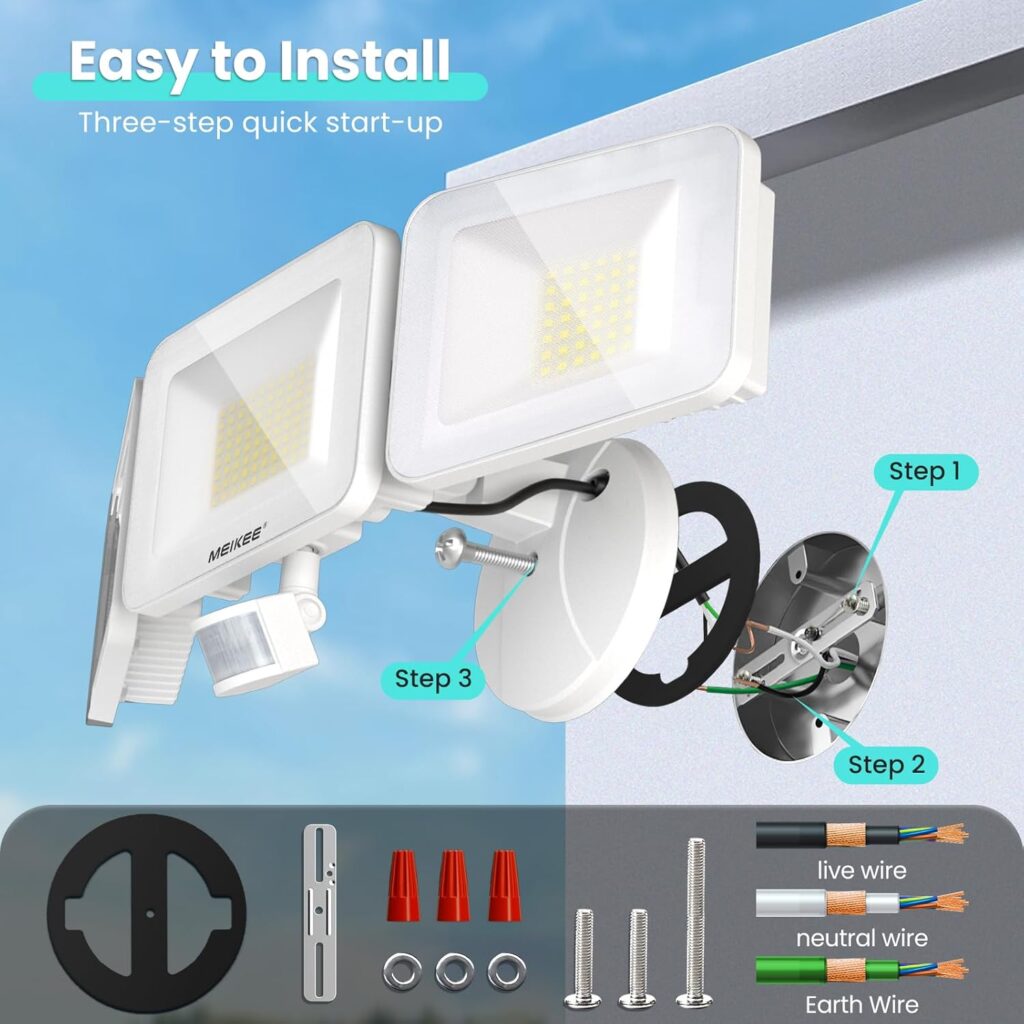
Setup comes down to three things: testing the light, matching its settings to the space, and respecting the weather rating.
MEIKEE motion-sensor lights include a test mode, usually a 5-second trigger that works without darkness or real movement. It lets you check aim and brightness at the mount, so use it before fixing the final angle.
Next, set the sensor range to the distance you need rather than the maximum. A long step on a short driveway reaches the street, which means passers-by can trigger it. Hold time follows the same logic. The range runs from 45 seconds to 10 minutes, so use the low end where you only walk through and the high end where you linger.
Hardwired models also need a junction box or existing outdoor light to connect to, and each of the three heads has its own angle, so leave time for aiming.
Keep landscape fixtures out of spots where water collects. A strong-jet rating like IP66 is not a promise of survival under standing water, so choose a position that drains after heavy rain, and press each cable connector all the way home and seal it.
Settings on remote-controlled models are changed from the remote, so store it where you’ll find it again.
Care Through the Seasons
Solar Spotlights
Charging depends on a clear panel. Wiping it every few weeks keeps dust and debris from slowing it down, and storms or pollen season call for extra passes.
Placement matters as much as cleaning, so give the panel the widest view of open sky you can manage across the day. Afternoon shade from a branch or fence cuts into how long the light runs after dark.
Built-in rechargeable batteries lose capacity over years of daily cycling. When a light begins to switch off earlier each night than it used to, battery age is a likely reason.
Low-Voltage Landscape Lights
Inspect connectors at the change of each season, and after any hard freeze and thaw, since ground movement can loosen buried joints. If a single fixture in a chain goes out, start with its own connector. The rest of the run and the transformer come later in the troubleshooting order.
Winter Shutdown
In regions with hard freezes, unplug the 120V plug-in landscape lights and the low-voltage transformers for the worst of winter instead of leaving them powered. This advice is aimed at plug-in and transformer-fed setups. The brand builds its hardwired flood lights to stay outdoors year-round.
Buying Safely
Outdoor LED lighting is a crowded category, so a listing that looks like a MEIKEE product isn’t automatically one. Confirming the seller matters more than usual here.
MEIKEE sells directly through two channels: its storefront on Amazon and its own direct-to-consumer site. The MEIKEE storefront on Amazon lists the current catalog, and the seller or brand shown on any listing should read MEIKEE or MEIKEE International.
Warning Signs in a Listing
- Photos that differ from the product images on the brand’s own pages
- No IP rating, wattage or lumen output in the specs, which the brand’s own listings include
- A seller name that never mentions MEIKEE or MEIKEE International
Check the Box
When the package arrives, compare it with your order. The brand’s boxes carry the IP rating, wattage and lumen output, and the model number should match your confirmation. Anything missing or different is a reason to contact the seller before the light goes on the wall.
The check carries more weight for hardwired lights than for low-voltage landscape sets, because wiring a unit that isn’t what you ordered carries electrical risk.
One Safety Alert Worth Knowing
The brand’s record includes a 2020 European safety alert for a MEIKEE 50W floodlight. It named one model number and one production batch and cited an earthing defect that could let someone touch live electrical parts. The importer destroyed those units rather than sell them.
The alert covered only that model and batch, not today’s range. It remains a fair reason to buy hardwired electrical products from sellers that offer clear returns and batch traceability.
Warranty and Returns
What the Brand Lists
MEIKEE’s listings commonly cite a two-year replacement warranty for defects in materials and workmanship. Terms can differ by listing, so check the page for your exact model.
The return and refund window is separate: around three months for standard products, and about one month for some solar items. If you bought through Amazon, Amazon’s own return policy may apply on top of that.
What a Warranty Usually Skips
Replacement warranties of this type address factory faults. Installation mistakes, such as connecting a low-voltage fixture to household current, and physical damage from a knock or a mower normally sit outside the cover.
Making a Claim
Your order record is the proof of purchase for a warranty claim, so keep the confirmation, and keep the packaging until the light has run properly for a full day and night.
For an Amazon order, start with the product support or return option attached to the order. For a purchase from the brand’s own store, MEIKEE points to its contact form for warranty and support requests.
FAQ
Does MEIKEE make its own products?
That is what the brand claims: it says raw materials, machining and final assembly all happen within its own operation. The claim comes from MEIKEE itself and can’t be verified from a product page.
Are the flood lights hardwired or battery powered?
They are hardwired. The solar spotlights and the battery wall sconces are the products that don’t need wiring.
Do low-voltage landscape sets include a transformer?
Usually not. The 12V and 24V sets need a separately purchased transformer, while the 120V plug-in lights don’t need one at all.
How long do the solar lights run per charge?
MEIKEE rates its 6-in-1 Solar Spotlight at about 8 to 12 hours of runtime from a full charge.
Why does my motion-sensor light stay lit?
Check the mode first. Constant light sits alongside round-the-clock and night-only detection in the menu, so the light may simply be set to stay on. Hold time and sensitivity, both adjustable on remote-controlled models, are worth reviewing as well.
Can I control the lights with a remote?
On many higher-wattage models, yes, and the remote handles brightness, mode and timer. Some entry-level models rely on physical switches.
Do the RGBW lights remember their last color?
Usually, yes. A memory function on the RGBW models restores the previous color and mode once power comes back after an outage.
Does MEIKEE sell indoor lighting?
Mostly no, because the range is designed for outdoor use. The rechargeable wall sconces are an exception, since MEIKEE markets them for indoor spaces as well as covered outdoor ones.
Whichever family you start with, go through each mode and setting after installation and keep your order confirmation until you’re satisfied everything works.