A cordless pool robot sounds simple until you open the product pages. Seauto alone sells nine models, and the listings lean on terms like sonar navigation, AWD and dual-stage filtration that say little about your own pool.
This guide sorts it out one decision at a time. It covers who is behind the brand, what the specs actually change, which model fits which pool, how Seauto compares with Aiper, what reviewers report, how the warranty and returns work, and how to look after the robot once it arrives.
Everything here comes from the brand’s published specs, its written policies and independent testing of Seauto and Aiper models. It is research rather than a poolside test, and where a claim comes from the brand, the guide says so.
How Seauto Got Started
Seauto is based in the City of Industry, California, and presents itself as a founder-led robotics company. Zoume Deng started it in 2021, according to the company’s own story page, after earlier work in window-cleaning robotics and with solar-robot partners.
The pool idea, the company says, came from a summer party at a friend’s house, where Deng saw how much effort keeping a pool clean and sanitary took. The first answer was the Crab series, Seauto’s debut robotic pool vacuum. The team describes more than a decade of combined experience in robotics and AI, with unmanned underwater vessel research in the mix.
Pools are not the whole story. Seauto’s stated aim is to push underwater technology forward and make underwater operations more efficient and safer, and the company has moved into robots for cleaning yacht bottoms and other underwater jobs. Even so, pool vacuums remain its core business.
According to Seauto’s FAQ, manufacturing takes place in China, and the company plans to expand into South Asia. It ships only to customers in the United States and the European Union, which is worth weighing if the country of manufacture matters to you.
Put simply, the company grew out of a single pool vacuum and now has underwater robotics on its roadmap. You can browse the whole pool range at Seauto’s own store.
What the Tech Terms Mean
Sonar path planning
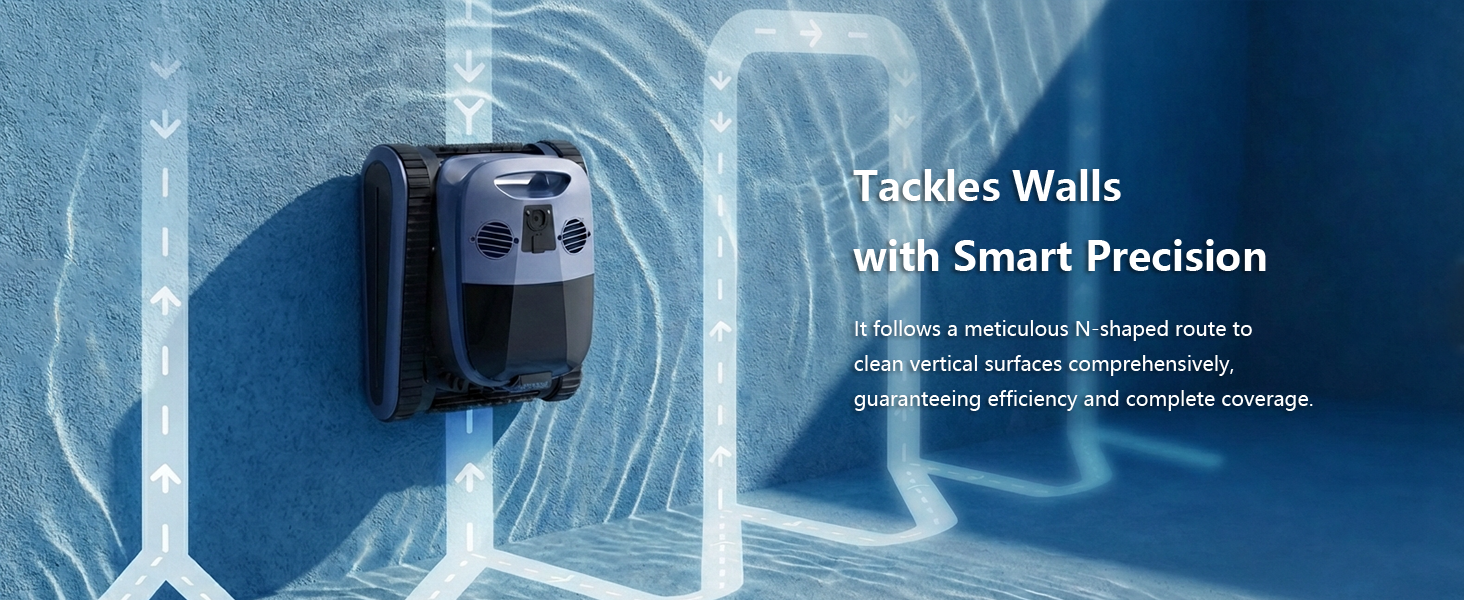
Sonar path planning is Seauto’s name for route-based cleaning, and it appears on the SAT40, SAT30, SAT25 and SAT20 Pro. These robots chart the pool while they work and then run a fixed route across the floor, walls and waterline, in place of wandering until they bump into something.
The Roker Plus, the entry robot, does without route planning and uses a basic automatic pattern, and it has no app control either. On a small above-ground pool that is a sensible trade. On a large or oddly shaped pool, coverage is less predictable without a planned route.
All-wheel drive and wall climbing
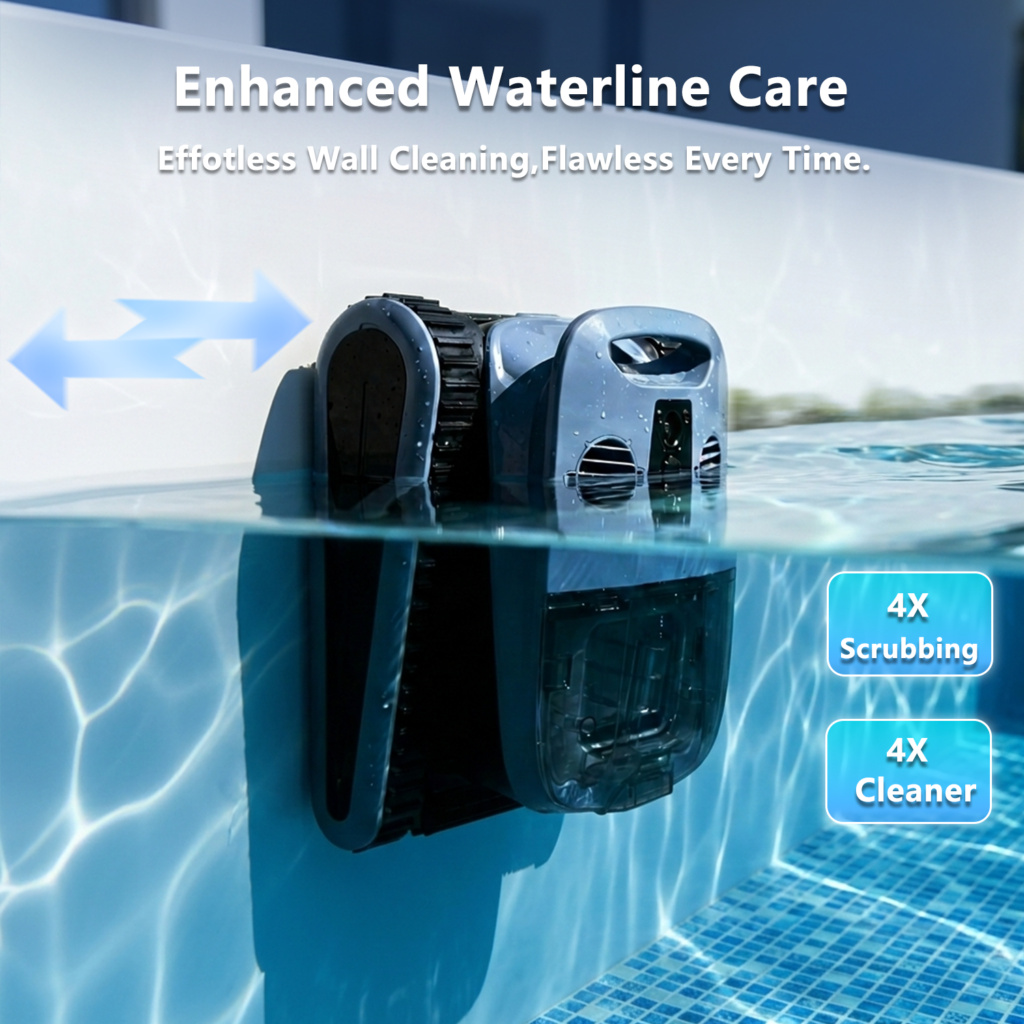
AWD is about traction: the drive system that holds the robot against a wall while it climbs and cleans the waterline. Seauto combines it with four brushless motors and four silicone brushes on the SAT40 and credits that mix for the robot’s handling of corners and slopes.
Look for waterline cleaning on any spec sheet you compare. Sunscreen residue and scum lines collect along that band, so a robot that stays on the floor leaves them behind.
Single-stage and two-stage filtering
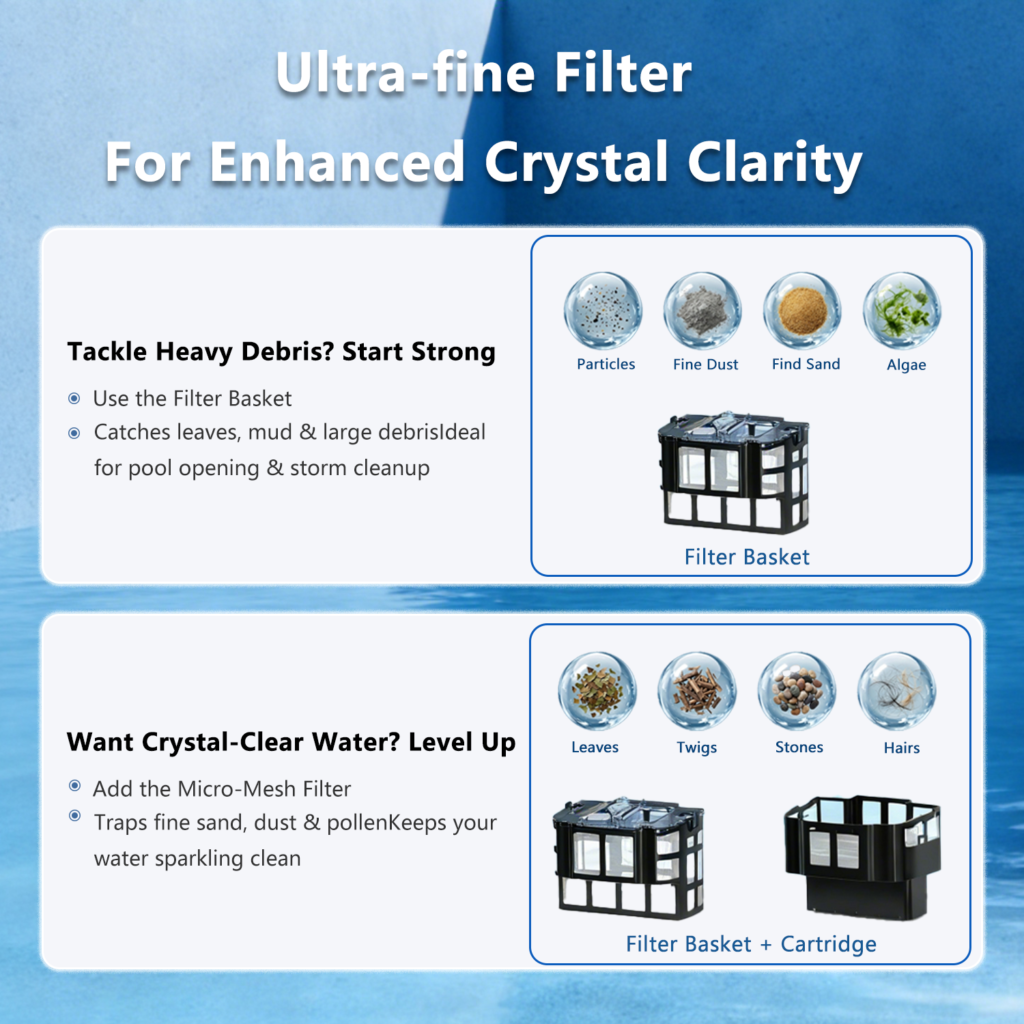
Filter layout varies across the range. The SAT40 stacks a 250-micron cartridge for leaves and twigs with a 10-micron ultra-fine stage for silt, while some other models use a single basket and skip the second stage, so confirm the filter on the exact model you are looking at.
A finer stage needs rinsing more often, which is the price of the second layer. Pools that collect fine sand or algae are where a two-stage setup is most likely to pay off.
Waterproofing and app control
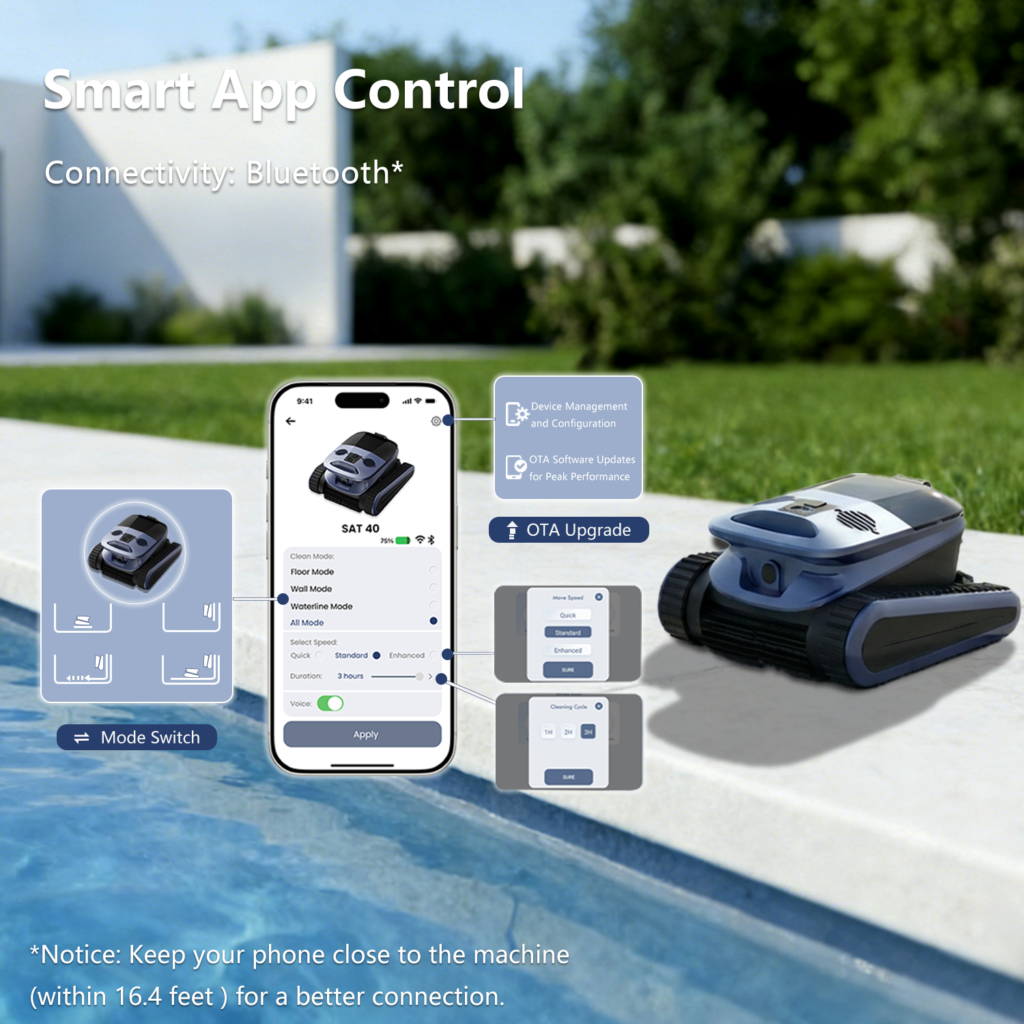
IPX8 is the rating for electronics sealed against continuous submersion, which a robot that runs underwater for hours depends on. App control over Bluetooth, found on most of the newer models, handles mode selection and starting a cycle, so you can do both from the deck.
Pick the Right Model for Your Pool
Before you compare specs, walk your pool and note its shape, any steps and ledges, and how much debris tends to land in it. Those three things narrow the choice faster than any spec sheet.
Prices below are rounded, and the store page is the place to check what you will actually pay. The SAT40 is left without a figure, so check its current price at Seauto.
Small or above-ground pools on a budget
The Roker Plus (about $139) is the cheapest way in. It is rated for up to 90 minutes per charge and pools up to about 50 feet, with an automatic pattern in place of app control. It makes sense for someone who just wants the floor tidied between manual cleanings and has no use for navigation features.
The SAT10 (about $159) is the other budget option: made for in-ground pools, but without the sonar navigation and app features of the pricier robots.
Mid-size in-ground pools
Two robots share the mid-size slot at about $299: the SAT20 Pro, with four-wheel traction and automatic wall climbing, and the Crab, Seauto’s original design with 3D-Navi infrared navigation. Both are rated for up to 2,150 square feet, and the Crab runs 2 to 3 hours per charge.
Steps, tight corners and sloped walls point to the SAT20 Pro, whose traction system is designed for them. Under trees, think twice about the Crab: independent testing found weak results on leaves and other organic debris, so it suits pools with mostly sand and dirt.
Larger in-ground pools
The SAT30 (about $369) uses sonar path planning, rated for up to 180 minutes per charge on pools up to 2,150 square feet. Priced between it and the SAT20 Pro, the SAT25 (about $339) targets the same sort of pool for buyers who want the newer generation for less than the SAT30 costs.
The biggest pools and the fullest feature set
The SAT40 sits at the top of the range with up to 240 minutes per charge and a rated reach of 3,200 square feet, plus two-stage filtration and AWD traction. It is the only model with every feature Seauto offers, and our full verdict on the Seauto SAT40 goes through the details. Check its current price at Seauto rather than relying on any figure here.
Seauto Compared With Aiper
Aiper is a fair rival to measure Seauto against, because independent testers have run the two brands side by side. The notes below come from that testing, mostly on models other than the SAT40.
Debris pickup
Aiper took a small lead on fine debris such as sand, thanks to a wider cleaning path that collects more on every pass. Both brands’ rubber suction guides, testers found, were a step up from older suction-only designs.
The Seal’s slimmer suction channel left it with a smaller cleaning path than the Aiper model tested alongside it. On leaves, though, neither did well: the Scuba S1 from Aiper and the Seal from Seauto both struggled to carry them past their scrubbing brushes.
Build quality and bin design
Debris bins are another point of contrast. Seauto’s robots close the bin with a rubber trapdoor, and reviewers questioned how well rubber holds up to repeated use and pool chemicals. Aiper’s Seagull Pro, by comparison, has a hard plastic bin on a hinge with a spring latch that testers found easy to remove, clean and put back.
Aiper has its own record to answer for. The Seagull Pro was the subject of a US safety recall over a fire hazard, which is more serious than a rubber flap, so neither brand comes out clean.
Price and where each one wins
Seauto’s models are generally listed at or below Aiper’s comparable ones, and the range starts at about $139 with the Roker Plus. Budget buyers may therefore find more coverage and features for the money at Seauto, though prices move, so compare current listings on both sites. Where leaf and pine needle pickup comes first, independent tests favor Aiper’s wider path.
For a mix of sand, dirt and the odd leaf, the SAT40’s two-stage filter and AWD traction should narrow that gap on paper. The research behind this guide includes no head-to-head test of the SAT40, so that is an expectation, not a result.
What Reviewers Say, Good and Bad
Start with the positives. Reviews on Seauto’s own store give the SAT40 and SAT30 five stars across the board, with owners praising route planning over random movement. Both are recent models, so the samples are small.
Seauto also backs its robots with a written 30-day money-back guarantee, a 12-month warranty on main components and free shipping on robot orders, which lowers the cost of trying one.
Where the picture turns
A third-party review site shows a low overall score for the brand, and warranty claims are the recurring complaint there. Reviewers describe months of exchanges before a clear reply, and one reported a unit failing a few months into the warranty window and being offered only a partial refund.
Independent testers have raised product issues too. An independent reviewer of the Crab found it picked up only a small share of the debris, judged the filter design faulty because dirt ran back out into the water, and suggested the pricier Shark over that model.
None of that makes every purchase a gamble, but it does show the praise on the brand’s own store and the reports from other places pulling in different directions.
Warranty, Returns and Shipping
What the warranty covers
Every model gets 12 months of coverage starting at purchase or dispatch, and the protected parts are the drive box, battery, circuit board, motor, sensor, plastic parts and power supply. Consumables such as the filter basket and brushes get a shorter 3 months.
Read the exclusions first: misuse, outside repairs, aftermarket parts, tampered serial numbers, impact damage, and robots bought from unauthorized resellers. What the policy does cover is defects in materials or workmanship under ordinary use, along with diagnostic help and software updates.
Filing a claim
Seauto inspects a returned unit within 1 to 3 business days, then processes a refund 3 to 10 business days after approving the claim, and it pays return shipping on approved warranty claims. To start, email the support team with your proof of purchase, the serial number and a short description of the fault.
Returns
Separate from the warranty, a 30-day money-back guarantee applies from delivery. A return that is Seauto’s fault, such as a wrong or damaged item, ships at the brand’s expense, while a change of mind ships at yours. The robot must come back in original condition with its accessories, manuals and packaging, and purchases made through dealers are excluded.
A robot that arrives defective qualifies for a replacement or refund, provided it is reported within 30 days of delivery.
Shipping
Robot orders ship free, and carriers vary by location. Allow roughly 5 to 10 business days from order to delivery: 2 to 3 days of processing plus 3 to 7 in transit, with dispatch Monday through Friday.
Care and Troubleshooting
Main components carry 12 months of coverage and consumables only 3, so small habits are worth building early. Seauto’s troubleshooting material suggests starting with these checks.
- Robot crawls or sits still: the guide points to a snag on the drain or a clogged basket, more likely after a very dirty pool. Rinse the basket after each run.
- Robot will not climb: check whether Floor-Only Mode is switched on, and empty a basket packed with debris.
- Yellow light, or a purple LED during a cycle: the robot is stuck or never started. Pull it out with a pole and restart it.
- Robot will not power off after leaving the water: the usual cause is water sitting in the detection probe, and wiping it dry fixes it.
Storage and repairs follow from the warranty’s exclusions, which cover wrong installation, misuse, outside repairs, third-party parts, altered serial labels, drops and extreme temperatures. So let the brand handle repairs, leave the label alone and keep the robot out of harsh sun and freezing weather.
The Roker Plus needs 2.5 hours on the charger, whereas the SAT40 and SAT30 need 4.5. If you spot a few drops of water inside a new robot, Seauto’s FAQ describes that as leftover from factory testing and not a leak.
Buying From the Right Seller
Ordering straight from Seauto’s own store is the simplest way to stay inside the brand’s policies. The return policy treats dealer sales separately from direct orders, which implies authorized dealers exist, and its 30-day guarantee does not extend to them.
Buying from a dealer can mean trading Seauto’s direct return window for the dealer’s own terms. The warranty is stricter still: robots from unauthorized resellers are excluded, and every claim needs proof of purchase plus a serial number.
On open marketplaces, a listing may be a resale, a gray-market import or simply mislabeled, so work through this list before ordering.
- Treat a price far below what Seauto’s own pages show as a red flag.
- Confirm the seller is Seauto’s own store or a dealer you can name, not a similar-looking shop.
- Save the order confirmation and receipt, since any warranty claim needs proof of purchase and a serial number.
- Be wary of a listing that promises delivery outside the United States and the European Union, because those are the only regions Seauto serves.
Questions Shoppers Ask
Which pools do Seauto robots suit?
Seauto lists vinyl, fiberglass and ceramic among the supported surfaces, across a range of pool shapes. Rated coverage differs by model.
Do I need an app to use one?
Bluetooth control from a phone is offered on most of the newer models. The Roker Plus, the cheapest robot, is built without it.
How long does the warranty last?
Main components are covered for 12 months and consumables for 3, with the clock starting at purchase or shipping.
Who pays for return shipping?
It depends on the reason. Seauto pays when the return follows its own error, such as a wrong or damaged item, and the customer pays when simply changing their mind.
Does buying from a reseller affect the warranty?
Yes. The written warranty excludes robots from unauthorized resellers, and every claim requires proof of purchase.
Do promotions change what I should pay?
Seauto has run promotions, but they come and go, so this guide leaves out any sale price, including a figure for the SAT40. Check the store page for what applies when you order.
The Bottom Line
Seauto offers cordless pool robots across a wide price range, and the right pick follows your pool. A small above-ground pool can do well with the Roker Plus, a mid-size in-ground pool with the Crab or SAT20 Pro, and a large pool with the SAT30 or the SAT40.
The main caution is service rather than specs, according to third-party review sites. Read the warranty terms before you need them, keep your receipt and serial number, and buy from the brand’s own store or a named dealer. Do that, and the choice comes down to pool size and budget.