WORX sells everything from small hand tools to a robot mower that runs without a boundary wire, which makes the catalog hard to size up at a glance.
This guide gathers what WORX has made public. It covers where the brand came from, how its battery system works, what the brushless motors change, how to match tools to your yard, how the robot mower compares with Husqvarna, and what to know about warranty and returns.
It is desk research, not a hands-on report: it draws on spec sheets and the brand’s own policy pages, with claims attributed where it matters. Prices are regular prices at WORX, rounded, so check the current figure before you buy.
Where WORX Came From
The WORX name sits under Positec Tool Corporation, and the timeline below shows how a contract manufacturer became a retail brand.
- 1994: Don Gao founds Positec in Suzhou, China. The company starts out making tools to order for other brands, an OEM business.
- 2004: The WORX consumer brand debuts. Tom Duncan, a former Vermont American executive, joins that year and takes over the North American division in 2005.
- 2007: Infomercials for a lightweight electric trimmer, the WORX GT, sell 313,000 units in the early part of the year.
- 2009: Lowe’s becomes the first big retailer to stock the WORX line.
- 2011: DIY Week names the brand’s lawn and garden tools its Product of the Year.
- 2012: Walmart, Costco and Home Depot have all joined Lowe’s, and WORX opens a distribution hub in Huntersville, North Carolina to serve its retail growth.
The Landroid, WORX’s first robotic lawn mower, arrived a few years after the DIY Week award. North American operations are now based in Charlotte, North Carolina, and the catalog runs to hundreds of products, from corded and cordless power tools to outdoor gear and the MAKERX crafting line.
What the Catalog Covers
The range sorts into three groups:
- Lawn and garden: string trimmers, mowers, leaf blowers, chainsaws and hedge trimmers.
- Power tools: drills, drivers, saws and sanders.
- Home and recreation: the Aerocart yard cart, the MAKERX crafting platform and the Hydroshot line of portable power cleaners.
Prices span a huge range, from about $15 for a screwdriver to about $3,700 for the top Landroid robot mower.
The Aerocart
The Aerocart 8-in-1 changes shape to serve as a wheelbarrow, a cart or a dolly, and it sells for about $260. WORX claims the leverage design makes a 200-pound load feel like 17 pounds.
Hydroshot portable cleaners
Hydroshot cleaners take the same battery packs as the brand’s cordless tools. The 20V PowerShare model is the budget entry at about $140 and 415 max PSI. The Nitro 20V Brushless Hydroshot Plus steps up to 710 max PSI for about $170, and WORX says it can draw from any fresh water source, which suits boats, RVs and places without a hose. A Nitro 40V Hydroshot Max reaches 800 max PSI.
JawSaw, push mower and blower
The JawSaw chainsaw (WG381) is one of WORX’s more unusual safety designs: the cutting chain sits inside a guarded jaw that is meant to clamp a branch before the chain engages. WORX positions it for occasional yard work, not heavy felling.
The WG733 is a 20V brushless cordless push mower aimed at smaller lawns where a robot mower is more than you need. The WG520 is a straightforward cordless leaf blower on the PowerShare platform, so it shares batteries with the rest of the 20V lineup.
PowerShare Batteries Explained
Think of PowerShare as a battery you buy once and reuse. WORX builds its cordless tools around three voltage tiers, 20V, 40V and 80V, and a pack made for one tier fits every tool in that tier. A 20V drill, blower and Hydroshot cleaner can take turns on the same pack.
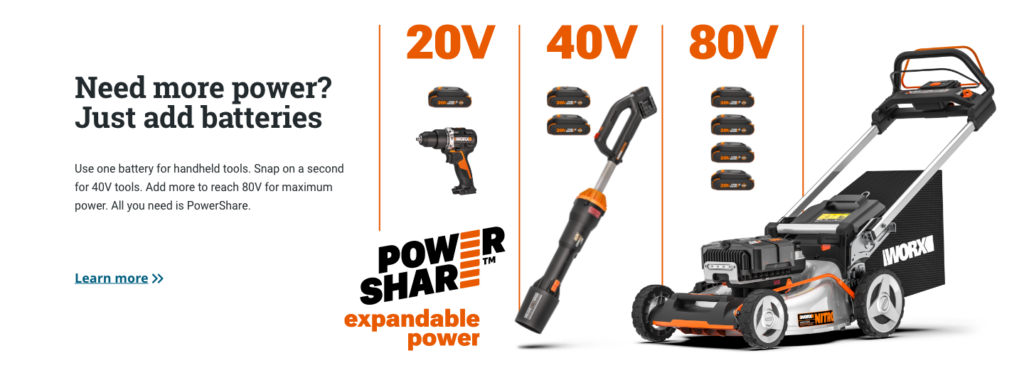
The savings show up at checkout. Tool-only versions skip the battery and charger, so each tool after the first costs less than a full kit would.
The limit is the tier boundary. A 20V pack will not run a 40V tool, so a yard that mixes tiers needs a battery and charger for each and loses most of that saving.
Which tier to start with
Start by asking which kind of work you do most. Lighter jobs, such as drilling, driving screws and the smaller lawn tools, mostly sit on 20V, which covers a large share of the catalog. Heavier outdoor work, including larger mowers and stronger pressure washers, sits on 40V and 80V.
Pick the tier that matches that work before buying the first battery, then keep later purchases on it.
Kit or tool-only
A kit is usually the right first purchase, since it brings the battery and charger that every later tool will borrow. After that, tool-only versions are the cheaper route as long as the battery fits.
A simple habit helps here. Label each battery with its voltage tier so you never grab a tool-only model for the wrong one. You can browse WORX’s range at WORX’s own store, which is where this link opens.
What NITRO Brushless Changes
NITRO is WORX’s name for its brushless motors. They turn up in tools that run hard for a while, such as pressure washers, blowers and premium power tools. By WORX’s own ratings, a NITRO motor gives roughly 50% more runtime and 25% more power than the brand’s standard brushed motors.
Brushless designs have no brush rubbing against the motor, so they are generally expected to run cooler and last longer. Expect NITRO tools to cost more than the standard range.
The Hydroshot family shows the gap clearly: 415 max PSI on the standard 20V model, 710 on the Nitro 20V Plus and 800 on the Nitro 40V Max.
Whether NITRO is worth the premium depends on how often the tool works. Weekly use or demanding jobs make the case. For occasional chores, the standard line costs less and should cover most of what you need.
Choosing by Yard and Habit
“Just buy a WORX” is not much of an answer when the catalog is this wide. Three questions narrow it down: how big is the yard, how hilly is it and how often will the tools come out?
Start with the yard
Measure the lawn before you shop. If a robot mower is on the list, size it to the real yard, because a unit rated for a smaller space may not finish a full cycle. Walk the property and note the slopes, the narrow gaps and any spot where grass meets a driveway or bed.
- Flat lawn under half an acre: a standard two-wheel-drive Landroid covers it.
- Lawn with real slopes: choose a 4WD model, because hills are where two-wheel drive struggles for grip.
- Mowing before sunrise or after sunset: consider the optional headlight, because navigation that depends on cameras has less to work with in dim light.
Match the tool to the job
Heavy, repeated work points toward NITRO and the 40V or 80V tiers. Light seasonal chores point toward the standard 20V line. A small lawn that does not justify a robot can be handled by a cordless push mower such as the WG733.

Budget for the whole system
Think about battery cost across every tool you expect to own, not only the first purchase. Several tools on one tier usually cost less in total than the same tools spread across tiers.
Robot Mowers and the Landroid Line
The Landroid Vision Cloud is the brand’s flagship robot mower. It navigates with stereo cameras and a cloud RTK service instead of a buried wire or a roof antenna, and the app builds a 3D map of the yard during setup.
Seven models cover four yard sizes. The WR310.1 and the 4WD WR341 suit about a quarter acre, the WR320.1 and 4WD WR342 about half an acre, the WR340 and 4WD WR344 about an acre, and the 4WD WR346 about an acre and a half. Regular prices run from about $1,200 to about $3,700.
The 4WD versions are the ones to look at for hills, and WORX rates the WR344 for slopes up to an 84% grade. The brand also includes its RTK Cloud service free for the life of the mower.

Our full verdict on the WORX Landroid Vision Cloud goes through each model, the app and the caveats in more detail.
Low light is the limit to plan around. Camera navigation can lose confidence when it gets very dim, so the optional headlight is worth adding for dusk runs.
How the Landroid compares with Husqvarna
Husqvarna’s Automower line is a direct rival. The two take different routes. The Landroid pairs stereo cameras with RTK Cloud, while the Automower 415X uses EPOS, which depends on GPS and a cellular link.
Both skip the old boundary-wire installation, and both mulch clippings back into the lawn. The cutting hardware is different. Husqvarna runs three small pivoting razor blades on a rotating disc, and the Landroid spins one blade of roughly 7 inches.
Price is where the gap shows. Comparable Automower models are listed roughly $700 above the equivalent Landroid, so confirm both prices before you compare. Cloud or cellular navigation sometimes comes with recurring fees, so the included RTK Cloud service matters over several years. Cutting design and navigation method differ as well, so price need not be the only deciding factor.
Care and Winter Storage
Robot or not, a mower wears out faster when it is ignored. Blades, cleaning and winter storage cover most of the upkeep, and a Landroid costs far more than a push mower, so the habits pay for themselves. For hand-held tools, wipe off clippings and dirt after each session and keep them somewhere dry.
Blades and cleaning
Blade work follows a rhythm: a monthly turn with a Phillips screwdriver and gloves on, then a full swap about every four months. WORX says to replace them sooner if they look dull, which keeps the cut even and spares the motor.
Cleaning is a dry job. Use a cloth and compressed air to clear clippings from the body and underside, and give the contact pins and charging strips extra care, because buildup there can disrupt charging. WORX’s guidance rules out a pressure washer, detergent or a hose, since water can get into the electronics and camera housing.
Winter storage
- Where: a dry indoor spot, such as a garage or shed, that stays above freezing (0°C or 32°F).
- Before it goes in: clean the mower, charge the battery fully and switch the mower off.
- While it waits: give the battery a fresh charge about every other month.
- The base station: it can stay outdoors over winter, but bring it inside ahead of severe cold.
Software upkeep
The Vision Cloud depends on the app and a cloud link, so software counts as upkeep too. Install app updates, and check that home WiFi reaches the dock. Where the signal fades across the yard, WORX offers an optional Radio Link WiFi extender that leaves the router where it is.
Keeping up with these tasks also matters for claims: the warranty leaves out neglect, and it never covers blades as they wear.
Buying Direct, Warranty and Returns
Where to buy
Buying at worx.com means shopping the brand’s own storefront. The site adds a store locator for finding physical retailers, free shipping above a $99 order total (with exclusions that include Alaska, Hawaii, Guam, the U.S. Virgin Islands and Puerto Rico) and Affirm financing for bigger purchases such as the Landroid.
Beyond its own site, WORX tools are stocked at Walmart, Costco, Home Depot and Lowe’s.
If you buy anywhere other than WORX’s own site, make sure the seller is authorized and the listing states its return terms. That matters most on a robot mower that costs thousands, where a warranty claim may hinge on showing where and when you bought it. An accessory of about $15 carries far less risk. A price far below the usual one with no stated return policy is a reason to pause.
The warranty
Registration decides the length. Register within 30 days of buying, online or with the card in the box, and WORX gives a 3-year limited warranty. Without registration, the term is 24 months.
Batteries and chargers get the same 3 years, with automatic replacement if one is defective, and the WORX site mentions 5-year coverage for certain 40V and 80V tools. The warranty is for defects in materials or workmanship. WORX may repair the product, replace it, or exchange it for a new or reconditioned unit.
Some things fall outside the warranty:
- Normal wear on consumable parts such as blades and bits.
- Damage from accidents, foreign objects or substances.
- Use on a trade, professional or rental basis.
- Misuse, neglect and unapproved repairs or modifications.
Whatever the store, hold on to the receipt or order confirmation: a claim needs proof of purchase that shows when and where you bought the item.
Returns and extras
The 30-day money-back guarantee WORX advertises covers eligible orders placed on worx.com. Holding on to the original packaging helps if you send something back, and an item marked final sale deserves a check of the return window first.
A few programs are listed on the brand’s own site, so check worx.com for the details. Verified active military members and veterans get a 10% discount on one purchase on worx.com in the U.S., confirmed through SheerID. There is also a Free Spools for Life program for replacing trimmer spools, and discount codes can generally be used once per order.
FAQ
What is PowerShare?
It is WORX’s way of letting one battery serve many tools, as long as the tools share a voltage rating.
Which voltage tiers exist?
20V, 40V and 80V. A pack moves among tools in its own tier, never across tiers.
How do NITRO tools differ from the standard line?
Brushless motors power NITRO tools, and WORX gives them higher runtime and power ratings than its standard brushed motors, with a higher price tag.
Does the Landroid need a boundary wire?
No. Stereo cameras plus RTK corrections from the cloud take its place.
Is there a subscription for the mower’s navigation?
WORX says no. It includes RTK Cloud for the life of the mower on every Vision Cloud model.
Can the Landroid handle hills?
WORX positions the 4WD models for sloped yards and rates the WR344 for slopes up to an 84% grade.
Who owns WORX?
WORX is part of Positec Tool Corporation, a company Don Gao started in Suzhou, China, in 1994. The brand’s North American base is in Charlotte, North Carolina.
Do I need to register a WORX product?
Yes, if you want the 3-year term instead of 24 months. Registration is open online, or you can mail in the card that comes in the box.
Bottom Line
WORX makes the most sense for people who want one battery family across their yard tools, or a robot mower with no wire and no navigation subscription. The strengths are cross-compatible batteries, a wide catalog and a Landroid line that scales with yard size. The trade-offs are the warranty registration step, camera navigation in dim light and the need to stay within one voltage tier.
Pick the voltage tier first, size any robot mower to the real yard and register whatever you buy within 30 days. When you are ready to compare models, browse WORX’s range at WORX’s own store, which is where this link opens.