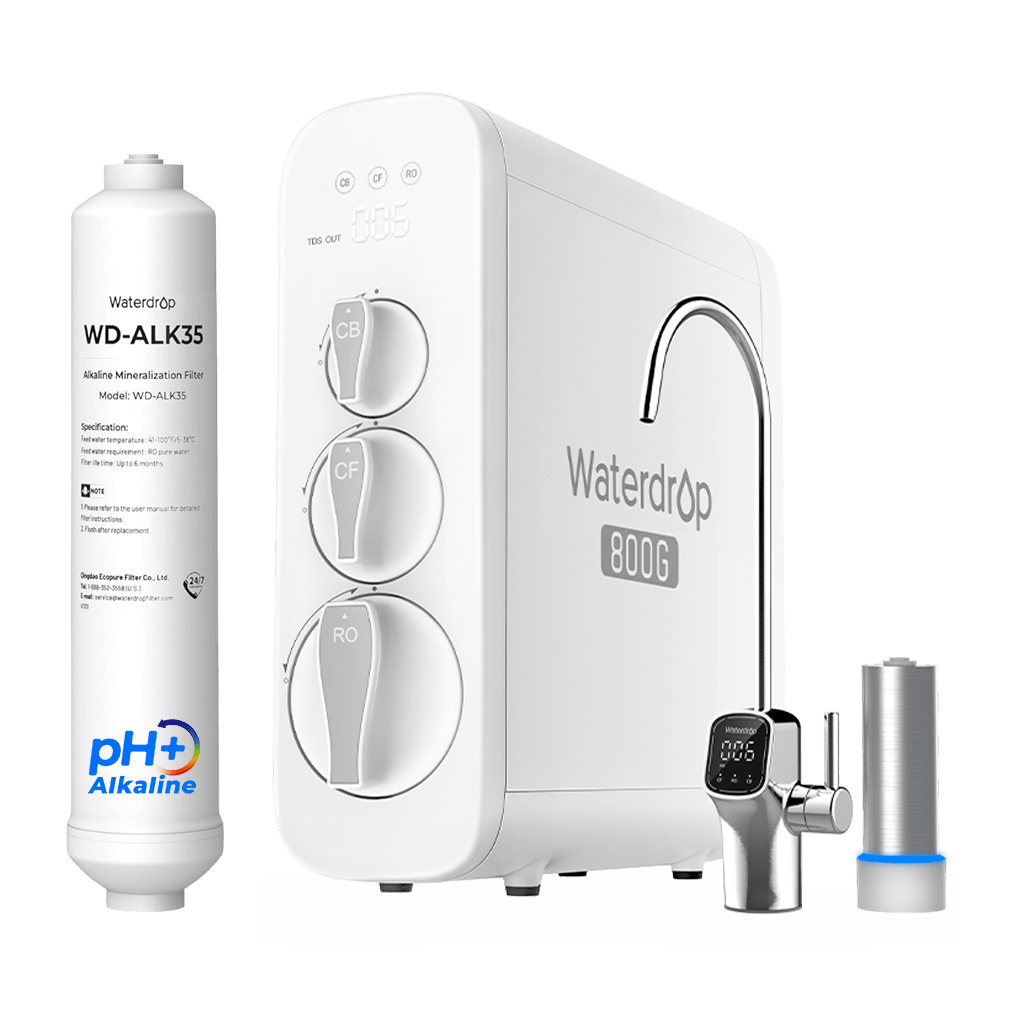
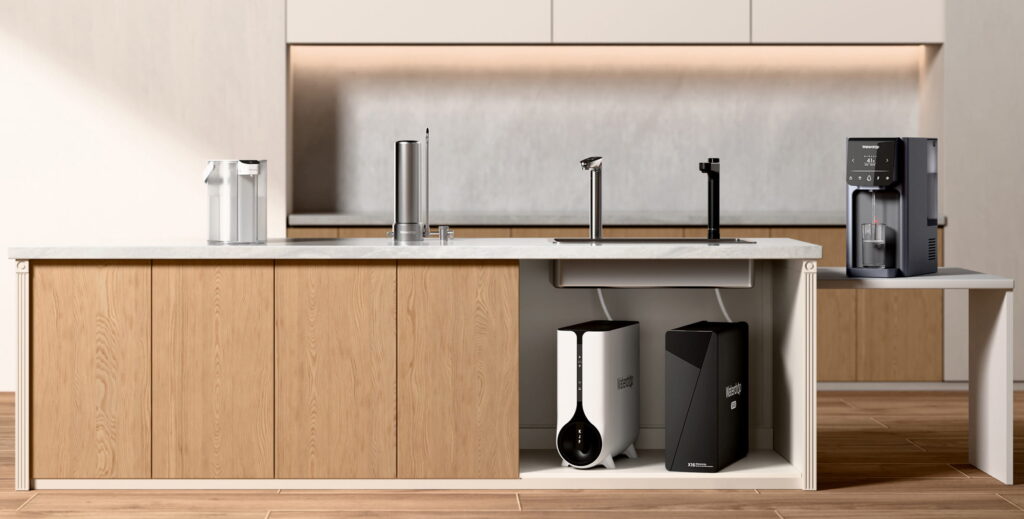
Waterdrop sells water filters straight to shoppers, and the G3P800 is one of its tankless reverse osmosis systems. It sits under the sink, pairs with a smart LED faucet and is rated for 800 gallons a day. To see how it fits with the rest of the line, browse Waterdrop’s range on its own site.
This is a research-based read. It leans on the spec sheet, the brand’s published policies, an independent lab-style test and a hands-on write-up from an independent reviewer, so you can weigh the facts before you click anything.
The short version: strong test numbers and a space-saving design, balanced by a one-year warranty and an install that may call for a plumber.
What the G3P800 Is
Waterdrop lists this as a 10-stage tankless unit centered on a very fine RO membrane. Here is what the spec sheet gives you.
- Design: tankless, 10-stage reverse osmosis
- Membrane: 0.0001 micron
- Rated output: 800 gallons per day
- Pure-to-drain ratio: 3:1
- Certifications: NSF/ANSI 42, 53, 58 and 372
- Faucet: smart LED faucet, run from a power adapter
- Sterilizing: built-in UV sterilizer
- Hardware: mounting parts, tubing, a drain saddle and a feed water adapter
- Install time: listed by Waterdrop as a 30-minute DIY job
- Warranty: one year, limited
Waterdrop says those certifications cover reduction of chlorine, taste and odor, total dissolved solids and lead. The brand also lists PFOA and PFOS reduction of up to 99 percent.
The 3:1 ratio means three parts of filtered water for every part sent down the drain. Waterdrop contrasts that with older tank-based designs, with ratios as poor as 1:3 or 1:4.
It also helps to know where it sits in the range. The X12 steps up to 1,200 gallons a day and 11 stages, and the X16 to 1,600 gallons a day and 11 stages, so the G3P800 is the mid-tier option rather than the top one.
Test Results and Owner Feedback
What an independent lab found
An independent testing site gave the G3P800 a score of 9.21 out of 10 and named it the best-scoring tankless under-sink RO unit it has tried. Measured output came in at 886.54 gallons per day, a little above Waterdrop’s own 800 claim.
In that same test, selenium fell by 100 percent and fluoride by 78 to 100 percent. Hexavalent chromium dropped by up to 100 percent, and total dissolved solids by 93 to 95 percent. Those figures describe one lab’s sample water, so your own results will depend on what comes out of your tap.
What owners and reviewers report
On Waterdrop’s own site the system shows about 4.9 out of 5 from roughly 100 reviews. Reviews gathered on a seller’s store are useful, but read them with that in mind.
A managing editor at a national outlet used it hands-on. She said the filtered water felt purer than tap, noticed less mineral buildup in her coffee maker and judged the taste clearly better than fridge-dispensed water.
The downsides she listed were everyday ones. Flow is slower than a normal kitchen faucet, and the water is not as cold as fridge water. She also hired a plumber despite the brand’s 30-minute claim, and her advice was to bring in a pro unless you have solid plumbing experience.
Space, Install and Upkeep
Going tankless is the main design bet. Waterdrop says the layout saves roughly 70 percent of the cabinet room that a traditional tank-based RO system takes up. That matters when the cupboard under your sink also holds a bin and cleaning supplies.
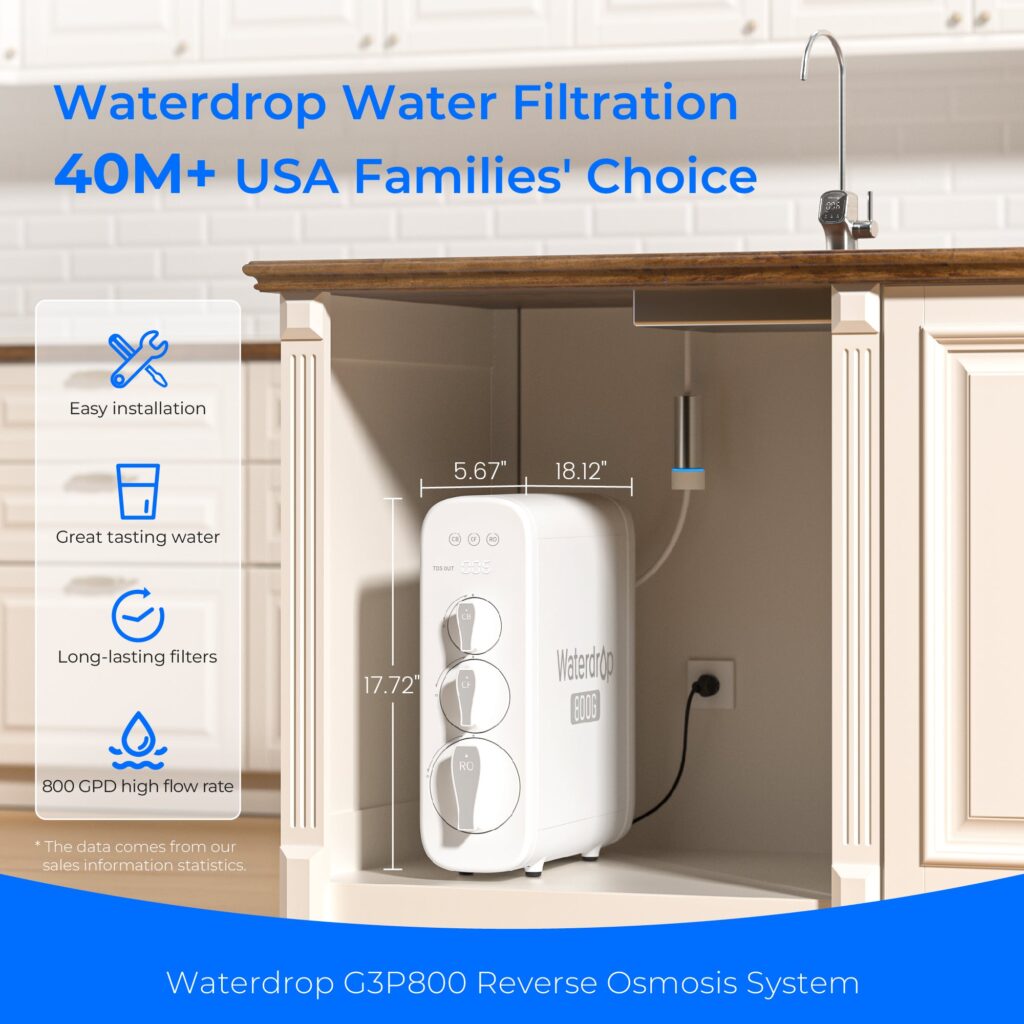
Measure the cabinet before you order, and look for a spare outlet. The G3P800 needs its power adapter for the faucet and the UV sterilizer.
Treat installation as a separate line item. If under-sink plumbing is not your thing, budget for a plumber on top of the system itself.
Filter schedule and cost
Waterdrop gives a separate interval for each stage:
- Sediment: every 2 to 6 months
- Carbon: every 6 to 12 months
- RO membrane: every 1 to 2 years
Each new filter gets a 10-minute soak in cold tap water, and the first two batches it produces should be poured away. Note the install date somewhere you will see it.
One comparison in the research puts a year of Waterdrop filters at around $145. Ongoing filters are a real cost, so weigh them next to the sticker price. Replacement filters are sold on Waterdrop’s own site.
How It Compares to iSpring
iSpring is a budget alternative. Waterdrop publishes its own side-by-side against an iSpring tank-based system, so treat the framing as the brand’s. This table pairs those iSpring figures with the G3P800’s specs.
| Metric | Waterdrop G3P800 | iSpring RCC7AK-BLK |
| Design | Tankless | Tank-based |
| Rated flow | 800 GPD | 75 GPD |
| Stage count | 10-stage | 6-stage |
| Waste ratio (pure to drain) | 3:1 | 1:3 |
| UV stage | Built in | No |
| Certifications | NSF/ANSI 42, 53, 58 and 372 | NSF/ANSI 58 |
| Warranty | 1 year | 1 year |
iSpring’s tank-based systems generally cost about 80 percent less up front, and yearly filter spend is lower too, at roughly $60 to $80 against about $145. A tank also means fewer electronic parts that could fail.
Waterdrop’s side of the ledger is flow, water waste and cabinet room. The brand says a cup fills in seconds, which it sets against low-output tank units.
For a closer match, iSpring’s tankless RO500 is a similar size but uses a 6-stage filter against the G3P800’s 10 stages.
Returns, Warranty and Shipping
Waterdrop’s return terms come down to a few points:
- Window: 30 days from receipt, with no restocking fee
- After 30 days: still accepted, with a 10 percent restocking fee
- Return postage: yours, unless a quality issue caused the return, in which case Waterdrop pays
- Condition: disassembled, repackaged as received and like new, with the original receipt
- Refund: processed within 5 working days of inspection, then 4 to 7 more days to appear on your card
The G3P800 carries a one-year limited warranty for manufacturing defects. Waterdrop saves two years for eligible X Series systems, and a few models add lifetime technical support. Faulty items are eligible for a free return, repair or replacement.
After 24 to 48 hours of handling, orders go out by one of three tiers: free economy in 4 to 8 business days, standard at $5.99 in 3 to 6 business days, or express at $10.99 to $42.99 in 2 to 3 business days.
Waterdrop also lists permanent programs: reward points worth about $3 per 1,000, a price match that runs for 30 days after purchase, referral credit for existing customers and trade-in credit on some models.
Confirm the terms on Waterdrop’s site before you order, since policies can change.
Frequently Asked Questions
Does the G3P800 need electricity?
Yes. The faucet and the UV sterilizer plug into a power adapter, so you need an outlet under the sink. Waterdrop’s under-sink ultrafiltration and dual carbon models are the exception, because they run on batteries.
Can I install it myself?
An independent reviewer hired a plumber even though Waterdrop rates most under-sink installs at about 30 minutes of DIY work. Judge your own comfort with plumbing before you rely on the brand’s estimate.
How often do the filters need replacing?
Each stage has its own interval, listed above. Models with an LED indicator flash red for 5 seconds when a swap is due.
Can it handle hard water?
Waterdrop’s stated limit for its RO systems is municipal water up to about 500 TDS. If your water tests above that, the brand suggests a pre-filter or scale inhibitor, and a water report will show where you stand.
What if my order arrives damaged?
The process starts with an email to Waterdrop’s customer service. Attach your order information plus photos of the damage, the packaging and the product label, and the brand says a replacement will follow.
The Verdict
The G3P800 suits households that want RO-level filtration without a tank taking over the cabinet. It fits best if you have an outlet to hand and are happy with either a DIY afternoon or a plumber’s visit. The independent test numbers are strong, and its 3:1 ratio sends less water to the drain than the older designs Waterdrop compares it with.
Skip it if the lowest up-front cost is your priority or the cabinet has no outlet. Shoppers who want more than a year of cover can look at eligible X Series models, which get two years.
Treat installation and filter changes as separate costs, read the return terms, and check the current price at Waterdrop before you decide. You can start by looking over Waterdrop’s range on its own site.