Choosing a landscape transformer sounds easy until you open a catalog. DEWENWILS alone lists more than a dozen models, from 60W up to 600W, spread across three styles of control. The model numbers do very little to explain how they differ.
This guide sorts them out in the order you would actually decide. First comes how much power you need, then how many zones, then how you want to control the lights, and finally what the brand’s warranty and returns look like. It leans on the brand’s published specs and policies rather than hands-on testing.
By the end you should know which tier fits your yard, which jobs a smart model is overkill for, and what to check before you order.
Start With Your Total Wattage
Wattage is the first filter. A transformer’s rating works like a budget that every fixture spends from, so the job is to total your fixtures and compare that sum with the box. Keep roughly 20% of the rating unspent, which spares the unit from running at its limit all night.
Scale makes the difference. A dozen 3W LED path lights come to 36W, which a 60W unit handles with room to spare. Add floodlights, spotlights and several zones and the total can pass 200W, and at that point the 300W models make sense.
Here is how the brand’s wattage steps line up with typical needs:
- Small yard, one schedule: the 60W HOSL02B is the entry point of the range.
- Small to mid-size yard: the 150W HSLT03A or the 300W HOSL05A cover dusk-to-dawn lighting on a single schedule.
- Pool deck or spa surround: the 300W HOSL05C is the pool-rated model, made for spots where moisture is a constant.
- Large property on one circuit: the 600W HOSL08A is the largest transformer in the catalog.
Do the same sum zone by zone if your model has several. Each zone needs its own headroom, not just the total.
Zones and Voltage
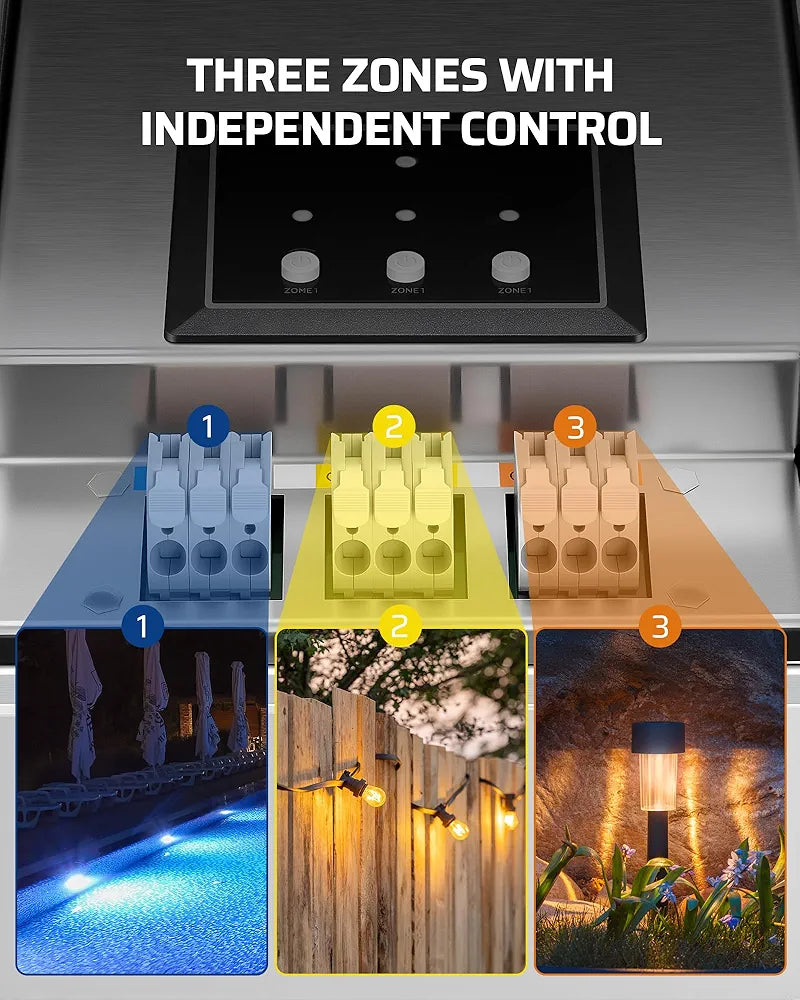
A single zone means every light on the transformer switches on and off together. That is fine for a simple dusk-to-dawn setup. It stops being fine once you want the pathway lights on late while the garden spotlights shut off early.
With several zones, the path lights can stay on late while garden accents and spotlights switch off earlier, all from one box. The 200W HWLT04A and 300W HWLT05A each have three independently controlled zones, as does the Matter-enabled HSLT05M.
12V or 14V output
Your fixtures decide this one, so read their spec sheet first. Most low voltage fixtures are made for 12V, and some are tolerant enough to run on 14V. The extra volt matters over distance, because voltage falls as it travels along the cable.
On models that set voltage zone by zone, such as the HWLT05A and HSLT05M, one workable split is 12V for a zone near the box and 14V for a zone that reaches far-off fixtures.
Why far lights look dimmer
A dim light at the end of a long run can come from voltage drop along the cable rather than from the transformer itself. For long runs, a heavier wire gauge than the minimum is the safer plan, so work out the cable before you blame the box.
Manual, Wi-Fi or Matter Control
DEWENWILS sorts its transformers into three control styles, and the right one depends more on your habits than on your yard size.
Manual models
Think of a manual unit as a light switch that watches the sky. A photocell turns the lights on at dusk and off at dawn, and a mechanical dial adds a timer on top. Nothing needs pairing. Models run from the 60W HOSL02B through the 150W HSLT03A, the 300W HOSL05A and the pool-rated HOSL05C, up to the 600W HOSL08A.
A manual unit is the logical choice when you set the schedule once and leave it. It also sidesteps Wi-Fi altogether, so a spot with a weak signal, such as a detached garage or a far corner of the yard, is no obstacle.
Between the two styles sits the 300W HSLT05A, which keeps the photocell and timer and adds a remote, for buyers who want more than a dial but no app.
Wi-Fi models
Wi-Fi models move the schedule onto your phone, through the DEWENWILS app or the Smart Life app, with Alexa and Google Assistant handling voice. Zone count splits this tier in two. The 200W HWLT04A and 300W HWLT05A have three zones. The 60W HOSL02W, the 120W HOSL03B2 and the 300W HOSL05D2 have one, and the first two of those put out DC power for modest runs.
That makes Wi-Fi a good match if you rework the schedule for seasons, guests or holidays and have no need for Matter.
The Matter model
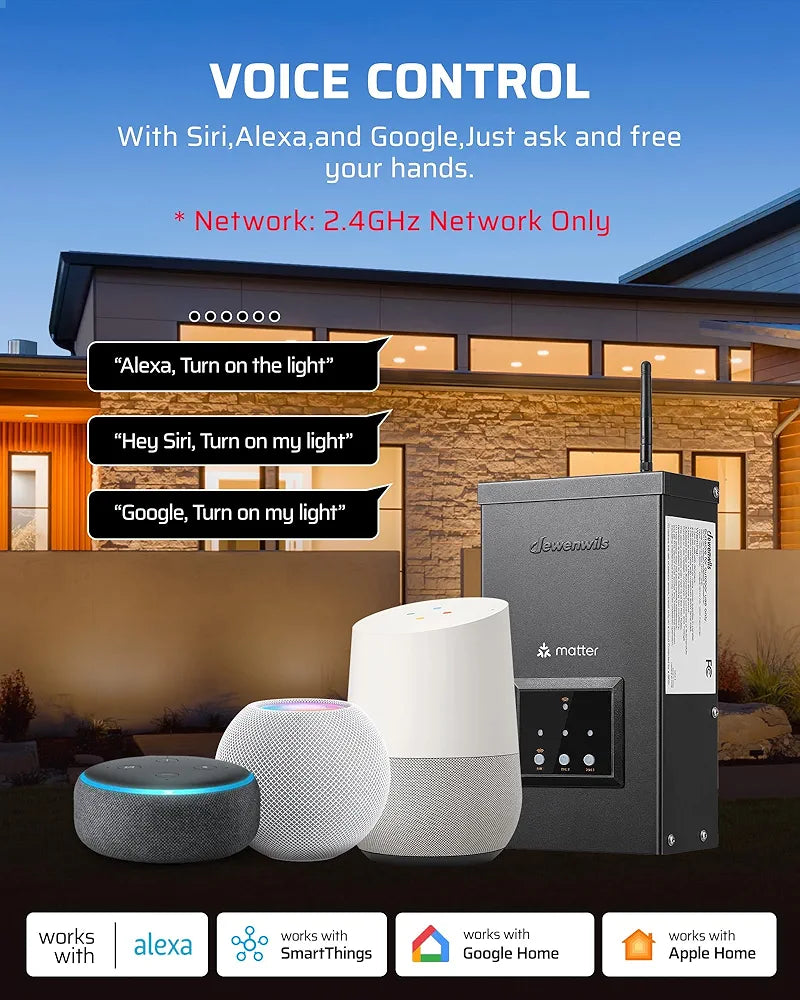
The 300W HSLT05M is the sole Matter-certified model. You scan a QR code to pair it with a Matter hub, and from then on the platform you already use takes over: Apple Home, Alexa, Google Home or SmartThings. It brings along the three zones and the per-zone 12V or 14V setting from the Wi-Fi models, and the Smart Life app adds energy monitoring.
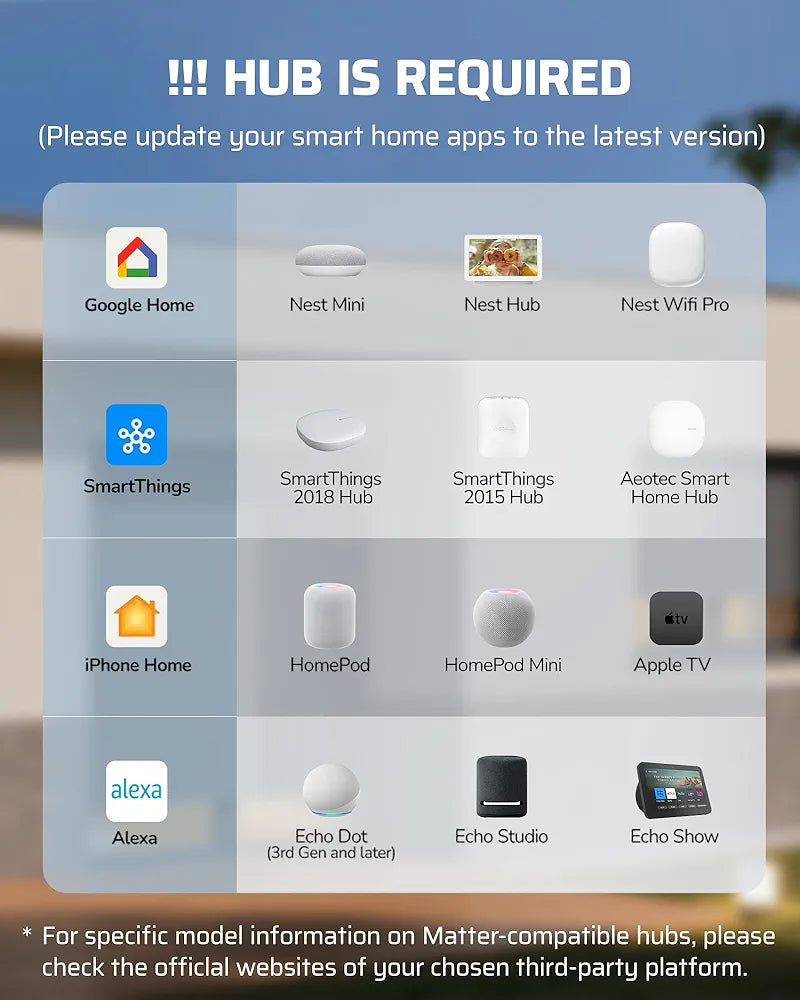
Two requirements apply: a hub, which can be an Echo Dot, a HomePod, a Nest device or a SmartThings hub, and a 2.4GHz network. Matter is a young standard, so confirm that your hub lists all three zones as separate controls before you commit to a detailed lighting plan.
Matter makes the most sense when one of those platforms already runs your house and you would rather not add an app just for the garden. Without a hub, a Wi-Fi model covers the same scheduling needs. For a spec-by-spec look at that unit, read our full verdict on the DEWENWILS HSLT05M.
The DEWENWILS Range at a Glance
This table gathers the models named above, grouped by how they are controlled.
| Style | Models | How you control it |
| Manual | 60W HOSL02B, 150W HSLT03A, 300W HOSL05A, 300W HOSL05C (pool areas), 600W HOSL08A | Photocell and a timer dial |
| Remote | 300W HSLT05A | Photocell, timer and a remote |
| Wi-Fi | 60W HOSL02W, 120W HOSL03B2, 200W HWLT04A, 300W HWLT05A, 300W HOSL05D2 | DEWENWILS or Smart Life app, with Alexa and Google Assistant |
| Matter | 300W HSLT05M | Any Matter hub, including Apple Home, Alexa, Google Home and SmartThings |
Look at the zone count as well as the wattage. The HWLT04A, HWLT05A and HSLT05M offer three zones, while the HOSL02W, HOSL03B2 and HOSL05D2 are single-zone. The manual units run on one schedule.
How DEWENWILS Compares With VOLT Lighting
VOLT Lighting makes a useful comparison because the two companies chase different priorities.
Warranty and listing. VOLT gives its toroidal transformers a lifetime warranty and states an ETL certification to UL standards. DEWENWILS gives its transformers a 12-month warranty and an FCC listing. On warranty length alone, DEWENWILS makes the lighter promise.
Smart control. DEWENWILS has the edge here. Its Matter and Wi-Fi models handle app scheduling, voice commands and, on the Matter unit, energy tracking. VOLT’s lineup centers on a conventional transformer fitted with timer and photocell receptacles, and it does not push app or voice control.
Size and build. VOLT spans a wider range, from a 50W Nano unit to 1200W Multi-Tap models for commercial-scale installs. DEWENWILS covers 60W to 600W. Both describe weatherproof housings. VOLT builds its cabinet from stainless steel and adds a magnetic secondary breaker. DEWENWILS opts for SPCC steel, finished with a waterproof coating and a metal shield.
Who each is for. VOLT markets itself to contractors and committed DIYers. DEWENWILS targets homeowners who are comfortable in smart home apps and would like the yard to follow the house’s routine, with no electrician needed to change a schedule.
Neither is the wrong call. The real question is whether long-term durability or everyday convenience carries more weight for you. Pick DEWENWILS if smart scheduling matters most. Pick VOLT when the longest warranty and a professional-grade listing come first, particularly for a big installation.
Setup and Care Tips
A transformer lives outdoors all year, so a little attention at setup pays off for a long time. These tips combine the brand’s stated specs with ordinary good practice.
Count the load before wiring
Total the fixtures on each zone first, and stay under that zone’s limit. The brand’s overcurrent and overload cutoffs are meant to react when a short appears, so treat them as a backstop. Repeated tripping is not good for the unit over the long term.
Seal every splice
The transformer is one part of the system, and the splices out in the yard are exposed to moisture. Put a waterproof connector rated for direct burial on each one, and leave indoor wire nuts in the toolbox.
Pick the mounting spot
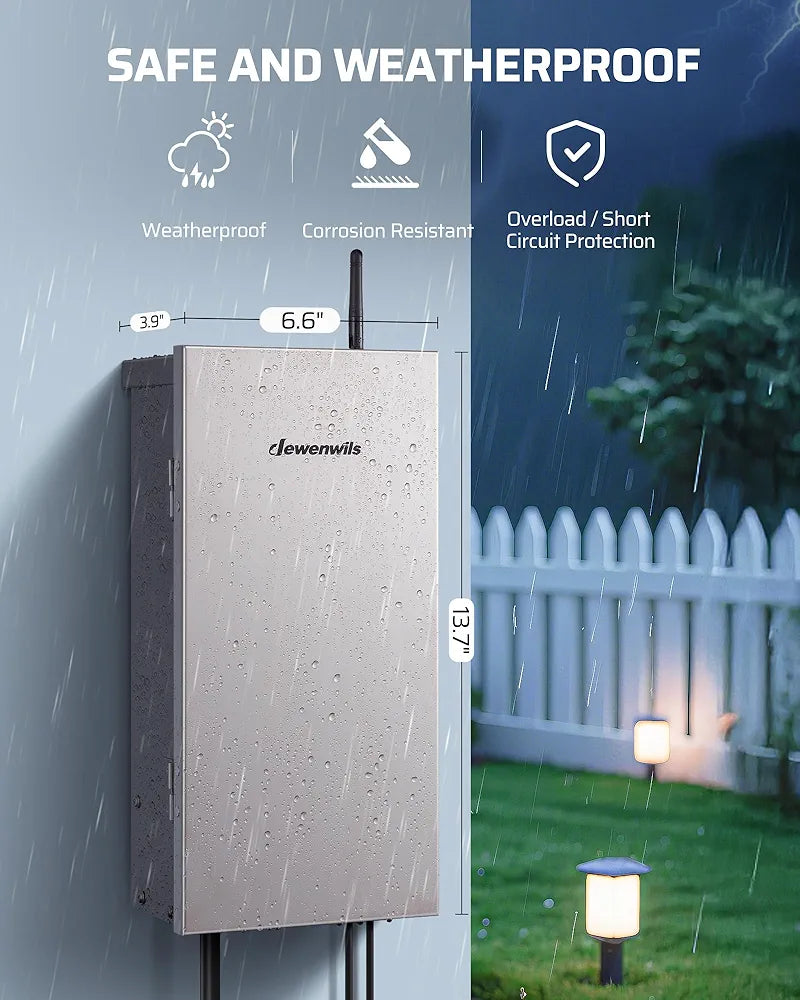
The brand describes its housings as weatherproof, yet placement still counts. A wall, post or stake works well, provided it sits out of the line of sprinklers and downspouts and water runs away from the base instead of pooling.
If a zone stops responding
Smart models depend on a 2.4GHz network. When a zone ignores its schedule, try re-pairing in the app, or scan the Matter QR code again, before you start tracing wires.
Review it each season
At each end of the lighting season, clear debris from the enclosure, confirm the door still closes fully, and move the schedule to match the changed sunsets. An astronomical dusk-to-dawn setting, where a model offers one, makes that last step unnecessary.
The Brand Behind the Boxes
Start with what the brand leaves out. The About page gives no founder’s name and no headquarters address, so there is no garage-startup story to tell. What it does state is a 2016 founding, an in-house research and development team, and a mission of putting smart control within reach of ordinary households.
The size claims are the brand’s own too: more than 100 patents worldwide and over 1,000 products on its site. Treat them as the brand’s own claims and a hint of scale, not an exact tally.
Transformers are a small part of what DEWENWILS lists. The wider catalog runs from smart timers and dimmers to wireless outlets, power strips, extension cords in GFCI and RV-rated versions, work and flood lights, exhaust fans and sprinkler timers.
Next to a lighting-only specialist, that makes DEWENWILS a general home-electronics maker that moved into landscape lighting. Its pull is range and features, not a long lighting pedigree. Adding Matter support was a notable move for a private-label brand.
Warranty, Returns and Buying Safely
These are the terms the brand’s policy pages lay out:
- Warranty: 12 months counted from receipt. A quality problem inside that window is met with a full refund or a free replacement.
- Scope: manufacturing defects and hardware faults. Misuse, faulty wiring and conditions far outside the housing’s design fall outside it.
- Returns on the brand’s website: 30 days from delivery, with return postage on you if you changed your mind. Refunds are described as arriving within 7 business days once the return is received.
- Shipping from the brand’s website: from warehouses in the United States, where handling takes 1 to 2 business days and transit takes 3 to 7.
- Support: write to [email protected] and include the order number plus a brief description of the fault.
Try that support address before a marketplace dispute. Buying elsewhere changes the paperwork: an order placed through Amazon or Home Depot follows that retailer’s return process, with the manufacturer warranty still applying.
Where to buy
Three channels are listed: the brand’s own website, an official brand storefront on Amazon, and Home Depot for select models. On Amazon, a listing sold by DEWENWILS or shipped directly by Amazon is a safer pick than an unfamiliar third party. When you are ready to compare costs, you can see the price on Amazon, and the link opens Amazon.
What to check on any listing
- A matching model number. Compare the number on the listing, such as HSLT05M, HWLT05A or HOSL02B, with the brand’s own naming, including the wattage and zone count.
- Certification marks. The brand says its transformers carry an FCC listing, so check the photos for a certification mark on the unit or its packaging.
- A specific description. Boilerplate wording that never names a model deserves caution.
- A seller who honors the warranty. A seller who refuses to refer warranty claims to the manufacturer is a warning sign.
A transformer steps household current down for outdoor use, so it is worth buying from a source you trust.
Frequently Asked Questions
What voltage do these transformers deliver?
The brand lists 12V or 14V AC output on most models, fed from 120V household power. A few, the HSLT05M among them, allow a different setting for each zone.
How many zones does the HSLT05M have?
Three. Each runs on its own schedule, and each can be set to either 12V or 14V.
Does the Matter model need a hub?
Yes. The brand requires a certified Matter hub for pairing. An Echo Dot, HomePod, Nest device or SmartThings hub all qualify, and Apple Home users connect through the same kind of hub.
Does 5GHz Wi-Fi work?
No, 2.4GHz is the only band the smart models support. With a router that merges both bands into one name, a temporary 2.4GHz-only network can get you through setup.
Are the housings weatherproof?
The brand describes the housings as weatherproof and corrosion resistant. Placement still counts, so keep the unit out of direct sprinkler or downspout spray.
Which model is the entry point?
The 60W manual HOSL02B is where the range starts. Check the current price on Amazon.
Is there built-in overload protection?
Per the brand, yes. It lists overcurrent and overload protection on its transformers, and the purpose is to stop a short circuit from harming the fixtures on the line.
How long are the warranty and return window?
Warranty coverage is 12 months from the day the unit arrives. A purchase from the brand’s own site can be returned within 30 days of delivery.