
Waterdrop’s catalog covers a lot of ground. Under-sink reverse osmosis systems share the catalog with whole-house units, pitchers, tap-mounted filters, refrigerator cartridges and even instant hot-water dispensers, and the model names are not always easy to decode.
This guide sorts that range into a decision you can actually make. It covers where the brand comes from, what each product line is for, how to match a system to your water and your cabinet, how Waterdrop stacks up against a budget rival, and what upkeep and returns look like. Everything comes from the brand’s published details and independent reviewers, so treat it as research rather than a hands-on test.
If you would rather read about a single system in depth, our full verdict on the Waterdrop G3P800 walks through its specs, the independent lab numbers and the policies that apply to it.
Where Waterdrop Comes From
The brand dates to 2015, and its first sales in California came in 2016. Two company names are worth noting for warranty questions or counterfeit reports: Ecolife Technologies, Inc., the operator, which is headquartered in California’s City of Industry, and Qingdao Ecopure Filter Co., Ltd., the manufacturer.
The brand states a deliberately narrow mission: solve at least one drinking-water problem for each customer, not every problem at once. The lineup reflects that, split into many small categories.
Milestones the brand lists
- Awards: a Red Dot Design Award for the G3 RO system in 2019, and a second Red Dot award after the X Series launch.
- Trade shows: Aquatech Amsterdam in 2019 and the Water Quality Association’s annual exhibition in 2023.
- Products: the K6 hot-water dispenser arrived in 2022 as a purifier, boiler and kettle in one under-counter unit, and the X Series, topped by the X16, followed the G Series.
- Community: backing for a clean-water project in Sub-Saharan Africa in 2018.
Treat the next figures as the brand’s own: more than 300 patents, shipments to over 82 countries, more than 200 certifications across the range and, it says, over a billion plastic bottles replaced by its filters. The two Red Dot awards are the exception, since an independent jury hands them out.
Tankless design is the thread running through the brand. In place of a bulky storage tank, Waterdrop uses composite filters and an instant-flow layout, and that choice explains most of the price and size differences you will meet later in this guide.
What the Lineup Covers
Here is what each Waterdrop line is for, in plain terms.
Under-sink RO systems
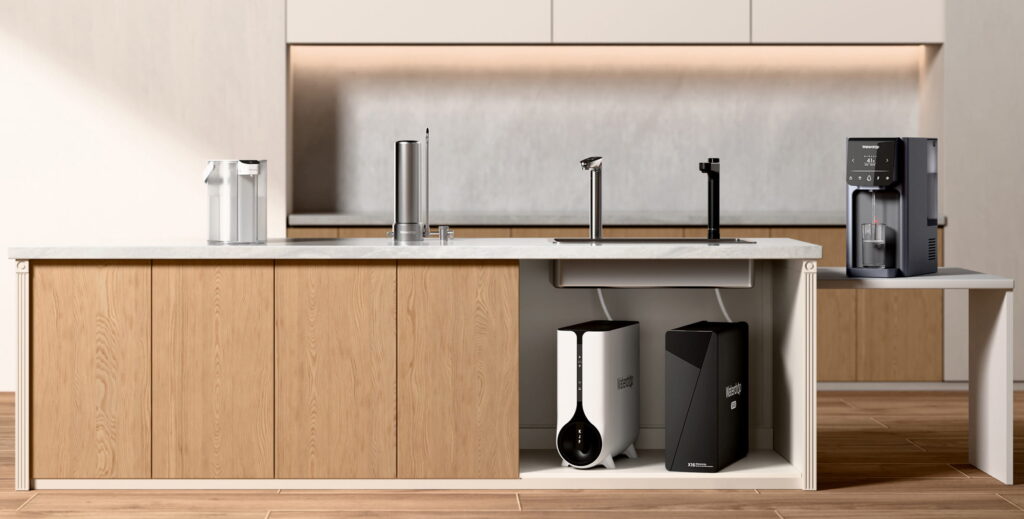
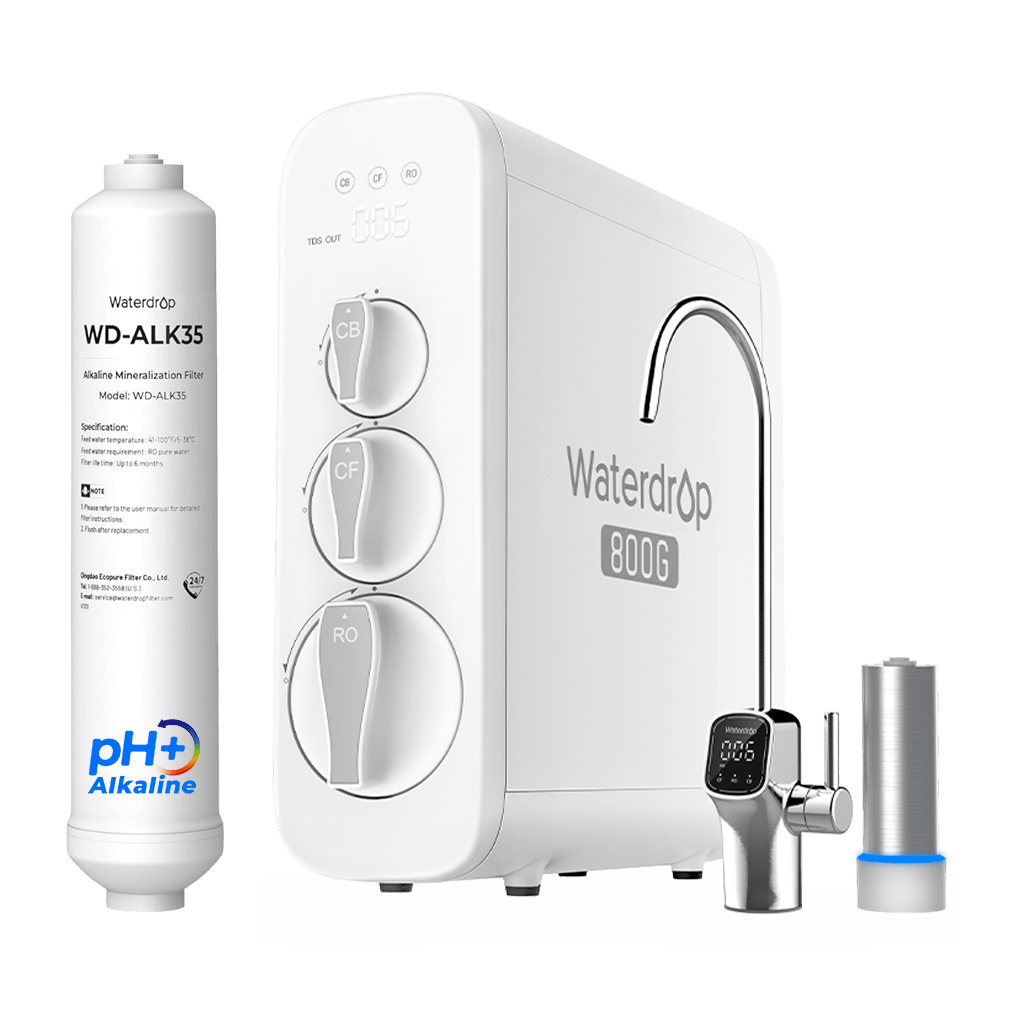
Waterdrop’s flagship category divides into the G Series and the X Series. The G3P800 is the mid-tier unit, a tankless design rated for 800 gallons a day with 10 stages of filtration. The X12 above it adds an alkaline remineralization stage and a smart stainless faucet, and the X16 raises flow to 1,600 gallons a day. The X12 comes in several bundles, so check the current prices for it and the X16 at Waterdrop.
Instant hot and cold units
The K6 rolls five appliances into one under-sink unit: a cold dispenser, a baby-formula dispenser, a kettle, a boiler and a purifier. It delivers water at a chosen temperature from 104 to 203 degrees Fahrenheit with no wait to preheat, and it sells for about $800 at Waterdrop. It suits a kitchen that wants to retire the kettle, not just filter drinking water.
Countertop dispensers
The A2 is a bottleless cooler. It sits on the counter and behaves like a water cooler rather than a plumbed-in system. Some models need no plumbing connection at all, which makes this line a natural fit for renters.
Whole-house filters
These go where water enters the home, so they treat showers and laundry as well as the kitchen tap. Waterdrop’s range starts with a 2-stage sediment and carbon unit at about $110 and moves up to a 3-stage carbon-plus-sediment design, with the price depending on how much iron and manganese reduction you want. They sit alongside a drinking-water RO system rather than replacing one.
Pitchers, faucet filters and fridge filters
The Chubby and Lucid pitchers are the entry point, with replacement filters from about $40. The brand says their 7-stage filters reduce lead, fluoride, arsenic and chlorine, and they need no installation or electricity. Faucet filters clip onto an existing tap for a smaller commitment than full RO. Fridge filters are cut to fit specific models and are pitched as a lower-cost alternative to original cartridges. Counterfeits have been reported in this category, so read the buying section below.
Start With Your Water and Space
Three questions narrow the field fast: what is in your water, how much room do you have, and can you touch the plumbing?
Your water source
Begin by finding your TDS number, from a utility report or a home test kit. Waterdrop rates its RO systems for municipal supplies up to about 500 TDS, and above that the filters can clog sooner than their rated lifespan. A well, or a high reading, calls for a scale inhibitor or pre-filter ahead of the RO unit.
Your cabinet
Waterdrop says a tankless system such as the G3P800 frees roughly 70 percent of the cabinet room a classic tank-based unit takes. Measure first, and check for an outlet, because the faucet and the UV stage need power. The brand’s under-sink ultrafiltration and dual carbon models are the exception, running on batteries instead.
Renting or avoiding plumbing
Pitchers and the A2 dispenser skip installation altogether. Neither needs drilling or a permanent connection, which matters when you are not allowed to modify a rented kitchen.
Coverage beyond the kitchen
A whole-house filter covers showers and laundry, though RO reduces contaminants more thoroughly. The two can work as a pair: the whole-house unit for general use and the RO unit at the kitchen tap for drinking.
Under-Sink Systems Compared
The G3P800 is the system covered in depth in our verdict. It is certified to NSF/ANSI 42, 53, 58 and 372, is rated for 800 gallons a day and keeps a 3:1 pure-to-drain ratio. An independent testing site scored it 9.21 out of 10 and measured its output at 886.54 gallons a day. Stepping up to the X Series adds flow and, on the X12, alkaline remineralization, at added cost.
| Model | Rated flow | Stages | Key features |
| G3P800 | 800 GPD | 10 | Smart LED faucet, built-in UV sterilizer |
| X12 | 1,200 GPD | 11 | Alkaline remineralization, smart stainless faucet, about 3.75 seconds to fill a cup, per the brand |
| X16 | 1,600 GPD | 11 | UV sterilizer, 2-year warranty on eligible units |
One trade-off to weigh is warranty length. The G3P800 and most other Waterdrop RO systems come with a one-year limited warranty, while eligible X Series models get two years.
Waterdrop positions the X16 for families that run the tap constantly. For other households the G3P800 may be enough, and a step up makes sense only for a specific reason, such as household size, a taste for alkaline water or a need for hot water on demand. To see every model, browse Waterdrop’s range on its site.
Hot Water and Add-On Options
The K6 is a different use case from a straight drinking-water RO system. Pick it only if you want the kettle function as well as filtration, because that extra capability is what you pay for.
A quick decision checklist can help:
- If you rent or cannot touch the plumbing, a pitcher or the A2 dispenser fits.
- If the cabinet is cramped, a tankless unit such as the G3P800 or an X Series model saves room.
- If you want treated water at every tap, add a whole-house filter and keep RO for drinking.
- If you draw from a well or your TDS reading is high, put a pre-filter or whole-house unit first.
- If you want hot water on demand, take a look at the K6.
How Waterdrop Compares With iSpring
iSpring is a budget alternative to Waterdrop. Waterdrop publishes a direct comparison against it, so the numbers below carry the brand’s framing. The pairing sets the X16, Waterdrop’s top model, against a tank-based iSpring unit.
| Spec | Waterdrop X16 | iSpring RCC7AK-BLK |
| Layout | Tankless | Tank-based |
| Output | 1,600 GPD | 75 GPD |
| Stages | 11 | 6 |
| Waste ratio (pure to drain) | 3:1 | 1:3 |
| UV stage | Yes, rated 99.9% | No |
| Tap style | Digital display and a TDS monitor | All-metal air gap |
| NSF/ANSI listings | 58 and 372 | 58 only |
| Cover | 2 years | 1 year |
On the brand’s figures the flow gap is roughly 21 times, and the Waterdrop unit wastes less water. This match-up uses the top-tier model, though. For a closer comparison, put the G3P800 next to iSpring’s tankless RO500, which is a similar size but relies on a 6-stage filter rather than 10.
Where iSpring wins
- Up-front cost: iSpring is lighter on the wallet, by roughly 80 percent next to Waterdrop’s tankless range.
- Filter spend: roughly $60 to $80 a year, against about $145 for Waterdrop, which adds up to a saving of $325 to $425 over five years.
- Fewer parts to fail: a tank-style unit relies on less electronics.
Where Waterdrop wins
- Speed: Waterdrop says a cup fills in seconds, where low-output tank units run slower.
- Water waste: a 3:1 ratio sends less to the drain than a 1:3 one.
- Cabinet room: no storage tank means more usable space.
- Warranty: two years on eligible X Series models, against one year.
If the cabinet is tight and the tap sees heavy use, the tankless layout is where Waterdrop’s premium pays off. If the goal is NSF-certified filtration at the lowest cost and a tank fits, iSpring is a reasonable budget choice.
Care, Setup and Replacement
Replacement intervals
Waterdrop’s guidance sets a different interval for each type of filter.
| Filter | Interval |
| Sediment stages | 2 to 6 months |
| Carbon stages | 6 to 12 months |
| RO membrane | 1 to 2 years |
| X12 F1A filter | 12 months |
| X12 F2 filter | 6 months |
| X12 F3 membrane | 24 months |
| Pitcher filter | 320 gallons or roughly 2 months, whichever limit arrives first |
Models with an LED indicator flash red for 5 seconds when a swap is due. On any model, the install date is your clock, so note it where you will see it and set a reminder. A spare filter on the shelf makes it easier to change on time.
Setting up a new filter
- Submerge the new filter in cold tap water for 10 minutes, which releases trapped air bubbles.
- Fit it, then pour away the first two batches the system produces.
- If the model has an activation button, press it.
Slow flow and leaks
- Slow pitcher: Waterdrop’s FAQ points first to sediment in the tap water, such as sand or rust. Shake the filter out and refit it before deciding it is defective.
- Leaking pitcher: the FAQ names overfilling as the usual cause, since water can run over the handle once the fill line is passed. If it leaks at the right level, contact Waterdrop’s support.
- Idle faucet filter: after a few days unused, run water through it for about 30 seconds before drinking.
Buying Genuine, Returns and Warranty
Counterfeit water filters exist, replacement cartridges included. Some fakes that carried unauthorized certification logos were confiscated once testing showed they did not remove lead. The most direct protection is to buy from Waterdrop’s own online store.
The brand also sells through other authorized retailers. If you buy anywhere other than Waterdrop’s own site, make sure the seller is authorized, and be wary of third-party listings with a near-identical product name. Take the most care with replacement filters.
Warning signs of a fake
- Printing: misspellings, blurry text or mismatched fonts on the box or housing.
- Certification marks: logos that are absent or oddly placed.
- Model number: a format that differs from the one on the brand’s product pages.
- Packaging: unsealed, thin cardboard or a barcode sticker applied badly.
- Weight: a filter that is lighter than its listed weight.
One red flag alone proves little. If you spot two or more, return the item and buy again from a verified seller.
Return window and refunds
The return policy comes down to three numbers: 30 days, 10 percent and 5 working days. A return made within 30 days of delivery carries no restocking fee, although you pay the postage unless a quality problem caused it. After day 30 Waterdrop still takes returns but applies a 10 percent restocking fee. Refunds follow within 5 working days of inspection, and your card may need another 4 to 7 days to show them. Items go back disassembled and repackaged as received, in like-new shape, and the original receipt must come with them.
Warranty, shipping and permanent perks
- Warranty: one year, limited, covering manufacturing defects on most RO systems; two years on eligible X Series systems; lifetime technical support on some models.
- Shipping: after 24 to 48 hours of handling, economy is free (4 to 8 business days), standard costs $5.99 (3 to 6 business days) and express costs $10.99 to $42.99 (2 to 3 business days).
Ongoing programs include a points scheme, where 1,000 points are worth about $3, redeemable as cash at checkout or toward free filters. There is also a price guarantee that covers sale periods and the 30 days following a purchase, plus referral credit and trade-in credit for some customers and models.
Frequently Asked Questions
Is a plumber required for an RO install?
Waterdrop rates most under-sink installs as a 30-minute DIY task, but an independent reviewer paid a plumber anyway. Whether you need one depends on how comfortable you are working under the sink.
What do Waterdrop systems reduce?
The answer varies by model and certification. Waterdrop’s listings mention TDS, chlorine and chloramine, taste and odor, scale and turbidity, along with heavy metals, chromium, cadmium and organic pollutants such as PFOA and PFOS.
Does reverse osmosis make water unhealthy?
Waterdrop’s position is that RO does not make water unhealthy and may reduce contaminants you would otherwise drink. That is the brand’s view, so if you have specific health concerns about your water, start with a local water report.
Is hard water a problem for RO?
Waterdrop’s stated ceiling is about 500 TDS for municipal water. Above that, add a scale inhibitor or pre-filter ahead of the RO unit.
Do any models run without electricity?
Not the tankless RO line, which needs a power adapter. Waterdrop’s under-sink ultrafiltration and dual carbon systems are the battery-powered exceptions.
What if my order arrives damaged?
Send customer service an email that includes your order information and photos covering the product, packaging and label. Waterdrop says it will then arrange a replacement.
Which Waterdrop Fits Your Home
Start with your water and your cabinet, then pick the lightest system that does the job. For a kitchen with some under-sink space, the G3P800 is a reasonable first look. Renters can lean toward a pitcher or the A2, and larger households or hot-water fans can look at the X Series or the K6.
Whichever route you take, plan for filter replacements, keep the install date visible and buy from a verified seller. Check current pricing and the full model list on Waterdrop’s own site before you order.