Tentsla makes a very specific kind of camping gear. Its flagship tent connects to a Tesla, one of its mattresses is cut to fit a Tesla trunk, and nearly everything else in the catalog supports those two ideas.
That narrow focus makes the buying decision simpler than it looks. Still, a handful of checks matter before you spend anything: your car model, your group size, the weather you camp in and what the brand promises if something goes wrong.
This guide covers all of it, from the brand’s background and how the tent works to materials, extras, care and policies. If you want a single-product breakdown, read our full verdict on the Tentsla X1. Everything here comes from Tentsla’s published information, and the guide flags the places where that information runs out.
Where Tentsla Came From
Start with who is behind the name. The company, Tentsla Ltd, has a Colorado registration dating to 2023 and is headquartered in Colorado Springs. Its warehouses sit in four regions: the US, Europe, Australia and Hong Kong. It is an independent business with no connection to Tesla, Inc.; the name simply points at the cars its gear is built for.
The founding story, as Tentsla tells it, is a cold-weather camping trip. In the middle of July, four friends were camping in Victoria, Australia, with a standard tent set up beside a Tesla. Some time during the night they realized the car’s cabin was the more comfortable place to be.
That observation became the whole premise. Rather than refine a stand-alone tent, the founders wanted a shelter linked to the car’s climate system, so that cabin heating or cooling could reach the sleeping area.
The money came from Kickstarter. The campaign was titled "Tentsla Tent: The Next Level Tesla Camping" and ran in spring 2023 with a $5,000 goal. It closed with $101,810 pledged by 161 backers, more than twenty times the target.
The brand describes its mission as "eco-conscious" gear for electric vehicle drivers.
Because the campaign page, its totals and its dates are public, the story can be checked. A funded campaign still says nothing about unit quality or long-term durability, so keep that in mind as you read on.
How a Tesla-Connected Tent Works
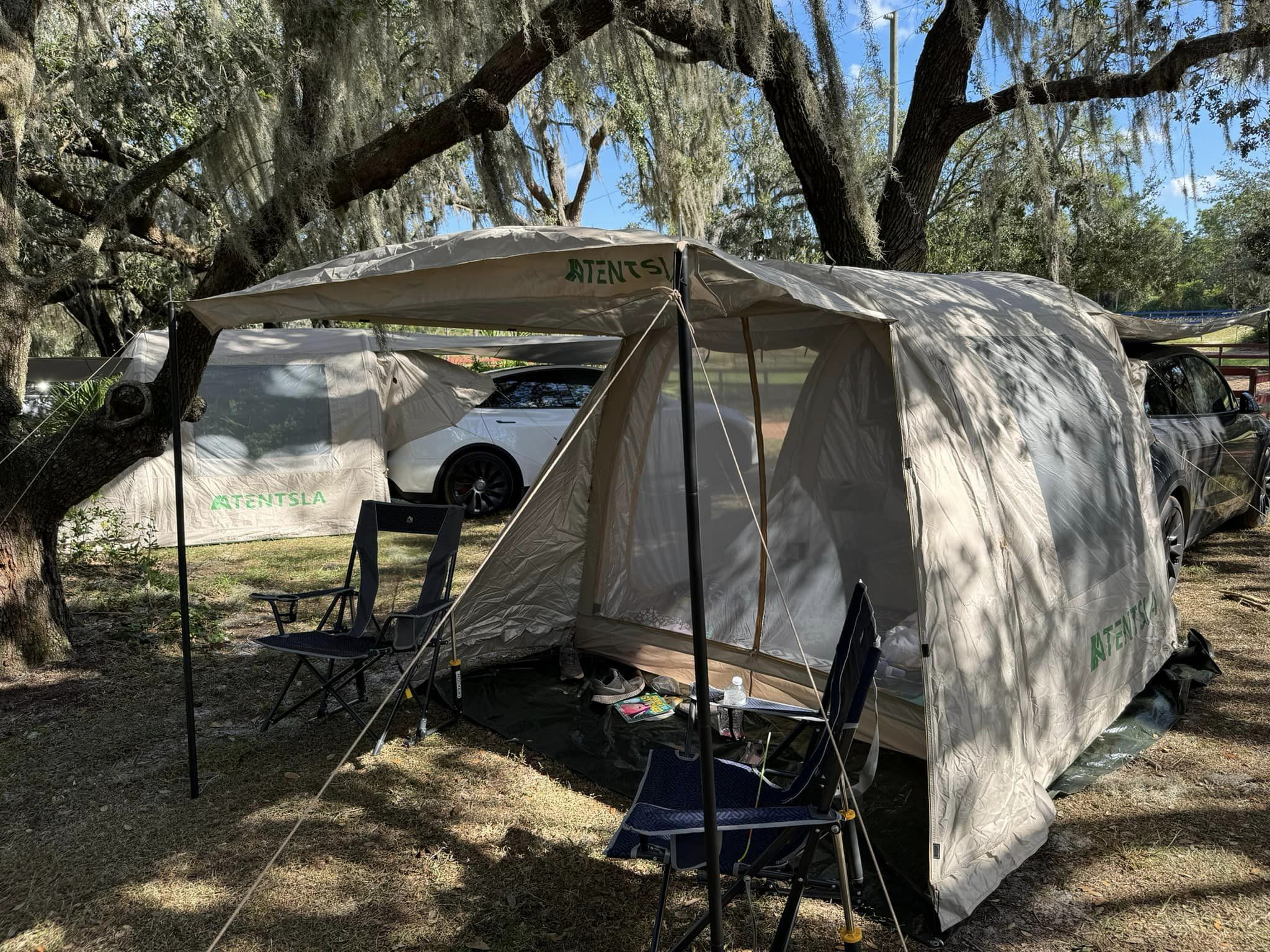
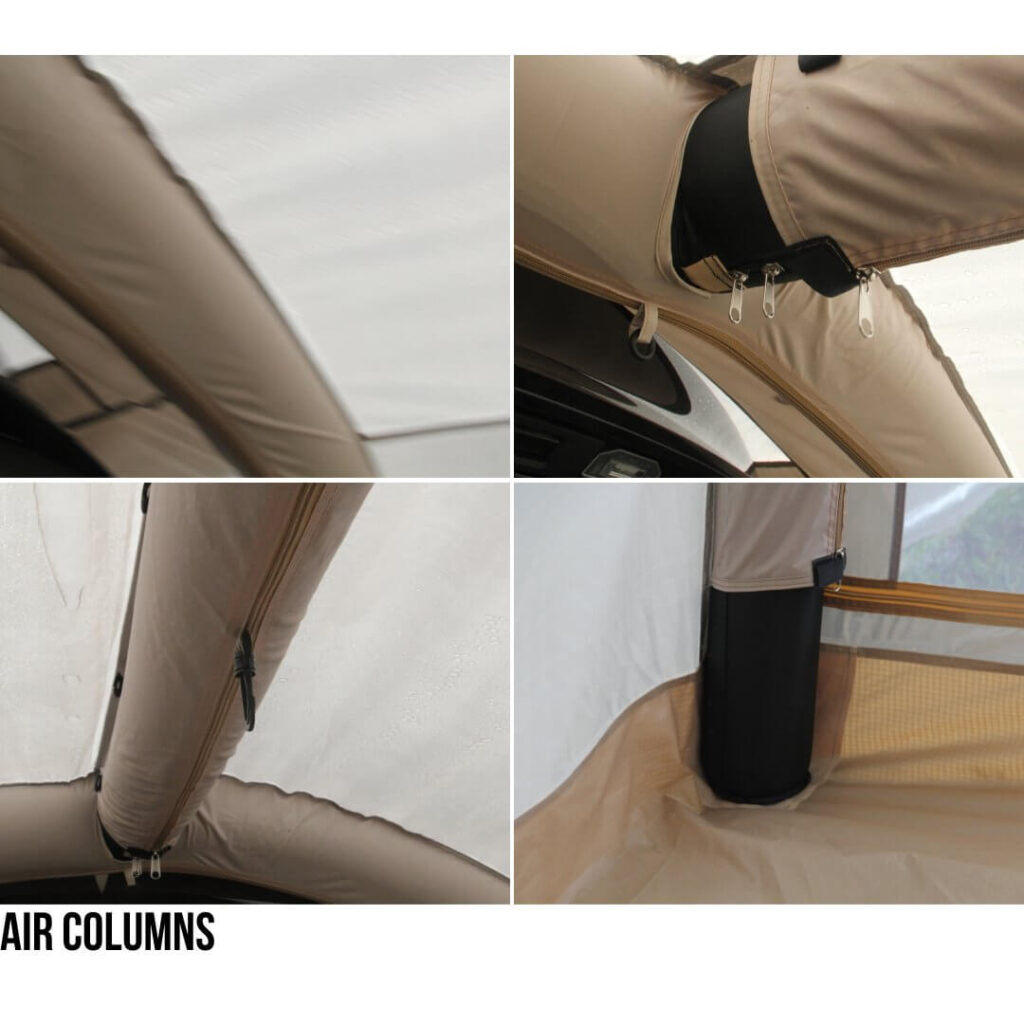
Begin with the frame, since it drives most of what follows. A conventional tent holds its shape with rigid poles slid through fabric sleeves. The X1 mostly replaces them with inflatable air columns: sealed tubes that firm up under pressure, the same principle used in inflatable paddleboards. Attach the pump and inflate the columns, and the tent holds its own shape. Tentsla says a pitch takes around five minutes after a first run or two.
Some rigid hardware is still involved. The box includes six aluminum poles for the canopy sections and for stake-out points that need a firm edge. Tentsla says the canopy sections can provide shade or carry solar panels, and the tent has a back door and a side door.
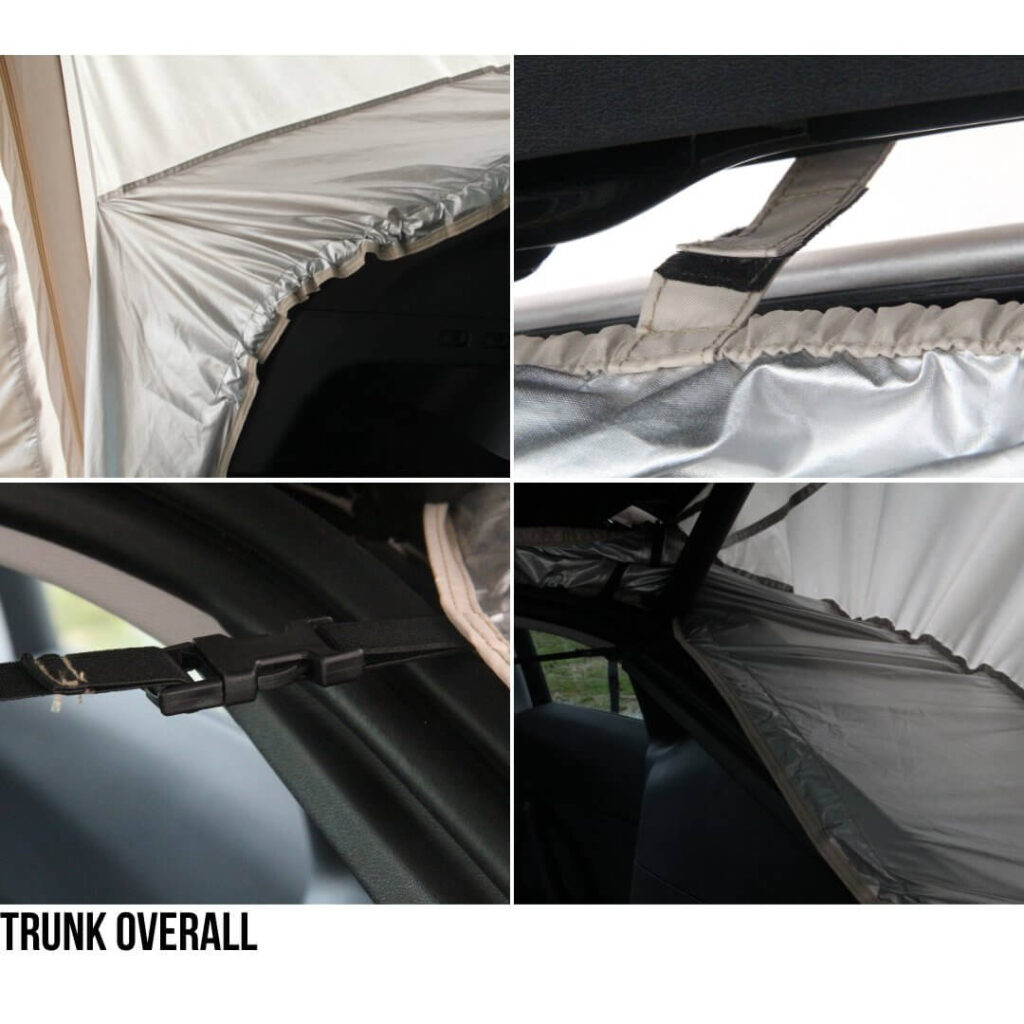
The car link is the second idea. The X1 does not stand alone: connectors in the box fit the rear trunk or the windshield area, and once the seal is made the tent and the cabin are meant to share airflow. Tentsla says the cabin’s climate control, running in Tesla’s Camp Mode, then holds the tent interior near the cabin setting. By the brand’s account, a regular tent would need its own heater or extra layers to match that.
For the full lineup and current pricing, browse Tentsla’s range at its official store.
Whatever tent you own, pick a level pitch with enough room behind the car to lay everything out flat before you inflate.
Check Your Tesla Model First
This is the one check that decides everything else. The X1 is designed for the Tesla Model 3 (including its refreshed version), the Model Y (including the newer version), the Model X and the Model S.
If you drive another electric car, or any other car, the connectors will not work, and no workaround is mentioned anywhere in the brand’s materials.
Fit confirmed? Then do a dry run at home. Practicing the connector attachment on your own car in the driveway beats learning it at a dark campsite.
Group Size and Space
Tentsla states the X1 sleeps up to four people, in an interior of 7.2′ x 7.1′. Two or three campers get more elbow room than a full house of four. Five or more will feel the limit quickly, so it is better to know that before you order than during the first trip.
Think about where everyone actually sleeps. The brand also sells a trunk-shaped mattress, so one option is to put a couple of people in the car and the rest in the tent. Sketch the sleeping plan on paper first, including where chairs, bags and wet shoes will go.
If your group is bigger, the Otrifowd ACtent is the roomier option, with an interior of 10′ x 8.2′ x 6.3′ for up to six people. A later section compares the two in more detail.
Fabric, Frame and Weather
Oxford polyester is the main fabric, in 210D and 410D weights. Denier measures thread thickness, so a larger number generally points to a tougher weave. Tentsla uses the heavier 410D where wear is highest, such as the floor, and the lighter 210D across the main body panels.
Beyond the weave, the outer layer carries a silver coating and the floor’s underside an anti-slip coating. Both coatings can wear down under rough scrubbing, which the care notes below cover. The air columns are Oxford-covered TPU, a flexible airtight material also found in inflatable boats and rafts, the windows have Terylene nylon mesh screens and the aluminum poles come in matte black.
Tentsla gives its water-resistance figure as a range of 3,000 to 6,000mm and does not say which panels reach which number. Read it as a range rather than a promise for every seam, and be cautious about counting on this tent as a shelter in alpine storms.
In practice, intermittent showers are one thing and long storms are another. If your trips lean toward the second, bring a groundsheet, check the forecast before you commit to a site and pull the guy wires snug before dark.
Pumps and Accessories
Tentsla’s catalog is small: one tent, one pump upgrade, two mattresses and one blanket. That makes it easy to rank what to add and in what order.
Pump. A manual pump comes with every X1. Campers who go out often, or who roll in late after a long drive, may like the electric E-Pump upgrade, which Tentsla says shortens setup further. Tentsla also lists a wireless pump made with OM, the Shark IIS, which the listing says has an active-cooling feature. For occasional trips, the included pump does the job.
Self-inflating double mattress. A khaki mattress made from PVC, flocking fabric and ABS parts, sized to sit inside the tent. It costs about $299 at Tentsla. On multi-night trips, a decent sleeping surface tends to matter more for comfort than most other add-ons.
Trunk mattress. A separate mattress cut for the shape of a Tesla trunk, silver on top and black underneath. It costs about $259 at Tentsla and suits anyone planning to sleep partly in the car.
Bohemia Blanket. A woolen camping blanket at about $59 at Tentsla, the cheapest item in the catalog. It will not make or break a trip, but it adds warmth on a cold night without leaning only on the car’s climate control.
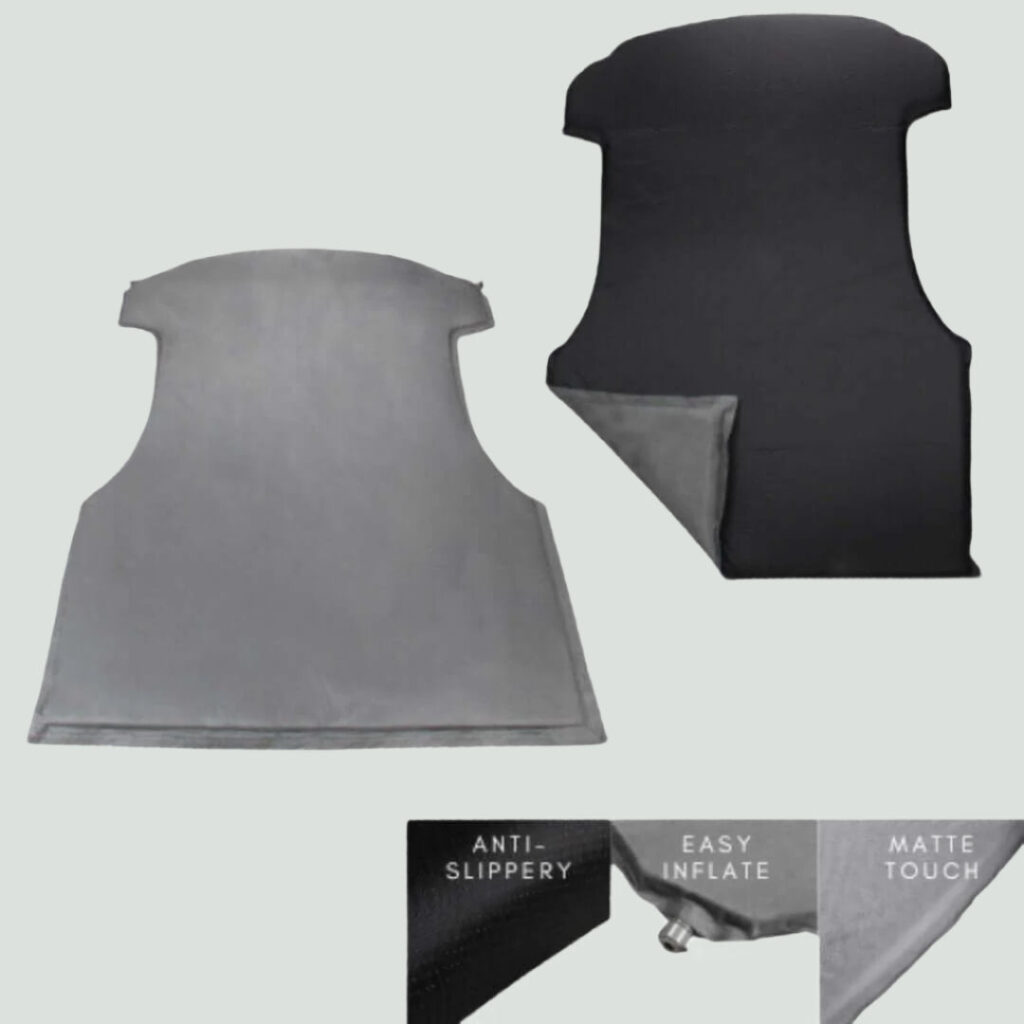
A sensible buying order: the tent first, since nothing else works without it, then the self-inflating mattress if budget is tight. The trunk mattress, wireless pump and blanket are comfort upgrades to add once you know you will use the tent regularly.
Tentsla X1 vs the Otrifowd ACtent
Otrifowd’s ACtent is the closest alternative. It is another tent made to connect to a Tesla, and both products started life on Kickstarter, aimed at the same problem. All numbers here are the makers’ own claims.
Setup. Tentsla says the X1 goes up in about five minutes with practice. Otrifowd says a first pitch of the ACtent can take 20 to 30 minutes, falling to 10 to 15 on repeat use. If you want to be ready fast after a long drive, the inflatable frame has the edge.
Weather. Tentsla’s range is 3,000 to 6,000mm. Otrifowd’s canopy is rated to about 2,000mm and its floor to 3,000mm. By the numbers, the X1 has the stronger rating, though Tentsla does not say which panels reach the top of its range.
Space. The ACtent lists 10′ x 8.2′ x 6.3′ and room for six. The X1 is smaller, at 7.2′ x 7.1′ for four people. For regular group trips, that gap is real.
Extras. The ACtent includes a dedicated charging-cable opening and can detach to work as a standalone tent. The X1 leans on its canopy sections for shade or solar mounts and ships with more hardware.
Price. The ACtent generally sits as the budget choice of the pair, so check current listings on both before you compare them directly.
Pick the ACtent for bigger groups and a tent you can use away from the car. Pick the X1 for smaller groups, faster setup and the stronger stated rain rating.
Setting Up, Cleaning and Storing It
Looking after an air-column tent is not demanding, but the habits differ a little from pole-tent care. These routines are grouped by when you do them.
On arrival. Unfold the tent in daylight on flat ground and look over the seams and air columns for shipping damage before you attach the pump. It is also a good moment to try the connectors on your own Tesla, since a problem is easier to spot in a driveway than at a campsite after dark.
At the campsite. Skip sharp gravel and rocky ground, or lay a footprint beneath the tent. The columns are Oxford-covered TPU, similar to the material in an inflatable kayak or paddleboard, so a basic patch kit for pinhole leaks is a sensible thing to carry.
When you pack up. Pack the tent dry if you can. Dampness is what causes mildew and lingering smells in any tent, so if you have to stow it wet, open it up at home within a day or two. Give the connectors attention too: they go on and off every trip, so they wear fastest. Wipe them after dusty or muddy sites and keep them in their own bag so they cannot scratch the fabric.
Cleaning. A soft brush and plain water are enough, followed by a full air-dry. Harsh detergents and hard scrubbing can wear down the silver and anti-slip coatings, so avoid them.
Between seasons. Keep the dry tent in a cool place out of direct sunlight, since long UV exposure is hard on coated fabric. Pack it loosely rather than tightly compressed, so the same creases do not take all the strain. Before the next trip, look over the poles, pegs and guy wires for bent or frayed parts.
Buying From the Right Place
Tentsla is a small independent brand, so it pays to buy from a seller you can verify. Ordering from Tentsla’s own store is the most direct route: you get the specs described in this guide along with the written warranty and return terms. You can start from the official Tentsla store.
Those protections are written around orders placed with Tentsla itself, so a listing elsewhere may not carry the same coverage. If you come across one, check who the seller is and compare the contents with the box list: a manual pump, a storage bag, 22 steel pegs, 15 guy wires, six aluminum poles and the connectors for the trunk and windshield.
Here is how Tentsla’s published terms break down:
- Return window: items must come back within 30 days of receipt, unused, undamaged and in their original packaging. Gift cards, clearance purchases and custom products are excluded.
- Return costs: you pay to ship the item back, unless a defect or a Tentsla fulfillment error caused the return. The original shipping fee is not refunded.
- Starting a return: email the support team with your order number, the reason and any photos. Once the request is approved, Tentsla sends a return address, and you ship the item with tracking. Refunds go to the original payment method, typically 7 to 10 business days after inspection.
- Damaged on arrival: tell Tentsla within 48 hours of delivery and include photos.
- Warranty: each X1 order carries 12 months of coverage on the included components, counted from delivery, for manufacturing defects that surface during use. It sits alongside the return window rather than replacing it.
- Processing and delivery: orders take 2 to 5 business days to process. Delivery usually follows in 1 to 5 business days in the free-shipping regions and 3 to 10 business days elsewhere.
- Shipping cost: free standard shipping covers the US, Australia, Hong Kong, Taiwan and the EU. A $50 fee applies to every other destination, including Iceland, Switzerland and the UK.
- Payment: PayPal, Apple Pay, Google Pay, Shop Pay with its installment option and major credit cards.
FAQ
Does Tesla have any link to Tentsla?
No. Tentsla Ltd is an independent company registered in Colorado. Its gear is built to work with Tesla cars, but the automaker has no corporate link to the brand.
Can the X1 be used with other cars?
Not according to the brand. The connectors are made for four Tesla models, so owners of other vehicles should look at a standard tailgate tent instead.
How long does setup take?
About five minutes, according to Tentsla, after a pitch or two of practice. The inflatable frame takes over most of the pole work.
Is the tent fully waterproof?
Tentsla gives a water-resistance range of 3,000 to 6,000mm and does not name the panels that reach the upper figure, so "fully waterproof" is stronger than anything the brand claims. For long storms, add a groundsheet and snug guy wires.
Does the X1 come with a pump?
Yes, a manual pump is in the box. Tentsla also offers an electric E-Pump separately for anyone who wants quicker inflation.
What does the warranty cover?
All components in the box for 12 months after delivery, aimed at manufacturing defects that appear during use. Returns follow a separate 30-day window.
How should I store it between trips?
Dry it first, then pack it loosely and keep it somewhere cool and shaded from direct sun. Give the connectors their own bag, and look over the poles, pegs and guy wires ahead of the next outing.