Rocoren’s car chargers span a wide wattage ladder, from a 36W entry model to a 165W unit built for laptops. That is close to a fivefold jump, so a wrong pick means either buying capacity you will never use or running short on the devices you actually own.
This guide is built from the brand’s spec sheets and published material, not from a bench test of my own. Where a figure is Rocoren’s own claim, the text says so.
The company’s background comes first, then the charging terms decoded, then each model in turn and a section on matching one to your drive. Buying safely, care habits, returns and a short FAQ close it out.
Who Is Behind Rocoren
Rocoren is the consumer electronics label of a company based in Nanchang, in China’s Jiangxi Province. The brand’s stated philosophy is “Simple For Life,” and its international site carries the tagline “New Choice For Charging.” Across the whole line, the brand cites UKCA, UL, FCC, RoHS and CE certification.
The company’s own roots are in distribution, not design. By the reported history, it began in 2017 selling products from Baseus, a larger Chinese electronics brand, through AliExpress. It is said to have landed among that platform’s top three sellers in its first year, with roughly 60 million RMB in revenue.
Southeast Asia came next. By 2018 the company was selling on Shopee and Lazada, and revenue passed 100 million RMB. In 2019 it was reported as a top-three seller in its categories across the region’s marketplaces, with revenue close to 200 million RMB.
The first brand the company owned came in 2020, and it was not a charger label. ROJECO, a line of pet products, launched as revenue crossed 300 million RMB. Rocoren, the electronics label for chargers, power banks and cables, followed between 2021 and 2023.
None of this guarantees that every product is perfect. It does show a company that learned the charging market from the selling side before making gear of its own, which is a different starting point from a label with no traceable past.
More Than Car Chargers
Car chargers are only one part of the catalog. Rocoren also lists a travel adapter, a USB Wi-Fi 6 receiver, magnetic wireless chargers, desktop charging stations with several ports, GaN wall chargers, USB-C cables rated up to 240W and power banks from 5,000mAh to 30,000mAh.
GaN, explained below, shows up in the wall chargers, including a 100W desktop unit and the 70W Xingjian Series with two USB-C ports and one USB-A port. This guide sticks to the car chargers, where the choice of model makes the biggest difference.
Charging Standards in Plain English
Product pages lean heavily on acronyms. This short glossary covers the ones that matter for Rocoren’s car chargers.
PD, the modern standard
PD stands for Power Delivery, the fast-charging standard used across phones, tablets and laptops. Rocoren’s chargers list PD 3.0. The newer PD 3.1 lifts the limit to 140W on one port, and Rocoren uses it in its 165W car charger.
Quick Charge and the older protocols
Quick Charge, or QC, is Qualcomm’s older rival to PD and is still found on some Android phones. On the Rocoren side, the chargers handle QC3.0 and QC4.0+, plus AFC, FCP and Apple’s 2.4A spec. Listing so many simply means the charger is meant to work out which standard a device uses and match it, so you never pick a mode yourself.
PPS for finer control
PPS, or Programmable Power Supply, lets a charger adjust voltage in smaller steps than standard PD allows. Certain newer Samsung and other Android phones use it for their fastest charging modes.
What protects the car side
Rocoren says a built-in chip in its car chargers identifies the connected device and manages how power is shared, and that the same chip provides over-voltage and over-current protection. That is relevant in a car, because the charger plugs into a 12V to 24V electrical system that can vary.
The brand lists a PC anti-flame retardant housing across its car chargers. FCC, CE and RoHS marks appear on individual product pages and not as one claim for the whole brand, so check the details for the exact model you are considering.
GaN in wall chargers
GaN is short for gallium nitride, a material that chargers use in place of the silicon in older designs. It is meant to run cooler and waste less energy, which lets a maker fit more wattage into a smaller body. That is why a modern wall charger can be about the size of a deck of cards.
The Car Charger Lineup
The car chargers climb from a basic two-port model to one aimed at laptops. Each model follows, smallest first.
Double Port 36W
Two USB-A ports at 18W each and no USB-C. It is the plainest charger in the lineup, meant for someone who needs a basic option for an older device.
Pudding Series 30W
One USB-A port and one USB-C port in a tiny body, with PD3.0 and QC3.0 support. For a single phone it is small enough to forget about.
ZhongXiang Series 70W
Two USB-C and two USB-A ports in one compact unit, with no rear-seat cable. It fits a driver who wants a phone and a dash cam or car aromatherapy diffuser on the same socket.
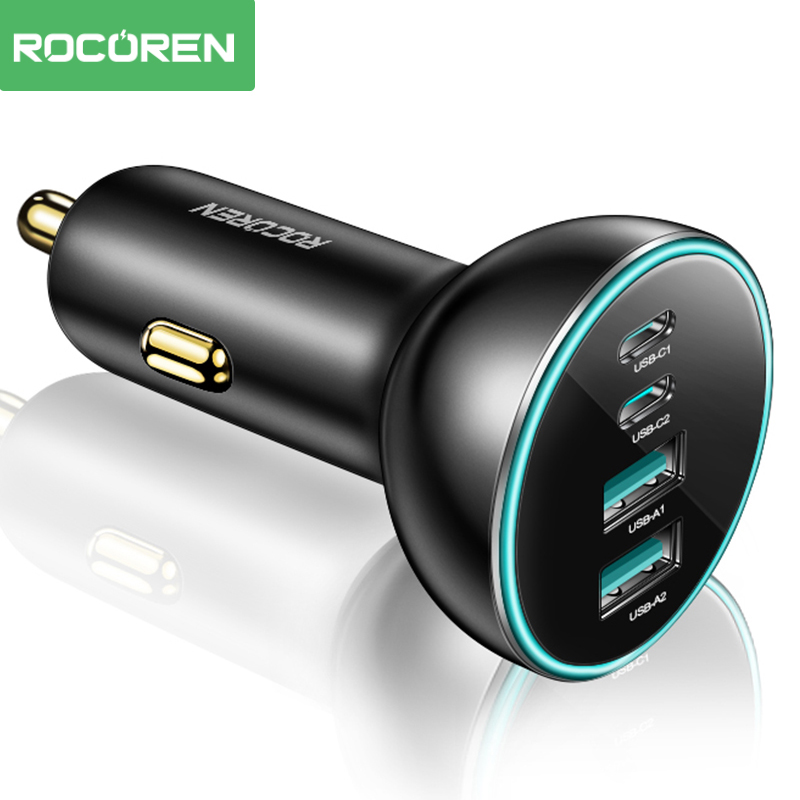
105W 6-Port
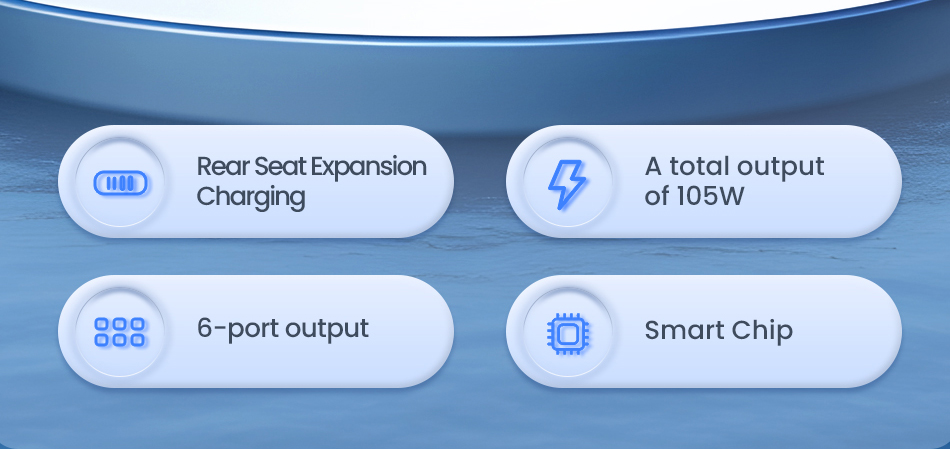
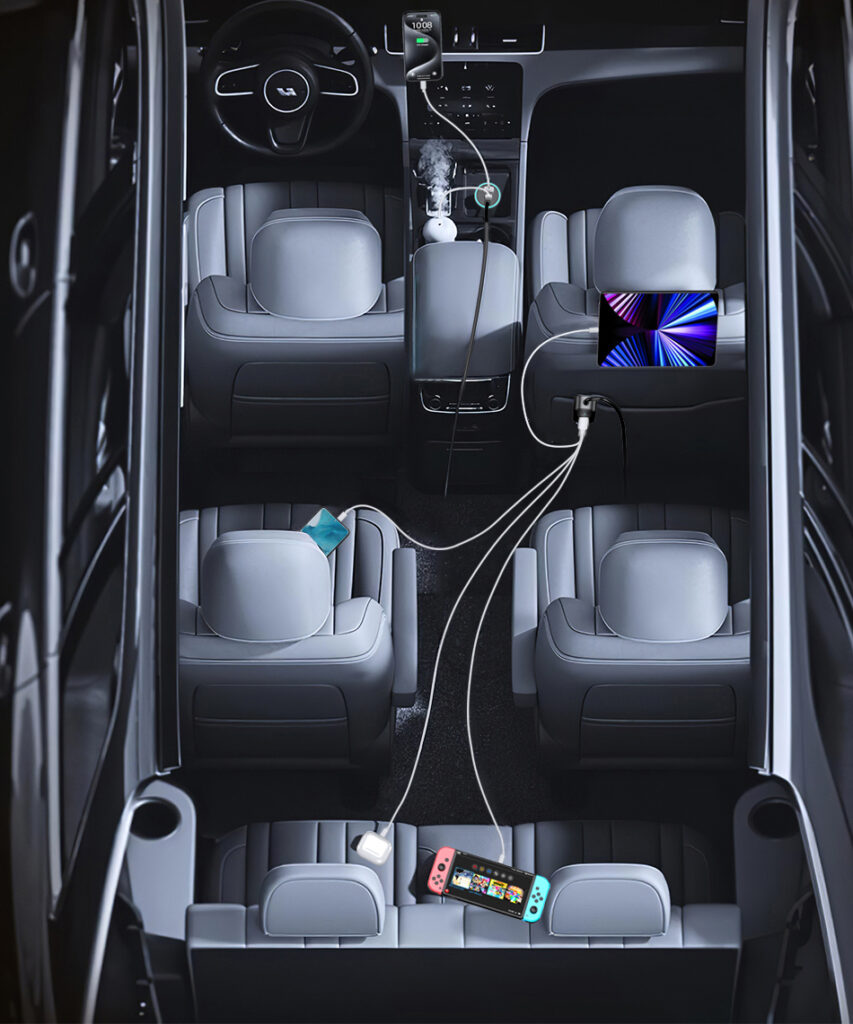
A front head sits in the 12V socket, and a 5-foot (1.5 m) cable runs to a rear-seat station, giving three USB-C and three USB-A ports in total. Each USB-C port is rated up to 35W and each USB-A port up to 30W, with the combined output capped at 105W. It supports every protocol in the glossary above.
Rocoren’s own marketing says an iPhone 16 reaches 60% in half an hour with it. That is a brand claim I have not verified. Our full verdict on the Rocoren 105W 6-Port Car Charger goes through its ports, protocols and safety features in more detail.
A bundle pairs the same 105W charger with six magnetic cable clips, for anyone who has settled on that model and wants tidier cords.
135W Multiple Ports
Six ports again, but two retractable cables replace the single fixed cord. Power splits into 60W combined for the driver’s side and a further 75W at the rear station. It suits anyone who would rather not have a loose cord lying across the back seat.
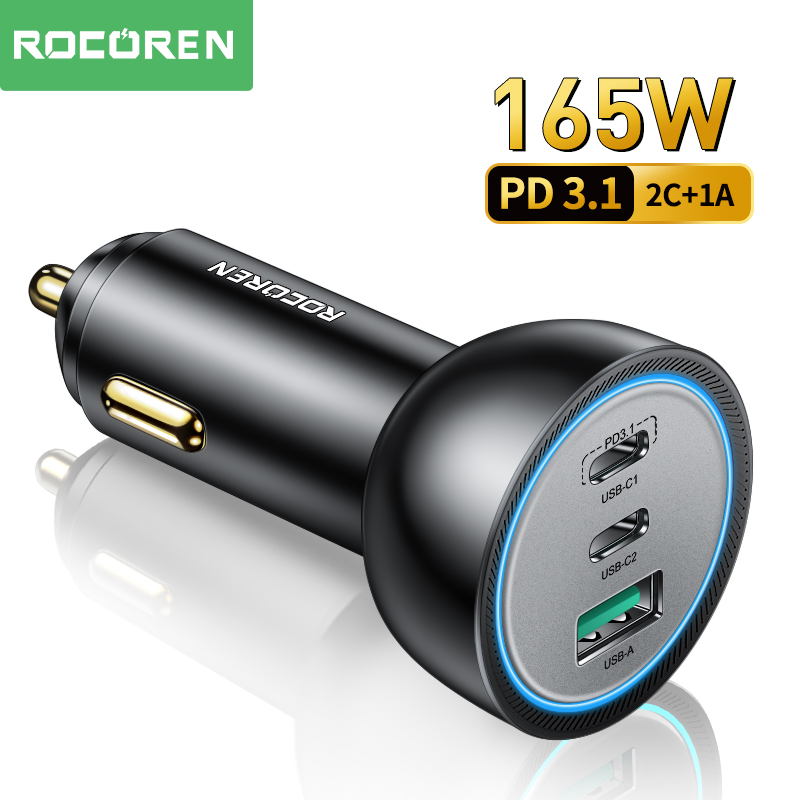
165W PD 3.1
Two USB-C ports and one USB-A port, with the main port rated up to 140W. It is the only model in the range with the headroom to power a USB-C laptop as well as a phone or tablet, while the other two ports handle a phone and a USB-A device together.
Matching a Model to Your Drive
Start with how you drive, then work back to a model. The table gives the short version, and the notes after it give the reasoning.
| Your situation | Best fit |
| One phone, mostly solo drives | 36W or 30W entry model |
| Phone plus dash cam up front | 70W with two USB-C and two USB-A |
| Passengers in the back seat | 105W 6-Port, with the 135W as the retractable-cable option |
| A laptop that needs power on the road | 165W PD 3.1 |
A solo commuter with one phone
Six ports would go to waste. The 36W Double Port or the 30W Pudding Series covers a single phone, and both are small enough to stay plugged in without crowding the cup holder or the console.
Two devices up front
The 70W ZhongXiang is built for this. Its two USB-C and two USB-A ports let a phone charge while a dash cam or another accessory runs from the same socket, and there is no rear cable to manage.
Family trips and regular passengers
The 105W 6-Port is aimed at this situation. The front unit serves the driver, and the 5-foot cable feeds a rear station that adds a further pair of USB-C ports and a further pair of USB-A ports, so back-seat passengers have ports of their own. If a cable across the rear floor bothers you, the 135W variant with retractable cables is the alternative. The 105W sits mid-range in the lineup, between the compact 70W and the 165W laptop model.
You can see which of these models are currently listed on Rocoren’s storefront on Amazon, and check the current price on Amazon for the one you pick.
Laptop charging on the go
For a laptop, Rocoren’s pick is the 165W PD 3.1 charger, which has one USB-C port rated up to 140W plus two more ports for a phone and a USB-A device. The mid-range models do not offer a port with that much headroom, and within the range only this one is meant to stand in for a dedicated laptop charger.
USB-C versus USB-A
Phones generally reach their fastest charging over USB-C. USB-A stays on every Rocoren car charger model because older cables, dash cams and other accessories still use that connector.
If your devices are already USB-C, lean toward a model with more USB-C ports. If you still keep USB-A cables around, a mixed model such as the 70W or the 105W lets you use both without replacing any cables.
One check before any purchase
Whichever model you pick, it depends on a 12V socket that holds firm contact. A loose, worn or intermittently powered socket will not be fixed by more wattage. If you have had charging trouble before, plug a basic device into the socket first, so a new charger does not take the blame for an old problem.
Rocoren Against Anker
Anker is a long-established name in charging gear, which makes it a natural point of comparison. The two brands overlap less than that suggests.
On their higher-end models, both support the main fast-charge standards: PD, QC and PPS. Certification is where the lists differ in breadth. Rocoren lists FCC, CE and RoHS for its car chargers, while Anker’s compliance documentation is broader and its safety testing history longer.
Product focus differs more. Anker’s six-port 200W Prime Charger is a wall unit for a home or office, and its car models have one or two ports, like the PowerDrive III Duo. Rocoren’s 105W and 135W models fill a space Anker mostly leaves alone: a car charger that shares its ports across the front and rear seats.
Support is where the two part ways most clearly. Anker lists an 18-month warranty on the PowerDrive III Duo, with a dedicated team and a formal replacement process behind it. Rocoren’s official site gives no warranty length and points people to an email address and WhatsApp, not a warranty portal. For anyone who values a documented return process, that is a real difference.
In short, a documented warranty and a longer track record favor Anker for a charger you will use daily. A front-and-rear port split, together with comfort about a smaller support team, favors Rocoren, which is worth considering on those terms.
Spotting a Genuine Rocoren Charger
A brand name in a listing title does not make a product Rocoren’s, so a few checks are worth making before you rely on a charger.
Start with the official storefront
Rocoren has an official storefront on Amazon under its own name. Items sold by that store, rather than by a third party using similar photos, are the surest route to a genuine unit with working support. Bookmark Rocoren’s storefront on Amazon instead of searching for it each time.
Check the seller, not just the photos
Photos can be reused by other sellers, so look at who is actually selling. What counts is that Rocoren appears as the real seller or brand and not merely as a word in the title. A “Visit the Rocoren Store” link near the product title is the thing to look for, and a seller name made of random letters deserves extra care.
Confirm the markings on arrival
Rocoren lists FCC, CE and RoHS for its car chargers, so those marks should be printed on the body of the unit. If none are visible, contact the seller before relying on the charger every day. Compare the ROCOREN wordmark on the unit and the box with the logo on the brand’s site, too. Blurry lettering, a misspelling or an oddly placed logo can point to a mislabeled unit.
Other retailers
Rocoren also lists select products on Walmart’s marketplace and on its own site, rocoren.com, and occasionally on eBay. Whichever store you use, confirm that the seller is Rocoren itself or an authorized reseller and not an anonymous third-party account. On eBay, read the condition note closely so you know exactly what is being sold.
Care Habits That Help It Last
Vibration, temperature swings and a socket never built for heavy daily use make a car a tough place for electronics. Four habits help.
Manage the rear-seat cable
On a multi-port model such as the 105W, the 5-foot rear cable takes the most physical strain, because it can be stepped on or caught in a door. The back-seat clip that comes with it holds the cable in place and keeps it off the floor.
Keep it out of direct summer sun
On a hot day a parked car’s cabin can climb well past 60°C (140°F), and repeated heat cycles are hard on electronic parts. If the car will sit in strong sun for hours, pulling the charger out first is a simple precaution that takes a few seconds.
Keep the ports clean
Dust and debris can collect in USB ports over months of use, particularly near a cup holder. An occasional puff of compressed air or a pass with a dry cotton swab keeps the contacts clean. These habits suit every model, because they deal with vibration, heat and dust and not with one charger’s design.
Test the socket first
If a charger seems dead, try it in another socket or another car before assuming it is faulty. The contact inside a 12V socket can loosen in an older or heavily used vehicle, causing an on-and-off connection that looks like a charger fault. If the charger works elsewhere, the socket is the culprit.
Returns, Warranty and Support
Rocoren’s official site gives no warranty length, while a larger brand such as Anker lists 18 months on some models. In place of a published policy, Rocoren offers direct contact by email at [email protected] or on WhatsApp. That reaches the team, but it is not a self-service portal.
Purchases made on Amazon fall under Amazon’s own return policy. For most electronics that Amazon sells and ships, the usual window is 30 days from delivery for items in original, unused condition, and your order page confirms the terms for a given purchase.
Hold on to the packaging until the charger has proven itself across several trips. A charger that looks dead in one vehicle may work in another, so try a second socket before you start a return.
Whether Amazon or a third-party seller fulfilled the order, the return goes through Amazon’s return system, and your order page shows the options for that purchase.
Frequently Asked Questions
What is Rocoren?
It is a label for charging gear, with car chargers, wall chargers, power banks, cables and wireless chargers in its range. The company that owns it has worked in charging and electronics distribution since 2017.
Is Rocoren a legitimate brand?
The brand cites UKCA, UL, FCC, RoHS and CE certification across its products. A list like that cannot promise that every unit is flawless, and the marks are shown per product page, so check the exact model before you buy.
Does it work in trucks and SUVs?
Rocoren rates the 105W model for 12V to 24V vehicle systems, a span that takes in cars, SUVs and trucks.
Are Rocoren and ROJECO the same company?
No. A single parent company stands behind both, yet ROJECO sells pet products and debuted in 2020, whereas Rocoren is a distinct electronics label that arrived between 2021 and 2023.