Shop for a lithium battery for a van, boat or backup rig and the model names read like code. A listing might say 12V 314Ah 200A Mini Bluetooth, or 51.2V 100Ah wall-mount, or 48V 12kW inverter. Add a catalog that runs from a tiny 20Ah pack to a 628Ah Ultra, and it is easy to buy too much, too little or the wrong kind.
This guide uses WattCycle as its running example. It is a direct-to-consumer brand that sells LiFePO4 batteries at prices well below the premium names. Below you will find what the chemistry means, how to read a model number, which size fits which job, how WattCycle stacks up against Battle Born, how to look after a battery and what to know about warranty, returns and sellers.
It is research, not a hands-on report. The figures come from the brand’s product and policy pages, and the views on build quality and support come from independent reviewers. I mark a number as a claim when it is one, and I leave out anything I couldn’t confirm.
What WattCycle Sells
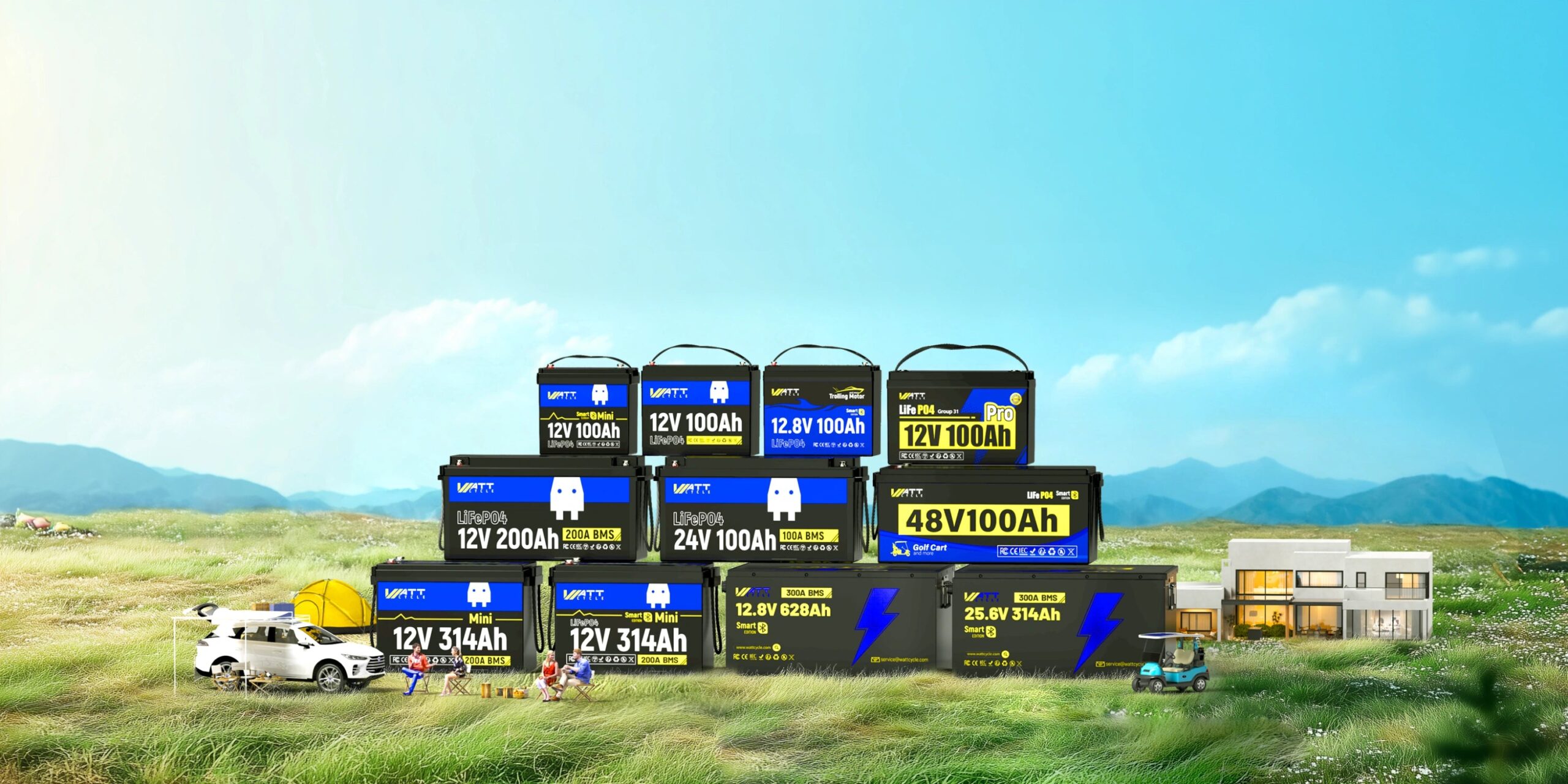
WattCycle’s core range is LiFePO4 batteries at 12V, 24V and 48V. The smallest is a 20Ah pack, and the 12V 628Ah Ultra is the biggest single 12V unit in the lineup.
Beyond the batteries themselves, the catalog includes wall-mounted and rack-style home storage units, all-in-one solar inverters rated up to 12kW, and chargers, cables and monitors. One brand can supply a whole system.
Pricing follows capacity. Most 12V models run from about $70 to $650, and WattCycle’s 100Ah batteries sit in roughly the $200 to $300 range. Its stated pitch is Grade-A cells and a built-in battery management system, with core specs close to the premium names at a fraction of their price. Check the current price at WattCycle before you buy.
The full range is on WattCycle’s own store, and the link opens in a new tab.
The Brand Behind the Batteries
Anyone hoping for a founder story will find little. WattCycle’s about page gives no founding year, no founder’s name and no headquarters city. It offers a mission about making dependable power affordable for everybody, plus the tagline "Built on Grit, Fueled by Freedom," which speaks to off-grid and adventure buyers.
The contact page is more revealing. Support questions go to a US phone number, while wholesale inquiries are routed to a separate mainland China number. Read together, that looks like a brand that builds overseas and sells directly to buyers on its own site.
Independent reviewers who have dealt with support describe the practical result. Orders mostly leave US warehouses, so delivery is quicker than overseas manufacturing might suggest, while technical help comes from an email team abroad. Selling direct also skips retail markup, which helps explain the low prices.
WattCycle lists ECE R10 and ECE R57 certification on selected batteries. Its 12kW inverter lists UL 1741 testing through Intertek (ETL) along with UL1973 and FCC Part 15 Class B compliance. These count as outside testing standards rather than in-house claims, so check the relevant product page to see which ones apply.
The Tech in Plain English
LiFePO4 versus lead-acid
All WattCycle batteries use lithium iron phosphate chemistry, shortened to LiFePO4. Set against lead-acid or AGM, the chemistry is generally described as longer-lived and lighter, often about one-third of the weight at the same capacity. It also copes with sitting partly charged, which slowly wears lead-acid out.
Price used to be the catch, and narrowing that gap is what WattCycle’s pricing is aimed at.
BMS tiers
Each WattCycle battery has a battery management system (BMS) built in, and the brand grades it in three tiers.
| Tier | What it adds |
| Standard | Basic protection cutoffs for overcharge, over-discharge, short circuits and temperature |
| Active Balancing | Extra circuitry that keeps the individual cells level while the pack charges and discharges |
| Ultra | The top tier, aimed at WattCycle’s largest-capacity batteries |
Balancing counts for more as a pack grows and racks up cycles. If the battery works every day, as in an off-grid solar bank, look at the tier. For standby backup that rarely cycles, it counts for less.
Bluetooth
Models with Bluetooth in the name pair with a phone app that reports voltage, remaining capacity and cell balance. That can replace a gauge on the dash or a standalone monitor.
The app is a convenience rather than a safety feature, because the non-Bluetooth models carry identical core protections. Treat it as an extra, not the reason to pick a model.
Self-heating
Charge LiFePO4 cells while they are frozen and they can be permanently harmed. WattCycle’s BMS deals with this through a low-temperature sensor that shuts the charging port in the cold. The battery stays protected, but it will not charge until it warms up.
WattCycle’s self-heating models take another route. They warm the pack from the inside so charging can carry on in cold weather. If your mornings regularly fall below freezing, that is the feature to weigh against the extra cost of a self-heating version over a standard Mini.
Reading Watt-Hours and Model Names
A WattCycle model name packs the specs into one string, in a fixed order: voltage, then capacity, then the BMS current rating, then case style and extras. Take 12V 314Ah 200A Mini Bluetooth as an example.
- 12V is the voltage.
- 314Ah is the capacity in amp-hours.
- 200A is the current rating of the BMS.
- Mini is the compact case style.
- Bluetooth means app monitoring is included.
None of this vocabulary is unique to WattCycle. The wider LiFePO4 trade uses the same labels, so a model name from a pricier brand can be read the same way.
Of those numbers, only voltage and capacity set your runtime. Amp-hours alone say little until you know the voltage. Multiply the two and you get watt-hours, which is what decides how long your devices run. WattCycle’s 12V 100Ah battery works out to roughly 1,280Wh usable, and its 12V 314Ah battery to roughly 4,000Wh.
Work backwards from your loads. For each device, watts times hours of daily use gives its daily watt-hours, and the sum of those is the figure the battery has to cover.
Matching a Battery to Your Setup
Small electronics and backup lighting
Plenty of jobs don’t need hundreds of amp-hours. The 12V 20Ah and 50Ah models suit small electronics, backup lighting and light trickle use, where a big house battery would cost more than the job warrants. The 50Ah is about $120 at WattCycle.
Weekend RV or small van
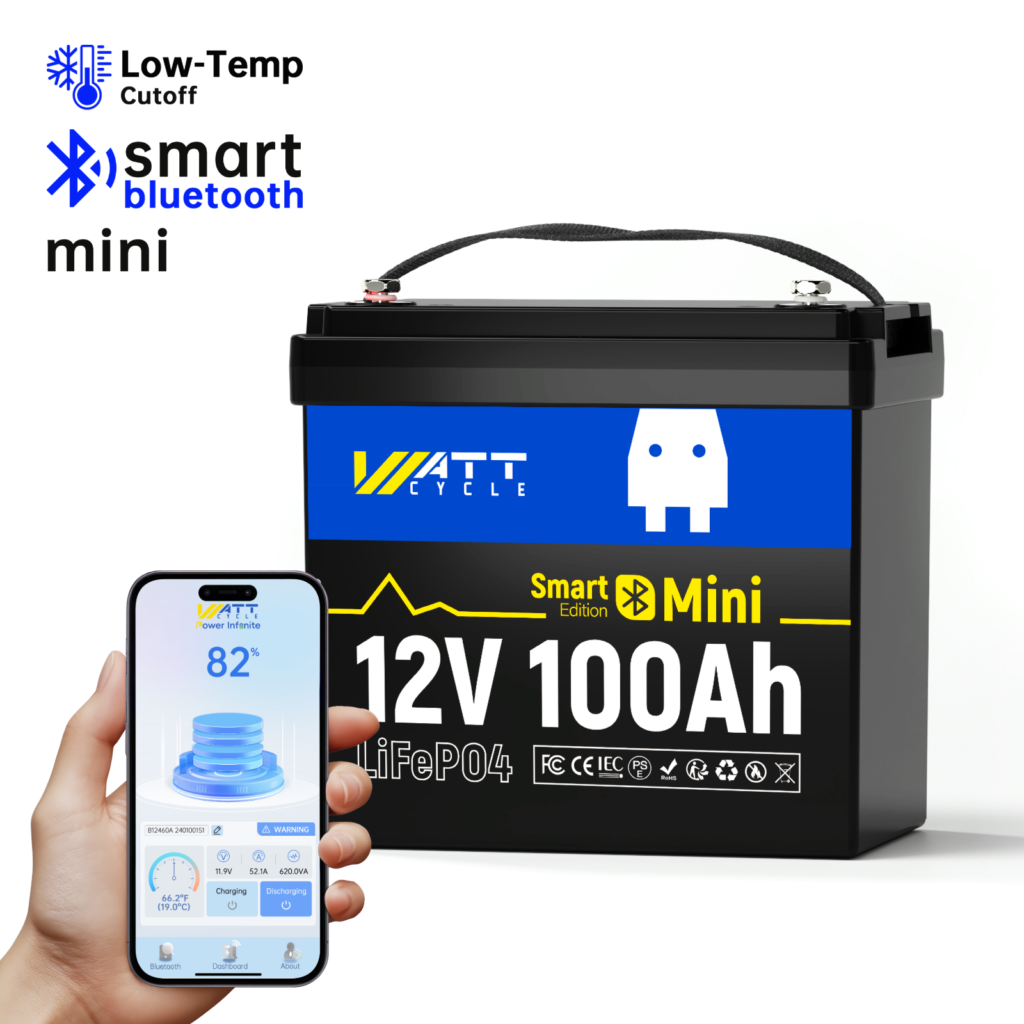
At 12V and 100Ah, the battery holds about 1,280Wh. As a rough guide, that can keep lighting, a fridge and phone charging going for a day or two before a recharge, though your own watt-hour total makes the call. The 12V 100Ah Mini Bluetooth costs about $220 at WattCycle and weighs under 25 lbs.
For a closer look at that model, read our full verdict on the WattCycle 12V 100Ah Mini Bluetooth battery.
Full-time van life and heavy loads
Living in the van or running something power-hungry like an induction cooktop points to the 12V 314Ah. It holds about 4,000Wh in a single unit, which saves wiring two 100Ah batteries in parallel. The 12V 314Ah Mini Bluetooth, with a 200A BMS, costs about $570 at WattCycle.
If your trips run cold, a self-heating version fits better, for the reasons covered above.
Boats and trolling motors
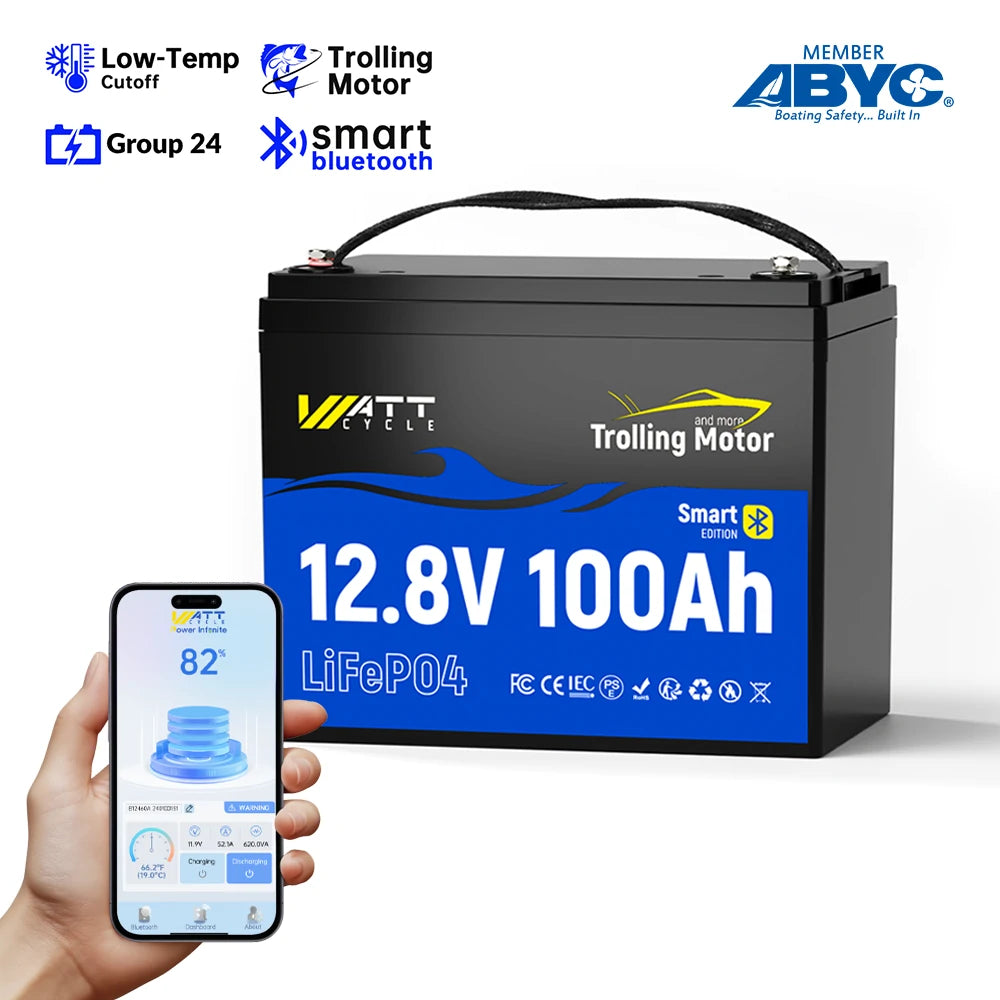
For trolling motors there is the 12V 100Ah TM Bluetooth, about $300 at WattCycle. A trolling motor pulls steady, high current, which is a different job from a house battery bank, so a purpose-built model makes sense.
If one battery must both run electronics and start the engine, look at the Truck Starter Dual Purpose model, which targets that mix.
Truck sleeper cabs
The 12V 314Ah Truck Starter Dual Purpose battery, about $650 at WattCycle, is built for semi-truck sleeper cabs, where it covers engine starting and house-battery duty together. A house-only pack isn’t designed to crank an engine, which is why this separate model exists.
Home backup and off-grid solar
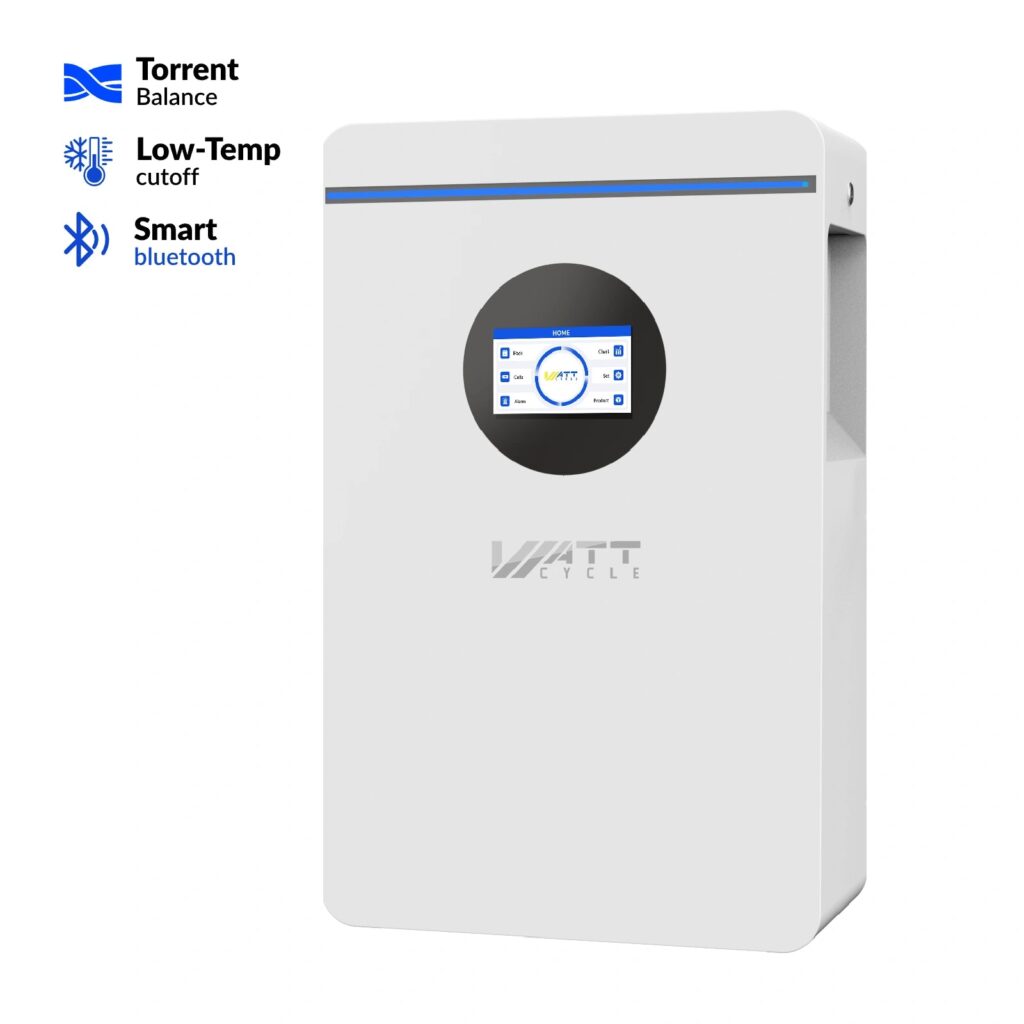
Backing up part or all of a home means stepping up to WattCycle’s 48V range. The wall-mounted and rack-style batteries pair with its all-in-one solar inverters, which scale up to 12kW and can be linked in parallel for bigger systems.
The 51.2V 100Ah wall-mount battery stores 5,120Wh with active cell balancing and is the entry point to the home storage line. The 48V 12kW all-in-one inverter delivers 12,000W of split-phase output with 24kW of dual MPPT solar input, and up to six units can be paralleled for a 72kW system. Prices on these two move around, so check the current price at WattCycle.
Either one is a bigger step than buying a single 12V battery, so go through the complete spec sheets for the battery and inverter before choosing.
How It Compares With Battle Born
Battle Born, a premium LiFePO4 maker that assembles in the US, makes a useful yardstick for a budget pack. Here is how the two line up.
| WattCycle, 100Ah class | Battle Born, comparable 100Ah | |
| Price | Roughly $200 to $300 | Typically $800 to $900 |
| Assembly | Made overseas, sold direct | Assembled in the US |
| Cold charging | BMS blocks charging below freezing; self-heating models warm the cells | Rated to charge down to 25°F |
| Cycle life | 4,000-plus, per independent reviewers | Typically 3,000 to 5,000 |
| Support | Overseas email team | Mature US-based network |
The price gap is the first thing you notice. The comparable Battle Born pack costs three to four times as much as a 100Ah WattCycle, for the same capacity class.
Where does the money go? Battle Born assembles in the US and has a support network that took years to build. WattCycle builds overseas and sells straight to buyers, the main reason its prices are lower. Even so, teardowns by independent reviewers describe construction they put alongside packs costing about three times as much.
The two handle cold in different ways, and each approach protects the cells. Battle Born rates its batteries to charge down to 25°F. WattCycle instead blocks charging below freezing, and its self-heating models warm the cells so charging can continue.
On cycle life, independent reviewers put WattCycle above 4,000 cycles, though the brand shows no official cycle count on its own site. Battle Born’s typical figure is 3,000 to 5,000 cycles, which works out to about seven to ten years of normal use. On paper the two look similar, and the WattCycle number is a reviewer estimate.
WattCycle takes the value argument by a wide margin, while Battle Born holds the edge on support and track record. On a tight budget, with slower email replies acceptable, WattCycle is a hard pick to fault.
Charging, Storage and Care
Looking after a LiFePO4 battery takes less effort than lead-acid, but it isn’t zero. Some simple routines separate a battery that reaches its rated cycle life from one that fades early.
Park it half-charged. For an off-season RV or boat, leave the battery at roughly 40 to 60 percent charge instead of full or flat. Months sitting at 100 percent speed up wear, while a fully drained pack can trip the BMS into deep-discharge protection. Look in every couple of months and top it up.
Respect the cold cutoff. Below freezing the BMS stops charging to protect the cells. If your camping, travel or work takes you into freezing weather, a self-heating model is the way around it.
Tighten and clean the terminals. Independent teardowns praise the thick wiring inside the case, but that only helps if the outside connections are torqued properly and kept clean. Terminals that are loose or corroded waste voltage and make heat, however good the inside is.
Match the charger. WattCycle’s chargers cover about 14.6V to 58.4V, with the right one set by your battery’s voltage. A charger meant for lead-acid or AGM can undercharge a LiFePO4 pack or trip the BMS protection for no good reason.
Glance at the app. On Bluetooth models, cell balance and voltage show up without opening anything. A drifting voltage or an uneven cell is easier to catch early that way than after runtime has already shrunk.
Warranty, Returns and Support
Coverage starts with registration. WattCycle’s registration page says registering switches the coverage on and eases later support and claims, so do it the day the battery arrives, not after something goes wrong.
The standard warranty on WattCycle’s LiFePO4 batteries is 5 years. A longer 7-year term applies to new batteries rated above 50A, which the registration page presents as an upgrade for WattCycle customers.
For returns, WattCycle promotes a 30-day refund window on eligible orders. Who qualifies, whether a restocking fee applies and how to begin sit on its Return & Refund policy page, which the warranty registration section links to, and the details may vary by product category.
WattCycle lists support as open 24/7 by email, by a US phone number and on WhatsApp for international customers. Bulk and wholesale questions use a different email address. Reviewers note that routing through an overseas team makes email replies slower than from a domestic call center, though they add that the brand tends to resolve problems in the end.
Buying From the Right Seller
The straightforward route is WattCycle’s own site. Buying there ties your order to WattCycle’s own records, and that counts because both warranty registration and support depend on proof of your original purchase.
If you buy anywhere other than WattCycle’s own site, make sure the seller is authorized. The seller name should clearly match WattCycle, not a reseller that merely put the brand name in a listing title. A name that doesn’t line up is a red flag.
This is general advice for import brands that sell direct, and it isn’t a response to any reported WattCycle counterfeits. Batteries are higher-ticket items, which is the kind of product gray-market resellers favor. A battery from an unauthorized seller may lack the paperwork the warranty process needs, which can void the cover you assumed you had.
To go straight to the source, shop WattCycle’s own store, which opens in a new tab.
Frequently Asked Questions
Is every WattCycle battery LiFePO4?
Yes. The chemistry is lithium iron phosphate throughout, from the 12V line to the 48V line.
Does every model have Bluetooth?
No. App monitoring belongs to the models with Bluetooth in the name. The others have the same basic protections but no phone link.
Can a WattCycle battery start an engine?
Not the general house-battery models, which aren’t built for cranking. For starting plus house duty, WattCycle makes a purpose-made 12V 314Ah dual-purpose battery.
How big does a WattCycle battery get?
The biggest single 12V battery is the 12V 628Ah Ultra Bluetooth. For more capacity, the 24V and 48V lines go further, including home storage batteries and inverters wired in parallel.
Where do orders ship from?
The batteries are made overseas, but reviewers who have dealt with support say most orders leave US warehouses. Technical help still comes through an overseas email team.
How do I register the warranty?
Use the registration page on WattCycle’s website once the battery arrives. That step is what switches your coverage on.
If you are still deciding, start with the watt-hour estimate, match it to the setup that fits you, and register the warranty the day the battery arrives.