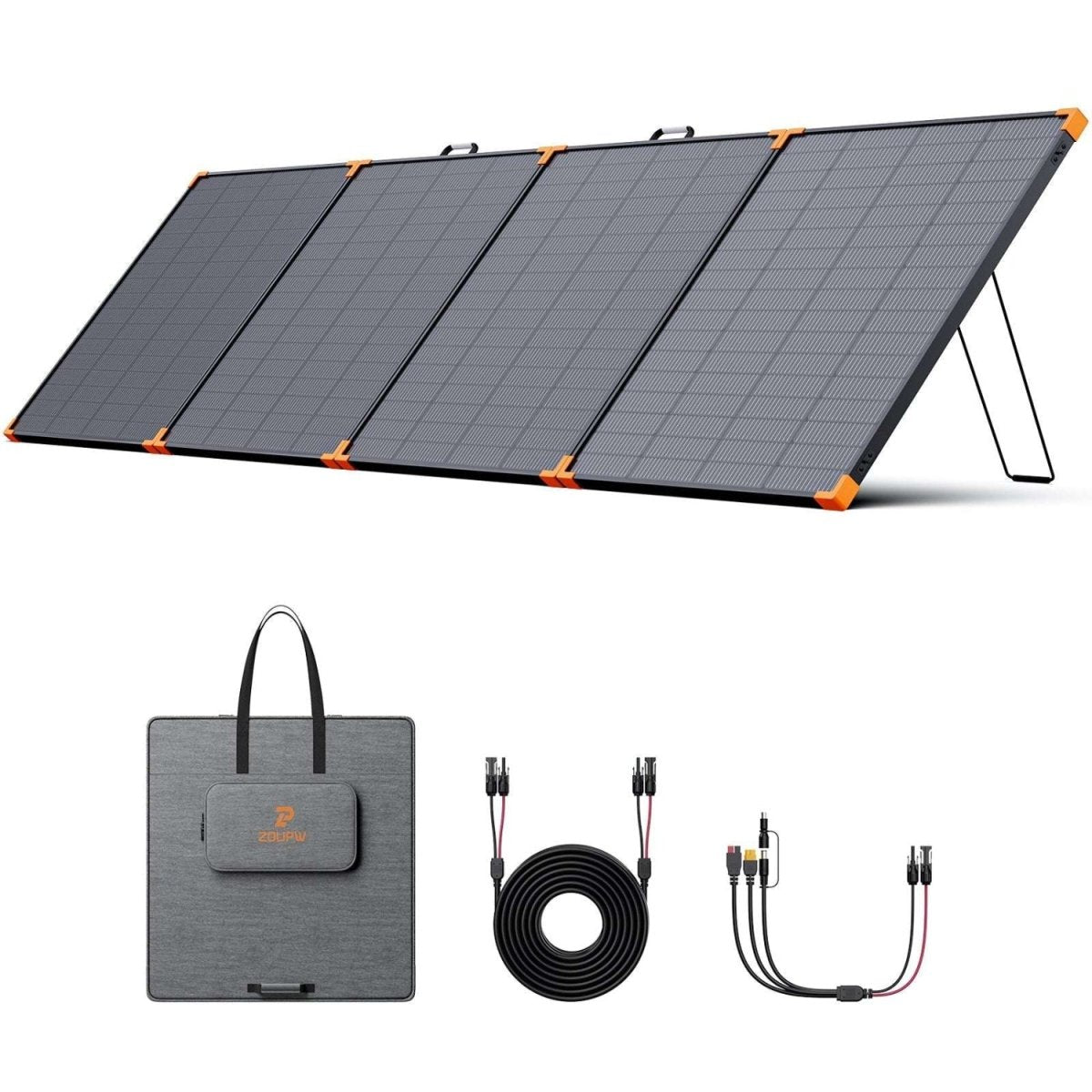
A 450-watt foldable panel at around $500 sits well below premium-brand pricing, which raises the obvious question of what was cut. This model has an independent outdoor test and more than 100 reviews on the brand’s own store behind it, so there is real evidence to weigh.
This is a research-based look, not a hands-on test. It draws on ZOUPW’s spec sheet and policy pages, set beside what an independent reviewer measured outdoors.
The short version: it is a reasonable value for a large foldable panel that reached its rated output in strong sun, as long as you confirm the warranty tier before you order.
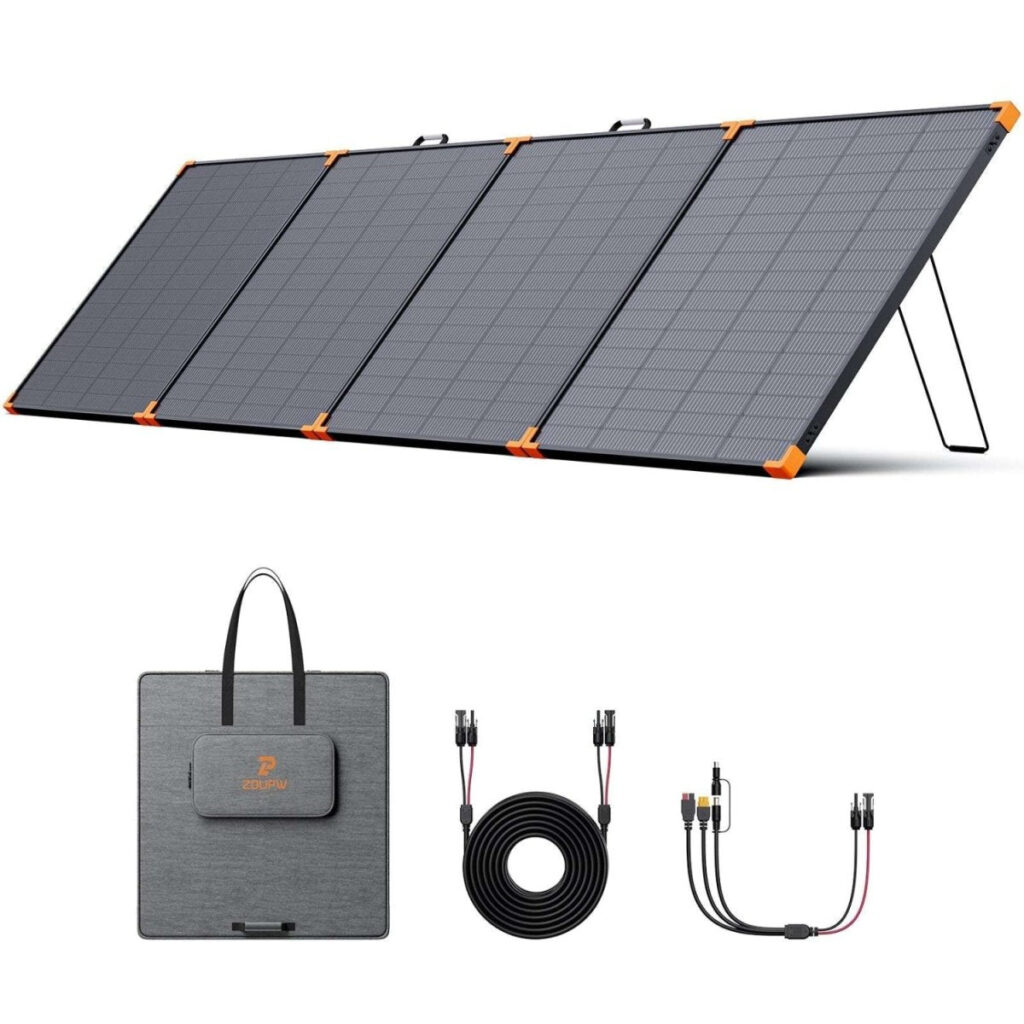
What the 450W Panel Is
ZOUPW makes solar panels and small charging accessories rather than power stations. The 450W belongs to its foldable line, aimed at campers and RV owners who set up and pack away often.
- Cells: N-Type 16BB monocrystalline, rated up to 25% efficiency.
- Build: anodized aluminum frame, ETFE-coated surface and reinforced polycarbonate hinges.
- Weather rating: IP68.
- Unfolded size: 121.85 by 34.57 inches.
- Folded size: 30.43 by 34.57 inches.
- Weight: 26.8 lbs.
- Max power voltage: 38V.
- Connectors: a 4-in-1 set covering MC4, XT60, Anderson and DC types.
- Price: about $500 at ZOUPW.
According to an independent reviewer, the panel is roughly 20 to 30% lighter than rigid panels of similar power, which counts for a lot if you carry it often.
Three terms from that list are worth decoding. N-Type refers to the semiconductor used in the cells. In 16BB, the BB counts busbars, which are fine metal lines that gather current, and more of them generally mean less power is lost inside the cell. ETFE is the lightweight film over the surface, and it is part of why a foldable panel packs down small.
ZOUPW’s own site lists this panel at about $500, and you can browse ZOUPW’s panel range at ZOUPW, which opens the brand’s homepage.
What Testers and Owners Report
An independent reviewer put the panel through outdoor testing in southwestern New Mexico and recorded its full 450W rated output on sunny days. Readings stayed above 400W whenever solar irradiance passed 800 W/m².
That reviewer had owned earlier portable panels and used them as a yardstick. By their account, this one out-produced similarly sized units and was easier to set up and pack away.
On ZOUPW’s own store, the 450W has more than 100 reviews. The store’s reviews page shows about 95% five-star ratings across roughly 500 ratings for the whole catalog, and the recurring praise is for output above the rated wattage, quick folding and a sturdy build.
Because those reviews sit on the seller’s own site, the independent measurement carries more weight here. Treat the store reviews as supporting evidence, not proof.
Fit With Your Power Station
Two numbers on your power station decide what a 450W panel can really deliver. The first is its maximum solar input. A station capped at 300W takes 300W at most, so a bigger panel leaves the rest unused. Check the station’s spec sheet before you pay for extra panel.
The second is voltage. Every station has an input ceiling, and the panel’s open-circuit voltage has to sit under it. Chain panels in series and their voltages add up, so recheck the limit whenever you expand the array.
The bundled connector set covers MC4, XT60, Anderson and DC types. ZOUPW’s compatibility list names EcoFlow, Jackery, Bluetti and Anker stations, along with Pecron, Goal Zero and BougeRV, plus UGREEN, OUPES and FlashFish.
As a rule of thumb, stations under 500Wh pair with 100W to 200W of panel. Stations from 500Wh to 1,500Wh pair with 200W to 300W. Large stations, RVs and off-grid setups pair with 300W to 480W.
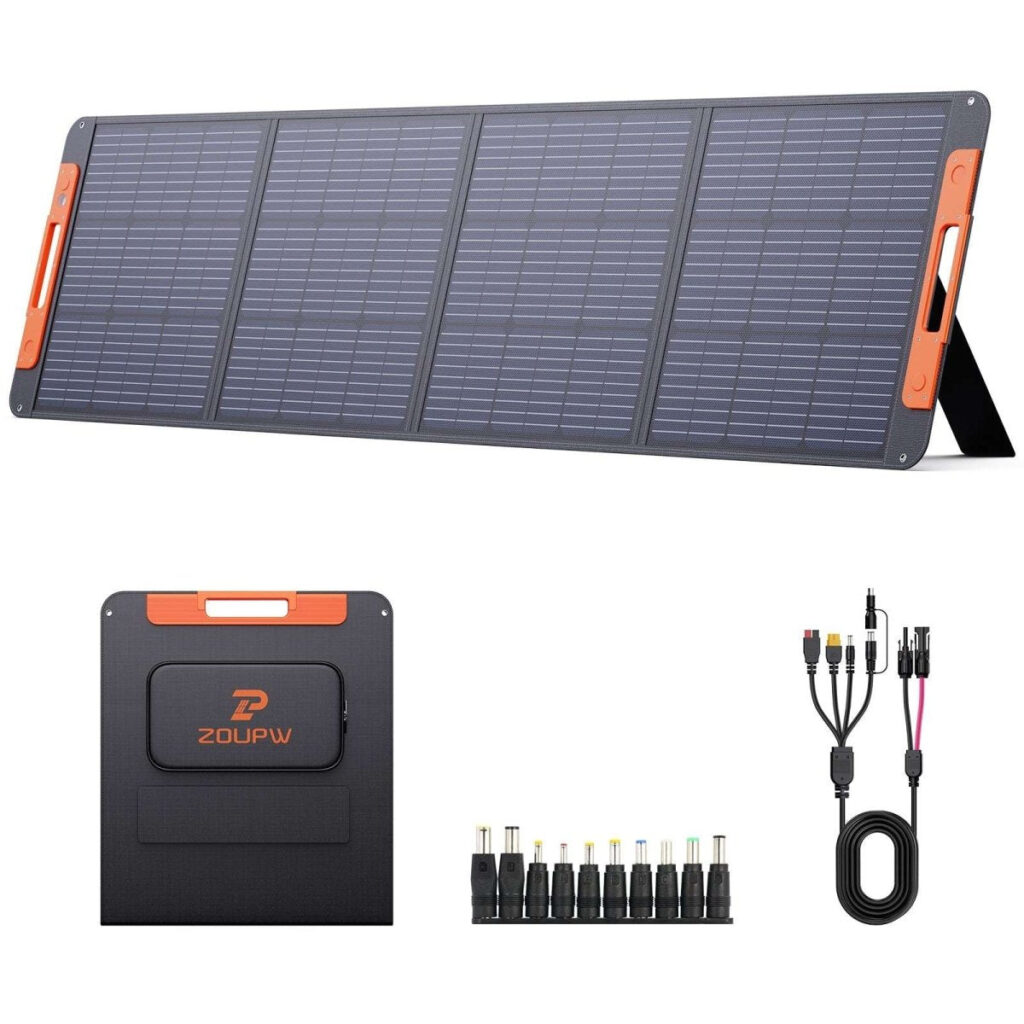
By that rule the 450W sits at the large end. It fits a big station, an RV or a cabin setup that can absorb the output, while smaller stations are better matched to ZOUPW’s 200W model, pictured below.
How It Compares
Begin with ZOUPW’s own lineup, where results differ. An outdoor-gear test measured the 200W foldable at 144W, about 72% of its rating, and ranked it tenth among twelve panels. The same test flagged weak performance in wind and slower deployment than costlier rivals, while crediting the included adapters and the low cost per watt.
| Panel | Measured output | Share of 200W rating |
| Renogy 200W Portable | 177W | about 89% |
| Jackery SolarSaga 200 | 171W | 86% |
| ZOUPW 200W Foldable | 144W | 72% |
The 450W did better in its own independent test, reaching its full rating. That makes two tests and two outcomes: one ZOUPW panel fell short of its label and another matched it. Two data points do not make a pattern, so read each model on its own evidence.
On price, the independent reviewer’s comparison found the 450W typically costs $100 to $200 less than Jackery and EcoFlow panels in the 400W-plus class, while matching its rated output in testing. The trade-off is warranty length. One year is the common term on ZOUPW’s foldable line, and some premium brands include several years on flagship panels.
For more power, ZOUPW’s 480W bifacial panel costs about $650. The brand says the bifacial design can add up to 30% extra rear-side power, though the gain depends on how you mount it. Pale sand, snow or a light tarp under the panel reflects more light than dark grass or asphalt.
Who It Suits and Who Should Skip
It suits you if you run a mid-size or large power station, travel in an RV, or want backup power for a cabin and prefer not to pay premium-brand prices. It also fits anyone who sets up and packs away often, since folding is the point of the design.
Skip it if your station’s solar input is low, because you would pay for headroom you cannot use. Skip it too if the panel will stay in one spot for good, such as on a roof or a boat. ZOUPW’s rigid N-Pro line is meant for that job and carries a 10 year warranty.
One caution concerns the brand itself. ZOUPW’s site gives no founder, founding year or headquarters, so there is no company history to weigh. The hardware, the test data and the written policies are what you can evaluate.
The kickstand is the main moving part on a foldable panel, so open and close it a few times when the panel arrives, and keep your order confirmation for any warranty claim. To see the range, visit ZOUPW’s store, which opens ZOUPW’s own site.
Shipping, Returns and Warranty
- Shipping: free within the continental U.S. Orders take 1 to 5 days to process before they leave.
- Return window: 30 days from delivery on orders placed with ZOUPW. The item must be unused, unmodified and boxed with all its accessories, and you need a Return Merchandise Authorization number before sending it back.
- Who pays for returns: ZOUPW covers postage when an item arrives damaged, defective or wrong. If you simply change your mind, you pay postage and a 10 to 15% restocking charge applies.
- Warranty length: one year on most foldable panels, three years on metal-frame ETFE and bifacial foldables, ten years on rigid N-Type panels. The 450W has an aluminum frame and an ETFE surface, so ask ZOUPW which tier applies to your order.
- What the warranty covers: manufacturing and material faults, plus abnormal failures during normal use. Normal aging, accidents, misuse, repairs by anyone but the brand and water exposure beyond IP68 are excluded, and only the original purchaser is covered.
To make a claim, email [email protected] with the order number, the model, a description of the fault and photos or video. Shipping damage must be reported within 7 days of delivery. If you buy anywhere other than ZOUPW’s own site, the reseller’s rules apply instead of ZOUPW’s, so check that seller’s policies before ordering.
Frequently Asked Questions
Does the 450W panel really deliver 450 watts?
In the independent test it did, on sunny days, with output above 400W under strong irradiance. Real results still depend on sun angle and conditions, and a separate test found ZOUPW’s smaller 200W foldable well below its label.
Which power stations does it work with?
The list covers EcoFlow, Jackery, Bluetti and Anker, along with Pecron, Goal Zero and BougeRV, plus UGREEN, OUPES and FlashFish. Confirm your own station’s input wattage and voltage limits as well.
Is it waterproof?
The brand rates it IP68, which the research behind this page reads as sealed against dust and able to handle rain-level water. It is not described as a submersion rating, so keep it out of standing water and wipe it dry before folding.
What does the warranty cover, and for how long?
The length depends on the product type: one year for most foldable panels, three for metal-frame ETFE and bifacial foldables, ten for rigid N-Type panels. Ask ZOUPW which tier fits your exact model.
Can I return it?
Yes, within 30 days of delivery, provided you bought from ZOUPW and the item is unused and complete with its packaging and accessories. If you changed your mind, expect a restocking charge and your own return postage.
The Verdict
The ZOUPW 450W panel earns its place for one reason. Someone outside the brand measured it, and it delivered its rated output in strong sun. That kind of outside check is a good sign.
It is a good fit for a larger power station, an RV or a cabin, at about $500 at ZOUPW. It is a weaker fit for small stations, fixed installs, or anyone who wants multi-year foldable coverage by default.
My advice is simple. Match the panel to your station’s input limit, confirm the warranty tier for your order, and inspect the kickstand on arrival. When you are ready, see ZOUPW’s range at ZOUPW’s store, which opens ZOUPW’s own site.