INNOVV’s catalog rests on three kinds of motorcycle electronics: dash cams, CarPlay-ready smart displays and a radar-based blind spot system. Model names such as K7, N2 and ThirdEYE reveal little about which does what, and each line solves a different problem.
This guide sorts them out. It covers the brand’s background, what each line does, how to match a setup to the way you ride and how to look after the gear once it is bolted on. It also walks through returns, warranty and the safest places to buy.
Everything here comes from INNOVV’s published specs and policies, plus an independent long-term review of the K7 dash cam and owner feedback on the brand’s product pages. Where the brand makes a claim, the guide says so. Where information is missing, it says that too.
Who Is Behind INNOVV
Rock Liu started INNOVV in 2013 with a team of fellow riders. His earlier career was in packaging, at a German luxury company that INNOVV’s own history page puts at 150 years old.
In the brand’s telling, a motorcyclist he spoke with called riding the ultimate joy of life, and that remark set Liu on a new path. He recruited engineers who rode too, aiming at the safety technology he felt bikes were missing.
His argument was a gap in the market: cars had gathered cameras and driver-assist systems for years, but bikes, which leave riders with less protection and more risk, had almost nothing similar.
A timeline of firsts
Most of INNOVV’s milestones are billed as world firsts. Those labels are the company’s own, not independent rankings, so read them as marketing claims.
- Founding: 2013, by Liu and a team of riders
- Dash cams: the K1 in 2015, billed as the first dual-channel motorcycle dash cam with built-in GPS, then the K5 in 2021, pitched as a world first for 4K recording on two channels
- Blind spot radar: the first ThirdEYE in 2019, billed as the first ODM-built blind spot radar for motorcycles, and a third generation in 2023 upgraded to 77GHz radar
- Helmet cameras: the H5 in 2022, a 4K helmet camera system
- Newer lines: the K7 dash cam and the N2 smart display, which took the brand into CarPlay-ready screens
The stated mission
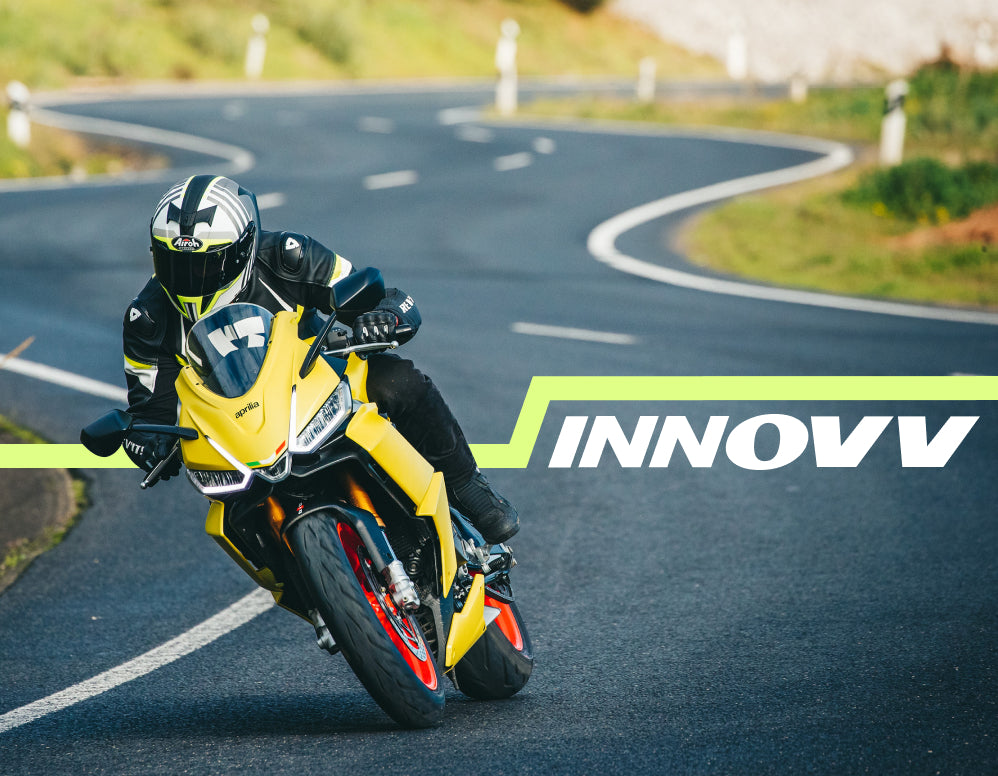
The brand’s tagline is Innovation in Motion, and its stated mission pairs the joy of movement with a safety-first approach to new technology. Slogans cost nothing, so it is worth checking what the products and policies actually deliver.
Two concrete choices stand out. The whole lineup carries an IP67 rating for dust and water, and the warranty on main products was lengthened from one year to two. Both are engineering and business decisions rather than wording.
What the company does not publish
INNOVV’s public pages give no headquarters address, no headcount and no manufacturing location. That gap is not unusual for a direct-to-consumer electronics brand, but it does mean outsiders cannot confirm who stands behind the products.
What you can verify is the product record: regular launches since 2013, IP67 across the range and a warranty that moved from one year to two.
Three Lines, Three Different Jobs
Decide first which problem you want solved, because each INNOVV line handles a single job and few riders need all three from the start.
K-series dash cams
A dash cam is your record of events after they happen. The K-series kits are front-and-rear recorders, and they begin recording by themselves whenever the bike is switched on.
The K7 shoots 2K from both cameras. The K6 keeps a 2K front camera and drops the rear to 1080P. The K5 pairs a 4K front camera with a 1080P rear one. Sony STARVIS sensors and an IP67 rating are common to all three.
N-series smart displays
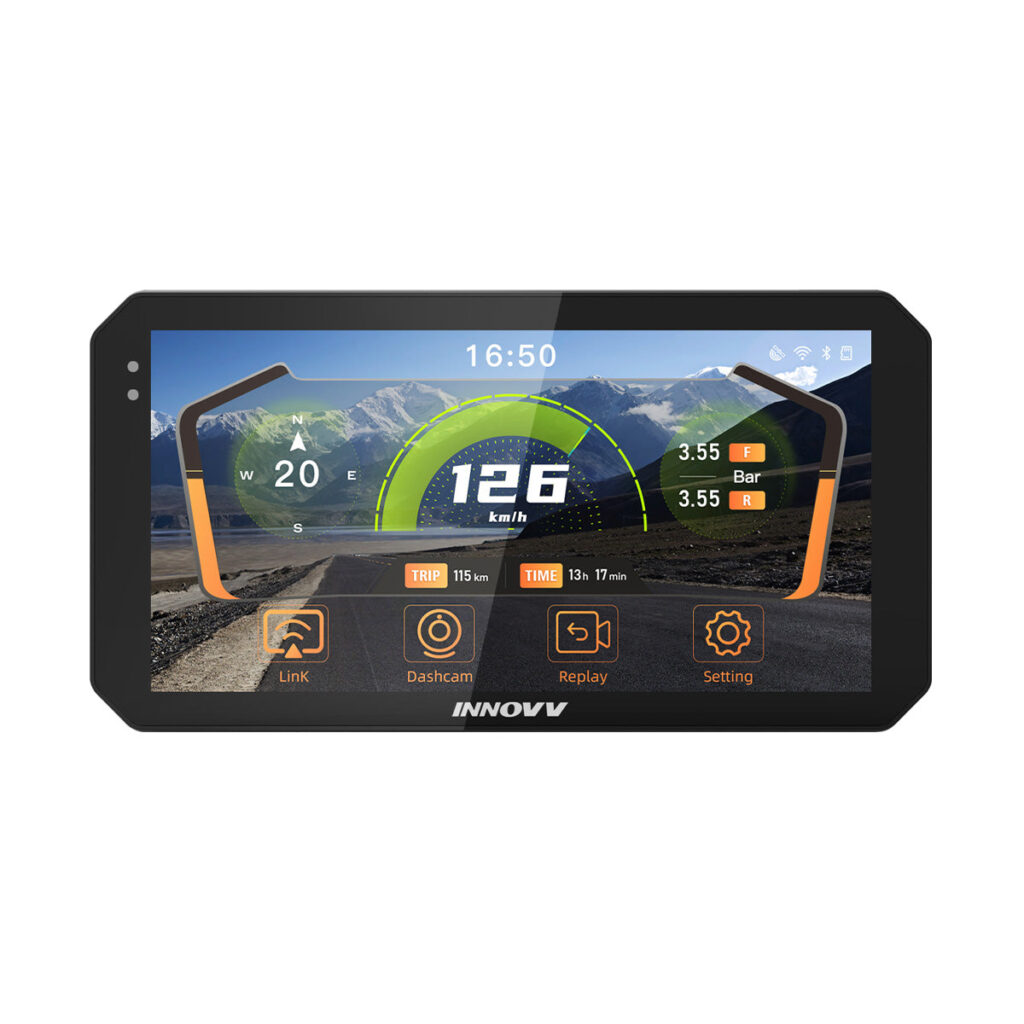
A smart display puts your phone’s navigation, calls and music right on the handlebars. Both the N2 and the N3 pair a 5.99-inch touch panel with wireless CarPlay and Android Auto.
The panel carries the brand’s IP67 rating, so it can stand in for a phone holder.
ThirdEYE blind spot radar
The ThirdEYE system pairs a rear-mounted radar module, which scans the area behind the bike, with an alert that signals the rider when a vehicle is detected there.
The RC6 combo
The RC6 BikeGuard is the hybrid. A dash cam and ThirdEYE radar come together in a single kit with one install. The trade is a camera spec narrower than the K7’s, so check the resolution numbers before choosing it over a separate K7 and ThirdEYE.
Choosing a Dash Cam
Riders who commute, deliver or sit in traffic regularly gain the most from starting with a dash cam. It is the piece that records the facts if something goes wrong.
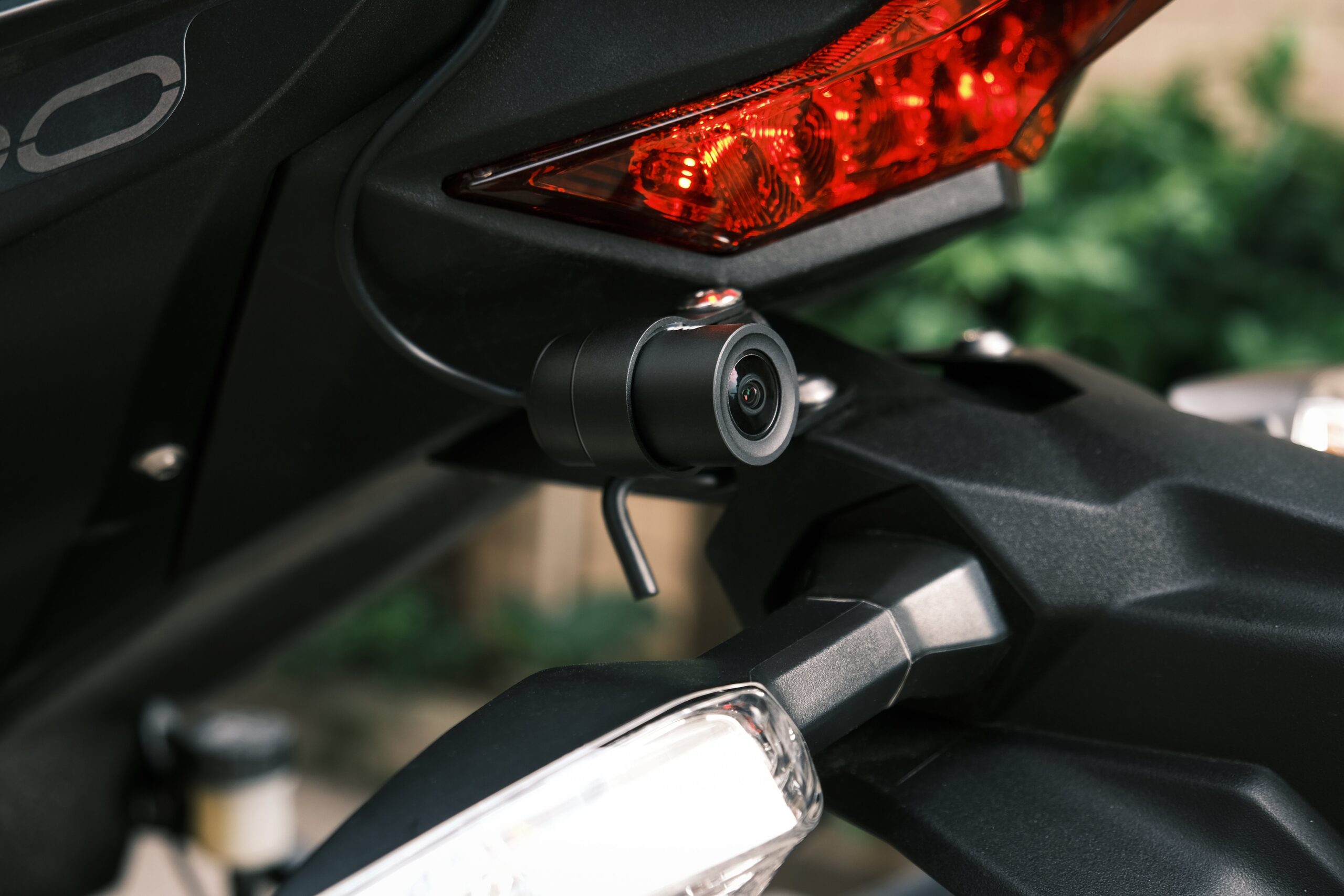
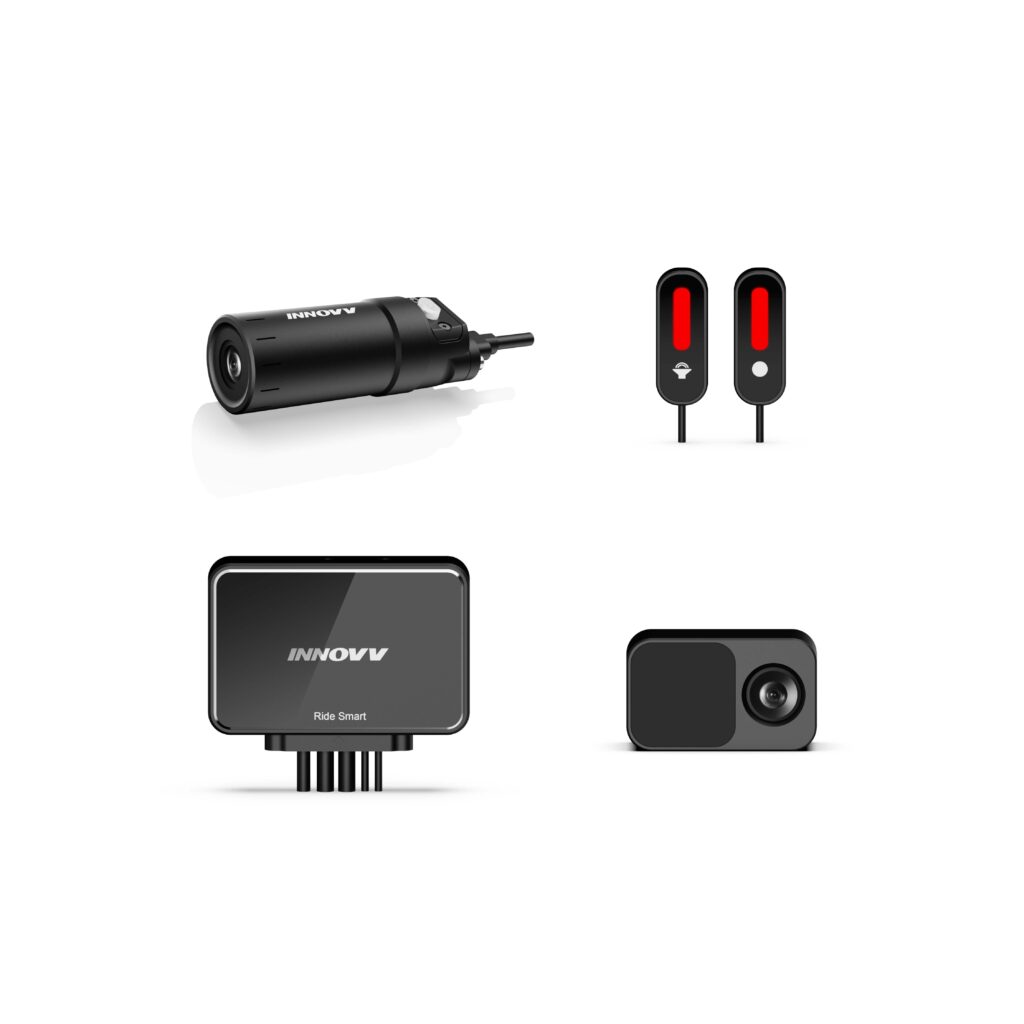
Take the K7 as the reference model. Sony IMX335 STARVIS sensors sit in both cameras, and each one records 2K at 30fps with an F1.8 lens and a field of view of 120 degrees. Inside the control box, two processor cores work alongside 4GB of memory, and the slot accepts microSD cards of up to 512GB.
Also included are a 10Hz GPS unit, a remote for the handlebar, a mic, brackets and dual-band Wi-Fi that sends clips to your phone. The camera bodies are aerospace-grade aluminum, and the whole system carries an IP67 rating.
An independent long-term reviewer called the K7 dependable for recording rides and said it runs without constant attention. The same reviewer liked the split-screen GPS playback and found the G-force sensor overly sensitive on rough pavement and off-road. Riders on rough ground should plan to turn it down.
For a closer look at the spec sheet, install quirks and return terms, read our full verdict on the INNOVV K7 dash cam.
K7 or K6
Riders who would rather save money than match resolution at both ends can consider the K6. It keeps the same 2K front sensor and the same IP67 rating, and it drops the rear camera to 1080P. The K7 runs the more powerful processor and records 2K from both cameras. Check the current price of each at INNOVV’s store before you decide.
Memory cards and GPS
The K7 accepts cards up to 512GB, while the K6 and the N-series displays accept 8GB to 256GB. A card sold for dash cams or security cameras and rated for continuous recording is the right match; a leftover card from an old phone is not.
GPS varies by model. A 10Hz module is part of the K7 kit, but for other K-series and N-series units it is an optional add-on or bundle item, so confirm the exact configuration if tracking matters to you.
Choosing a Smart Display
Riders who tour, or who dislike a phone holder cluttering their view, are the natural audience for the N-series. You can browse INNOVV’s range at its own store and look for the N-series configurations on offer.
The N2 and N3 share a 5.99-inch touchscreen, wireless CarPlay and Android Auto, and IP67 hardware that includes the screen. Optional extras for both are a 10Hz GPS module and tire pressure monitoring, shortened to TPMS.
N2 or N3
The N3 trades up on brightness and mounting. It is rated at 1200 nits peak brightness, against a range of 800 to 1200 nits for the N2. It also adds a quick-release AMPS mount and a security lock slot.
That suits riders who move one display across several bikes or like to carry it off the bike during stops.
The N2 comes in several configurations. Some bundles include GPS, a 2K camera and free tire pressure monitoring.
GPS is optional
CarPlay navigation works from your phone’s GPS, so the display does not need the module to guide you. The 10Hz unit simply adds redundancy.
A note on sunlight
Feedback on INNOVV’s product pages for the N2 and the N3 includes a recurring remark: the screens are harder to read in direct summer sun. Strong sun is a tough test for displays in this category generally, so the issue is not unique to one brand.
If most of your riding happens under a high sun, look up recent feedback on your exact model first.
Choosing Blind Spot Radar
ThirdEYE suits riders who spend time in heavy traffic or lane-split. The spec sheet describes a rear-mounted radar that scans a 120-degree horizontal field on 77 to 79GHz.
Its detection range runs from 0.2 to 50 meters, it follows as many as 64 targets simultaneously and it refreshes every 50 milliseconds. Those figures come from the spec sheet, and this guide has no independent test of how the system performs on the road.
Mirror, Watch and R1300GS versions
The Mirror version puts LED indicators on your mirrors, so alerts sit in your peripheral vision. It fits most motorcycle mirror mounts.
The Watch version shows the same alerts on a wrist-worn display. It makes sense if your bike’s mirrors are a poor match for the mirror hardware.
The R1300GS Mirror Radar Edition is shaped for the mirrors on that BMW model and fits them without adapters. A dedicated C1 monitoring unit is built around the same radar band.
Modular Setups and the Chigee Alternative
INNOVV sells its three lines as separate systems that you wire independently, so a setup can grow in stages. Documentation comes from the dash cam, navigation and phone access from the display, and live alerts from ThirdEYE. Nothing forces a full purchase on day one.
Chigee builds around a single unit instead. The AIO-5 Lite, for example, folds a CarPlay screen, a dash cam and blind spot detection into one device, which leaves fewer pieces to mount and wire.
Neither route is better for everyone. One box and one mount appeal to riders who want the simplest install, while separate pieces appeal to riders who prefer to buy gradually or leave out a feature.
Screen brightness and tire pressure
Chigee markets the AIO-6 at close to double the brightness of competing units, aimed at the problem of screens washing out in direct sun. It also ships with tire pressure monitoring built in.
On the INNOVV side, tire pressure monitoring is an optional extra for the N-series, though a few N2 bundles include it. Both brands end up in a similar place by different routes.
Resolution and warranty
On dash cam resolution, INNOVV leads on paper. The K7 records 2K from front and rear at once, and the K5 went further with 4K up front, which Chigee’s combined units do not match.
Both brands build for bikes. INNOVV offers a two-year warranty on main products and aluminum K7 camera housings, while the AIO-6 is built around a metal chassis and is water resistant.
Choose Chigee’s design if a simple fit matters most, and INNOVV’s if you want top dash cam resolution or a staged build. Whichever way you lean, compare it with the specific Chigee model you have in mind.
Install, Care and Upkeep
IP67 is a rating for the hardware, not a guarantee for a sloppy install. These habits protect the gear through the two-year warranty term and past it.
Plan the cable route
Owner feedback on INNOVV’s product pages describes the K7’s front and rear leads as long and thick, so a tight fairing can make tidy routing awkward. Lay the whole route out loose before anything is fastened.
Then keep every connector clear of the exhaust, the chain and the suspension linkage. Water and dust are what IP67 addresses; a crushed or overheated cable is not on that list.
Know the temperature limits
The K7’s DVR is specified from -30°C to 60°C, while the N-series displays cover a narrower span, -15°C to 60°C.
Screens are generally more sensitive to temperature than camera housings. A bike kept somewhere very cold or very hot, such as an unheated garage in a harsh climate, is the case for removing the display and leaving the cameras in place.
Look after the memory card
Because the cameras loop their recording, the card is rewritten constantly. If it is never reformatted, file-system errors can build up and surface as dropped frames or a clip that never saves.
Reformat it from the INNOVV app every few weeks as routine. Buy a name-brand card rated for continuous recording; INNOVV supplies a Samsung card in its own bundles.
Wipe the lenses and the radar
Road film builds on a lens so slowly that footage quality slips without anyone noticing. Wipe both cameras whenever you wash the bike, the way you would clean a visor.
The ThirdEYE module faces rearward and sits low, so spray and mud reach it first on wet rides. Debris on the radar stops it scanning properly, so rinse it after rides through rain or on unpaved roads.
Update the display firmware
Look in the app for an N-series firmware update once every month or two, not only after something misbehaves. The displays update over the air, so it takes little effort.
Where to Buy, Returns and Warranty
Buying from INNOVV directly
The most direct route is INNOVV’s own online store, where you deal with the manufacturer rather than a reseller. The brand states that shipping is free worldwide, that listed prices already cover import duties and that the full 30-day return window applies.
According to the brand, US orders leave a local warehouse and usually arrive within 3 to 7 business days.
Why the sales channel matters
INNOVV’s warranty applies only to purchases made through official channels. A unit bought secondhand or from a gray-market seller can lack any record linking it to an authorized sale, so a claim may be refused even when the hardware is genuine.
For that reason, stick to the brand’s own store or to a seller INNOVV lists as authorized.
Red flags on third-party listings
If you shop anywhere other than INNOVV’s store, a few warning signs apply to any electronics purchase. Be wary of a seller who cannot show a link to INNOVV or to an established retailer, or who refuses to hand over a purchase receipt, since you need one for a warranty claim. Listing photos that do not match the packaging on INNOVV’s website, and a price far below the brand’s own, are the other two signs.
INNOVV lists support contacts on its website. When a listing leaves you unsure, emailing to ask whether that seller is authorized costs little and can spare you a warranty problem.
Return policy
Returns are open for 30 days from the day you receive the order. The item has to be unused and in its original condition, and the original outbound shipping fee is not refunded. Customized or personalized products fall outside standard returns. What else it costs depends on the situation:
- Opened but unused: a 5% handling fee
- Used: a depreciation charge of 5 to 15%, depending on condition
- Damaged, defective or wrong item: INNOVV covers the return shipping
- Change of mind: the return shipping is on you
The process starts with a message to INNOVV’s customer service team, which confirms the item qualifies and gives you a return address. Send it back in the original packaging if possible. Refunds come only after the brand has inspected the item, and they reach the original payment method within 7 business days of approval.
Warranty coverage
- K, N and ThirdEYE series (main products): two-year limited warranty
- Accessories such as mounts, cables and chargers: three-month limited warranty
- Purchases made before the longer term began: one-year limited warranty
Only products bought through official INNOVV channels qualify. Misuse, accidents, unauthorized changes and ordinary wear and tear are excluded.
For high-mileage riders, INNOVV also sells an extended warranty for the K, N and ThirdEYE series, from around $40.
FAQ
Are INNOVV products waterproof?
INNOVV gives its entire lineup an IP67 rating, which covers dust and brief submersion. The brand says that is enough for ordinary rain and for washing the bike.
Is GPS included?
Only on some. A 10Hz GPS module comes in the K7 kit, but most other K-series and N-series units treat it as an optional add-on or a bundle extra, so confirm the configuration before ordering.
What is the difference between the K7 and the K6?
It comes down to the rear camera and the processor. The K7 records 2K from both cameras with a stronger chip and 4GB of RAM. The K6 shares the 2K front camera and the IP67 rating but records the rear view at 1080P.
Is the K7 good for off-road riding?
It can be, with one adjustment. An independent long-term reviewer found that the G-force sensor saves clips too readily on rough ground, which makes lowering its sensitivity a sensible first step. INNOVV designs and markets the K7 with street riding in mind.
Where is the safest place to buy?
Order from the brand’s own online store or from a seller INNOVV names as authorized. Because the warranty depends on an official purchase, a gray-market unit can leave you without help.