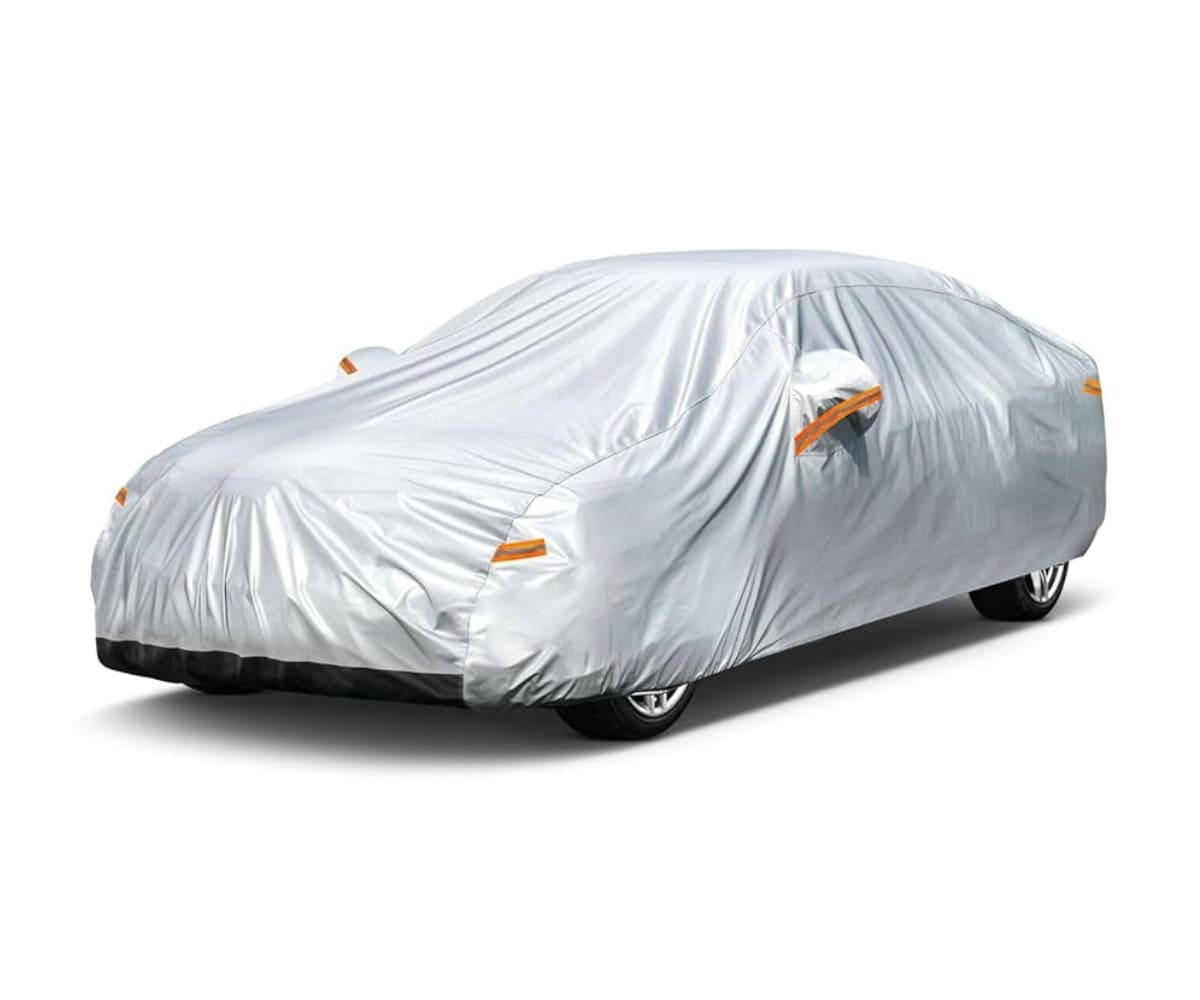
Car covers look simple until you start shopping for one. Body style, length, layer count and fit type all change what lands on your driveway, and it is easy to pick a mismatched combination.
GUNHYI adds a few extra choices to the mix. It makes covers for four body styles (sedan, SUV, truck and hatchback), in 6, 7 and 16-layer builds. Most are universal-fit, and a handful of popular cars get a custom cut.
This guide covers the brand, the materials, the layer tiers, sizing, care and the guarantee, all drawn from GUNHYI’s own product details. It is research-based rather than hands-on testing, so anything that comes from the brand is labeled as the brand’s claim.
Who Is Behind GUNHYI
It helps to know who stands behind a brand before you buy from it. With GUNHYI the answer is thin. The brand’s own website shows no founder, no company history and no about page, only product listings and an FAQ.
Because the site offers no biography, this guide does not include one and sticks to what the brand’s own pages state.
What the brand’s pages do show is how it sells. Rather than running one storefront of its own, GUNHYI spreads its covers across Amazon, Walmart, Sears and eBay. Its site at thegunhyi.com works as a catalog that points visitors on to those retailers. The brand says orders ship from US warehouses, which typically shortens delivery compared with shipping from overseas.
The range has more than one layer to it. Universal-fit sedan, SUV and truck covers form the older base, and custom-fit covers for the Grand Cherokee, the Model 3 and the Tiguan have been added on top of them. That pattern suggests a brand still extending its catalog.
Put together, GUNHYI looks like a modern accessory brand built around marketplace sales: several channels, US shipping and a set of custom-fit options that has been extended over time. That is a perfectly reasonable model. The practical consequence is that your buyer protections depend on the platform you order from.
What the Layers Are Made Of
GUNHYI’s FAQ says every cover in the range is built from the same three kinds of material.
- Aluminum layers: these reflect sunlight and block UV rays
- PE and PEVA layers: these do the waterproofing, and the brand cites resistance to water pressure of up to 1800mm, which it calls sufficient for prolonged heavy rain and snow
- A soft cotton liner: this sits against the paint and cushions it from the tougher outer layers, so the cover is less likely to mark the clear coat during long stretches of use, according to the brand
Product pages and the FAQ all describe this same stack, and the brand calls its covers fully waterproof. Treat the 1800mm figure as GUNHYI’s own claim. It comes from the manufacturer, not from an outside test.
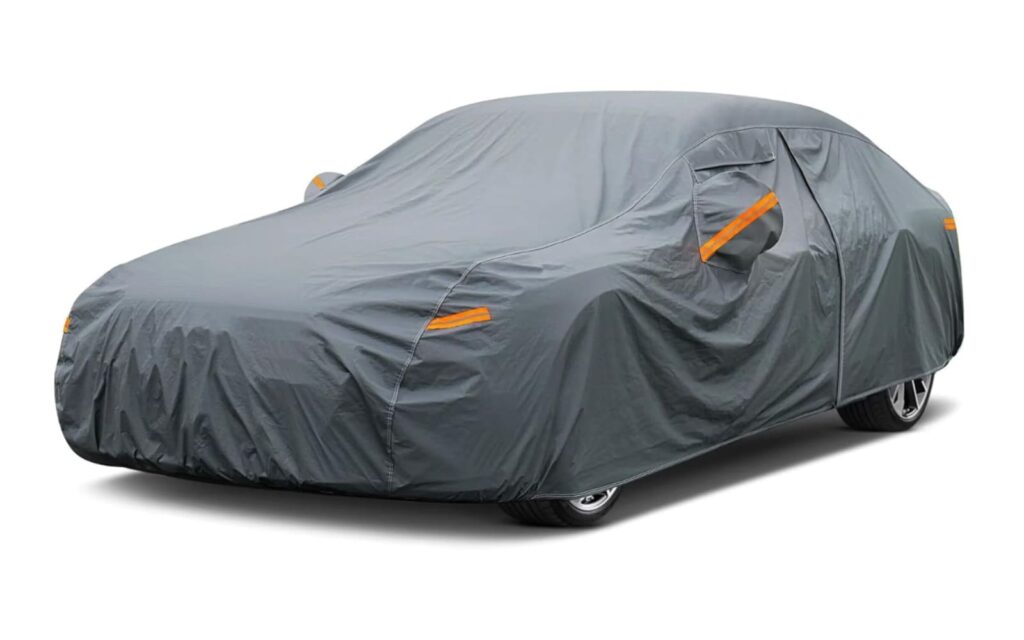
Read the number in a product name as a stacking count. The same three materials are layered or doubled up, so a 16-layer cover is not made of 16 different fabrics, and a 6-layer one simply uses fewer sheets.
Six, Seven or Sixteen Layers
GUNHYI sorts its range by layer count first, so it is worth knowing what each tier is meant to do.
Six layers
At the entry tier, GUNHYI aims the 6-layer covers at hatchbacks and sedans that need basic protection from sun, rain and dust without add-on features. Low weight makes them the easiest to handle for a car that is covered and uncovered often.
Seven layers
Seven layers is the SUV tier. These covers are used mostly on SUV models and add a bit more thickness across the larger body panels.
Sixteen layers
At the top of the range, the 16-layer covers include extra vents against condensation, spare windproof straps and a storage towel. Certain custom-fit 16-layer versions, the Model 3 cover among them, add a zippered door too, letting you open up the car without lifting off the entire cover.
Does more always mean better?
Usually, but at a cost. Added layers bring thickness and durability along with weight and bulk, which you feel when folding and storing the cover. For a car covered every day, the lighter 6-layer build is easier to handle. For a car left for weeks in an exposed lot, the vents and spare straps of the 16-layer build are the features that matter.
Body Style, Size and Fit
Choosing well comes down to a short run of decisions, best taken in this order.
Start with your body style
GUNHYI makes separate covers for sedans, SUVs, trucks and hatchbacks, each cut around its own roofline, trunk or bed. A cover made for another body style will not sit properly, whatever its layer count.
Measure the length
Universal covers are sold in length brackets, and the 16-layer sedan version runs from about 178 to 208 inches in a few steps. Run a tape along the car from bumper to bumper and pick the bracket that matches. The compatible-model list in the title is only a cross-check. A bracket that is too long leaves slack fabric, and one that is too short pulls snug.
Decide between universal and custom
A universal cover is cut for a group of similar cars. A custom-fit cover follows one model’s lines more closely. GUNHYI offers the second type for a few popular cars: the Jeep Grand Cherokee, the Tesla Model 3 and the VW Tiguan.
Each approach has a clear strength. Universal sizing lets one product serve many cars, and it works well once the length is right. A custom cut is the answer to slack, flapping panels, which is the drawback of a cover shaped to suit several models. That matters most on tall SUV bodies, where a universal cover can leave gaps near the wheel wells. The flip side of universal sizing is that mirror pockets and vents will not land in exactly the right spot on every car.
Match the layer count to your exposure
- Parked outside through every season: sixteen layers, since the vents, spare straps and towel are most useful when the cover stays on for weeks
- Some sun and the occasional shower: seven layers, a middle path between thickness and weight
- A garage or covered spot: six layers is enough, and it folds up lighter
Check the extras
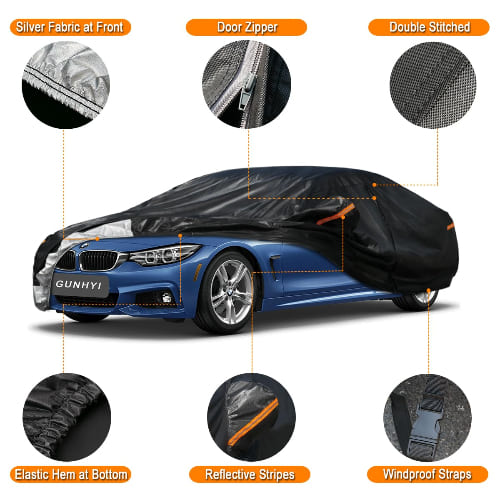
Not every cover has the same extras, so read the feature list for your size. The higher tiers are where GUNHYI adds zippered access doors, mirror pockets and reflective strips for night visibility. A zipper is most useful to drivers who use the car daily, because it avoids taking the cover off each time.
A worked example
Imagine a Toyota Camry that stays parked outdoors all year in a wet climate. The sensible route is to measure its length, choose the matching 16-layer sedan size, and rely on the added vents and spare straps through long rainy spells.
The Lineup by Vehicle Type
GUNHYI’s catalog is broad, so here is a tour of the main covers, organized by the vehicle each one is made for.
Flagship sedan cover
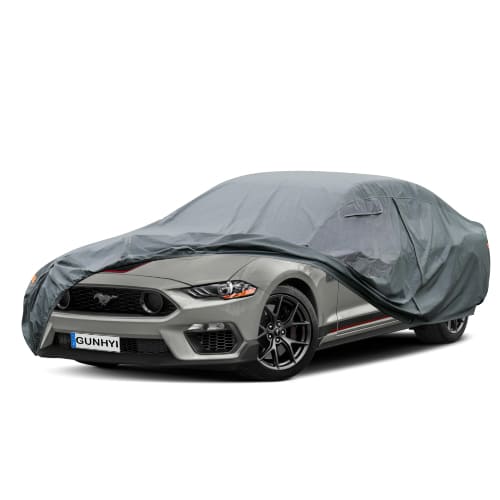
This 16-layer cover leads the sedan range. It suits common sedans like the Camry, Accord and Altima, and its extras are the vents, a storage towel and a set of backup windproof straps. We cover it in depth in our full verdict on the GUNHYI 16-layer sedan cover.
Tesla Model 3 custom fit
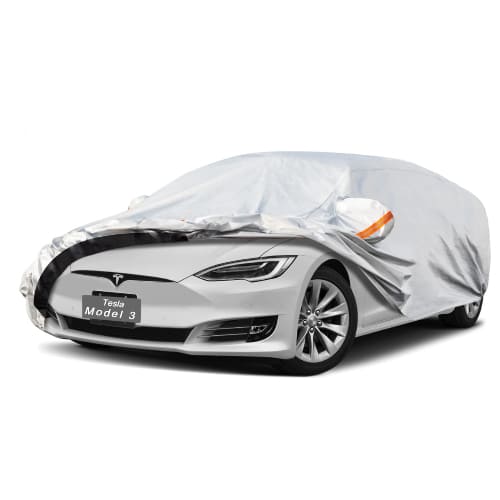
Tailored to the Model 3’s body rather than a length bracket, this version also has a zippered door, so daily access does not mean pulling off the whole cover. It makes sense if you own that car and want a snug, model-specific shape.
SUV cover with seven layers
Designed for smaller SUVs, from the RAV4 and CR-V to the Rogue, Forester and Tucson. Seven layers is a compromise on bulk and protection, aimed at vehicles that outgrow the sedan sizes.
Grand Cherokee custom fit
Cut for the Grand Cherokee alone, it carries the usual 16-layer extras. A model-specific shape pays off on tall SUV bodies, where a universal cover can leave gaps near the wheel wells.
Truck cover
This six-layer cover handles full-size pickups up to 230 inches long. The brand lists the F-150, Silverado, Sierra and Ram 1500, in regular cab, extended cab and crew cab versions. Sticking to six layers keeps the fabric load easier to fold, which matters when a truck takes so much material.
Hatchback cover
A universal-fit option for hatchbacks like the Golf, Fit, Soul, Matrix and Leaf. As the lightest tier in the lineup, it suits cars kept in a garage that need cover outside only now and then.
Large sedan size
This is the bigger sibling of the flagship, made for long sedans like the Avalon, ES350, MKZ, Model S and 740i. It keeps the 16-layer build but is cut larger for cars that exceed the regular sedan length range.
You can browse GUNHYI’s storefront on Amazon and check the current price there for the body style and size you need.
GUNHYI Compared With Budge
Budge’s lite line is more than 15 years old, while GUNHYI is the newer, layer-stacked alternative. That contrast makes a useful pairing for comparing material, weather protection and track record.
Material
Budge’s lite cover is a single sheet of double-stitched polypropylene, a thin and light design aimed at dust, debris, water and UV. GUNHYI layers aluminum, PE and PEVA waterproofing sheets and a cotton liner, in a 6, 7 or 16-layer build according to the model. Going from one layer to several trades weight for coverage, and the thicker cover does not win automatically.
Weather protection
GUNHYI cites resistance to water pressure up to 1800mm and credits its PE and PEVA layers for it. Budge’s cover is water resistant rather than waterproof, since it has no dedicated membrane, and it is positioned as a lighter-duty, entry-level cover instead of an all-weather one.
Paint contact
Each brand puts a soft surface next to the paint: cotton on the GUNHYI side, a smooth inner face on the Budge side. On paper that is a draw.
Track record
Budge’s lite line has more than 15 years behind it. GUNHYI is the newer brand, so its record is shorter.
Budge fits a car that only needs a simple cover against dust and light showers. GUNHYI fits a car that meets tougher weather and needs dedicated waterproof layers along with an aluminum layer against UV.
Where to Buy and What Is Covered
The brand’s own site is a catalog without a checkout. Orders go through Amazon, Walmart, Sears or eBay, the four retailers GUNHYI lists. Sticking to those channels is how you get a genuine cover along with the retailer’s standard buyer protections.
Spotting an unofficial listing
- Shipping origin: the brand says its products leave US warehouses, so a listing quoting weeks of international transit is a reason to look elsewhere
- Materials: a genuine listing describes the aluminum, PE and PEVA, and cotton build in the same terms each time, while one that leaves this out or names other materials deserves a closer look
- Seller name: on Amazon, the seller should be GUNHYI itself or an authorized seller you can recognize, not a storefront with an unrelated name
The 12-month guarantee
According to GUNHYI, a 12-month after-sales guarantee covers its range, and three problems qualify. Quality defects present on arrival, such as loose stitching or torn fabric, can lead to an exchange or a refund. Missing or damaged accessories, including the straps and the towel, are reissued. A wrong-size cover is replaced once the error is confirmed.
The guarantee works alongside the marketplace’s return policy rather than in place of it. What that policy allows depends on the seller: the return window, any restocking fee and the cost of shipping the cover back are all set per listing, and a third-party seller may be stricter than the platform’s default. Read those terms before you order.
Filing a claim
Evidence makes a claim easier. Hold on to the order confirmation, and photograph any defect or sizing mistake on the day the cover arrives. The platform’s own return process is the first stop. Once that window has closed, the brand’s 12-month guarantee still applies to defects and missing parts, provided you are within the year.
Care, Storage and Windy Days
A layered cover lasts longer with basic upkeep, mainly to protect the waterproof layers and the cotton lining.
Clean it gently
Water, mild soap and a garden hose are all the cover needs. The PE and PEVA layers are the reason to keep a pressure washer away, since repeated high-pressure blasts can push water past them. After rinsing, let the cover dry all the way through before it is folded. Mildew can take hold on the cotton lining when a damp cover goes into storage.
Fold it, don’t squeeze it
Rolling the cover tightly each time puts the same creases under repeated strain, and that can wear layered fabric faster than normal outdoor use. A loose fold is gentler. On the 16-layer covers, the storage towel or bag is a clean, dry place to keep the cover between uses.
Keep the vents clear
Vents need free airflow to do their job of limiting condensation under the cover, which matters most with the thicker 16-layer builds. Leave space around them instead of pushing the front of the car up against a wall or tarp.
Straps and windy days
Each GUNHYI cover comes with windproof straps for the front, middle and rear. If the edges lift in gusts, start with strap tension: cinch all three rather than only the outer two, then tighten again after about an hour outside, once the fabric has relaxed over the car. Covers that include spare straps can put them to work on a windy or exposed spot.
Check in each season
Before winter and again before the strongest summer sun, inspect the seams for loose stitching and the straps for wear. Anything found early can be raised under the brand’s 12-month guarantee for quality defects, so it helps to check while that window is open.
Questions People Ask
How waterproof are the covers?
GUNHYI describes them as fully waterproof and cites resistance to water pressure up to 1800mm. Remember that this is the maker’s own figure.
What does 16-layer actually mean?
It is a stacking count for the same three materials, not a count of 16 different fabrics. Covers at that tier also add vents, backup straps and a storage towel.
How does the cover treat the paint?
GUNHYI describes the cotton liner as the part that cushions the paint during long periods under cover. A clean, fully dry cover is what that liner needs to stay in good condition.
What vehicle types are in the range?
Sedans, SUVs, trucks and hatchbacks, each in its own size range.
Is there a version cut for my exact car?
Select models do, namely the Model 3, Tiguan and Grand Cherokee. Any other car falls under the universal sizing, which is based on overall length.
How should I pick a size?
Measure bumper to bumper, then find that length on the size chart. The model list in the title can confirm the choice but should not make it.
Can I get into the car without removing the cover?
Only on covers with a zippered door. GUNHYI includes one on several of its 16-layer and custom-fit models.
What if the cover keeps lifting in the wind?
Start by checking the strap tension at the front, middle and rear. The care section above walks through securing the cover.
Where can I buy GUNHYI covers?
The brand lists Amazon, Walmart, Sears and eBay. To start on Amazon, browse GUNHYI’s storefront on Amazon and compare sizes there.
Choosing in Short
Begin with the body style, then check whether a custom-fit cover exists for your specific car and whether it is worth choosing. If not, a correctly measured universal cover in the layer count that suits your parking spot handles most situations well.
A garage car that only needs occasional cover points to six layers. A mixed setup points to seven. A car parked outside through real weather points to sixteen, with its vents, spare straps and towel. Whichever you choose, measure first, pull every strap snug each time and keep the guarantee details handy.