Open a jump starter page and the first thing that jumps out is a huge number. Pownym’s packs follow the pattern, with labels like 7000A stamped across the photos.
Behind that number sits a fairly simple product: a pocket-size 12V lithium pack with smart clamps, a built-in light and a pair of USB-A outputs.
This guide covers how to read the specs, how the four versions differ, how Pownym compares with NOCO’s GB40 and how to look after the pack. It draws on spec sheets, product graphics, the brand’s own claims and battery-care advice from jump starter and battery makers. No lab tests were run, and every spot where the brand’s numbers disagree with each other is flagged.
How a Jump Starter Does Its Job
Before weighing any figures, it helps to know what a pack is asked to do. The real question for any model is whether it can supply enough current, for long enough, for your particular engine. A peak amp figure on the box cannot answer that, and the next section explains why.
The job itself is narrow. When an engine will not turn over, what is missing is a heavy surge of current that lasts only seconds. A run-down battery cannot deliver it, so you hear clicking or a sluggish crank. The pack feeds that surge through its clamps, the engine fires, and the car’s alternator carries on from there.
Size is where lithium pays off. Pownym’s packs weigh roughly 1.5 to 1.6 lb, where older boosters were closer to 15 lb. In exchange, lithium cells dislike high heat and long spells at zero charge, so the care advice later in this guide carries real weight.
Peak Amps and Engine Claims
The amp label
No single number is applied consistently to this product. Pownym’s photos label the same unit 6000A, 7000A and 8000A, the Enhanced version’s spec table lists 7500A and the main listing says 7000A.
Such drift is not unique to Pownym. Because no industry test governs peak amps, a maker can capture one brief spike under ideal conditions and print it on the label.
Cold cranking amps, or CCA, say more. Under the SAE J537 standard, CCA is what a pack can deliver for 30 seconds at 0°F, with voltage held at 7.2V or higher. Pownym publishes no CCA number, and few entry-level brands do.
Engine size
The engine claims scatter just as widely. One title says “12L gas/6L”, while other pages promise all gas engines alongside diesel ratings that include 6.5L, 8.0L, 10L and 12L.
If a brand contradicts itself, build your plan on the lowest claim. A sedan, a small SUV or a half-ton pickup should fall inside the claimed range of any version. With a large diesel truck, I would want independent proof before trusting any of the numbers.
The capacity typo
One more oddity sits in the spec table, which lists battery capacity as “8000 amp_hours”. Taken literally, that would outsize a car battery, so it is surely a slip for 8000mAh, a normal figure for a pocket starter. The same field reads 6000 or 7000 on other versions, and with no watt-hour figure anywhere, the true capacity stays unconfirmed.
Battery, Ports and Light
The spec table names lithium polymer as the cell type. A graphic elsewhere labels the cells an “S-class intelligent ternary lithium battery”, a name that dresses up an ordinary lithium type.
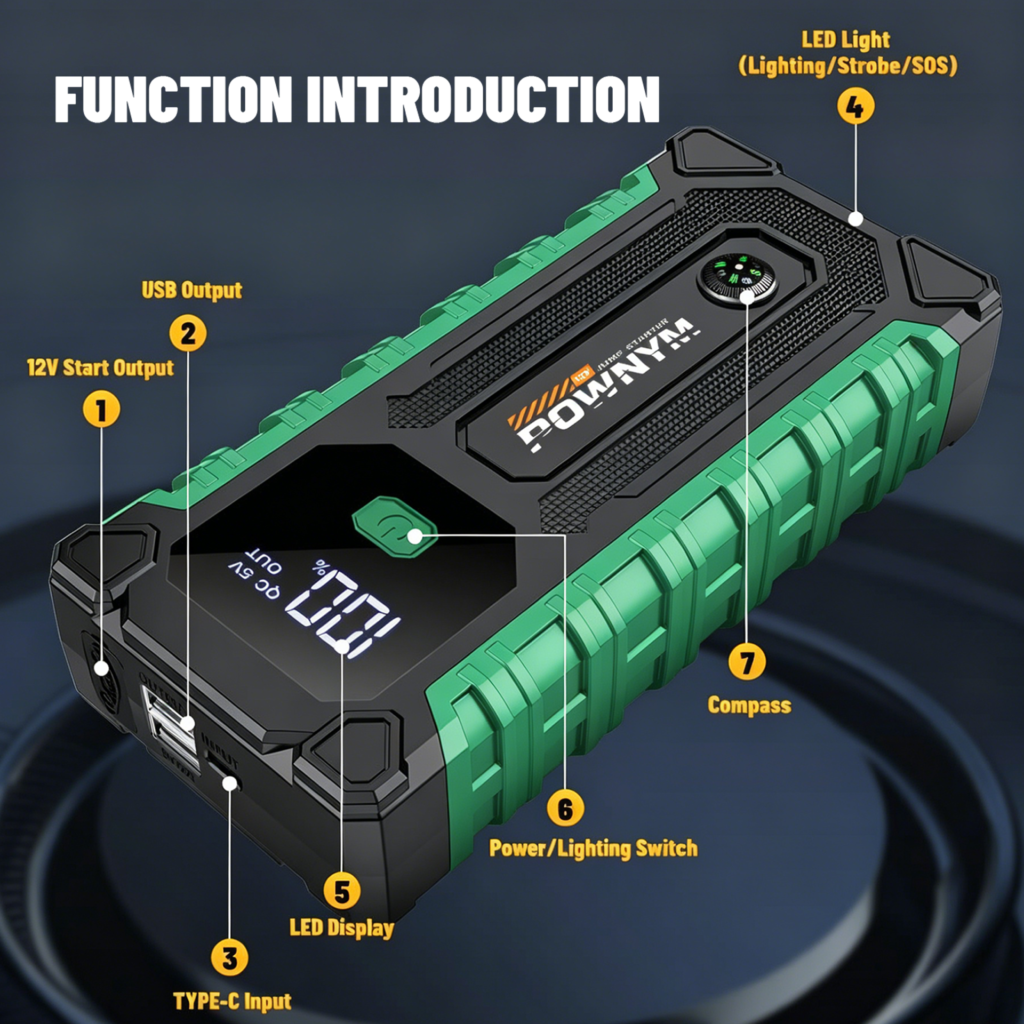
- Recharge: the brand’s graphics say about 2 hours to full through the USB-C input.
- Standby: the brand claims 24 months, with the pack keeping 90% of its charge afterward. Read that as an upper limit rather than a timetable.
- Temperature: the brand gives an operating range of -4°F to 140°F.
- Dimensions: roughly 7.4 by 3.4 by 1.6 inches.
The ports are modest. One USB-C input and two USB-A outputs all run at 5V/2A, which is phone-level charging. Pownym’s pages mention laptops, but a laptop typically needs far more wattage, delivered over USB-C Power Delivery, than these ports provide. Keep to phones, earbuds and similar devices, and remember that charge spent on gadgets is charge your car cannot use. Top the pack up after a long session.
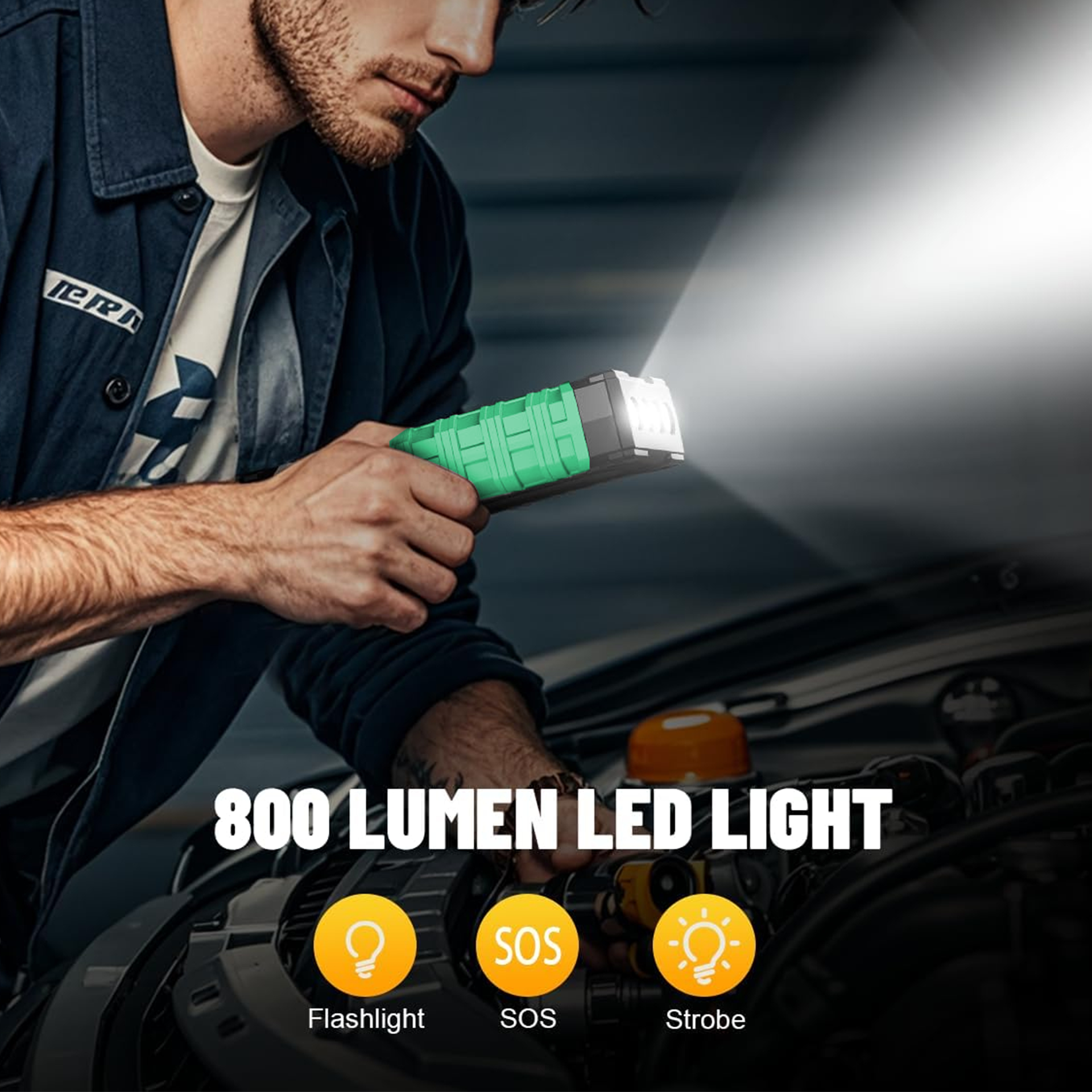
Light comes from four LEDs rated at 800 lumens, and the modes are flashlight, strobe and SOS.
On most versions the display shows the battery percentage plus a “QC 5V OUT” label, and the brand says it stays legible in bright sunlight. On the Upgraded version, the photos reveal a more crowded screen that adds voltage readouts for input and output, which the listing never explains. Every unit pictured carries a small compass, a pleasant roadside extra and not a navigation tool.
Smart Clamps and Safety Features
Safety starts at the control box the clamps plug into. Its indicator lights report on the connection, and the box is designed to check it before releasing power.
The catch is that a deeply flat battery can look to the box like no battery at all, so it holds power back. The forced start button exists for that case, because pressing it overrides the low-voltage block. Since that skips part of the protection, confirm first that red sits on positive and black on negative.
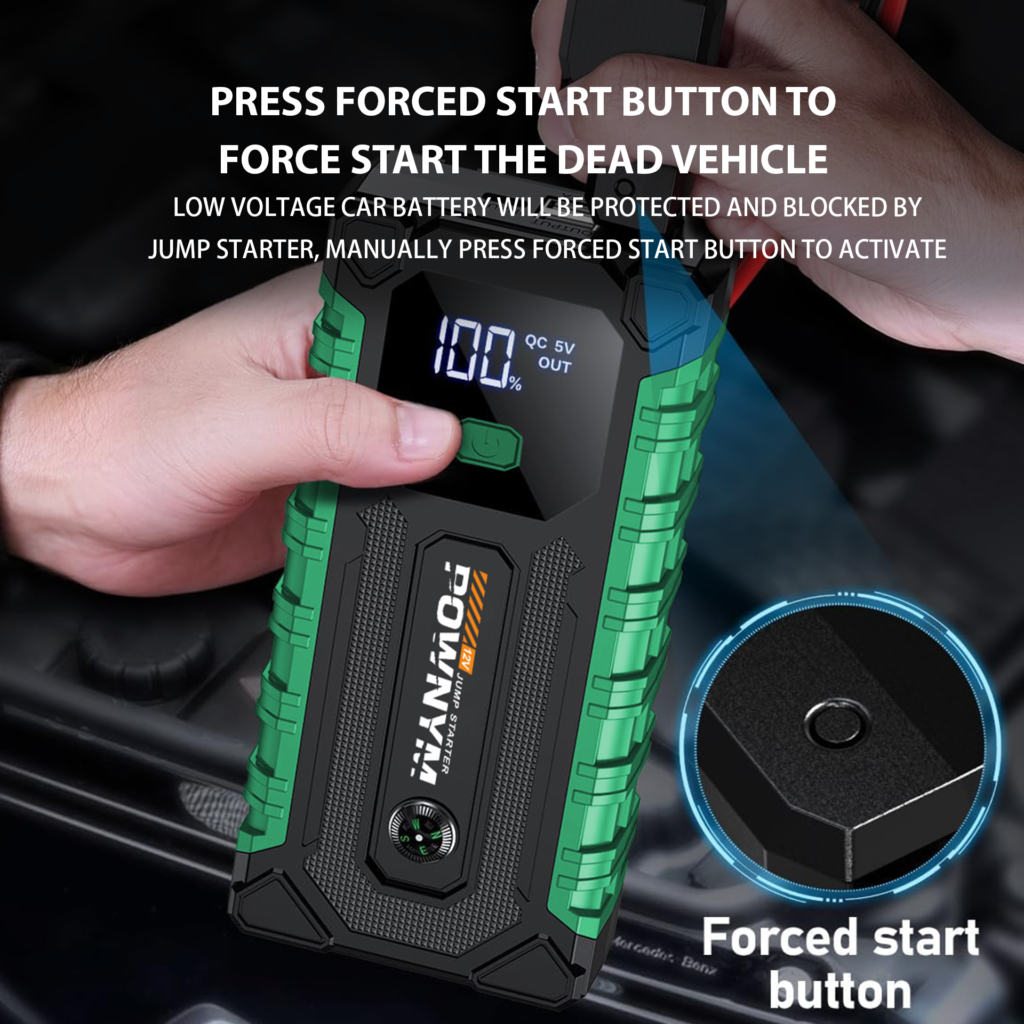
On protections, Pownym’s list runs through reverse polarity, short circuits, over-current, over-charging, over-discharging, plus temperature and spark safeguards. The count depends on where you look, with ten in the bullet points and fourteen in one graphic. A different headline touts a “144-layer” design but shows only fourteen icons, which looks like a typo.
A few habits do more than any tally. Attach red to the positive terminal before black goes on negative, keep the two clamps from touching while the control box is powered, reserve forced start for a battery too flat to detect (rechecking polarity first) and unhook as soon as the engine runs. For the exact sequence on your unit, trust the manual over any general guide, this one included.
Know the warning signs of a tired pack too. A percentage that falls far more quickly than before, a pack that never reaches 100% and a case that swells or warms up while idle all deserve attention. A swollen or overheating pack should be unplugged, kept away from anything flammable and retired, and the seller should hear about it.
What Pownym Says About Itself
Little about the brand can be checked from outside its own material, so it helps to separate claims from facts. The claims come in three parts. Pownym says its products were built by a team of energy experts, that it has more than ten years of automotive research and development behind it with design and production kept in-house, and that manufacturing follows automotive quality management standards, batch testing included.
None of the three names a certification, a factory or a person, and nothing here confirms them. A decade of experience could belong to the factory behind the brand and not to the brand name, which is plausible but unproven. For that reason the pack is best judged on its features, its safety design and the return window.
The product this guide focuses on is the 12V lithium jump starter. Beyond it, the range leans toward car and garage gear: a second jump starter that has an air compressor built in, a six-piece flex-head ratchet wrench set (1/4, 3/8 and 1/2 inch drive, with extensions in a foam tray), self-retracting ratchet straps rated to 1,500 lb of break strength, with hooks and handles that are rubber-coated, and a rolling knee creeper.
Choosing Between the Four Versions
Four options appear together on the product page: Standard, Upgraded, Enhanced and a carry bag edition. In photos they are nearly indistinguishable, and what separates them is accessories, claimed engine size and extras.
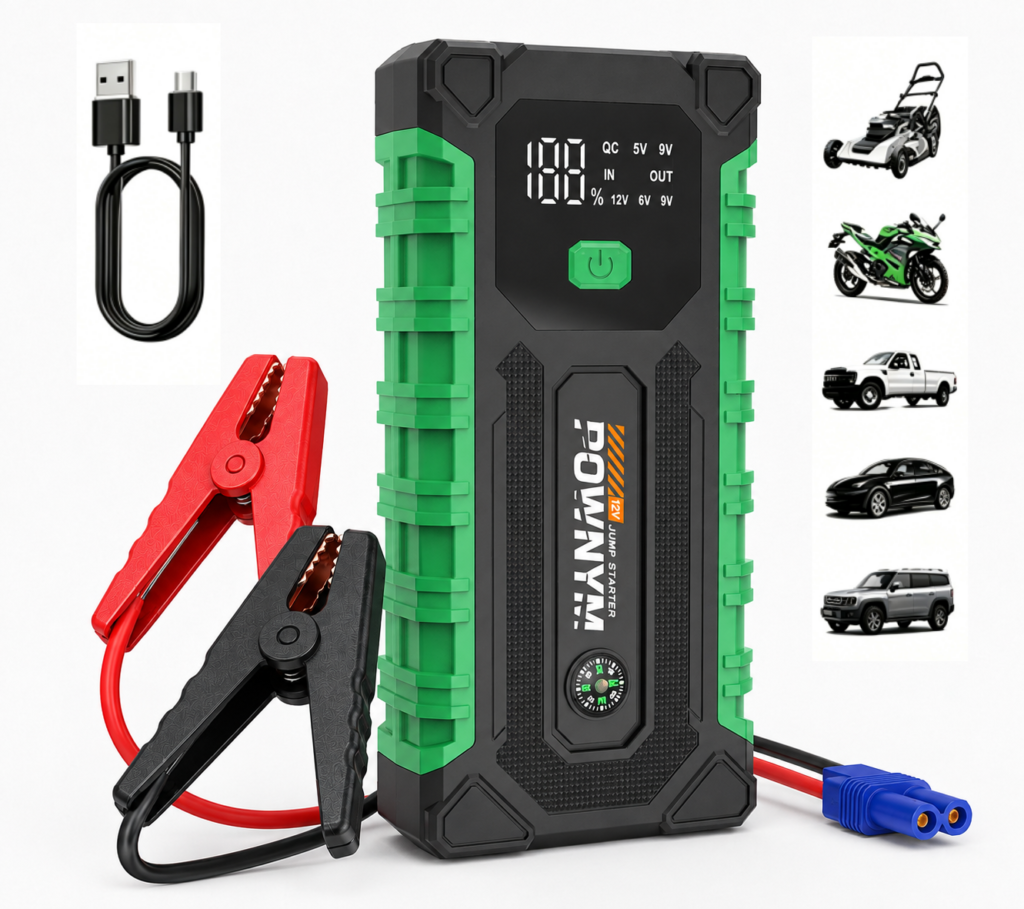
Treat the shared traits as the baseline. All four are 12V lithium packs made for Pownym’s own storefront, each with smart clamps and USB charging. Dimensions appear on three of the pages and agree at roughly 7 x 3.5 x 1.5 inches, while listed weights run from 1.5 to 1.6 lb. The decision is therefore about accessories and claims rather than product type.
Start with your engine
Claims differ by version. The Standard and Upgraded pages mention all gas engines and 10L diesel, the Enhanced page says up to 8.0L, and the carry bag title reads “12L gas/6L”. Choose around the smallest figure you see. Anyone with a big diesel should favor a maker that states a clear, cautious diesel rating, and the NOCO comparison below shows what that looks like.
Think about storage
Without a case, a pack tends to pick up scuffs in a trunk while its cables tangle. The bag addresses both, which is why the carry bag edition is my default pick. To find it, browse Pownym’s storefront on Amazon. For the full breakdown, read our full verdict on the Pownym 7000A jump starter with carry bag.
Decide whether you need a tire inflator
If you also want to inflate tires, Pownym sells a separate model that adds an integrated air compressor and a pressure readout to the jump starter. Its title claims all gas engines and 12.0L diesel. It is a bigger unit, so anyone who already owns an inflator is better served by the standard packs. It is one of the other products in Pownym’s storefront.
Upgraded and Enhanced
These two make sense only if their extras appeal. The Upgraded photos show a display with input and output voltage readouts, and the Enhanced spec table lists a slightly higher peak figure of 7500A. A higher label alone is no reason to choose either, since peak figures follow no standard test.
Whichever version you pick, confirm that the option highlighted on the product page matches the one you meant to order.
Pownym Against NOCO
NOCO’s GB40 Boost Plus is a compact jump starter with a detailed spec page, which makes it a useful yardstick. The NOCO figures below come from that page.
| Feature | Pownym 7000A | NOCO GB40 |
| Peak current | 7000A on the main listing | 1,000A |
| Engines | all gas, diesel from 6.5L to 10L by page | gas to 6L and diesel to 3L |
| Weight | 1.6 lb | 2.4 lb |
| Flashlight | 800 lumens in three modes | 100 lumens in seven modes |
| Water protection | no rating given, ports described as dustproof | IP65 |
| Recharge | about 2 hours, the brand’s figure | 3 hours at 2.1A |
| USB | a pair of USB-A outputs, one USB-C input | USB output at 2.1A, 10W USB-C input |
Leave the amp figures out of the comparison. Peak ratings follow no shared test, and NOCO’s engine claim is the more specific and cautious of the two.
On paper, Pownym comes out ahead on light, weight, a second USB-A port and the extras of a carry bag and forced start button. NOCO leads on weather protection, a single clear engine rating and a longer time on the market.
The light gap is the difference you would notice on a dark roadside, with 800 lumens against 100, although NOCO offers seven modes to Pownym’s three. Each also serves as a modest power bank. By NOCO’s own account, the GB40 can refill a phone as many as four times, a figure Pownym does not give, and neither suits a laptop.
A commuter sedan or small SUV is a natural match for Pownym, while a boat or other damp, exposed storage spot favors NOCO’s IP65 rating. For a diesel larger than 3L, neither is a clear match: NOCO’s rating stops at 3L, and Pownym’s own diesel figures contradict each other.
Charging, Storage and Care
Charge it, then test it
According to Pownym, the pack is not ready to use out of the box and needs a full charge first. The brand puts that at about 2 hours over the included USB-C cable.
Once it is charged, try a jump on your own car at home. The steps feel calmer without a stranded driver’s pressure, and any defect surfaces while a return is still straightforward.
Recharge and check
Clore Automotive, a jump starter maker, calls recharging after each use the best practice, since a pack that just helped start a car may be low when the next emergency arrives. Battery Tender adds that a stored lithium pack should be topped up at least every 3 to 6 months, because cells drain slowly even when idle. Pownym’s 24-month standby figure is a best case, so tie a quick display check to a routine chore such as a seasonal clock change or a tire rotation.
Heat and cold
Heat is the harder test for lithium. Automotive guides note that a parked car’s cabin can climb past 120°F, and although the brand rates the pack to 140°F, Battery Tender warns that high temperatures speed up wear. That argues for the glove box or trunk over the dashboard, shade over direct sun and a trip indoors during a heat wave.
Cold is gentler on the cells but trims available power. Clore suggests monthly charging when the pack sits in a car parked outdoors through extreme cold, and after a deep freeze, before an early start, carrying it inside overnight is worth the trouble.
Battery Tender also points out that cells age faster when they sit at full charge for long periods. Readiness matters more for an emergency pack, which makes a full charge plus periodic checks a sensible middle path.
Dryness and the carry bag
Pownym lists dustproof ports and a shock-absorbing shell but no water-resistance rating, so assume the pack is not waterproof. The bag also keeps the cables from tangling and protects the screen from scratches.
Buying, Returns and Warranty
The official listings name POWNYM Brand Store as the seller, with Amazon handling shipping, and show a 30-day refund-or-replacement window. That window is the most useful protection a buyer has, so see Pownym’s full range on Amazon and put it to work.
Spotting the genuine listing
Lookalike jump starters are common, so spend a minute on these checks once you open a product page.
- The product information should show model number GL987.
- The unit itself prints POWNYM and “12V Jump Starter” on its face, with a small compass low on the body and an orange band across the logo.
- The buy box should name POWNYM Brand Store as seller and Amazon as shipper, and the seller name leads to its business details.
- The brand link beneath the product title should open Pownym’s own storefront with its other products.
Other brands’ sponsored jump starters can sit right beside Pownym’s. Those are separate products, so check the brand name before adding anything to your cart. Should the box or unit lack Pownym branding, or not be what you ordered, begin a return immediately and attach photos.
Used or open-box packs are worth skipping as well. Lithium cells are what age, and there is no telling how a previous owner charged or stored them.
Warranty
A 12-month warranty from the manufacturer appears on the spec sheet, and claims run through the seller on Amazon: open your order and use the contact option. A useful message names the order number and version, describes the fault and any code the display shows, lists what you already tried (a full recharge, a different battery) and includes a short video if possible. The listing promotes after-sales support with a 24-hour reply, a promise that cannot be confirmed.
Timing decides the route. Within 30 days of delivery, a pack that arrives damaged, missing parts or not what you ordered, or one that will not charge or start your car, goes back for a refund or replacement. A failure after day 30 but inside 12 months goes through the warranty. Returns are usually quicker, so act on any suspected defect before day 30.
Pownym Jump Starter FAQ
Is Pownym a proven brand?
A track record is hard to judge here. No independent lab tests are cited in the material behind this guide, and the brand’s headline claims are unverified, so lean on the safety features, the return window and your own early test.
Is it really 7000 amps?
That figure is a peak rating, and no standard test sits behind it. Pownym’s own pages show anywhere from 6000A to 8000A for one unit, which is why what the pack does for your car tells you more than the sticker.
Will it power a laptop?
Unlikely. Its outputs are two USB-A sockets at 5V/2A each, and laptops generally need USB-C Power Delivery at a much higher wattage.
What does an error code mean?
The material behind this guide includes no error code list, so your manual is the reference. If the unit shows a fault you cannot clear, contact the seller through your Amazon order while the return window is open.