Fuel system parts are the kind of purchase where small details decide whether a build goes smoothly. The hose material, the fitting size and the filter rating all matter, and a broad catalog does not make those choices any easier.
EVIL ENERGY is a good case study. The brand sells fuel, cooling and exhaust parts for project cars, LS swaps and EFI conversions, and it covers everything from a single fitting to a complete fuel kit.
This guide pulls together what the brand says about itself, what its spec sheets list and what builders have reported on car forums. I haven’t installed these parts myself, so read it as research rather than a bench test. By the end you should know which parts match your build and what to double-check before you order.
Where EVIL ENERGY Comes From
Founded in 2016, EVIL ENERGY has concentrated on three areas since day one: fuel system, cooling system and exhaust parts. By its own description it is a direct manufacturer rather than a reseller of other companies’ designs.
Headquarters are in Diamond Bar, California, and U.S. orders ship from warehouses in New Jersey, Georgia and California. The factories the brand cites are in Canada, with roughly 10,000 square meters of floor space and a staff above 300.
The company reports export sales above $3 million a year and names Europe, the Middle East, Asia and the Americas as its reach.
The brand says its red devil logo stands for fearlessness, power and infinite possibilities, a theme that fits the bold naming across its catalog.
The brand’s published material does not name a founder or describe a first product, so that part of the story stays blank here rather than being guessed at.
EVIL ENERGY also runs programs for its own community: a forum, an Ambassador Program, Evil Energy Rewards, and a dealer inquiry route for shops that would like to carry its parts. The tone is built around builders joining in rather than a quiet, luxury image.
What the Catalog Covers
The range is wide enough that a project builder can source much of a car from one maker. Here is how it breaks down.
- Fuel: pumps, filters and fuel cells.
- Plumbing: PTFE and CPE hose, plus AN fittings.
- Cooling: radiators, oil coolers and catch cans.
- Exhaust: mufflers and exhaust manifolds.
- Chassis: coilovers and wheel spacers.
- Intake: intake manifolds and cold air kits.
For fuel work, the pieces that matter most are the hose, the fittings, the filter and the tank. The next sections take them in the order you would decide on them.
Start With the Fuel You Run
Your fuel decides your hose, so settle that first. EVIL ENERGY sells two main line materials, and they are not interchangeable.
PTFE line
PTFE, short for polytetrafluoroethylene, is the material to choose when ethanol is involved. The brand’s spec notes say it resists the permeation that ethanol-heavy fuel can cause in other hose materials. For the PTFE line in the LS Swap Fuel System Kit, the brand publishes these figures:
- Inner diameter: 5/16 inch.
- Working pressure: 1,500 PSI.
- Burst rating: 4,500 PSI.
- Temperature window: negative 76°F to 446°F.
- Listed fuels: gasoline, diesel and E85.
If E85, methanol or a high-ethanol blend is in your plans, even for later, buy PTFE line with matching fittings, since the brand’s compatibility notes require it. When you cannot say yet which fuel you will end up tuning for, PTFE is the more forgiving choice.
CPE line
CPE stands for chlorinated polyethylene. Layer by layer, the hose has a rubber inner tube, 304 stainless steel wire and a nylon braid on the outside to resist abrasion, a combination that keeps the cost lower than PTFE.
CPE is meant for gasoline-only setups, so it is a reasonable pick for a plain pump-gas build. Ethanol is the catch: running it through CPE speeds up wear, and the brand’s notes call for PTFE with any ethanol blend. Forum threads point the same way as soon as E85 comes up.
Matching a Kit to Your Build
Once the fuel is settled, match the parts to the job. Plenty of builds only need one upgrade rather than a whole new fuel system.
A full LS swap or EFI conversion
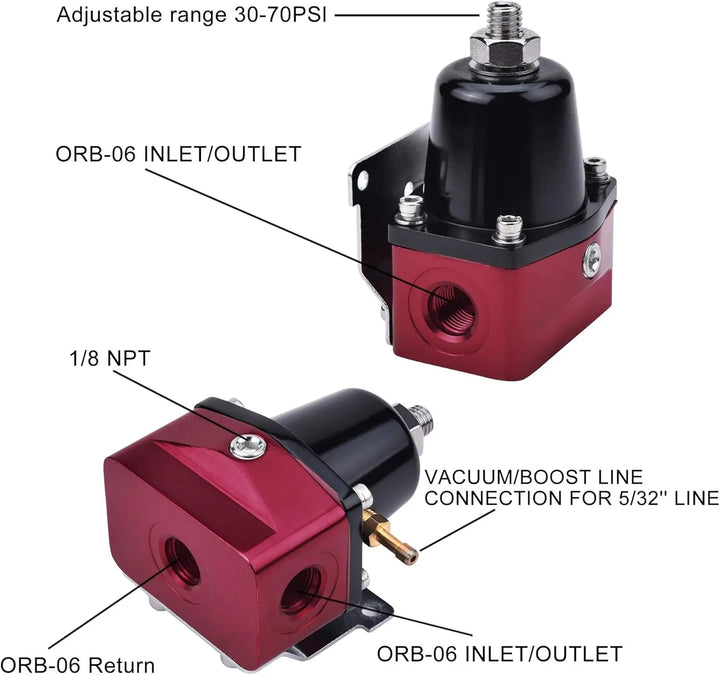
The LS Swap Fuel System Kit is designed for this job. It packages an adjustable 6AN regulator with the fittings and a 25-foot run of PTFE line, and you can browse EVIL ENERGY’s store to find it.
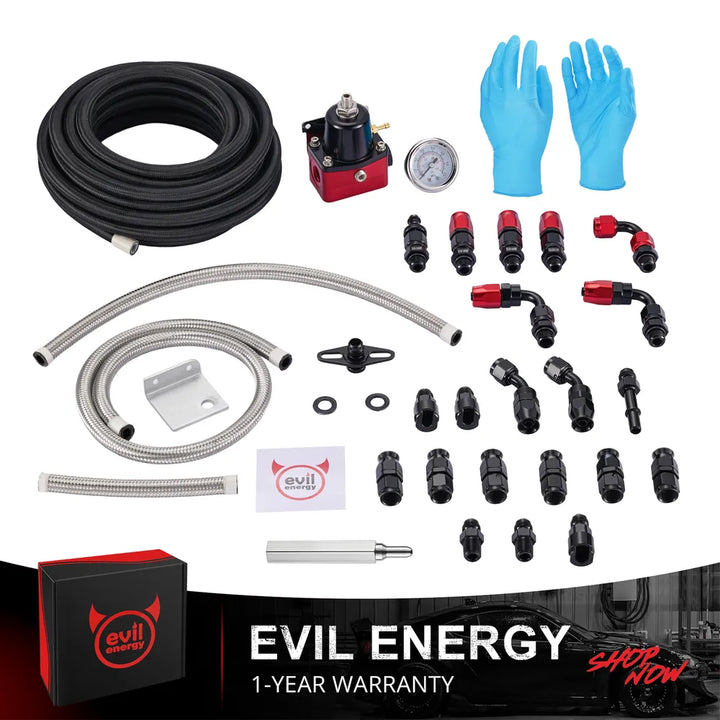
You choose one of three pressure windows when you order. The lowest runs 30 to 70 PSI, the middle one 20 to 120 PSI and the highest 30 to 140 PSI. Check your injector and fuel rail specs before you decide.
Upgrading one weak point
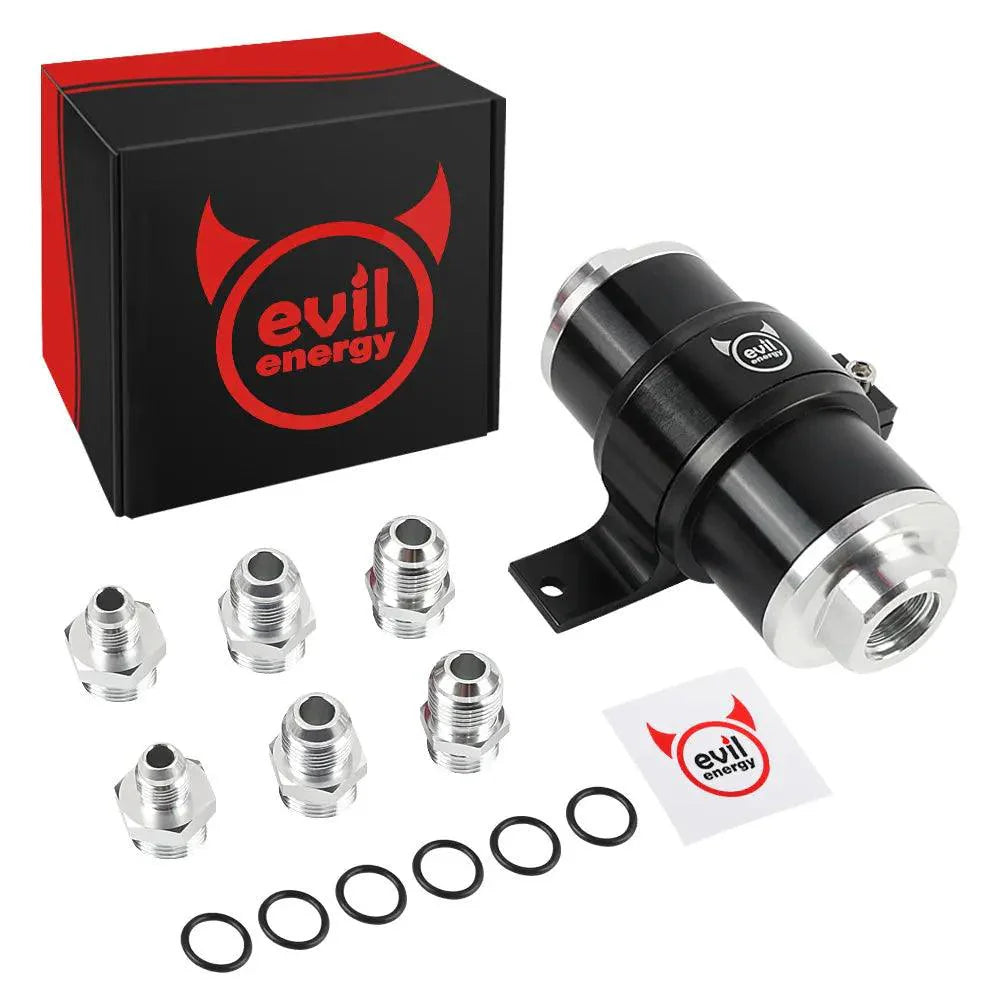
Sometimes one part is the real weak point. An inline filter is the simple upgrade when fuel quality is doubtful or you want to look after the injectors, and the brand makes it in 10, 30, 40 and 100 micron ratings.
Finer ratings trap smaller particles, though they call for more frequent cleaning. For fuel injection, 10 micron is the fit, while 100 micron behaves more like a coarse pre-filter ahead of a carburetor.
Track, drift and off-road builds
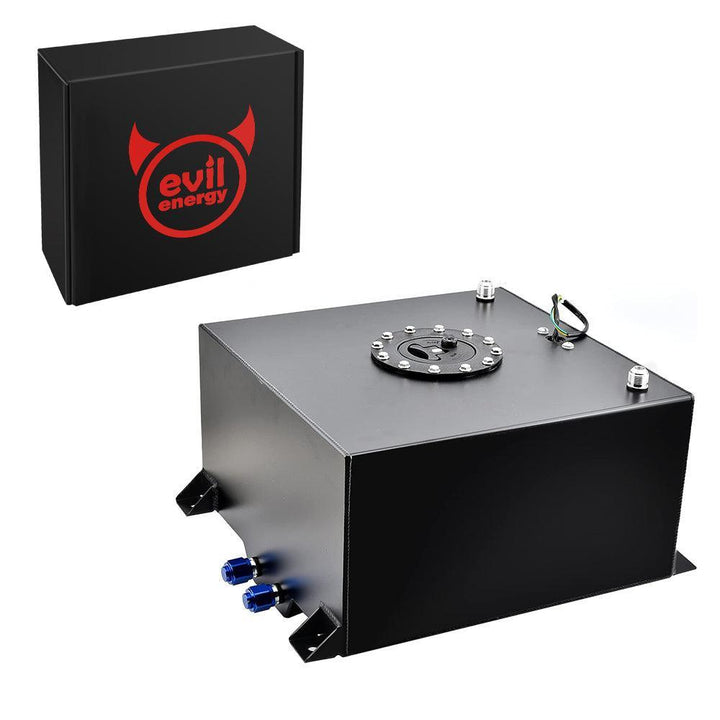
These cars ask for more capacity and tighter control over slosh than a stock-style tank offers. The brand’s fuel cells use 1060-H24 aluminum and include anti-slosh foam, in sizes from 1 to 20 gallons.
Where a cell will carry E85 or methanol, the brand’s own notes require PTFE plumbing.
A rough budget guide
The first two tiers use the approximate part prices listed later in this guide. For the bigger kits, check the current price at EVIL ENERGY.
- Under $50: an inline filter or a set of hose end fittings can shore up one weak spot.
- About $50 to $150: either a fuel cell or an oil cooler kit suits a targeted upgrade.
- Bigger spend: a full LS swap kit, or one of the fuel cell master kits that ship with a pump.
The Parts Worth a Closer Look
A handful of listings round out a typical fuel project. The prices below are approximate figures from EVIL ENERGY’s store, so check the product page for the price that applies when you shop.
| Part | Key specs | About |
|---|---|---|
| Oil catch can (300ml) | Removable baffles, aircraft-grade aluminum, washable filter, drain valve | $35 |
| Inline fuel filter | Aluminum alloy housing, stainless steel element, 10, 30, 40 or 100 micron | $42 |
| PTFE hose end fitting | 6061-T6 aluminum, 360-degree swivel, 3AN through 12AN | $9 each |
| 10AN transmission and engine oil cooler kit | Aluminum alloy cooler, 10, 15 or 16 rows, steel bracket | $126 |
| Fuel cell gas tank | 1060-H24 aluminum, 1 to 20 gallons, anti-slosh foam, level sender | From $70 |
| External inline fuel pump | Rated at 300 liters per hour | $60 |
On the catch can, oil is separated by removable baffles and steel balls, the finish is powder-coated and the internal filter is washable. A drain valve that is easy to reach keeps emptying quick.
The oil cooler kit pairs an aluminum alloy cooler, offered with 10, 15 or 16 rows, with a steel mounting bracket. It fits uses that push transmission temperatures beyond stock levels, such as towing or autocross.
Hose end fittings are cut from 6061-T6 aluminum, an alloy common in performance parts, with a 360-degree swivel. Sizes run from 3AN to 12AN, and several angles are offered. At about $9 each, one fitting is also a low-cost way to judge the brand’s machining and wrench fit before ordering a full kit.
The external pump moves 300 liters per hour by its rating, and it can either join a fuel cell kit or replace a worn factory pump on its own.
How It Compares With Earl’s Performance
Forum threads about EVIL ENERGY’s fuel line often name Russell, Fragola and Earl’s Performance as the alternatives. Earl’s serves as the yardstick here.
Background
Earl’s Performance Plumbing is the older name, with decades of AN plumbing across fuel, oil, brake and cooling lines, and Holley owns it today. EVIL ENERGY started in 2016 and presents itself as a manufacturer with its own factories, not as a brand with a racing heritage.
Price and convenience
EVIL ENERGY describes its aim as affordable basic parts, and its bundles add one-order convenience. Buying a regulator, the right length of line and the fittings separately from a premium maker means three purchases to compare, which is where a bundle earns its place.
Durability
Durability is the point on which forum opinion divides the two. Posters report that EVIL ENERGY’s PTFE hose wears out sooner than Russell, Earl’s or Fragola under sustained heat or high pressure.
Neither brand escapes criticism. For Earl’s, some owners mention a small installation quirk, hose ends that can fray the hose slightly during disassembly. For EVIL ENERGY, the comments concern long-term material wear instead.
Fitting compatibility
Fit is where the two differ at the workbench. Forum posters say EVIL ENERGY fittings occasionally measure slightly outside standard AN tolerance, so a regular -6AN wrench may not seat. Earl’s uses standard AN sizing, which suits the wrench sets builders usually own. Either way, test-fit your tools before final assembly.
Which one suits which build
For serious track use, big boost or nitrous, forum posters lean toward Earl’s or Fragola line. For a daily-driven LS swap or a mild EFI conversion on a budget, EVIL ENERGY fits, provided you check fitment before the full install.
Installing and Maintaining the Parts
A few habits during setup head off most fitting and leak trouble. The first two tips below match what forum threads about the brand repeat, and the others cover routine care of the fuel system.
Choose the line by fuel
Settle the fuel question before buying hose. E85, methanol and other high-ethanol fuels call for PTFE rather than CPE, because ethanol running through CPE speeds up wear.
Try a wrench on a fitting first
Forum posters often repeat one piece of advice: confirm that your -6AN, -8AN or -10AN wrench seats on a fitting before you cut any line. When it does not, a non-marring adjustable AN wrench tightens the fitting without rounding it off.
Check for leaks twice
The first check comes before the engine ever runs. Pressurize the system and inspect each fitting and connection for weeping or seepage. The second comes after 50 to 100 miles, because heat cycles can show up a connection that felt tight on a cold install.
Filter and catch can routines
The inline filter’s stainless steel element is reusable, so pull it out and clean it periodically instead of waiting for flow to fall off. Check that the arrow on the housing matches the direction of fuel flow, because a filter installed backward restricts flow instead of cleaning the fuel.
The catch can is built for routine service, with an easy drain valve and a washable filter. Empty it on a regular schedule so it never fills to the top.
Keep your records
Hold on to the order confirmation and any install photos. A quality-issue claim with the brand needs photos or a video clip, so a ready purchase record helps it move along.
Where to Buy and What Protects You
The simplest route is EVIL ENERGY’s own store, where each product page carries the brand’s warranty and return terms. The brand says its coverage applies to orders placed through its official channels, so its own store is the most direct way to be covered.
If you buy anywhere other than EVIL ENERGY’s own site, make sure the seller is authorized. These are the warning signs worth watching for.
- A price far below the brand’s own for the identical kit.
- A listing with no brand name in the seller field.
- No warranty or return policy mentioned anywhere.
- Photos that do not match EVIL ENERGY’s packaging or part numbers.
An unusually cheap listing could come from an unauthorized reseller that will not stand behind the warranty or, in rare cases, from a counterfeit.
Aftermarket fit
EVIL ENERGY says on its site that its products are aftermarket and carry no affiliation with any car manufacturer. Expect parts made to fit your vehicle, not factory-branded ones.
Warranty
A year is the minimum warranty the brand lists across its products, though each item can differ. Some fuel system parts get only six months, so look up the warranty on the exact listing.
Returns
The return window stretches to 180 days but works in two stages. An item that is unused, uninstalled and still in its packaging goes back with free return shipping during the first 90 days. After that, returns are accepted until day 180 with a 15 percent operating fee, so day 90 is the cutoff for a fee-free return.
The reason for the return decides who pays postage. Defective parts, and parts that differ from the listing, come back at the brand’s cost once you send photo or video evidence. A wrong order or a change of heart puts the postage on you, and you must email the brand within 30 days of delivery.
Shipping and support
Free shipping starts above $50. Below that, checkout adds a charge calculated from weight and destination. For support, the brand lists an email address on its site and states that it replies within 24 business hours.
Questions Before You Order
What is EVIL ENERGY?
An automotive parts maker founded in 2016. Its core lines are fuel system, cooling and exhaust parts, with other performance parts around them.
Does the brand make its own parts?
The brand says it does, describing itself as a manufacturer that sells direct, with Canadian factories and more than 300 employees.
Can I run E85 through the fuel line?
Only if the line is PTFE. The brand’s compatibility notes list PTFE as a requirement for E85, methanol and other ethanol blends.
Are the AN fittings standard sizing?
Not every one. Some forum posters report fittings measuring slightly off standard AN tolerance, and the hose end fittings come up in those reports. Put your wrench on one before final assembly.
Are these original manufacturer parts?
No. By the brand’s own wording, they are aftermarket parts with no car-maker affiliation.
Does EVIL ENERGY sell to shops?
Yes. A dealer inquiry route on its site is meant for shops interested in carrying the line.
Does the brand run a loyalty program?
It does. The program is named Evil Energy Rewards, and a separate Ambassador Program exists as well.
The Takeaway
EVIL ENERGY positions itself around affordable basic parts for enthusiasts, which points to builders without a race-team budget. The spec sheets list PTFE rated for E85, 6061-T6 fittings and aluminum housings. The open questions, according to forum posters, are fitting tolerance and long-term line wear under heat, and both deserve weight in proportion to how hard your build will push the fuel system.
Start with your fuel, pick the smallest kit that covers your build, test-fit your wrenches and buy through the brand’s own store so the warranty applies. If the LS swap kit is the one you are eyeing, our full verdict on EVIL ENERGY’s LS Swap Fuel System Kit goes through its spec sheet in detail.