Cold storage is one of the harder jobs off the grid. A compressor fridge can run on solar, provided the panels and batteries are sized for it. An absorption fridge on propane takes a different route, using a gas flame as its energy source, and what it asks of you is a tank, a level floor and fresh air.
Smad’s US store sells absorption fridges and freezers, which produce cold from a heat source rather than a compressor, in sizes from a 1.4 cu ft mini to a 19 cu ft stainless refrigerator.
This guide gathers what Smad publishes (spec tables, a 41-page manual, the FAQ and the policy pages) along with the owner reviews on its store. The aim is to help you choose a model, set it up safely and understand the warranty. Nothing in it comes from hands-on testing.
How Absorption Cooling Works
Where a kitchen fridge relies on a compressor, an absorption fridge relies on a sealed loop that heat keeps moving. The manual lists the refrigerant as ammonia (R717), which shares the loop with water and hydrogen, and the larger models hold 300 grams of it.
Following the ammonia
Start in the cold section, where the work shows. Liquid ammonia evaporates there at a low temperature, helped by hydrogen, and the evaporation draws heat out of the food. Water then takes the ammonia vapor back in, and the solution travels to the heat source, a propane flame or an electric heater, which boils the ammonia out again. The vapor climbs into fins at the back, loses its heat and condenses into liquid, ready to evaporate once more.
No motor drives any part of that loop. Gravity and heat move everything, which explains why the lineup is described as quiet and also why it is fussy about being level.
Silence, leveling and airflow
Smad’s spec tables describe the lineup as “Absorption (Silent 0 dB)”, since there is no compressor or fan. The FAQ adds a caveat: faint fluid sounds, and small noises as parts expand and contract, can still be heard.
Leveling matters because gravity does the pumping. The manual sets the limit at 3 degrees of tilt before performance suffers, and the FAQ warns that a crooked install may stop cooling altogether. Airflow matters because the heat taken from the food and the heat from the burner both leave through the rear fins, so those fins need open space around them.
The trade-offs
The design has four costs worth knowing before you buy. The dial gives no temperature, so a separate thermometer belongs in the cabinet. Cooling starts slowly: Smad’s FAQ gives about 8 to 12 hours for the first cooldown, and the manual wants an empty 24-hour run before food goes in. The coldest rating on the biggest chest freezer stops at 10.4°F. And burners and flues need cleaning on a schedule, covered below.
Ratings and Power Modes by Model
Rated temperature ranges vary widely across the lineup, and so do the power inputs, so check both before comparing sizes. The table runs from the coldest rating to the warmest.
| Smad model | Rated range | Power inputs |
| Small chest freezer (2.4 cu ft) | -4°F up to 6.8°F | Propane, 110V AC, 12V DC |
| Stainless fridge (19 cu ft) | -0.4°F up to 50°F | Propane, 110V AC |
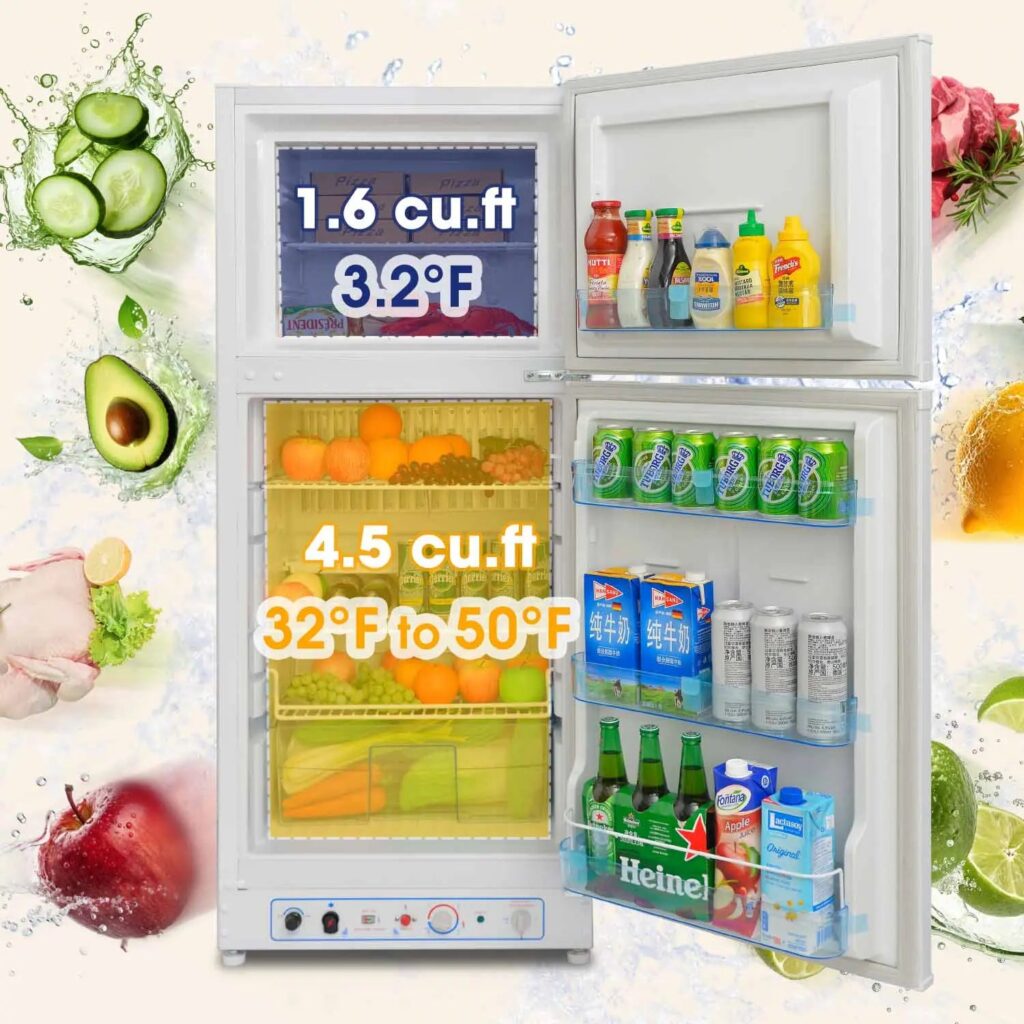
| Top-freezer fridges (6.1 and 9.4 cu ft) | 3.2°F up to 50°F | Propane, 110V AC |
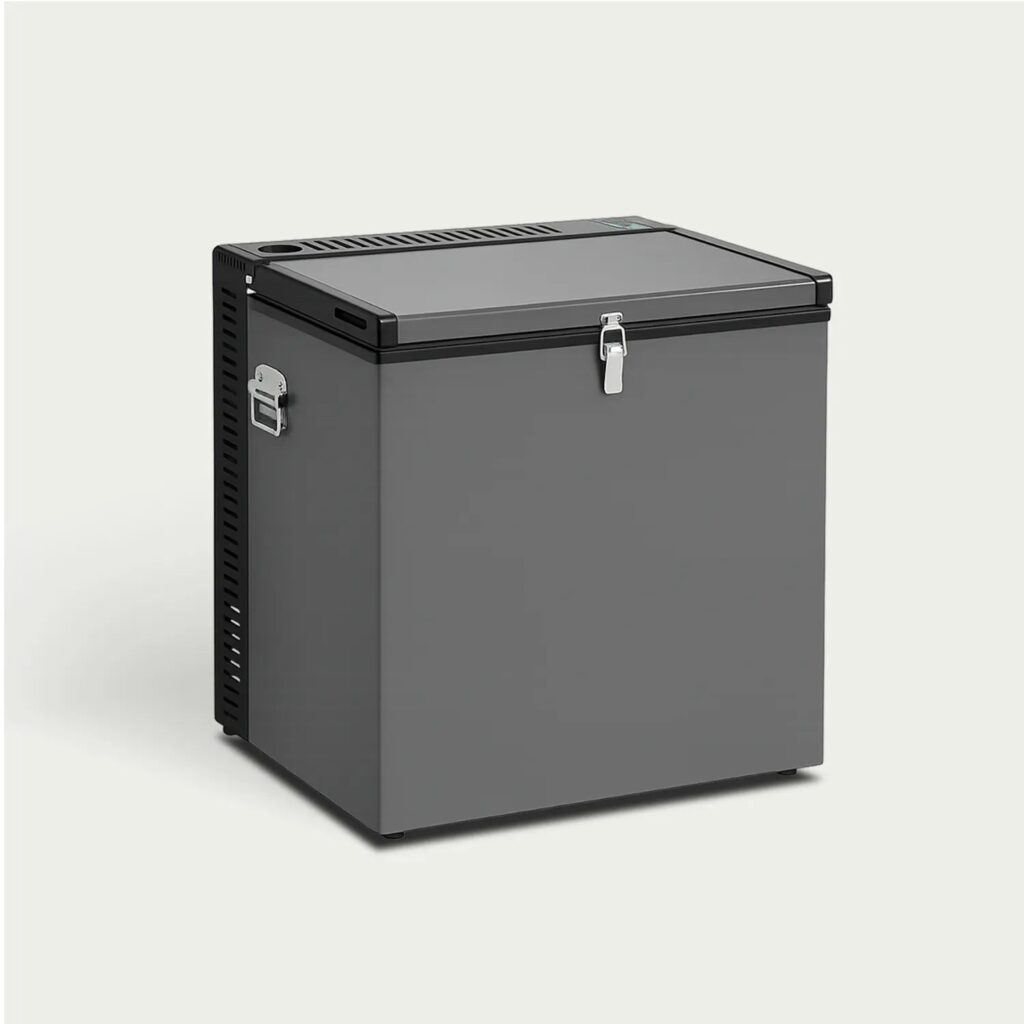
| Large chest freezer (7.0 cu ft) | 10.4°F up to 32°F | Propane, 110V AC |
| 3-way fridge (3.5 cu ft) | 10.4°F up to 50°F | Propane, 110V AC, 12V DC |
| Mini fridges (1.4 and 2.1 cu ft) | 32°F up to 50°F | Propane, 110V AC, 12V DC |
The 2.4 cu ft freezer reaches a lower rating than its much larger sibling. Since USDA guidance for the best frozen quality is 0°F or colder, food that must be held near that mark points toward the colder-rated models. The minis do not freeze at all.
Two-way or three-way power
The last column splits the lineup in two. Two-way units take propane or 110V AC, while three-way units add a 12V DC input, which makes them a fit for RVs, vans and trucks. One warning from Smad: never connect a 24V supply to the 12V input, since the manual says it will burn out the heating element.
The AC mode can run through an inverter, but the 5.35 kWh daily figure listed for the 7.0 cu ft chest freezer is a heavy load, so plan on propane first and AC as the backup, one source at a time.
Size, Space and Propane Budget
Size for your household
The table pairs each model with its rated propane use per day and a rough guide to the household it suits.
| Smad model | Rated propane use per day | Where it fits |
| 1.4 cu ft mini fridge | As little as 0.75 lbs | One person or weekend use |
| 2.4 cu ft chest freezer | 1.32 lbs | Compact freezing at 77 lbs, with a colder rating than the big chest freezer |
| 3-way fridge (3.5 cu ft) | 1.43 lbs | A couple at a cabin now and then, or an RV |
| 6.1 cu ft fridge | 2.33 lbs | A part-time cabin couple; at 57.5 inches tall it suits low ceilings |
| 7.0 cu ft chest freezer | 1.98 lbs | Bulk frozen storage beside a fridge |
| 9.4 cu ft fridge | 2.33 lbs | A couple or small family living off the grid full time |
| 19 cu ft stainless fridge | 3.53 lbs | A big household; the 13.4 cu ft fridge is the other large option |
Two owners on Smad’s store comment on size. One 2.1 cu ft owner liked the mini but wished for a bit more room, so size up when unsure. One 9.4 cu ft owner said it has enough space for two people.
Measure before you order
Smad’s FAQ asks for measurements of the cabinet and of every doorway, hallway and staircase on the delivery route. The clearances in the next section come on top of the cabinet’s own dimensions.
Budget the propane
Divide a tank’s weight by the daily figure in the table to estimate runtime. For the 9.4 cu ft fridge, a 100 lb tank comes to roughly 43 days at the rated draw. An owner on Smad’s store reported roughly a month from 40 lbs, so treat the rating as a guide, not a promise.
Prices
Smad changes its store prices often, so this guide prints none. Check the current price at SMAD for any model you shortlist.
Setup, Ventilation and Safety
First start-up
- Position: adjust the feet until the cabinet is level. If it tipped over in delivery, leave it upright for 4 hours first.
- Gas check: ahead of the first lighting, open the tank valve with nothing ignited and wipe soapy water over each gas connection. Bubbles signal a leak.
- Clean: wash the interior with lukewarm water and mild detergent, then dry it.
- Loading: run it empty for a full day, put in about a third of the capacity, and fill the rest a day later, keeping roughly a fifth of the interior open so air can circulate.
Lighting the 7.0 cu ft chest freezer on propane takes three moves: set the power selector to propane, press the pulse igniter and keep the safety valve button held for 10 to 15 seconds. The temperature dial is numbered 1 to 4, with 4 coldest. If there is no spark, rule out the igniter battery first; its screw cap is at the left end of the control panel.
Clearances and fresh air
Smad’s manual gives two sets of clearances, one for a free-standing unit and a tighter minimum for cramped spots.
| Install | Behind | Each side | Above |
| Free-standing | About 300 mm (12 inches) | About 300 mm (12 inches) | 400 mm |
| Tight space | 20 cm | 10 cm | 20 cm |
The room matters as much as the gap around the cabinet. On propane, the manual and FAQ set these conditions:
- No bedrooms and no airtight spaces.
- An air opening of 3 square inches or more for fresh air.
- A window or exterior door in the same room.
- A CO detector in that room.
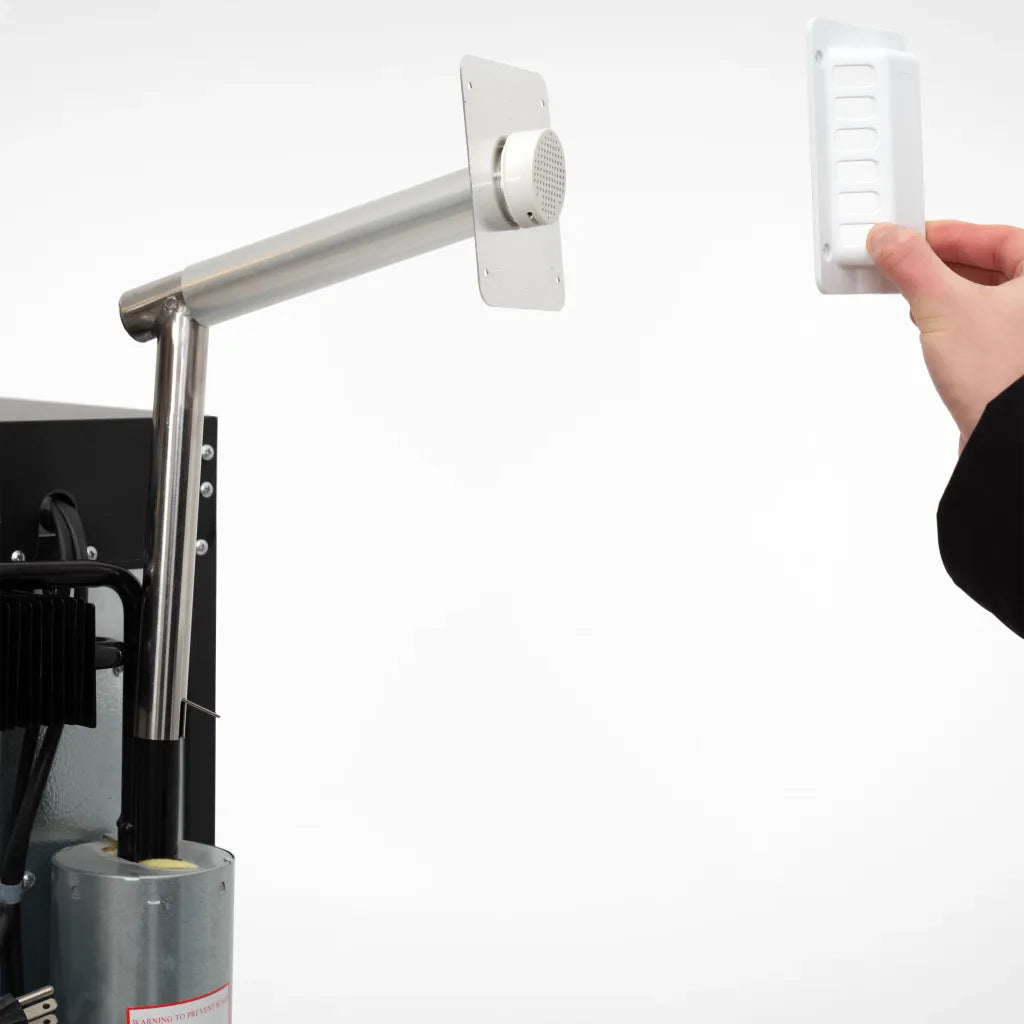
For a permanent indoor setup, Smad’s FAQ urges venting to the outside, and the store lists a gas flue vent kit. The same FAQ cautions that high elevation can weaken both ignition and cooling, so buyers should send Smad their elevation before ordering.
Gas and tank
The unit is designed for LPG, not natural gas, and the manual specifies a 28 to 30 mbar regulator with the tank at least 1 meter away.
If you smell gas, close the tank valve first, then put out any open flame and open the windows. Leave electrical switches alone, a phone included, and call the gas supplier.
Care and Maintenance Routine
Maintenance advice sits in several places in the manual. This table gathers it by part, with how often each one needs attention.
| Part | What the manual says | How often |
| Gas hose and connections | Look the hose over for cracks or heavy chafing, and retest each joint with soapy water, never a flame. | Monthly |
| Rear fins | Remove the dust, keeping hands off the pipes, which are hot while it runs. | About every 10 days |
| Burner head | With the gas off and the unit cool, brush it with a soft brush. Never probe the jet with a needle or wire. | About every 10 days and at each tank swap |
| Burner, orifice and flue tube | Clean all three, including the spiral baffle, which Smad says gas cooling needs for efficiency. | At least yearly |
| Electrode and thermocouple | Inspect both while the flue cover is off, and replace either one if corroded. | Yearly |
| Frost | Once it is thicker than 4 mm, switch off, empty the cabinet and leave the lid open until it melts. | As needed |
These are manual-defrost units, so the frost row is a task you will repeat. According to the manual, a burner has a working life of about 2 to 3 years of continuous use, and replacement goes through a dealer or service technician.
Smad lists replacement parts such as a gas thermocouple and a pulse igniter in its store, which you can browse on SMAD’s own site. Anything beyond routine fixes belongs with a certified technician.
Where to Buy, Warranty and Returns
Why buying direct matters
Smad’s warranty page ties coverage to orders placed on its own SMAD USA site, and to the first purchaser with proof of purchase. A brand-new unit from a third-party seller may therefore fall outside the warranty. Buying from the US store also brings free standard delivery, a 30-day return window and direct access to wear parts such as thermocouples, igniters and flue vent kits.
Marketplace listings sometimes use different model names and capacities, which makes it hard to match a unit to the spec sheet and warranty. Confirm by email with Smad whether such a purchase is covered before ordering.
Shipping and delivery day
Smad cannot deliver to Alaska, Hawaii, US territories or PO boxes, and it does not ship abroad. Elsewhere in the lower 48, handling takes 24 to 48 hours and delivery 3 to 6 business days, with large units going by freight. When the carton arrives, inspect and photograph it, because the manual wants shipping damage reported within seven days.
Returns and cancellations
The cost of sending a unit back depends on the reason. A change of mind is the costly one: Smad accepts it only by mutual agreement, and the buyer covers return shipping plus a restocking fee of 20% of the original order value. A defect leaves Smad choosing between accepting the return, repairing the unit free of charge or shipping a replacement. If the wrong or a damaged item arrives, Smad pays for the return shipping.
Nothing goes back before approval. Approval starts with an email that includes a screenshot of the order confirmation and, for a quality complaint, 3 to 5 clear photos. After that, pack the item in its original packaging, and Smad sends a label and books the pickup. The refund takes 1 to 7 business days to process once Smad receives the unit, plus up to 7 more to appear in your account. Cancelling is free if you contact Smad within 24 hours of ordering.
Warranty fine print
The one-year limited warranty is repair-first: a new unit comes into play only if yours cannot be fixed. Replacement parts are covered, but you pay to ship the unit for warranty service and carry the risk in transit. Cosmetic damage, misuse, improper installation and ordinary wear are excluded, and approved warranty returns have to be sent within 7 days.
Two details conflict between Smad’s pages. On length, the warranty page mentions one year only, while the product FAQ gives refrigerators a year on the whole unit and five on core cooling parts. On timing, the warranty page counts from the day of purchase and the return policy from receipt. Email Smad with your exact model, ask for both points in writing, and file the reply with your receipt.
Smad Compared With Unique Off-Grid
Two brands appear in this comparison: Smad, the newer name, and Unique Off-Grid, whose catalog credits a family founder with starting the company more than 50 years ago and whose freezers sell through big retailers. The matchup here is the SMAD 7.0 cu ft model against the Unique UGP-6F.
Safety hardware is the clearest difference. Unique also offers the UGP-6F CM, a variant that integrates a CO alarm and a safety shut-off, a feature that may matter for indoor use. Smad lists no built-in alarm and recommends a separate CO detector, though it adds a key lock and a balanced hinge that holds the lid at 45° or 75°.
On size, the two are close. Smad is 40.6 inches wide against 40.5 for Unique, lists 191 liters of capacity against 169, and weighs 141.1 lbs against 165. Unique rates propane use at about 1.8 lbs a day, with Smad at 1.98.
One gap limits the comparison: the material reviewed gave no temperature range for the UGP-6F, so the cold ratings cannot be set side by side. Smad’s is 10.4°F up to 32°F. Anyone who needs deep-freeze performance should put the question to both companies.
Pick Smad for a lighter cabinet with more listed capacity, provided you will supply your own CO alarm. Pick Unique for the longer brand history, a built-in alarm option and big-retailer availability. Compare current prices at both before deciding.
The Company Behind Smad
The corporate site, smadgroup.com, dates the company to 2004, and no founder is publicly named. One supplier directory gives an earlier start, 1999, and the sources reviewed hold no independent record that settles it. The manufacturer is Qingdao Smad Electric Appliances Co., Ltd., in the Shibei District of Qingdao, China.
On its own figures, the company has 600 employees, more than 50 production lines and over 70 technical engineers, with annual output of 350 million yuan. It exports to more than 100 countries and cites an ISO 9001 quality system.
Support runs by email, and the phone number printed on the store carries a Chinese +86 code, which is worth knowing if you prefer to settle problems by phone. Orders ship from US warehouses, so the store works as a direct-to-consumer operation. Smad runs dealer, influencer and affiliate programs, and videos from off-grid YouTube creators are embedded on the store, so read that footage as brand-friendly, not independent testing.
On its own store, Smad answers critical reviews in public. After one reviewer reported two dents in a fridge door, Smad’s reply offered either a partial refund or a swap and added that it never resells returned units. When another reviewer said a 13.4 cu ft fridge was not cold enough, Smad apologized on the page and followed up by email. Three gaps show up in the published material: one manual shared across the whole absorption range, warranty pages that disagree with each other, and no US phone line.
The trade-off for a manufacturer of this scale is a short public track record in the US: about 40 reviews across the propane models on the store, and a warranty tied to buying direct.
Common Questions
Who is behind the Smad brand?
Qingdao Smad Electric Appliances, a manufacturer in China that exports to more than 100 countries. The US store ships from warehouses in the US.
Does 7.0 cu ft mean seven cubic feet?
Slightly less. Net capacity in the spec table is 191 liters, or about 6.75 cu ft, and the 7.0 in the name is a rounded label.
How soon does it start cooling?
Smad’s FAQ gives roughly 8 to 12 hours for the first cooldown. The manual wants the unit to run empty for 24 hours before any food goes in, then to be filled gradually.
Is it frost-free?
No. Frost is cleared by hand: past 4 mm, the manual says to power the unit down, remove the contents and leave the lid open until the frost has melted.
Can it run on natural gas?
Not as supplied. It is built for LPG delivered at 28 to 30 mbar, and conversion needs approval from your gas supplier plus a different jet installed by the distributor.
Which Smad Model to Pick
- Cabin fridge for full-time use: the 9.4 cu ft model. Its five reviews on Smad’s store are all five stars, though that is a small sample.
- Mid-size or low ceilings: the 6.1 cu ft fridge at 57.5 inches tall.
- RV or van: the 3-way models, from the minis to the 3.5 cu ft fridge, plus the 2.4 cu ft freezer for colder freezing.
- Bulk frozen storage beside a fridge: the 7.0 cu ft chest freezer, if its 10.4°F limit is acceptable. Our full verdict on this 7.0 cu ft SMAD propane freezer covers every detail.
- Backup or occasional cooling: the 1.4 cu ft mini, which is a fridge only.
Whichever model you choose, two rules matter most: keep it level and keep it ventilated. And for warranty coverage, buy through the brand’s own store. You can compare the full lineup on SMAD’s site before you decide.