A neck fan looks like a gimmick until you are standing on a hot platform, queuing at a festival gate or sitting in a stuffy office with both hands busy. Then a light band that moves air over your neck starts to make sense.
This guide uses the Chasesun Portable Neck Fan as its running example. It makes a clear case study: one product, a published spec sheet and a close rival, Kesguar, to measure it against. Along the way it explains how bladeless fans work, which specs deserve your attention, where a neck fan earns its place and how to look after one.
It is research, not a hands-on report. The figures come from the spec sheet and the brand’s own storefront, and the noise and airflow comparisons come from independent testing. I point out where a number is only a claim and leave out anything I could not confirm.
What a Neck Fan Actually Does
A neck fan is a personal cooling device. It does nothing to the temperature of the room. Instead it moves air over the skin of your neck, chin and jaw, which is where many people feel the heat first and where a fan is easy to aim without holding anything.
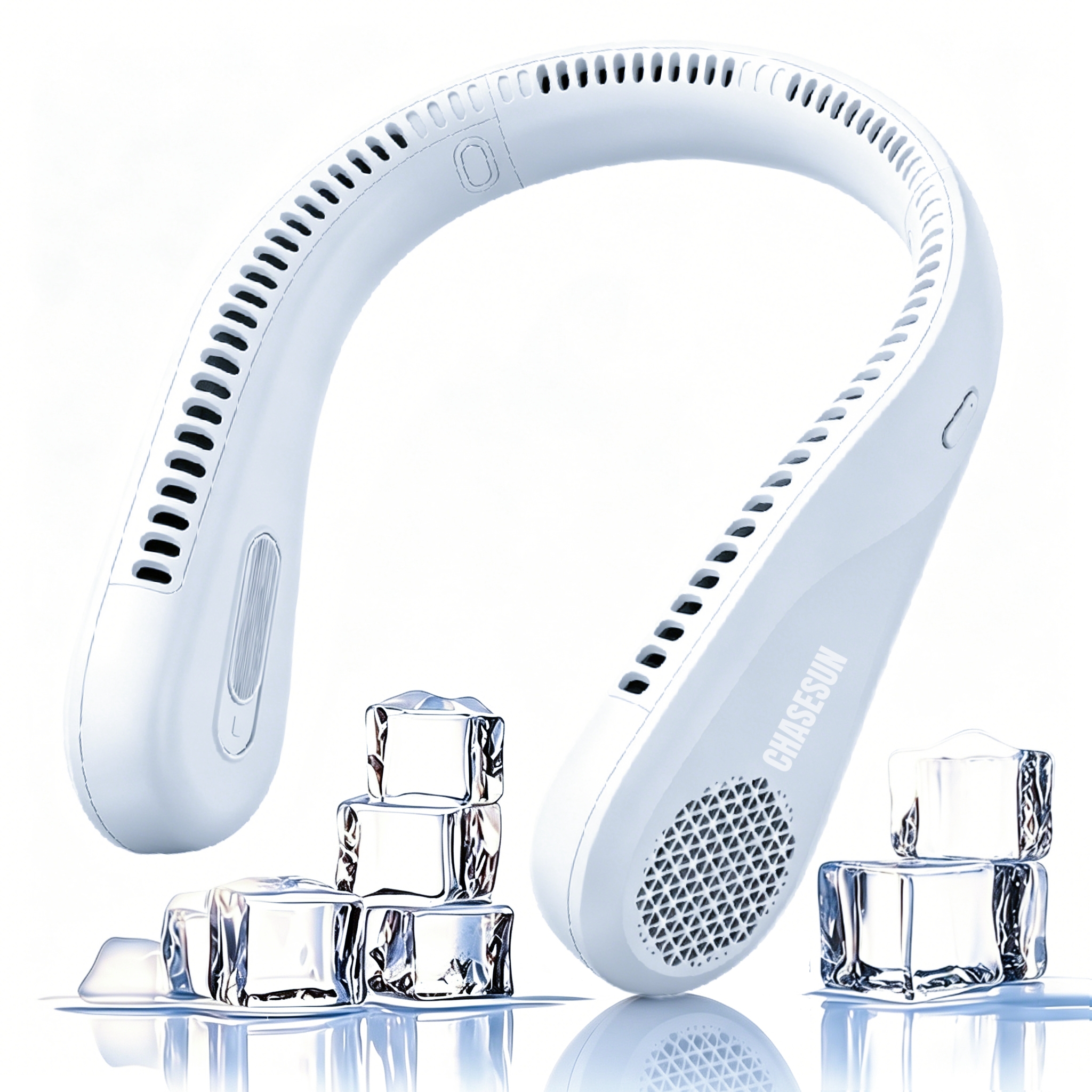
The word “bladeless” on a neck fan is about appearance. Hidden inside the casing, a small motor still creates the airflow, which is routed along internal channels and released through a row of vents instead of an open cage.
Chasesun’s version has 86 outlets, arranged to spread air over the neck and jawline, and the worn format means the airflow stays on you without a hand on the device.
Keep one expectation in check. A neck fan gives relief to you, not cooling to the space around you. That is why the specs worth comparing are about comfort and endurance, such as noise, weight, airflow and battery, and not about room size.
Start With Where You Will Wear It
Before you look at a single spec, ask where the fan will spend most of its time. That answer settles most of the other choices.

Desks and shared rooms
Noise matters most in shared rooms. A fan with a hushed lowest setting can stay on through a video call, while a loud one tends to get switched off. Chasesun’s claimed 25dB on its lowest speed is the figure to weigh here.
Commutes and waiting around
Waiting on a warm platform or at a bus stop is a natural use, because the fan needs no hand to hold it. Before you commit, picture a band-style fan under a bag strap or a jacket collar.
Concerts, festivals and events
Long days in the sun put battery life first. Pick a fan rated for a full day, and bring a charging cable so you can recharge afterward.
Yard work and chores
Mowing, weeding and similar jobs already keep your hands busy, so a fan you never have to hold fits naturally. Outdoors, the extra noise of the higher speeds matters less than it would at a desk.
Camping and hiking
On a trail every ounce counts, and at 9.2 ounces the Chasesun adds little to a pack or to your neck. It is described as water-resistant, but with no published IP rating that means keeping it dry when you can, not wearing it through rain.
Air travel
Terminals and packed cabins can run warm, and a worn fan leaves your hands free for bags and boarding passes. Before you pack any battery-powered gadget, check the airline’s own rules for carrying it.
As a gift
Anyone who runs warm, commutes without air conditioning or works outdoors could use one. With a single model and no color choices, there is little for the giver to get wrong.
Noise, Weight, Airflow and Battery
Neck fans look alike in product photos. Four measurable things set them apart, and the trade-offs between them are where the decision gets made.
Noise
If other people are nearby, quiet matters more than force. Look for the figure measured on the lowest speed, and remember that noise rises as the speed does.
The Chasesun spec sheet claims about 25dB on low, and independent testers reported close to that. The figure covers the lowest setting only, so expect more sound as you raise the speed.
Weight and fit
Anything worn on the neck for hours should fade into the background, so weight deserves attention. Chasesun’s 9.2 ounces compares with about 11.3 ounces for Kesguar, a gap you would carry all day.
Fit is personal, though, and nothing on a spec sheet settles it. Whatever you buy, check how it sits against the collars, straps and headphones you wear most often.

Airflow and speed settings
A long list of speed settings matters less than it sounds, because only the speeds you would actually use count. A sharper test is how strong the air feels at the speed you favor, measured against the weather you face.
Chasesun lists 35 CFM, with air moving at about 3.4 m/s. Independent testing places that at the gentler end of the category, a trade for the low noise.
Battery and charging
Always ask how the advertised runtime was measured. A figure taken on the lowest speed shrinks once you turn the fan up.
Chasesun states up to 20 hours at the lowest of its four speeds. Refilling from empty takes about four hours over USB, so an overnight charge fits, provided you remember to plug it in.
The Chasesun Specs in Plain Terms
Here is the whole spec sheet in one place, followed by what the lines mean in daily use.
| Spec | Chasesun Portable Neck Fan |
| Weight | 9.2 oz |
| Noise | About 25dB on the lowest speed |
| Airflow | 35 CFM, air speed around 3.4 m/s |
| Speeds | 4 |
| Air outlets | 86 |
| Battery | 6000mAh |
| Runtime | Up to 20 hours at the lowest speed |
| Full charge | About 4 hours over USB |
| Water | Water-resistant, no published IP rating |
The 6000mAh figure is capacity, comparable to a mid-size power bank. That capacity is what lets the fan stretch to a long day on low, and it is why runtime drops when you raise the speed.
The 86 outlets are the bladeless part of the story. Chasesun designed them to spread air over the neck and jawline instead of firing a single narrow stream, which is the brand’s answer to a fan worn this close to the face.
Read the water-resistance claim carefully. Chasesun uses the term, but no certified rating is published, so assume sweat at most and keep the fan away from taps and heavy rain.

If those figures fit your plans, you can browse Chasesun’s storefront on Amazon. The link opens Amazon in a new tab, so check the current price there.
Chasesun vs Kesguar
Kesguar is a close competitor to the Chasesun. Both have a 6000mAh battery and a runtime of up to 20 hours, and the differences start after that.
| Spec | Chasesun | Kesguar |
| Weight | 9.2 oz | About 11.3 oz (320g) |
| Speeds | 4 | 6 |
| Airflow | 35 CFM | Stronger, exact CFM not published |
| Design | No exposed blades, 86 vents | No exposed blades, dual turbo airflow |
Chasesun’s case rests on weight and quiet. It is lighter by roughly two ounces, and its low-speed figure of about 25dB is the one to weigh for desks and shared spaces.
Kesguar’s case rests on control and force. It offers six speeds against four, and independent comparisons say it moves more air.
If you want to see how the Chasesun holds up on its own, our full verdict on the Chasesun Portable Neck Fan goes through the specs, the trade-offs and who should skip it.
Charging, Cleaning and Storage
Three things shorten the life of a battery-powered fan: poor charging habits, heat and grime. Each is easy to manage.
Charging habits
Lithium batteries last longest when they avoid both ends of the scale. Top up the fan before it dies completely, and don’t leave it on the cable for days once it has filled.
Cleaning
Water-resistant is not waterproof, so skip the tap. A lightly damp cloth is the right tool for the housing and the vents, and the fan should be fully dry before you charge it or switch it on again.
A fan worn against bare skin collects sweat and sunscreen. Wiping it down after a hot day keeps that residue from building up in the vents, where it may gradually weaken the airflow.
Storing it between uses
Putting the fan away for months? Leave it partly charged, not empty and not full, in a cool, dry place. Heat is the bigger threat to the battery, so a parked car or a sunny windowsill is the wrong spot.
If battery life drops sharply or the fan stops charging, check the return and warranty terms on your order before writing it off.
Buying the Right Listing
Many neck fans look nearly identical in thumbnails, so it pays to confirm that you have the genuine item. Chasesun sells through Amazon and through its own small storefront.
With one model in the range, there is nothing to confuse it with, which keeps the check short. Work through these points:
- Specs first. The page should show 6000mAh, four speeds, 86 air outlets and 9.2 ounces. Very different figures under the Chasesun name suggest another product using it in the title.
- Then the brand. Chasesun or CHASESUN LLC should appear as the brand, not a generic store name.
- Too good to be true. An offer that seems unusually generous can point to a copycat or to a lower-spec unit sold under a similar name.
- One model only. The brand’s own materials list a single fan and no color options, so anything pitched as a different version deserves a second look.
Check returns yourself before ordering. Purchases through Amazon fall under its standard marketplace return policy, so read the terms on the product page you pick. Chasesun’s storefront links to a warranty page, but its terms are not covered by the material behind this guide.
If something goes wrong, start with the seller you bought from.
About the Brand
Chasesun LLC is the registered name behind the fan, and the oldest copyright date on its storefront is 2019, which points to a company that has been around for some years, in one form or another.
Beyond that, the material behind this guide gives no founder name, mission statement or press coverage. The range is just as short: one fan, with no second product line and no accessories.
With no flagship shop and no long history to lean on, the product has to earn trust through its specs and through independent testing, not through brand reputation.
Chasesun Neck Fan FAQ
How many hours will it run?
Chasesun’s runtime figure is up to 20 hours, measured on the lowest of the four speeds, and each higher speed shortens that.
How long does a full charge take?
Roughly four hours over USB, starting from empty.
How do I change the speed?
A press of the control button steps the fan through its four speeds.
Is it noisy?
The lowest speed is claimed at about 25dB, and independent testing reported a similar figure. Noise rises with the speed, so the top setting will be louder.
Will it tire my neck?
The 9.2-ounce body is light, and lighter than Kesguar’s roughly 11.3 ounces, but comfort over several hours depends on your build and clothing, so the spec sheet can’t settle it.
Does it catch hair or loose clothing?
Chasesun’s bladeless design is meant to prevent it. Small vents replace exposed blades, so there are no open blades to snag hair or loose fabric. That is a design claim, not a safety certification.
Is it waterproof?
No. The fan is described as water-resistant with no published IP rating, so assume sweat at most and never submerge it.
How strong is the airflow?
Chasesun lists 35 CFM with air at about 3.4 m/s. Next to rivals with higher CFM figures, that is the gentler end, which is the price of the lower noise.
Can I pick a color?
There is one model, and no color options are listed publicly.
Is it suitable for children?
Chasesun has not published age guidance, so that decision belongs to a parent or another adult. A bladeless design avoids exposed blades, but that is a design feature and not an age rating.
Before You Decide
Choose a neck fan by how you will use it, not by how many features it lists. Decide where it will live, then rank noise, weight, airflow and battery in the order that matters for that setting.
The Chasesun leans toward quiet and light. It gives up some raw airflow for that, and its water resistance and warranty terms are worth checking for yourself before you order.
If that balance sounds right for your days, you can browse Chasesun’s storefront on Amazon and compare it with your shortlist.