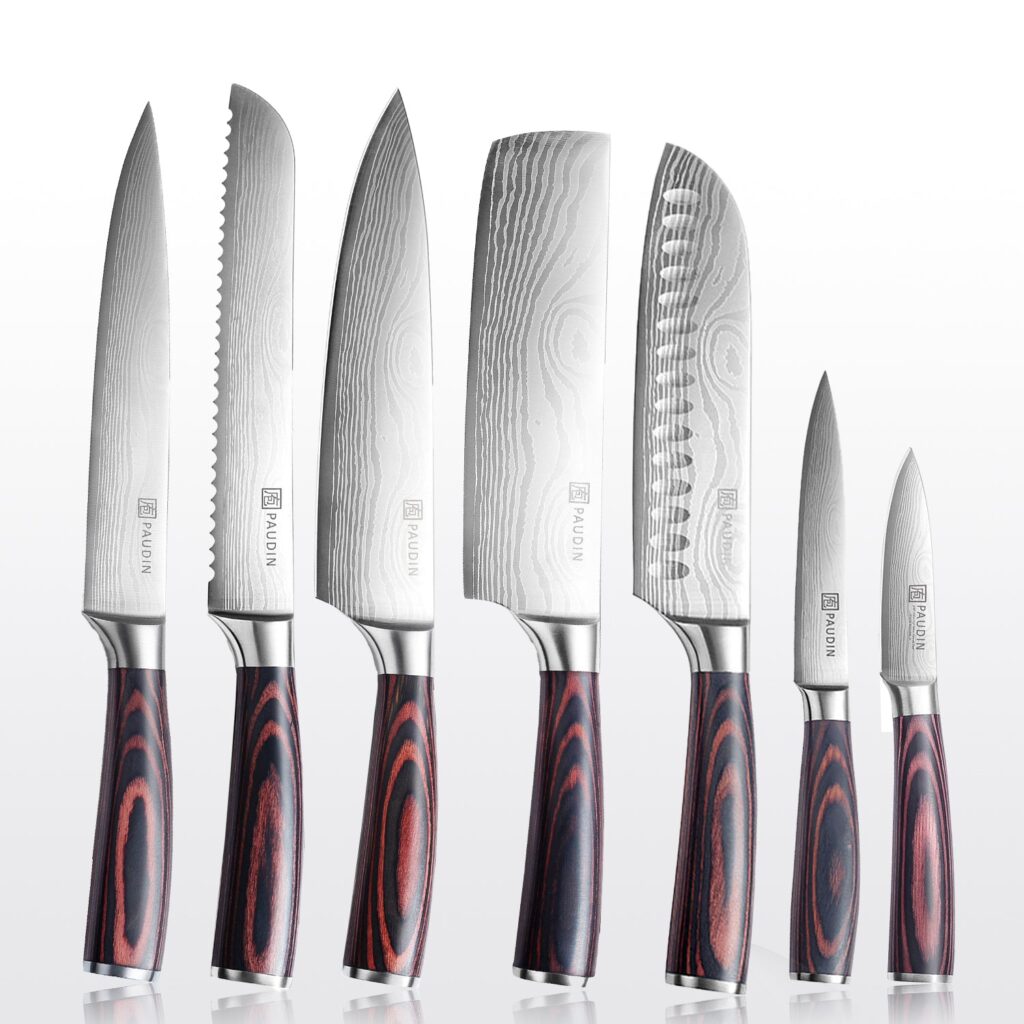
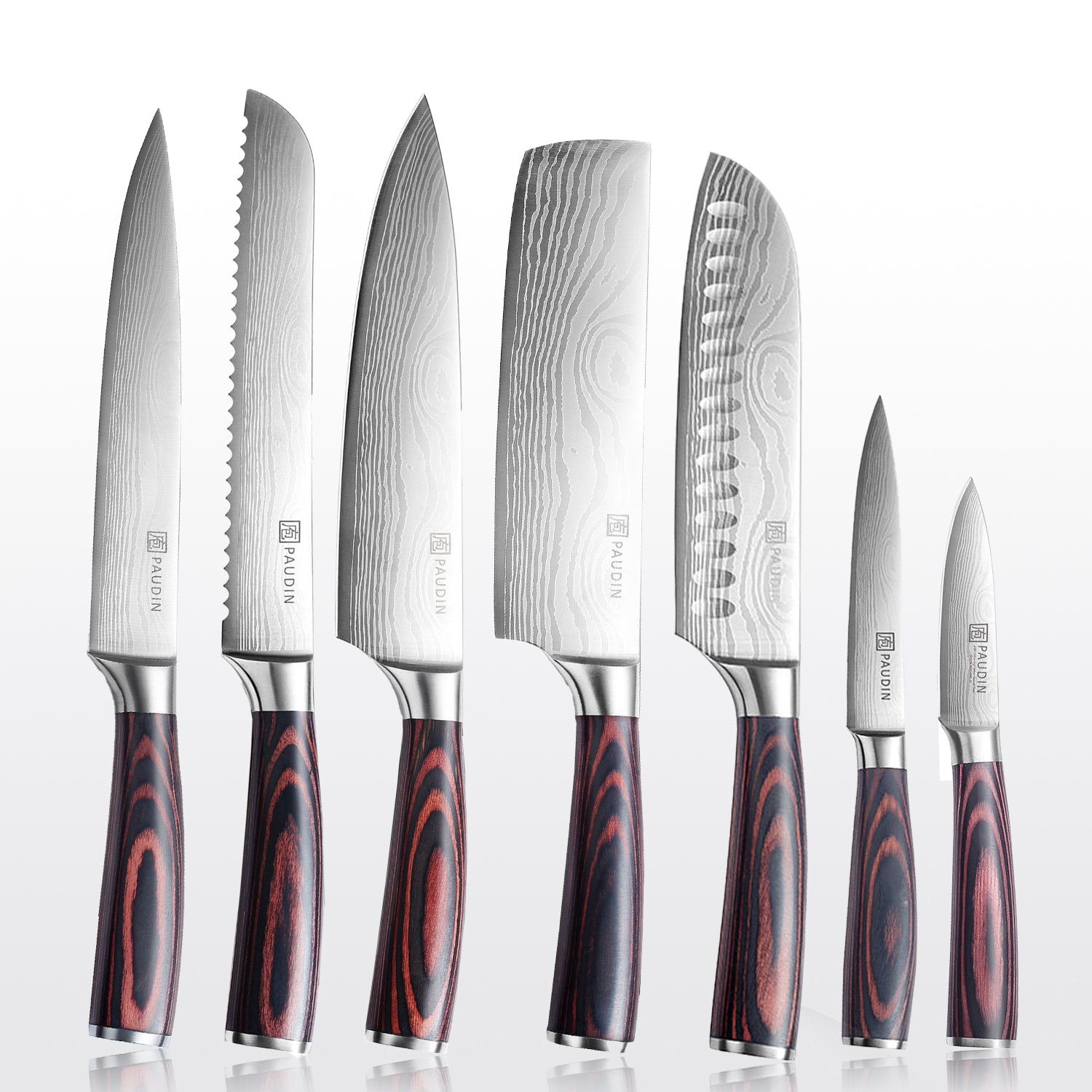
Paudin has built its name on knives with wave-etched blades and warm red-brown wood handles. The Universal Classic 7-piece chef knife set is the one covered here, and it puts a blade for nearly every kitchen job into one gift box.
This is a research-based look. It draws on the brand’s spec sheet, its published policies and an independent hands-on review of a larger Paudin set, so you can weigh the numbers before you click anything.
The short version: a thin-edged, handsome set for home cooks who are happy to wash by hand and hone now and then. It is not a dishwasher set, and an independent reviewer pitches the brand at home cooks rather than professionals.
What You Get in the Box
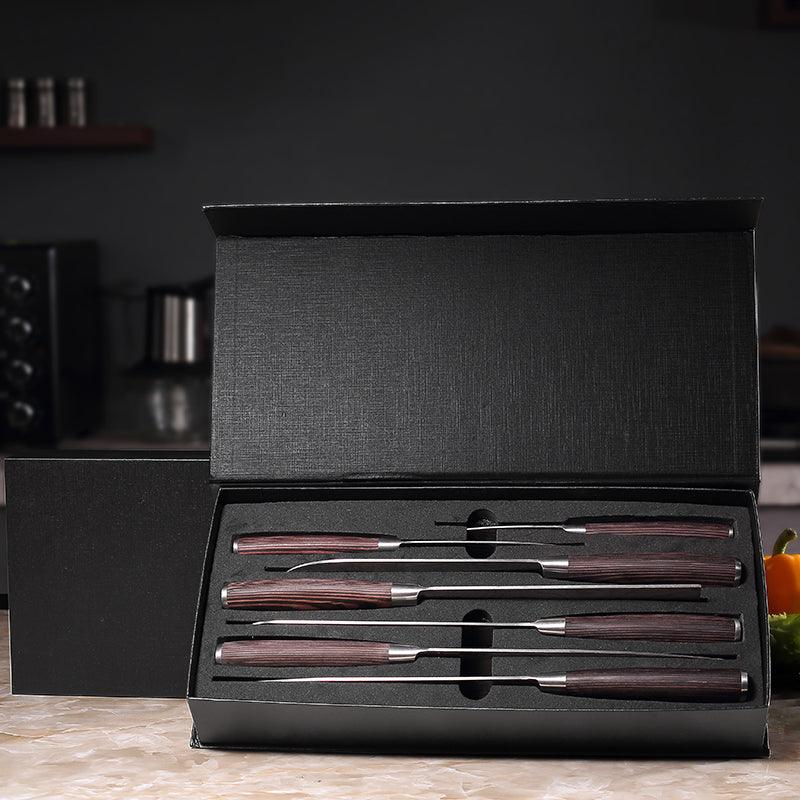
Seven knives arrive in a black presentation box, and a block is not part of the package. Plan on a magnetic strip, a drawer tray or a separate block to keep the edges from touching.
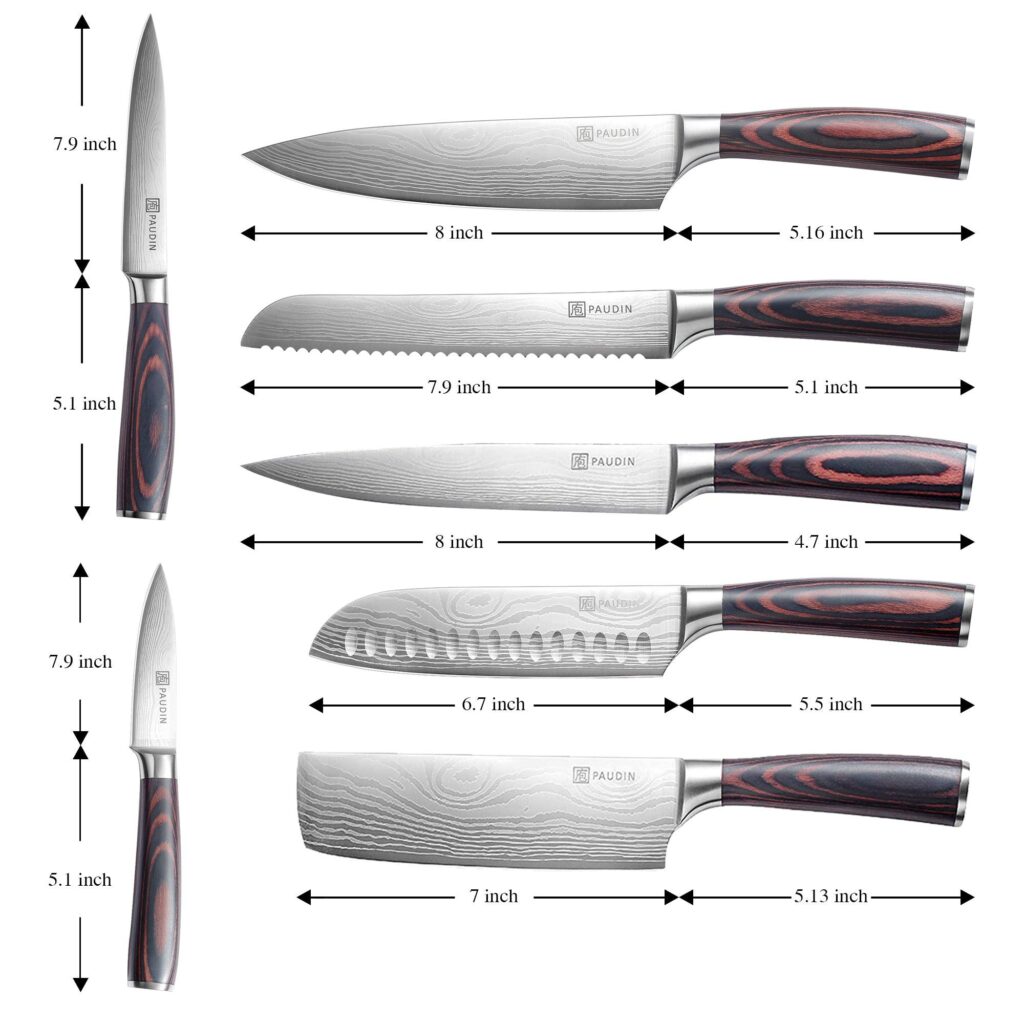
- 8″ chef knife: the all-rounder for chopping, slicing and dicing
- 8″ bread knife: serrated, for crusty loaves and soft produce
- 8″ carving knife: a long, slim blade for roasts and larger cuts
- 7″ santoku: a compact, flat-edged all-rounder whose edge dimples help slices release
- 7″ nakiri: a squared-off knife made for vegetables
- 5″ utility knife: a mid-size helper for sandwiches and fruit
- 3.5″ paring knife: peeling, trimming and other detail work
If roasts and fresh loaves are rare in your kitchen, the carving and bread knives may stay in the box. Cook both often and a full set beats buying singles one at a time.
To see what is listed, you can browse Paudin’s storefront on Amazon, which opens the brand’s page there.
The Specs in Plain English
These are the figures the brand publishes for the set. The notes after them explain what they mean at the cutting board.
- Blade finish: laser-etched wave pattern
- Grip: Pakkawood handles
- Metal: 5Cr15MoV, a high-carbon stainless grade
- Rockwell rating: 56+ HRC
- Bevel: 13° on each side of the blade
- Thickness: 2mm blades
- Care: hand wash, dry right away, store dry
Four elements define this steel. Carbon gives hardness, chromium resists rust, and molybdenum and vanadium add toughness and a fine grain. The grade name, 5Cr15MoV, encodes the mix: roughly half a percent carbon and fifteen percent chromium, with the last two in small doses. It is a Chinese stainless grade.
A rating of 56+ on the Rockwell C scale puts the set toward the softer end of kitchen steel, since many Western knives sit in the high 50s and many Japanese ones reach 60 or more. Softer steel generally resists chipping and is easy to realign on a honing rod. The price is more frequent edge refreshing than harder blades would need.
At 13° per side the edge is acute, the kind that generally takes little pressure on soft produce. The same thinness leaves it prone to bending out of line on hard or frozen items, which are better left to a different tool.
One spec wrinkle. The brand never says which knives use which steel, and Paudin’s own store describes this line as 3Cr13MoV/5Cr15MoV with a hardness of 52+/56+. That means some blades may be the softer grade, so anyone who cares about the detail should write to Paudin’s support team before ordering.
The wave pattern is etched onto a single steel by laser, not forged from layers, and the brand’s listing describes it that way. It changes the look, not the way the knife cuts.
What Stands Out on Paper
The edge geometry. A 13° angle on a 2mm blade is a slim profile, and it is the number that explains why these knives are marketed as razor sharp.
The mix of shapes. The santoku and nakiri borrow from Japanese designs, so the set leans toward vegetable-heavy cooking while still covering bread and roasts.
The handle. Pakkawood layers wood veneer with resin. It keeps a natural-wood appearance and tolerates moisture better than ordinary timber, though it should still stay out of standing water.
For an outside view, an independent hands-on review of Paudin’s 14-piece set found the blades sharp and called the set a sound entry-level option for home cooks. The same reviewer noticed an uneven grind along the edge, spines with sharp corners, and a possible small rise in corrosion risk from the etching. A hardness measurement cited there, 57 HRC, fits the brand’s stated range.
That review covers a different set, so read it as a hint about Paudin’s general build rather than a verdict on this one.
Where It May Fall Short
Hand washing only. The brand’s care panel recommends hand washing and drying straight away. Wood handles and a thin edge do not suit dishwasher heat or rattling.
Regular upkeep. A thin edge on softer steel asks for a honing rod before cooking and a stone a few times a year. Keep bones and frozen items away from the chef knife, santoku and nakiri.
No storage included. Loose knives in a drawer can chip edges and scratch the etched pattern, so plan for space and a holder of your own.
Aimed at home kitchens. The independent reviewer pointed this brand at home cooks, and nothing in the specs suggests a set meant for hours of daily prep.
How It Compares With imarku
imarku is a useful point of comparison. It also sells Japanese-style knives with Pakkawood handles in a gift box with no block.
| Detail | Paudin Universal Classic | imarku Japanese Pro |
| Warranty | Lifetime, against defects, tied to purchases from Paudin’s own store | One year from delivery |
| Rockwell figure | 56+ HRC (store also shows 52+/56+) | 57±1 HRC |
| Bevel | 13° each side | Roughly 13° each side |
| Steel | 5Cr15MoV, with 3Cr13MoV also named by the store | Japanese high-carbon stainless |
| Set size compared | 7-piece set | 5-piece set |
On paper the two sit very close. imarku quotes a slightly harder steel, and it says vacuum heat treatment is part of its forging. Its 8″ chef knife is listed as hand-forged 7Cr17MoV with a full tang, a grade with more carbon and chromium than 5Cr15MoV, which in theory means longer edge life.
Each brand also comes with a heritage story. imarku’s traces a Japanese bladesmith family back to 1949, while Paudin’s centers on four founders from four countries, a tale the research behind this page could not confirm independently. Treat both as marketing and judge by the specs.
Pick Paudin if you want more knives in one box and you like the red-brown handle look. See Paudin’s knives on Amazon to browse the lineup.
Pick imarku if you would rather own fewer knives, want a slightly harder stated steel and prefer a warranty that does not depend on where you bought.
Warranty, Returns and Where You Buy
Read this first. Paudin’s warranty page ties every claim to purchases made on the brand’s own store, and only the original buyer qualifies. A marketplace listing may advertise a lifetime warranty as well, so hold on to your order details whichever store you use.
Within that limit, the cover is for flaws in materials or workmanship and for items that fail during ordinary home use, and Paudin chooses between repair, replacement and store credit. Scratches, dulling and discoloration count as everyday wear and are excluded, as are misuse, accidents, neglect and poor maintenance, and anything modified, resold or bought from a seller the brand has not authorized.
Paudin’s own site allows returns for 30 days from delivery, though a change-of-mind return there brings a restocking fee and a handling fee, with return shipping on you. Orders placed through Amazon follow Amazon’s own return terms, so read them at checkout.
Whichever store you use, look the knives over when they arrive for visible flaws in the handles, blades and edges. Photograph anything odd, since Paudin asks for photos with every claim.
Frequently Asked Questions
Is the 7-piece set dishwasher safe?
Not this one, since the care panel recommends hand washing. Paudin’s store labels a few Ultra Dark models dishwasher safe, but those belong to a different line.
Does it include a knife block?
No. This set ships in a gift box alone. Storage comes with Paudin’s block sets, for example the 15-piece set with its wooden block.
Is the wave pattern real Damascus?
Paudin sells its Cloud Premium and Plume Luxe lines as Damascus steel. This line is different, because its pattern is laser-etched.
Where are Paudin knives made?
The independent review of the 14-piece set notes Chinese manufacture, and the US trademark is held by a company in Shenzhen.
Does it make a good gift?
It is packaged for it, in a presentation box. One practical point: the brand-store warranty belongs to the original purchaser only, so a giver should keep the order confirmation.
The Verdict
For a home cook who wants a full, good-looking set in one purchase, the Paudin 7-piece set is a strong candidate on paper. The thin 13° edge and the spread of shapes cover most tasks, and the brand’s care rules are short and easy to follow.
Be realistic about the trade-offs. The steel is on the softer side, hand washing is required, storage is up to you, and the brand’s own listings disagree about which steel is used. Treat the knives gently, hone often and they should suit an ordinary kitchen.
If you need dishwasher-safe knives or professional-grade toughness, look elsewhere. Otherwise, browse Paudin’s storefront on Amazon and compare the current listings with your own shortlist.