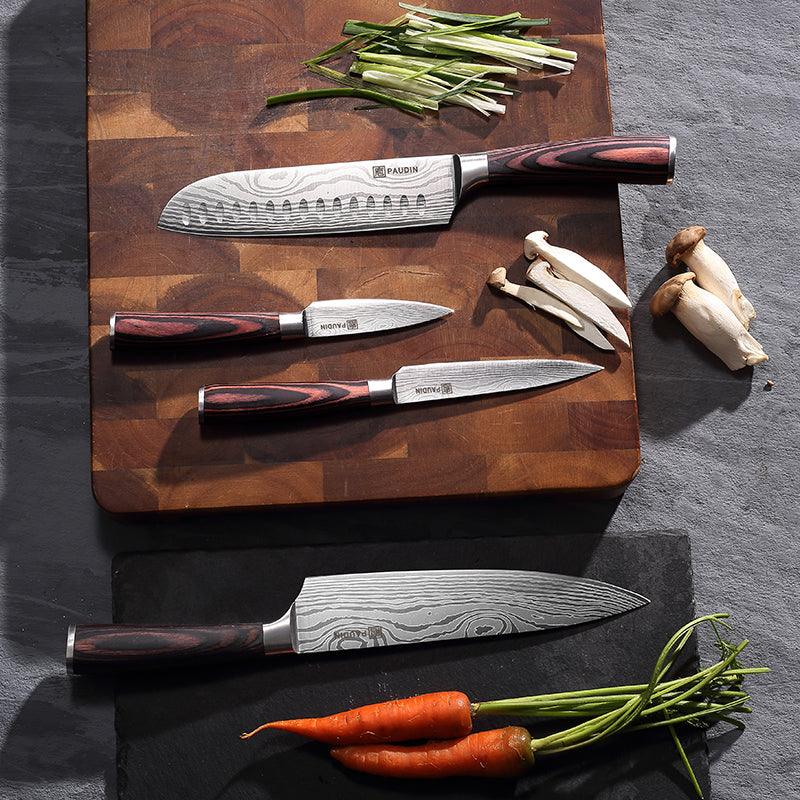
Paudin’s catalog is wide. Single knives, compact trios, large block sets, steak knife sets, sharpening gear and Damascus lines all sit under one name, and the product pages do not always agree with each other on the details.
This guide sorts it out. It covers who stands behind the brand, what the steel and edge numbers really mean, how to match a set to the way you cook, how to keep the blades in shape and what the warranty does and does not promise.
It is built from the brand’s own spec pages, its published policies, public trademark records and an independent hands-on review of a larger Paudin set. Where the sources disagree or go quiet, the guide says so instead of guessing.
Who Is Behind Paudin
Paudin’s About page frames the whole brand around one idea: a knife should follow the natural lines of the food instead of forcing its way through. The idea comes from the name, a play on Pao Ding, a cook in the ancient Chinese text Zhuangzi. In that parable he carves an ox so skillfully that the blade never meets bone, and in the brand’s retelling the blade kept its edge for nineteen years.
The business side is easier to verify. The US trademark for PAUDIN is registered for kitchen knives, cleavers and similar cutlery, and its owner is a limited company based in Shenzhen, China. The record shows first use in US commerce in late 2017, a filing during 2018 and registration in 2019.
The About page also credits four founders from four countries. Justin of the United Kingdom is linked to design, Hiroyoki of Japan to blade-making tradition, Vicky of Russia to durability and David of China to balance and the Pao Ding tale. Nothing in the research behind this guide backs up those names or roles, so read it as brand storytelling and not as documented history.
Is Paudin a Japanese brand? The cues point that way, but the evidence does not. The santoku and nakiri shapes and the Japanese craft language in the marketing are borrowed, while the trademark owner is Chinese and an independent reviewer reports that the knives are made in China. None of this counts against the knives. It does mean the numbers on the spec sheet are a better guide than the branding.
Paudin describes itself as a seller in 22 countries whose customers include restaurants, schools and churches, with custom orders accepted from 30 pieces. It also operates a web store of its own, and the warranty page there says those orders ship through Amazon’s multi-channel fulfillment. The brand sums up its outlook as harmony, precision and endurance, and says it favors sharpness, durability and looks over chasing trends.
The Paudin Lineup
Universal Classic
This is the line the 7-piece set belongs to. It pairs red-brown Pakkawood handles with a laser-etched wave pattern, 5Cr15MoV steel and a 56+ HRC rating. Sets come as a 3-piece trio, a 5-piece set and the 7-piece set, and most of them arrive in gift boxes rather than blocks.
Cloud Premium and Plume Luxe
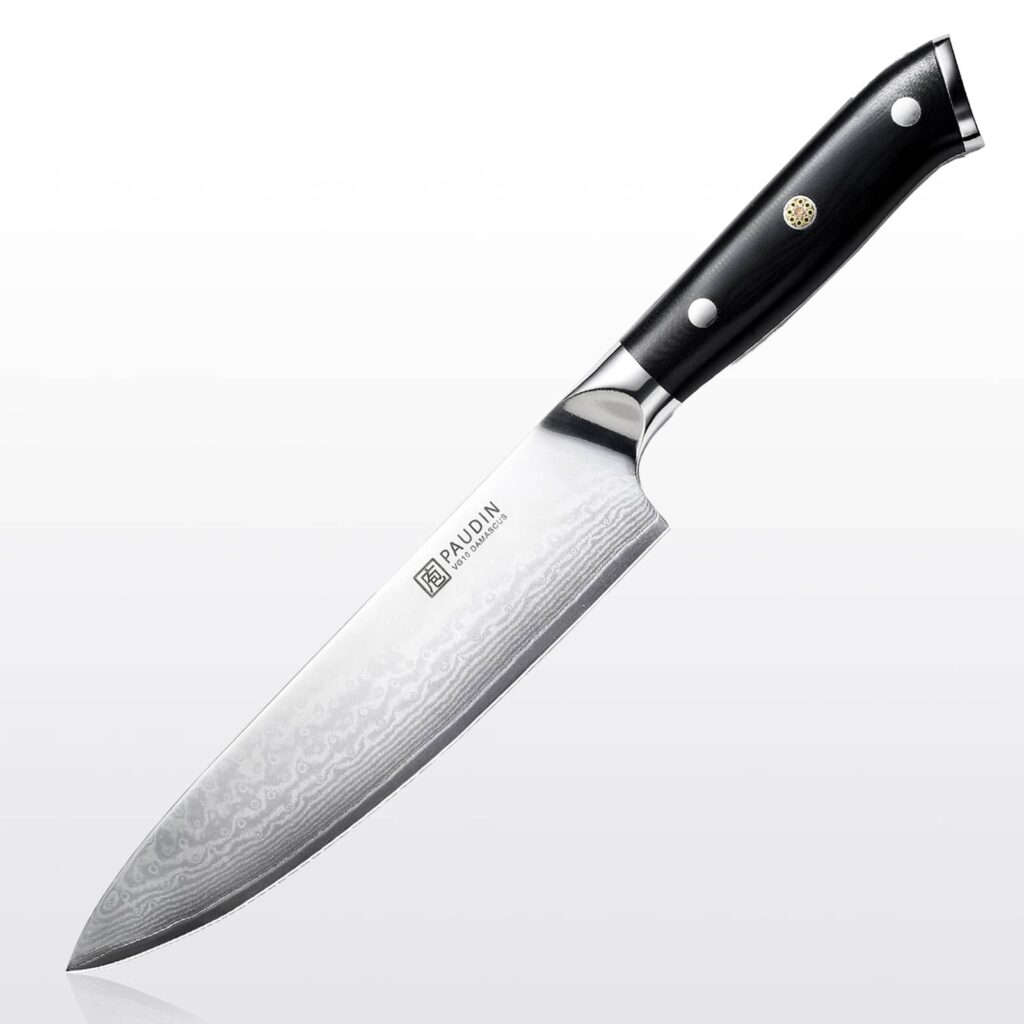
Both sit above Universal Classic and are sold as true layered Damascus. Cloud Premium’s spec line gives VG10 steel rated 62+ HRC, and the handle is G10 fiberglass, but the page’s description mentions AUS10, so the core steel is not clear. The sources add little about Plume Luxe beyond its Damascus construction.
Block sets and other lines
The 15-piece block set is built differently from Universal Classic. Paudin lists a full tang, three rivets in each handle, ABS handle material, an acacia wood block and an edge angle of 14 to 16° per side. Another set, the AS5, is listed with 14C28N steel at HRC 63. A handful of Ultra Dark models carry a dishwasher-safe label in the brand’s store, unlike the Pakkawood sets.
What the Steel and Edge Numbers Mean
Decoding 5Cr15MoV
Paudin’s headline steel is a Chinese stainless grade with four ingredients doing most of the work. Carbon supplies hardness and edge holding, chromium supplies rust resistance, and molybdenum and vanadium add toughness and a fine grain. The code spells out the recipe: the 5 stands for roughly half a percent carbon, Cr15 for roughly fifteen percent chromium, and MoV for small amounts of the last two.
For reference points, it sits closer to the steel in many classic Western knives than to premium Japanese steel. That tends to mean easy sharpening and decent rust resistance in exchange for a shorter stretch between touch-ups.
What HRC 56+ tells you
Hardness is a trade. Harder steel keeps an edge longer but can chip when twisted or pushed against bone, and softer steel does the reverse. Universal Classic is rated 56+ HRC, short for the Rockwell C scale. Many Western kitchen knives land in the mid to upper 50s, and Japanese blades often reach around 60 or higher, so this set sits toward the softer side. Expect it to shrug off chipping and recover with a few strokes on a honing rod, while needing attention more often than harder blades.
An independent review of a 14-piece Paudin set cites a measurement of 57 HRC from a testing site, which lands inside the range the brand claims.
The edge angle and blade thickness
Angles differ from set to set. Paudin lists 14 to 16° per side for the 15-piece block set, the independent reviewer measured roughly 15° on the 14-piece set, and the 7-piece set is the thinnest of the three at 13° per side on a 2mm blade.
A thin edge like that generally takes less pressure to push through soft produce such as tomatoes and onions. It also rolls more readily against bone or frozen food, which is why regular honing counts for more when the steel is on the soft side.
The steel mismatch worth knowing
Some blades in the 7-piece line may use a softer steel than the headline spec suggests. The product listing names only 5Cr15MoV at 56+ HRC, while Paudin’s own store describes the line as 3Cr13MoV/5Cr15MoV with a hardness of 52+/56+. The 3Cr13MoV grade holds less carbon, so it is softer: it dulls sooner but is a little easier to sharpen.
Paudin does not say which blades use which grade. A message to the brand’s support team before ordering is the way to settle it, for anyone who cares about that detail.
Wave pattern and Pakkawood
Despite the Damascus-style look, the Universal Classic pattern is etched by laser onto one steel, and the brand’s listing says so. The same reviewer flagged a slight possible rise in corrosion risk from etching, another argument for washing by hand.
Pakkawood is made by bonding wood veneer with resin, which keeps the timber look and copes with moisture better than untreated wood. It is not indestructible, so keep handles out of standing water.
Which spec matters most
A home cook weighing a single number should probably look at the edge angle before the steel grade, because it is the spec behind the razor-sharp claims. The softer steel is the trade-off, and regular honing is the usual remedy.
Choose by How You Cook
Work from the cooking you do to the pieces you need, not the other way round.
Match blades to your jobs
- Everyday chopping, slicing, dicing and mincing: the 8″ chef knife, with the 7″ santoku as a compact, flat-edged alternative whose dimples help slices drop away
- Vegetable-heavy cooking: the 7″ nakiri, a flat, rectangular blade made for chopping straight down through onions, carrots and leafy greens
- Roasts, ham and poultry: the 8″ carving knife, long and slim
- Crusty loaves, layer cakes and ripe tomatoes: the 8″ bread knife with its saw-toothed edge
- Sandwiches and small fruit: the 5″ utility knife
- Peeling, trimming and delicate work: the 3.5″ paring knife
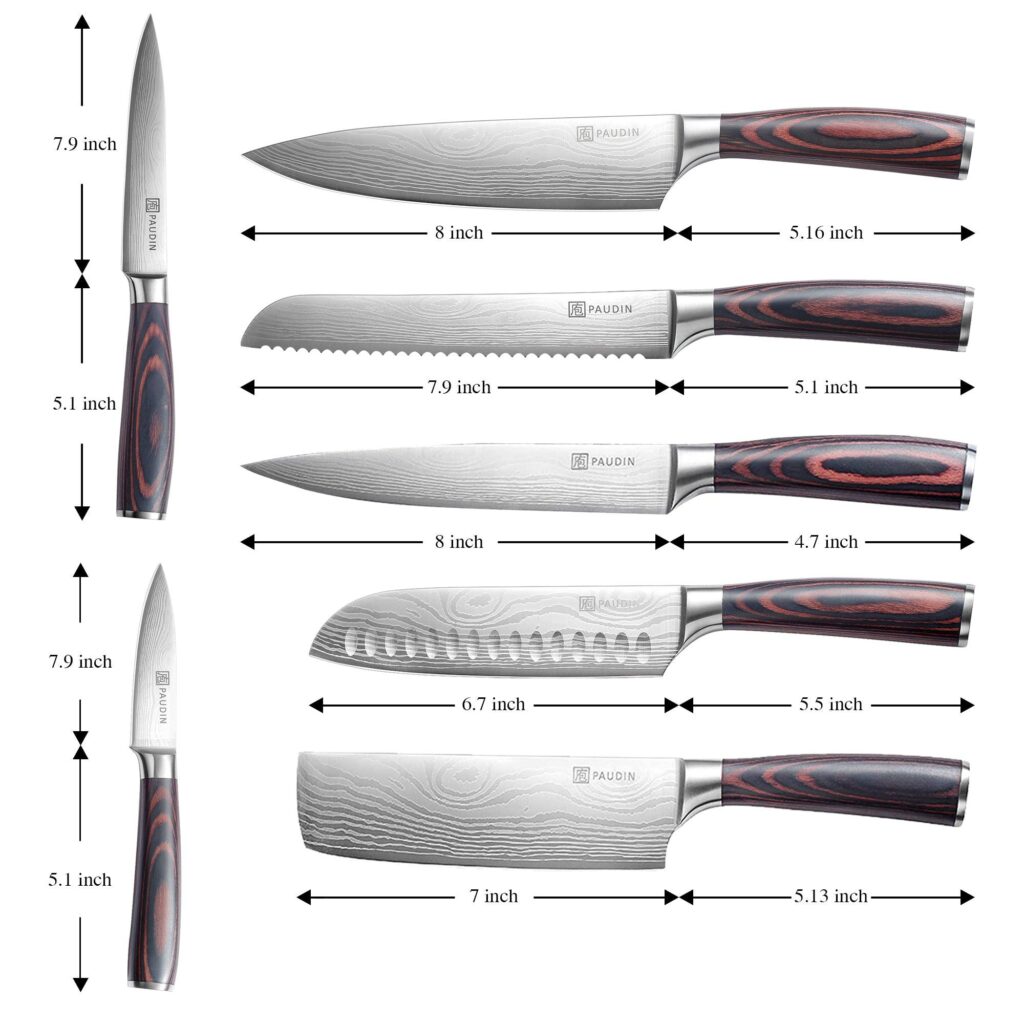
If roasts and homemade bread are rare in your kitchen, those last two blades may sit idle, and a smaller set or a few single knives make more sense. If both are regulars, the full set gets used.
Plan for storage
Most Universal Classic sets come in a gift box with no block, so a holder is a separate decision: a magnetic strip, a drawer tray or a freestanding block. Buyers who want storage supplied should look at the 15-piece set, which includes an acacia block.
Whichever holder you choose, measure the space first, and keep loose blades out of drawers where the edges knock together.
Which Paudin Fits Which Cook
The 7-piece set
The guide centers on this set, which holds every blade a home kitchen typically needs. Our full verdict on the Paudin 7-piece chef knife set weighs its specs, trade-offs and warranty conditions in detail.
Smaller steps: 5 pieces and 3 pieces
The 5-piece set keeps the chef, bread, santoku, utility and paring knives and drops the nakiri and carving knife. The 3-piece trio pairs a chef knife with a nakiri and a paring knife, a lean kit for a studio or first apartment where drawer and counter space are tight.
Just one knife
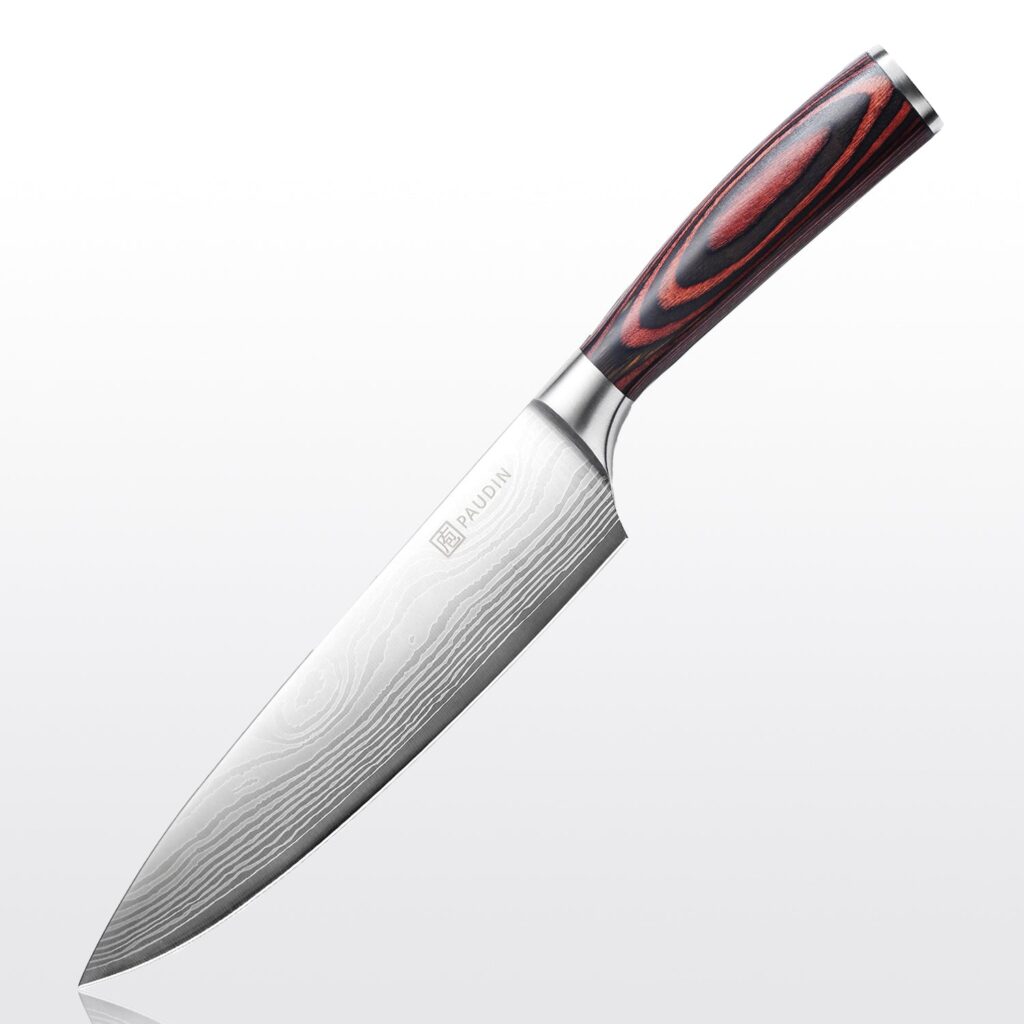
Paudin’s store lists the Universal Classic 8″ chef knife with a 200mm blade and a weight of 196g. That is a light blade meant to cover daily prep on its own.
Storage in the box: the 15-piece block set
This set brings a chef knife, bread knife, santoku, boning knife, utility knife and paring knife together. Six 4.5″ steak knives, a sharpener, kitchen shears and an acacia wood block complete the box, and the construction departs from the Pakkawood line.
The upgrade: Cloud Premium
The Cloud Premium 8″ chef knife suits cooks who already sharpen on a whetstone. The brand lists a Damascus blade rated 62+ HRC and a G10 fiberglass grip. Harder steel holds an edge longer but is less forgiving of twisting or contact with bone.
To browse the range, see Paudin’s knives on Amazon, which opens the brand’s storefront there.
How Paudin Compares With imarku
imarku is a natural comparison for a good-looking Japanese-style set. Both brands pair Pakkawood handles with gift-box packaging and talk up razor sharpness.
Each also has a heritage story to go with it. imarku’s About page traces a Japanese bladesmith family back to 1949 and says the brand reached the US in 2016, while Paudin’s story rests on the Pao Ding parable and the four founders. Both are marketing, so the hard numbers make the better basis for comparison.
Steel and hardness
On paper imarku is slightly harder. Its Japanese Pro line is described as Japanese high-carbon stainless at 57±1 HRC, with vacuum heat treatment named as part of the forging, against Paudin’s 5Cr15MoV at 56+ HRC and the store-versus-listing inconsistency noted earlier.
imarku’s 8″ Pro Chef knife is listed as hand-forged 7Cr17MoV with a full tang. That grade has more carbon and chromium than 5Cr15MoV, which in theory should hold an edge longer, and it makes imarku worth a look for anyone shopping for a single knife.
Warranty and returns
On length, Paudin’s lifetime promise beats imarku’s one year from the day the order arrives, which covers materials, construction and workmanship. The catch is that Paudin’s warranty page limits its promise to purchases from its own store.
Both brands allow returns within 30 days on their own sites. imarku asks for knives that are new, unused, unsharpened and in the original packaging, and it pays for return shipping only when the knives are defective or the wrong ones were sent. Paudin also takes back unused items after a change of mind, but it adds fees and leaves the shipping cost with the buyer.
The tie-breaker is simple. Paudin suits shoppers who want a larger set, in particular its 7-piece set against imarku’s 5-piece one. imarku suits those who prefer fewer knives, like the idea of marginally harder quoted steel, and want warranty cover that ignores where they shopped.
Care, Honing and Sharpening
The brand’s care panel for the 7-piece set comes down to three habits: wash by hand, dry straight away and store somewhere dry. The routine below sorts the extras by when they happen.
After every use
Use lukewarm water, a drop of mild dish soap and a soft sponge, moving from spine toward edge rather than along the cutting edge. A dishwasher is the wrong tool here, since its heat, strong detergent and clattering against other items are tough on the Pakkawood as well as the edge.
Then towel the blade and handle dry and give them a minute to air before they go away. Do not park knives in the sink or on a damp rack, and skip long soaks for the handles. Tomatoes, citrus and onions can mark steel, so rinse the blade soon after cutting them.
A baking soda paste on a soft cloth is a common remedy for light surface spots, followed by a thorough rinse and dry. Should a handle crack early, get in touch with Paudin, as workmanship flaws fall under the warranty, subject to its store-purchase condition.
Before cooking
Thin edges on softer steel tend to roll over instead of chipping, and a honing rod nudges them straight again. A few light strokes on each side before you start is enough. The KS3 rod has a Pakkawood handle that matches the knives, but any decent rod will work.
A few times a year
A stone handles what honing cannot. A rod only realigns an edge, while a stone removes metal to form a new one, so reach for it once honing stops helping.
Paudin’s whetstone kit uses water, not oil, so soak the stone for 10 to 15 minutes first. The 1000 grit side rebuilds a dull edge and the 6000 grit side polishes it and clears the burr. Included extras are a flattening stone, a bamboo base and an angle guide, which targets the part beginners usually find hardest: holding a steady angle.
Warranty, Returns and Buying Smart
What the lifetime warranty covers
The catch comes first. Paudin’s warranty page says a claim has to concern something bought straight from the brand’s own store, and only the original buyer can make it. A marketplace listing may advertise a lifetime warranty as well, so keep your order details whichever store you use.
Inside that limit, cover applies to faults in materials or workmanship, items that become unusable under normal home use, and wrong or faulty deliveries, with Paudin choosing between repair, replacement and store credit. Ordinary wear, misuse, accidents, negligence and poor maintenance fall outside it, as does anything altered, sold on or acquired from a seller Paudin has not authorized.
Returns on the brand’s own store
A 30-day window counted from delivery applies to orders on Paudin’s own site, and only there. A refund, exchange or store credit is on offer if the package arrived damaged, the product is defective or the wrong item came, or if you changed your mind and the item is unused.
Change-of-mind returns carry a restocking fee and a handling fee, the return shipping is yours and is not refunded, and the item must go back unused in undamaged original packaging. Orders placed through Amazon follow Amazon’s return terms instead, so read them at checkout.
Spotting copycats
Wave-etched blades and red-brown handles also turn up on plenty of generic knives, so the look alone proves little. Check that the seller is the brand itself, and compare the logo engraved near the heel of each blade with Paudin’s own product photos. Treat offers that look too good to be true from unknown marketplace sellers with suspicion, because the warranty excludes knives from unauthorized sellers.
When you are ready to compare current options, browse Paudin’s storefront on Amazon, which opens the brand’s page there.
Common Questions
Where are Paudin knives made?
An independent review of the 14-piece set reports Chinese manufacture, and the US trademark belongs to a Shenzhen company.
Is the wave pattern genuine Damascus?
Paudin markets its Cloud Premium and Plume Luxe lines as Damascus steel. Universal Classic is different, because its pattern is etched by laser.
Can Paudin knives go in the dishwasher?
Not the Universal Classic set, whose care panel recommends hand washing. A few Ultra Dark models are labeled differently, so look at each product page.
Do Paudin knives rust?
Any stainless steel can if it stays wet. The brand’s own advice is to dry the blades right after washing, and the independent reviewer noted that the etching might slightly raise corrosion risk.
What angle should I sharpen at?
Aim for the factory angle: 13° per side on the 7-piece set and 14 to 16° on the 15-piece block set. The whetstone kit includes an angle guide to help.
Is a Paudin set a good gift?
The sets arrive in a presentation box, so little wrapping effort is needed. The brand-store warranty covers only the original purchaser, so the giver should keep the order confirmation in case the recipient needs help later.
The Bottom Line
Paudin suits home cooks who want good-looking knives and are willing to hand wash, dry promptly and hone often. The 7-piece Universal Classic set is the sensible starting point for most kitchens, a single 8″ chef knife suits minimalists, and the 15-piece block set suits anyone who wants storage included.
Keep the caveats in view too. The steel is on the softer side, the brand’s own listings disagree on the grade, and the lifetime warranty has a store-only condition. None of that rules the brand out, but it is worth knowing before you buy.