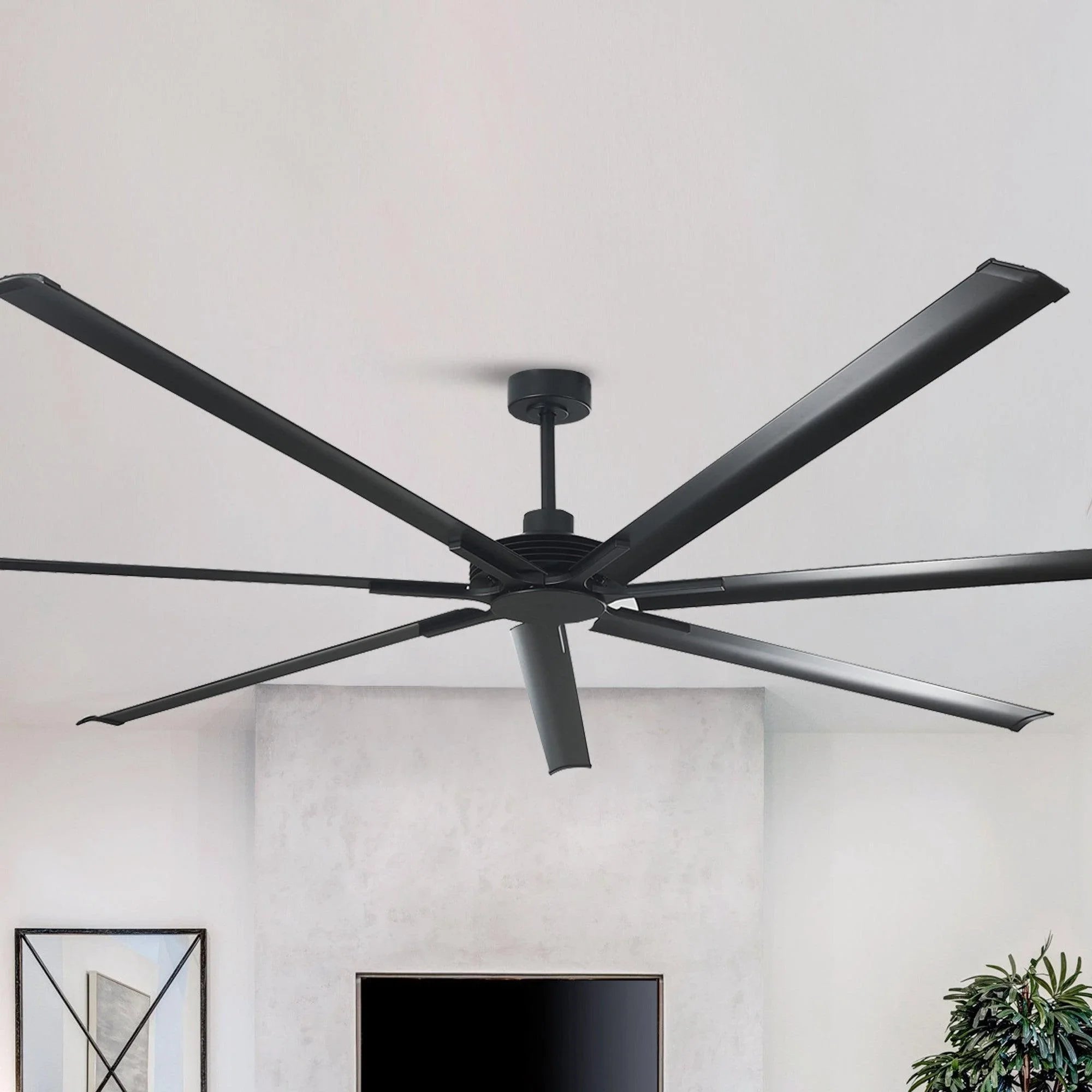
Choosing a ceiling fan sounds easy until you open a catalog of more than 20 models that stretches from small flush mounts at 31 inches to huge 120-inch units for warehouse floors. Parrot Uncle’s range is that wide. That helps if you already know what you want, and it overwhelms if you do not.
This guide gathers what the brand publishes about its fans: how to match blade span to a room, what the ceiling pitch limit means, how the motors work, how the main models differ and what the warranty covers. It comes from spec sheets and policy pages, not from a test bench, and anything that is the brand’s own claim is labeled that way.
If you only want the one fan this guide keeps coming back to, start with our full verdict on the Silent Storm ceiling fan. If you want the thinking behind the choice, read on.
Who Is Behind Parrot Uncle
Start with the name, which has nothing to do with birds. Parrot Uncle is a California home furnishing brand based in City of Industry, and it began selling in 2013. The company bills itself as a pioneer in lighting and ceiling fans.
The company says its designs rest on three ideas: innovative, artistic and smart. Branding language aside, the catalog does show range, with dozens of fan styles, several lighting categories and a furniture line.
Ceiling fans came first. Chandeliers, pendant lights and wall sconces followed, then sofas, recliners and TV stands, with electric fireplaces and smart home controls arriving later.
Two facts help place the company. It holds an A+ rating from the Better Business Bureau. And besides its own site, its products are sold through Home Depot, Lowe’s and Walmart.
The reputation gap
Feedback on the products and feedback on the service point in different directions. On the brand’s own site, the Silent Storm fan shows about 4.9 out of 5 from nearly 100 reviews. A third-party review site rates the company at about 2.7 out of 5 from roughly 100 reviews, and the complaints there concern customer service rather than the fans themselves.
The recurring themes are slow replies, communication gaps tied to a support team based in China, and trouble settling warranty or shipping questions. A team in a different time zone may add delay for U.S. buyers who write during their own business hours.
None of this means a bad order is likely. It does mean the service side is the weaker half, so keep every receipt and confirmation email.
What the Brand Sells
Fans are where the brand began, and the catalog is still built around them. The range breaks into three groups by blade span.
| Group | Blade span | Where it is aimed |
|---|---|---|
| Compact flush mounts | 31 to 48 inches | Bedrooms and offices |
| Downrod fans | 54 to 72 inches | Modern, farmhouse and industrial rooms |
| HVLS-style fans | 84 to 120 inches | Garages, workshops and warehouses |
Nearly every fan in the range ships with a DC motor, a six-speed remote and reversible blades, so the basics barely change from one model to the next. That makes the models easier to compare.
Lighting
The lighting range splits into clear groups. Chandeliers and fandeliers, which fold a fan and a chandelier into a single fixture, sit at the premium end. Rattan and woven pendant lights lean toward an organic, textured look. Farmhouse wall sconces fill out the rest.
That textured look differs from the clean industrial lines of the fans, so do not assume the whole catalog matches.
Furniture and fireplaces
Furniture is the newest big category, with sofas, recliners, dining sets and TV stands. Smart home controls and electric fireplaces fill smaller sections. These lines are newer than the fans, so research each piece on its own before you order.
A first-time buyer can start with the fans, the category the brand began with and the one this guide covers in the most detail.
DC Motors and HVLS in Plain English
Two terms appear on almost every fan listing, so here they are without the jargon.
What a DC motor means
DC stands for direct current, the kind of power these motors run on. Many older fan motors use alternating current instead. DC motors are generally described as quieter and lighter on power, with finer speed control, and they usually pair with a handheld remote in place of a wall switch.
What HVLS means
HVLS stands for high volume, low speed. It describes the biggest fans in the range, where large blades turn slowly and move a lot of air in place of small blades spinning hard. Take the Silent Storm: its 120-inch size tops out at 58 RPM against 95 RPM for the 84-inch, yet its published airflow is more than double.
Reading the airflow number
CFM is cubic feet of air per minute, the airflow figure on a spec sheet. The Silent Storm is listed at 11,200 CFM in the 84-inch size, 11,500 in the 100-inch and 24,000 in the 120-inch. Compare CFM between models of a similar blade span, and treat it as a guide to size rather than a promise about how a room will feel.
How to Choose Size, Pitch and Placement
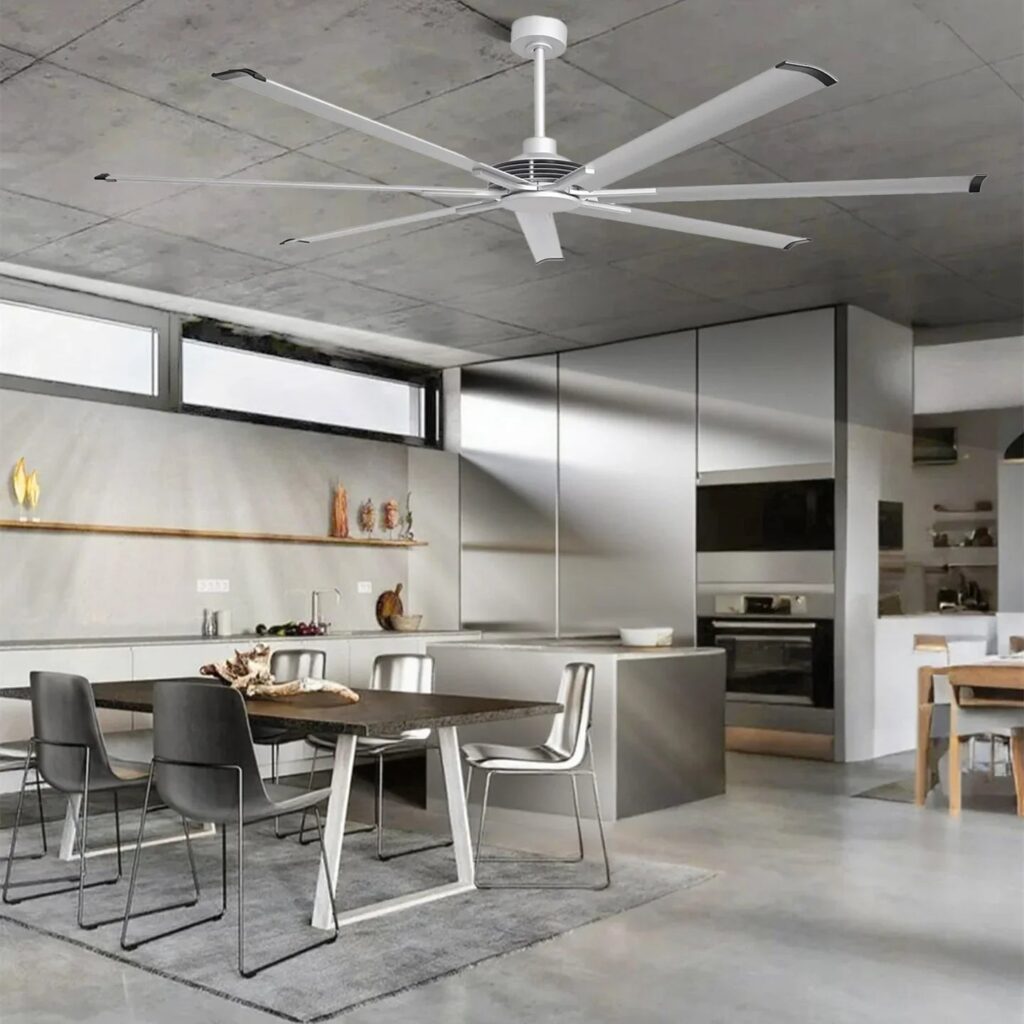
Begin with the room
Match the blade span to the space rather than to a finish you like. This rough guide follows the way the brand’s lineup is sized.
| Space | Suggested blade span |
|---|---|
| Rooms under about 175 square feet | 42 to 48 inches |
| Rooms up to about 350 square feet | 52 to 56 inches |
| Big living rooms and open-plan areas | 60 to 72 inches |
| Garages, workshops and barns | 84 to 120 inches, HVLS style |
Before you browse, write down your floor area and your ceiling height. Those two numbers settle more than any product photo will.
Check the ceiling pitch
Downrod mounts suit ceilings that slope no more than 15 degrees. Beyond that, the fan will not hang level, so look at flush or angled-mount options in the catalog. Confirm this before you order, not on installation day.
Indoor, covered or open air
Exposure ratings differ from model to model. The Silent Storm is for indoors and covered patios, not for fully wet locations. A spot that takes direct rain calls for a model listed with a water-resistance rating such as IP66, and the brand lists its Porter outdoor fan in soft brass with that rating.
Remotes, not wall dimmers
Nearly every Parrot Uncle fan is run from a remote, because its DC motor is built around that setup. The brand’s own FAQ advises against adding an existing wall dimmer, since it may clash with the controls built into the fan. Decide where the remote will live before installation day.
Light or no light
Some models, including the Silent Storm, have no light at all. Others pair the fan with a light, from LED lighting built into the housing to fandeliers that act as a room’s main fixture. Settle early whether the fan should double as your light, because the answer changes which models stay on your list.
Models Worth Knowing
A handful of models are described below. Think of this as a snapshot of types, not a ranking.
Silent Storm Extra Large Ceiling Fan
The model this guide returns to most often. It comes in 84, 100 and 120-inch sizes and three finishes, and the brand prices them alike. It has a DC motor, no integrated light and a rating for indoors and covered patios. It suits a garage, workshop or high-ceiling room, and you can browse Parrot Uncle’s own online store to see what else the brand offers.
Vaczon 84-inch HVLS fan
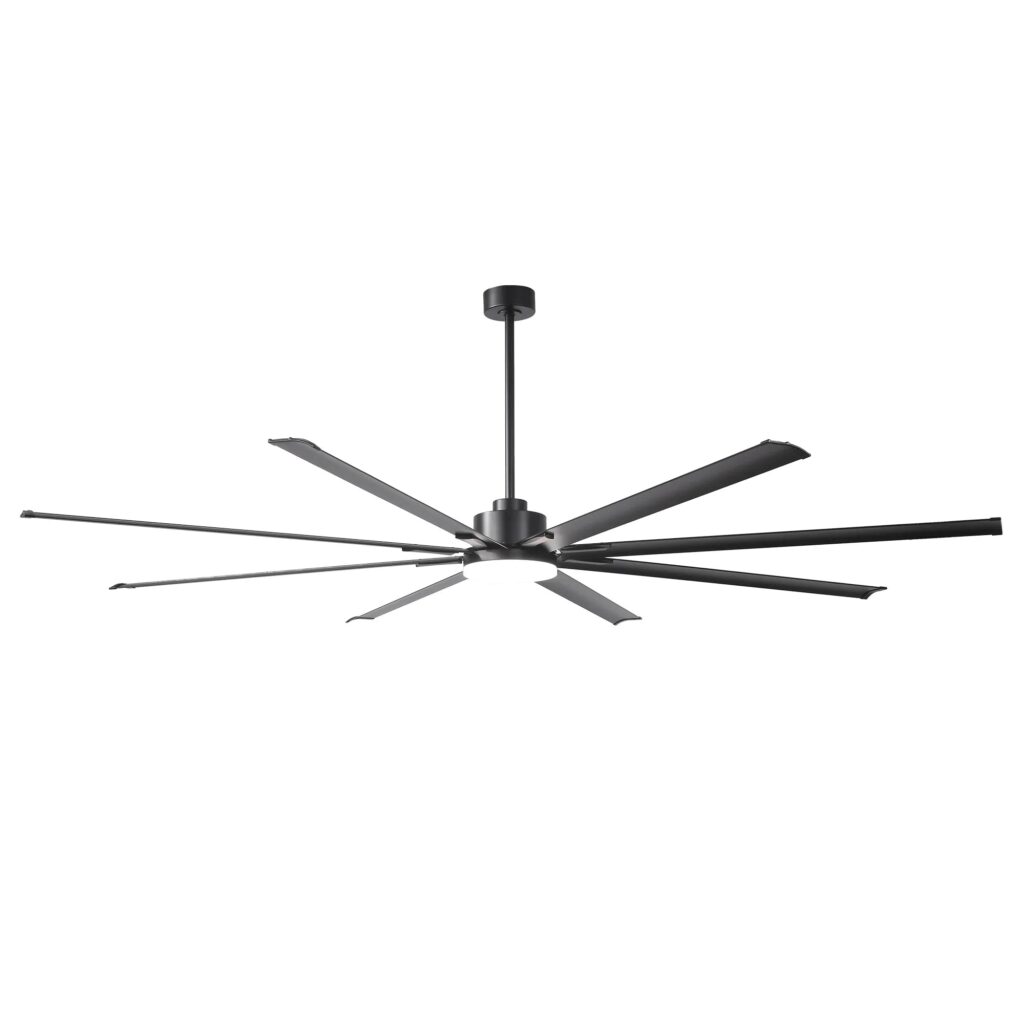
A black HVLS-style fan at the 84-inch span. It is worth comparing if you like the idea of the Silent Storm and want another large-fan option at the same size.
Balachandran 65-inch industrial downrod
A brushed-nickel industrial fan that offers a way into the DC-motor range without giant-fan airflow you may never use. It suits a mid-size bedroom or a home office.
Amelia 52-inch industrial fandelier
In black, this one merges a ceiling fan and an industrial-style light fixture into one remote-controlled unit. It is aimed at dining rooms and open kitchens where the fan should also be the main light.
Oretha 60-inch windmill
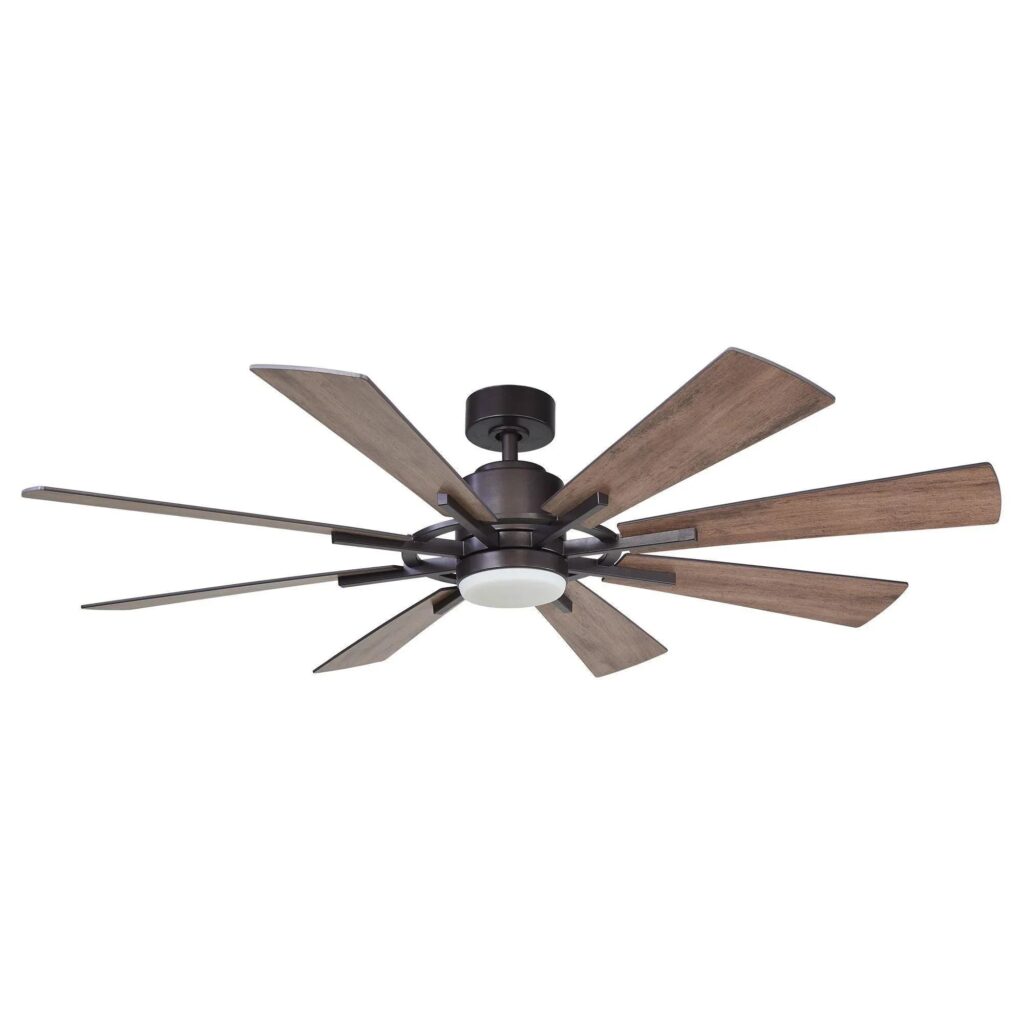
Windmill-style blades and an oil-rubbed bronze finish set the Oretha apart. It suits a buyer who finds the rest of the catalog too industrial or too plain.
Porter 56-inch outdoor fan
Soft brass with an IP66 rating, built for direct weather exposure and not only covered patios. If your target is a fully open porch, check this one first.
Padus large fan with dimmable lighting
A black, large-format fan with built-in dimmable LED lighting. It suits anyone who wants one fixture to replace both the fan and the main room light.
Parrot Uncle Compared With Big Ass Fans
Big Ass Fans, whose residential line is called Haiku, also builds oversized DC-motor fans for garages, workshops and open living spaces, so it makes a fair point of comparison.
Smart features
Smart-home support is the clearest gap. Haiku models connect to an app and to Alexa and Google Assistant, which allows scheduling and grouping much like smart lighting. Parrot Uncle fans, the Silent Storm included, run from a remote with no app or voice control.
Price
Haiku fans are priced well above Parrot Uncle’s for similar or smaller blade spans. On cost alone Parrot Uncle comes out well ahead, before features enter the picture. Compare current prices at both brands.
Airflow, build and support
On paper, the Silent Storm’s published CFM numbers are competitive with Big Ass Fans models of a similar diameter. The brands differ more in build materials and durability work, where Big Ass Fans puts its emphasis. Parrot Uncle has a shorter history, so there is less of a long-term track record to lean on. Big Ass Fans has been established longer, so check each company’s support terms before you decide.
Who should choose which
Parrot Uncle fits buyers who want large-fan airflow on paper without app control. Big Ass Fans fits buyers who value smart-home integration and a longer premium track record and have the budget for it. Unless smart features are on your must-have list, the extra spend goes mostly on convenience rather than a clear airflow gain.
Keeping a Fan Quiet for Years
A few small habits help a fan stay smooth past its first season instead of starting to wobble or rattle. None of them is complicated.
Check the hardware
A new installation settles as the mounting hardware seats. About three months in, look over the blade screws, the downrod connection and the canopy mount for looseness, then repeat the check roughly once a year. It takes minutes and can catch a rattle early.
Clean the blades
Dust can throw a blade’s balance off slightly, and an unbalanced fan may wobble or hum. Every month or two, wipe each blade with a soft cloth that is only slightly damp, moving along its length. Harsh cleaners can strip the finish on brushed nickel and brass models.
Change direction with the seasons
Every fan in the lineup reverses. Counterclockwise rotation sends air straight down for summer. Clockwise rotation at a low speed lifts air toward the ceiling in winter and helps spread the warm layer that gathers there. DC models change direction from the remote.
Replace the remote batteries
Remote batteries fall outside the warranty, and a weak or corroded one can make a healthy fan seem dead. If the fan responds late or inconsistently, swap the batteries first.
Respect the limits
Stay within the 15-degree pitch limit for downrod mounts, and choose a flush mount for a steeper ceiling. Leave wall dimmers out of the setup as well. Each of those mistakes can put extra strain on the motor and mount.
Where to Buy, Returns and Warranty
Where you buy matters more than usual here, because the warranty excludes products from unauthorized sellers.
Where Parrot Uncle sells
The brand sells through its own site and through Home Depot, Lowe’s and Walmart. A purchase from any of those four keeps the warranty valid, and you can browse the full range on Parrot Uncle’s site. Be careful with any other listing, particularly on general marketplaces, unless the seller is clearly Parrot Uncle or an authorized distributor.
The warranty does not apply to a fan from an unauthorized seller, even a genuine one. Service can also be hard to get when the model number is missing or does not match. A price far below the brand’s own, or a seller who cannot confirm the exact model number, is a reason to walk away.
Returns
| Topic | Terms |
|---|---|
| Return window | 30 days from the shipment date |
| Condition | New, unused and in sealed original packaging |
| Return shipping | Paid by Parrot Uncle for a quality problem, and by you for any other reason |
| Outcome | A refund or an exchange within the window |
Warranty
| Item | Coverage |
|---|---|
| Fan motors | Limited lifetime, covering manufacturing defects in normal home use |
| Light kits and fan parts | Limited cover for one year from the date of original purchase |
| LED bulbs and modules | One year against defects in materials or workmanship, glass parts excluded |
| Other products | A 30-day warranty by default |
| Not covered | Misuse, unauthorized repairs, electrical surges, cosmetic damage, normal wear, remote batteries, installation labor and claims without proof of purchase |
Filing a claim
Claims start with an email to [email protected]. Include the receipt or order confirmation, the model number and a short account of the fault, plus photos or video if you have them. Only the original buyer is covered, so file the confirmation somewhere safe.
Frequently Asked Questions
What does Parrot Uncle sell?
Mostly ceiling fans from 31 to 120 inches, with lighting, furniture, electric fireplaces and smart home controls rounding out the catalog.
How long before an order ships?
Standard items need about 7 business days of processing after payment clears. Handmade fixtures take longer, at roughly 15 business days. Tracking details usually appear online two to three business days after processing finishes.
How is shipping calculated?
Freight and express charges depend on weight, distance and the shipping method chosen, not on a flat fee.
Can one order ship in pieces?
Yes. Items that come from different warehouses can go out separately, with no extra charge.
Who pays for return shipping?
The brand pays when a product quality issue prompts the return. For every other return, the buyer pays.
Is sales tax charged?
The brand’s FAQ says buyers pay no sales tax on Parrot Uncle orders.
Which payment methods work?
You can pay by Visa, Mastercard, American Express, Discover or PayPal.
What does the standard warranty cover?
Most products carry a one-year limited warranty on defects in materials or workmanship, with repair or replacement. Any claim needs proof of purchase.
Is the fan motor covered for life?
Fan motors carry limited lifetime coverage for manufacturing defects in everyday residential use. Light kits and other parts are covered separately for one year.
The Short Version
Four checks narrow the field quickly.
- Floor area: it sets the blade span
- Ceiling pitch: 15 degrees or less for a downrod mount
- Location: indoor, covered patio or fully exposed
- Control: a remote rather than a wall dimmer, and whether the fan should also be your light
Style and finish come after that. Buy from the brand or one of its three listed retailers, keep your receipt, and go in with realistic expectations about customer service.