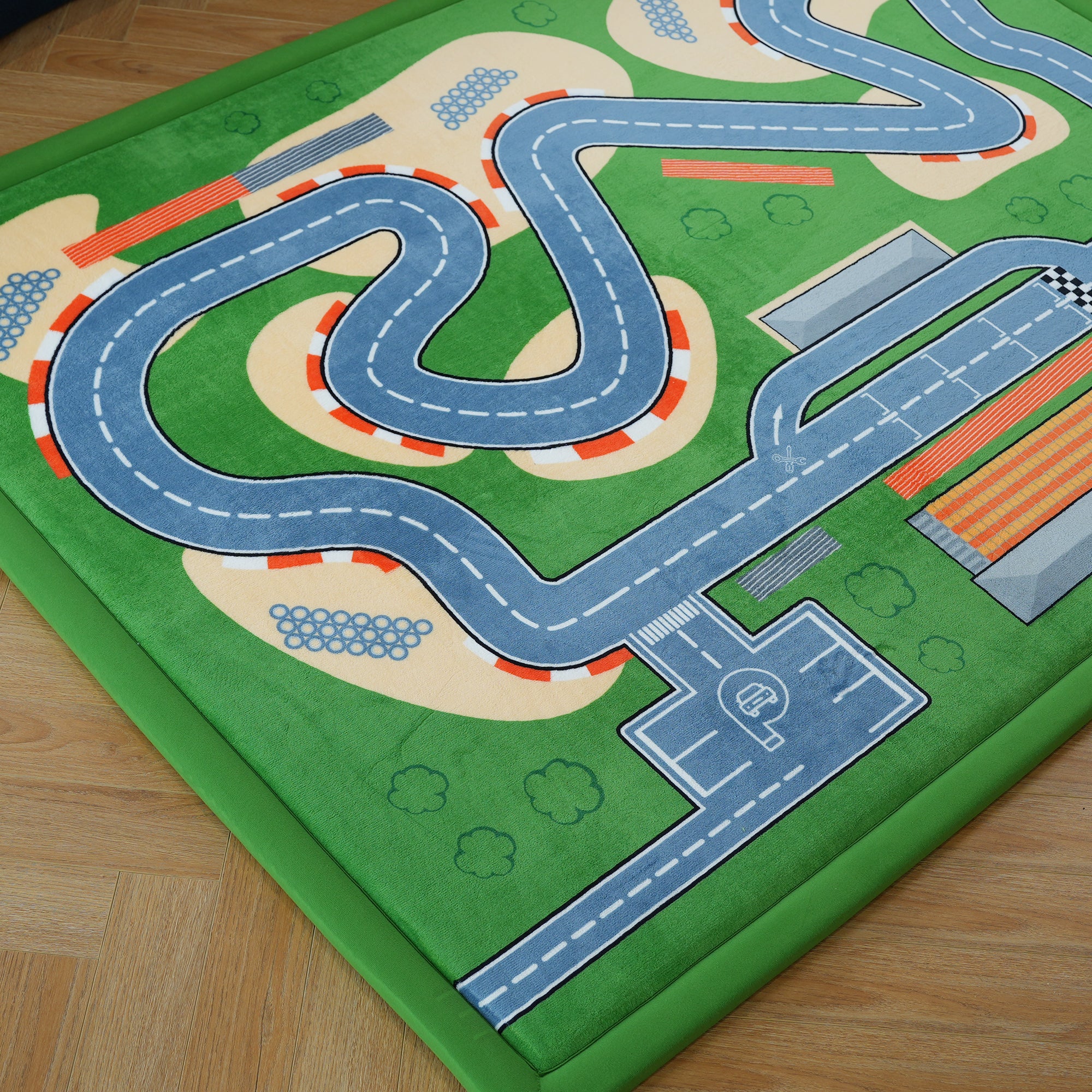
Thick foam rugs are one alternative to interlocking puzzle tiles, and PaPaMat sells a wide range of them. The brand makes padded mats for babies and kids, from printed race tracks to plain flannel rugs.
The range is wide. Fabrics, foam depths, sizes and prints all combine, so it pays to settle the choices in a sensible order before ordering a mat this large.
This guide follows the decision in the order that matters: what the mats are made of, how large to go, which fabric suits your household, how to set up and clean one, and what to know about safety and returns. For a closer look at a single model, read our full verdict on the PaPaMat Race Track mat.
What PaPaMat Actually Makes
Everything in the range is built the same way: a soft fabric on top, a memory foam core in the middle and a dotted non-slip layer underneath. The audience is babies and young children, and what varies from mat to mat is mostly the fabric, the foam depth, the size and the print.
PaPaMat also operates its own store at papamat.com. Besides the products, papamat.com publishes its shipping terms and return policy, has an FAQ page and runs a modest blog on practical subjects, among them mat cleaning and the stages of crawling.
What the brand says about itself
The About page centers the brand on the belief that a child’s room should feel safe, comforting and well lived in. Alongside that it lists headline numbers on families served, hours of play and customer satisfaction. Nothing independent in the research behind this guide backs those numbers, so read them as marketing.
What is not public
The research found no founder name, no founding year, no factory location, no funding information and no press coverage. None of that is a red flag on its own, but it means the mats are best judged on their specs and written policies rather than on a brand story.
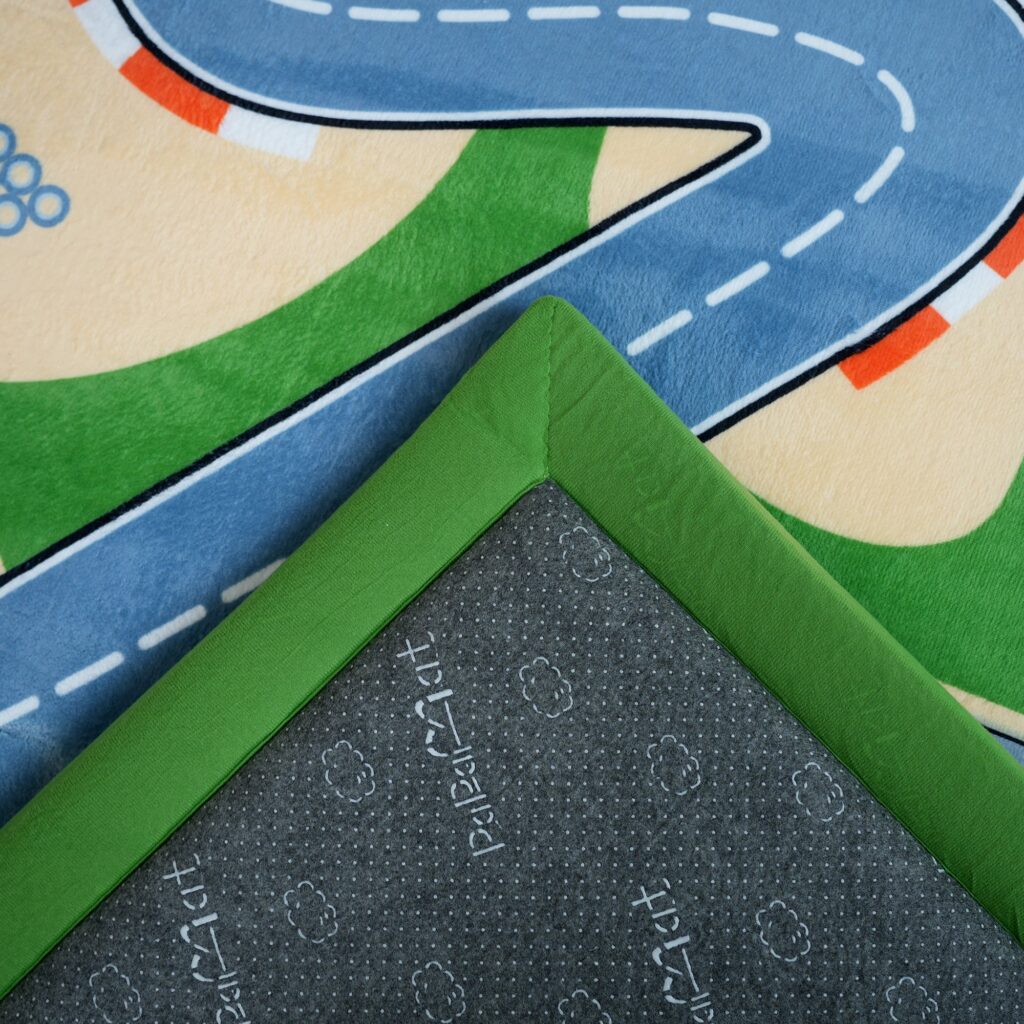
Two small identifiers help. The PaPaMat logo is printed across the grip dots on the underside of every mat, so it works as a quick authenticity check. The brand also calls its foam Elasti-Foam, and says that shipping the mats vacuum-compressed lowers shipping emissions.
Fabric Series and Foam Thickness
The brand’s FAQ sorts its mats into four fabric series, each pairing a top fabric with a fixed foam depth and density. That pairing shapes how a mat feels underfoot, how it is cleaned and how it looks in a room.
| Series | Depth | Density | Character |
| Coral fleece (velvet) | 1.3 inches | 23D | Smooth, light, breathable |
| Flannel | 1.5 inches | 25D | Plush and warm |
| Minky | 1.5 inches | 30D | Smooth, and the densest of the four |
| Jacquard faux fur | 1.3 inches | 25D | Fluffy, with a raised pattern |
Coral velvet for printed designs
Most printed kids’ designs, the Race Track among them, use coral velvet. The pile is short and smooth, and at 1.3 inches this is the lightest-feeling of the four series, going by the brand’s own description.
Flannel for solid colors
Flannel is where PaPaMat keeps its solid colors, available with a wide border or a narrow one. The series pairs 1.5 inches of foam with a 25D rating, which the brand describes as plush and warm, and it resembles a rug more than a toy. Colors are plentiful: the wide-border version alone comes in 19 shades, from cream to emerald.
Minky for the firmest foam
The Minky series covers the dinosaur and other animal prints. It has a smooth top that the brand labels Crystal Minky, over 30D foam, the highest density PaPaMat lists for any series. The dinosaur family alone has nine prints, among them a lion and a space adventure.
Jacquard faux fur for the living room
In the jacquard series the pattern is woven into the faux fur instead of being printed over it, which gives a raised geometric texture. The brand’s images list a pile of roughly 0.6 inches. Colors are neutral, with ivory, brown and grey, which suits a room with grown-up furniture. One brown version in 79 x 118 inches has a chevron-style pattern and is big enough to fill a seating area.
The washable exception
One mat departs from the pattern: the 1.6 inch washable model. Its brushed cover unzips for machine washing, and inside sits polyester cushioning over a foam layer. The brand features it among its newer products, and it is the only mat in the range sold with machine-washable fabric.
The washable model is a different listing from the Race Track page that this guide’s links open, so check its care line separately before you order.
The backing, a small detail that matters
How well a mat stays put is down to the bottom layer. The brand’s wording varies, with the Race Track described as silicone-dotted and the flannel mats as having a rubber base and logo grip dots, but the intended floors do not: wood, tile and laminate.
Thickness and density, explained
Depth and density move together across the range. The 1.5 inch series uses denser foam than the 1.3 inch coral velvet mats, so choosing between them is about firmness as well as height. The D figure is a density rating, and a higher one generally suggests foam that compresses less under knees and palms.
PaPaMat gives no formal definition of the rating, so use the numbers only to compare its own mats. The 1.6 inch washable mat is built differently, and its appeal is the removable cover more than its height.
Choosing the Right Size
Measure the patch of floor you want covered, outline it with tape and keep in mind that sizes are quoted in inches. A mat just out of the box also looks smaller than it will once it has fully expanded.
| Size in inches | Typical use |
| 50 x 50 | A playpen floor or a small nursery nook |
| 59 x 71 or 59 x 79 | A play area for one child in the living room |
| 79 x 118 | A small playroom with two or three children |
| 79 x 158 | A large room covered from wall to wall |
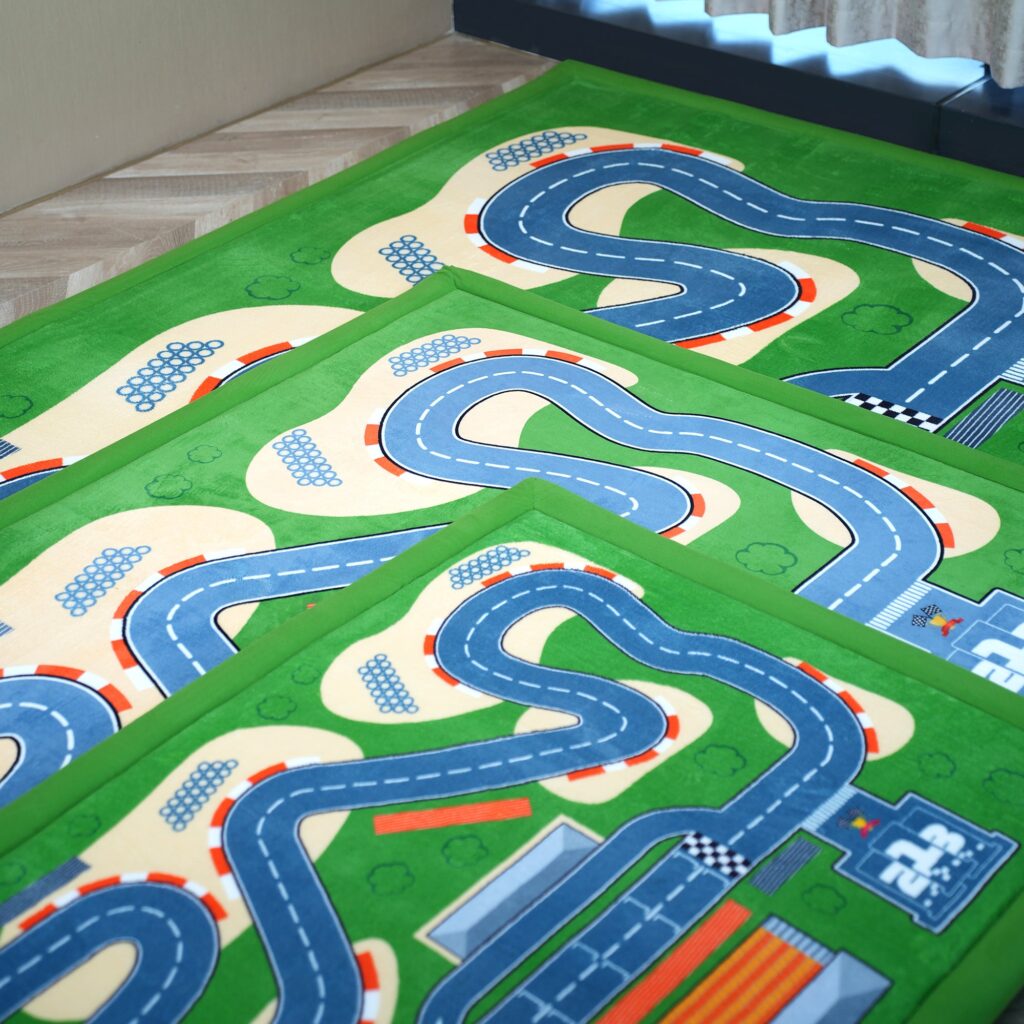
The Race Track is offered in 59 x 79, 79 x 118 and 79 x 158 inches. Other designs add 50 x 50 and 59 x 71, and some flannel colors reach 118 x 158 inches. For the Race Track, check the current price on Amazon in the size you want. The link opens the Race Track listing there, and options and availability can change.
Three setups to picture
- Playpen: PaPaMat pictures its 71 x 59 inch mat sitting inside a playpen of identical size, so measure the inside floor of yours first.
- Living room corner: a 59 x 79 inch flannel or ivory jacquard reads as a regular rug beside the sofa, and an adult has room to sit on it next to the baby.
- Playroom: in a race track or farm print, the 79 x 118 inch size can cover a small playroom shared by a few children.
Matching a Mat to Your Home
Start with your child and the mess level
Begin with how messy the room is likely to get. Where spit-up or leaks are frequent, the zip-cover washable mat is the one built for laundering. For a calmer room, flannel or jacquard offer the plushest finish.
Then think about the child. For tummy time any series works, provided play is awake and supervised. A crawler or new walker may like the deeper 1.5 inch foam of flannel or Minky. If cars and blocks are the favorite toys, coral velvet is the series with the short, smooth top.
Then match the design to the room
A playroom is the place for a printed design, such as the race track, farm, world map or solar system, each of which gives the floor a theme. A living room calls for something quieter, and solid flannel or a neutral jacquard looks like an ordinary rug.
Checks before you order
- Read the care line on the exact mat you pick, because only the zip-cover model is machine washable.
- Measure and tape out the area instead of estimating the size by eye.
- Allow the brand’s 3 to 7 day recovery window before judging how a new mat looks.
- Remember that papamat.com takes back only unopened mats, which leaves little room to change your mind there.
Setup, Break-In and Smell
Every mat ships vacuum-compressed, so creases and a flat look at first are what the brand expects. PaPaMat’s guide says to unroll the mat onto a flat surface and give it 3 to 7 days to regain its full height. For a quicker result the brand suggests a steamer, and the flannel product page mentions ironing as well.
Dealing with the new-foam scent
The brand says any faint new-foam smell goes away within 24 hours. That is PaPaMat’s own statement rather than a tested result, so treat it as an estimate.
What to expect on day one
By the brand’s account, creases, a flat profile and a faint scent are part of unpacking a compressed mat, and they fade as the foam recovers. Give the mat the full recovery window before judging it, and keep the steamer tip in mind if you want it sooner.
Cleaning and Everyday Care
PaPaMat’s guide treats moisture as the thing to manage. Spills should be blotted straight away and the spot wiped with a damp cloth, with mild soap in the water for sticky marks. A mat that has been wet should air dry fully before anyone plays on it again. For routine upkeep, the guide has you vacuum regularly to lift dust and crumbs.
Deeper cleaning
When a mess covers a big area or has set in, PaPaMat’s answer is a portable carpet cleaner, with the Green Machine named as one example. The brand’s caution is to keep the cleaner gentle and avoid getting the mat too wet, since foam that holds water dries slowly.
The one thing not to do
The brand’s firm no is the washing machine, which it rules out for every standard PaPaMat, along with soaking or submerging. Its explanation is that machine washing strains the foam and the fabric layers, and that trapped moisture can change how the mat feels as time passes.
There is one more note: the 50 x 50 inch narrow-edge flannel mat is listed as hand wash only for its fabric. Whatever you buy, read the care line for that exact mat.
Placement, storage and pets
The grip dots do their job only when they touch a clean, dry floor. Over carpet they have far less to hold, so if you use the mat there, watch for it shifting.
Storage appears in the brand’s photos as a rolled-up mat, and its pages call the mats portable. Roll one only once it is fully dry, since damp foam is best avoided, and expect a few creases when it is unrolled again, which the same flat-time-and-steamer approach should smooth out.
The brand’s position is that the mats are pet-friendly, but it warns that hard scratching by sharp claws can damage the fabric, so keep a dog’s nails trimmed. A periodic look for torn fabric or exposed foam is also sensible, as children may pick at anything loose.
PaPaMat Compared With Huloo Sleep
Huloo Sleep sells a comparable mat. Both brands offer a 79 x 118 inch size with 1.3 inches of foam under a coral velvet top, so the specs look close at first glance. The differences show up in design, size range and a few details.
| Point of comparison | PaPaMat Race Track | Huloo Sleep |
| Size used here | 79 x 118 inches | 79 x 118 inches |
| Depth | 1.3 inches | 1.3 inches, with 2 inch options in some sizes |
| Top fabric | Coral velvet | Coral velvet |
| Look | Printed kids’ designs | Solid colors |
| Listed weight | 15 pounds | 8.23 kilograms, about 18 pounds |
| Washable at this size | No, vacuum and spot clean | No, vacuum and spot clean |
The biggest difference is the look. PaPaMat’s catalog includes printed designs such as a solar system, a farm, a world map and a race track, whereas Huloo sticks to solids, among them dark grey, sage green and cream, a quieter match for a living room where the mat should pass as a rug.
Size range differs too. Huloo’s goes from a 28 x 72 inch strip to 158 x 118 inches, while the Race Track is sold in three sizes, though PaPaMat’s flannel line adds many more.
Setup is similar: both mats ship compressed, and both brands mention a steamer. PaPaMat gives a recovery time of 3 to 7 days, while Huloo’s page gives two different windows, 3 to 7 days in one spot and 24 to 72 hours elsewhere. Each also shows safety badges in its product images, OEKO-TEX included, and no public test reports turned up for either set.
A child who likes cars, maps or animals, especially where the mat itself is part of play, points toward PaPaMat. A household after a plain solid or the 2 inch thickness points toward Huloo. If washability decides it, the only option in the specs reviewed for this comparison is PaPaMat’s 1.6 inch zip-cover mat.
Safety, Claims and Certifications
A play surface, not a sleep surface
PaPaMat’s own marketing points the mats at tummy time, crawling and toddler play, and that is the right use. Guidance from the American Academy of Pediatrics holds that a baby’s sleep surface should not dent under their weight, and memory foam is made to dent. Naps belong in the crib.
Tummy time should be awake and supervised by an adult. Some listing photos for these mats show babies asleep on them, which is not a habit worth copying.
What the badges do and do not tell you
PaPaMat’s product images carry badges for ISO, ASTM, CPSIA, CertiPUR-US and OEKO-TEX. Those are the brand’s own statements. OEKO-TEX STANDARD 100 is a textile standard that tests for harmful substances, but no public test reports turned up for the other badges, so treat the full set as brand claims rather than documented results.
In its FAQ the brand also claims the materials are odorless, BPA-free and non-toxic. The brand says a slight new-foam scent can still appear at first, so read the odorless claim with that in mind.
Marketing claims to take lightly
Claims about developmental benefits, such as bone growth or visual development, sometimes appear in play mat marketing. This guide found nothing that supports them, so do not buy on that basis. What a soft mat plainly offers is padding for knees and a gentler landing after a fall.
Buying, Shipping and Returns
The brand’s own channels are Amazon and papamat.com, with the same mats on both but very different return rules. Nothing in the research pointed to big-box retail stocking PaPaMat, so if one turns up at another seller, find out who is selling it and what the return terms are before you pay.
Buying on Amazon
Return terms on Amazon appear next to the buy button and can vary by listing and seller, so read them for the exact size and design. A genuine listing shows the PaPaMat byline under the title, and the sold-by line should name PaPaMat, so any other seller name merits a closer look. To start, check the PaPaMat Race Track listing on Amazon.
Buying from papamat.com
The brand store delivers only inside the United States, excluding territories, APO and FPO addresses and P.O. boxes. Processing normally takes 1 to 2 business days, and delivery takes roughly another 5 to 7.
Its written return policy is strict. Final-sale goods, personalized items and gift cards are excluded outright. For everything else, a request has to be made within 30 days of delivery, and the mat must be unopened, unused and in its original packaging, because the brand says it cannot take back mats opened from their vacuum seal for hygiene reasons. The customer pays return shipping, and a handling fee is deducted when the return is not about quality.
The store’s FAQ and its policy page do not match exactly: one refers to unused products in original packaging, the other to unopened ones. If in doubt, contact the store’s support team before breaking the seal.
Damaged or defective mats
No standalone multi-year warranty turned up, so the damage policy is the main protection. A mat that arrives damaged, faulty or wrong should be reported within 7 days of delivery, with photos attached, and PaPaMat says it will replace the mat or refund it in full at no extra cost. Refunds, once approved, are returned to the payment method used within 10 business days, and exchanges are possible when stock allows.
A delivery-day checklist
Keep all the packaging until you are sure the mat is staying. Before you open the box, photograph it, particularly if it looks crushed. Once the mat is out, check that the size and print match your order and look the fabric over for tears, stains and misprints.
Which route fits you
Returns decide it. A mat that has been opened cannot go back to the brand store, which leaves a shopper who is still unsure about size or fabric with little room to fix a mistake there. Read both sets of terms before committing, and measure first either way.
Questions Before You Buy
Are PaPaMat mats safe for babies?
The brand makes safety claims and shows several badges in its images, but all of that is self-reported. Use any mat for awake, supervised play only, and move a baby who falls asleep to the crib.
What age are the mats for?
The brand markets them for tummy time, crawling and toddler play, and adult supervision applies whatever the child’s age.
Does the mat smell when it arrives?
A faint new-foam scent is possible, and the brand says it fades within a day.
Can any PaPaMat go in the washer?
Only the 1.6 inch mat whose cover zips off. For every other PaPaMat the brand recommends against machine washing, and also against soaking or submerging.
Is it waterproof?
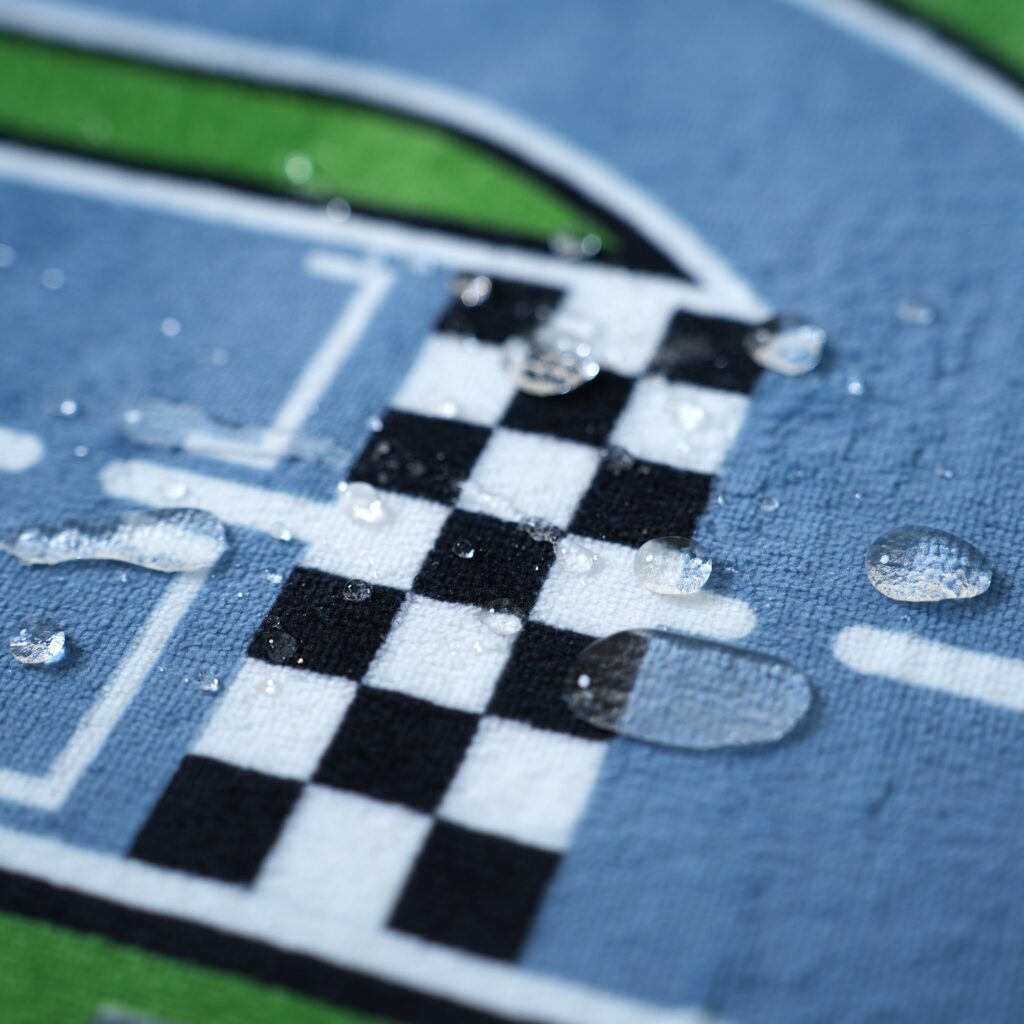
The brand describes the Race Track top as water-repellent and stain-resistant, which is a narrower claim than waterproof. Blot spills promptly.
Which thicknesses does PaPaMat offer?
Three depths: 1.6 inches for the washable zip-cover mat, 1.5 inches for flannel and Minky, and 1.3 inches for coral velvet and jacquard.