Shopping for a bamboo cutting board is harder than it looks. Between colors, thicknesses, set sizes and washing rules, a single brand can offer more than a dozen versions that all seem alike at first glance.
Keechee is a good example. The small home and kitchen brand makes a focused range of bamboo boards, and the right one comes down to a handful of questions about how you cook and clean. This guide walks through those questions, explains what the specs actually mean and covers care, policies and a fair comparison with another well-known brand.
It draws on the brand’s published specs, care guidance and policies rather than bench testing, and it labels any figure that is the brand’s own claim.
Meet Keechee and Its Bamboo Boards
Keechee sells through Amazon and through its own online store. Boards are its main product, with a few kitchen extras alongside: a bread slicer with adjustable thickness, a banana holder, salt cellars and bamboo drawer organizers.
The brand’s mission comes from its founder, who goes unnamed on the About page: everyday things should be simple, natural and built to last. The idea grew out of a visit to the founder’s parents, where a knife from a grandmother and a cookie tin from childhood were still doing their jobs. Back home, the founder’s own kitchen looked like a mix of mismatched materials and plastic pieces that felt disposable.
Keechee says its first product was a deep-carbonized bamboo board and its second was a dishwasher-safe board. The brand bills that second board as a world first, a marketing claim that has not been independently confirmed.
The Bread Pilot shows how the brand says it develops products, which usually begin with a small frustration. It is a bow-style slicer with a guide that sets slice thickness from a quarter inch to two inches, and its blade flips for left-handed use. A second pattern is mixing materials, such as a salt cellar with a bamboo base and an acacia wood lid. The tagline on its product images captures the approach: Better Everyday Living, Naturally.
How Bamboo Cutting Boards Are Built
Construction explains much of what separates one board from another. Keechee’s standard boards use three cross-laminated layers of bamboo strips, each layer running across the one beside it, a little like plywood, and the crossed layers are meant to keep a board from flexing as it takes on and gives up moisture. The strips are bonded together because bamboo is a grass, not a tree.
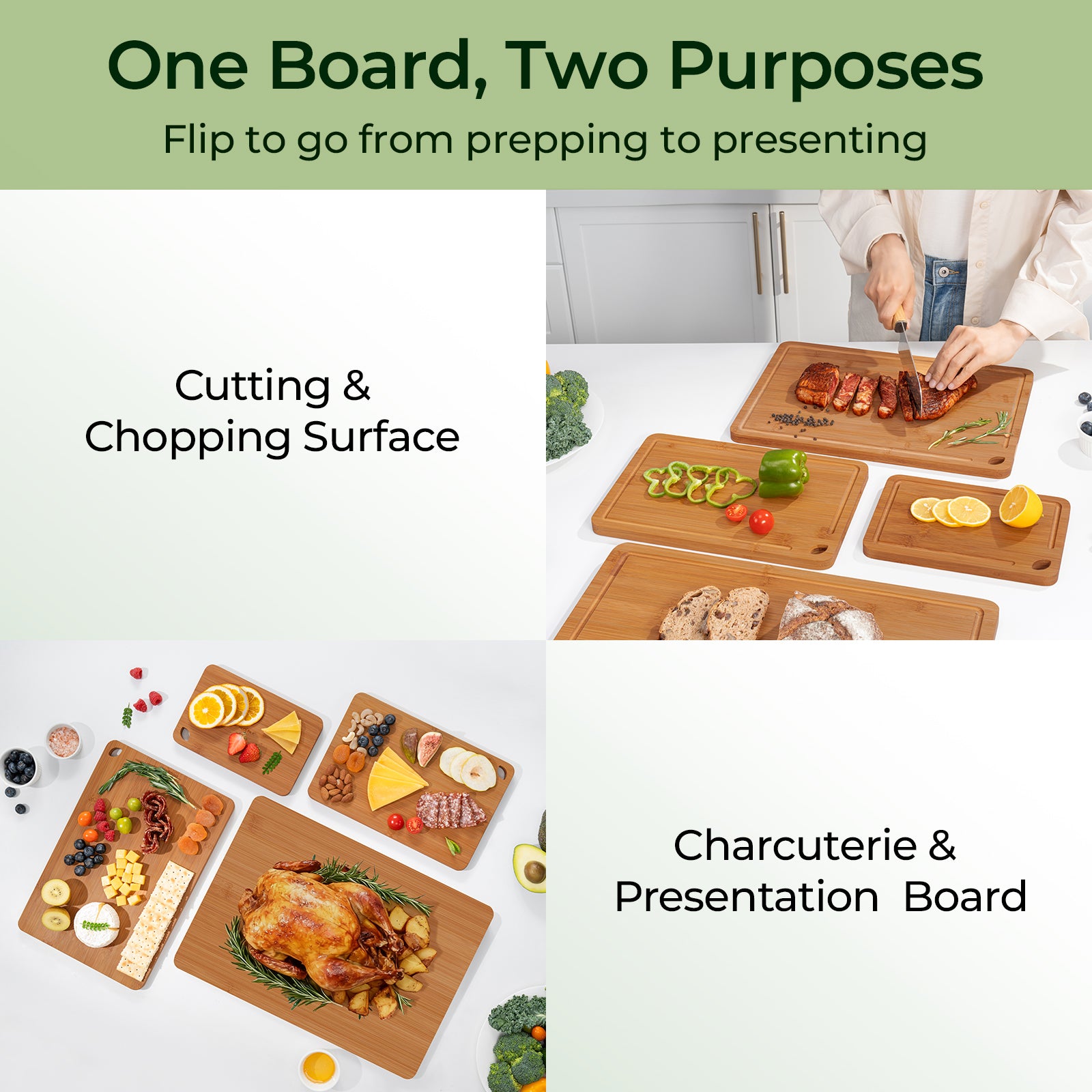
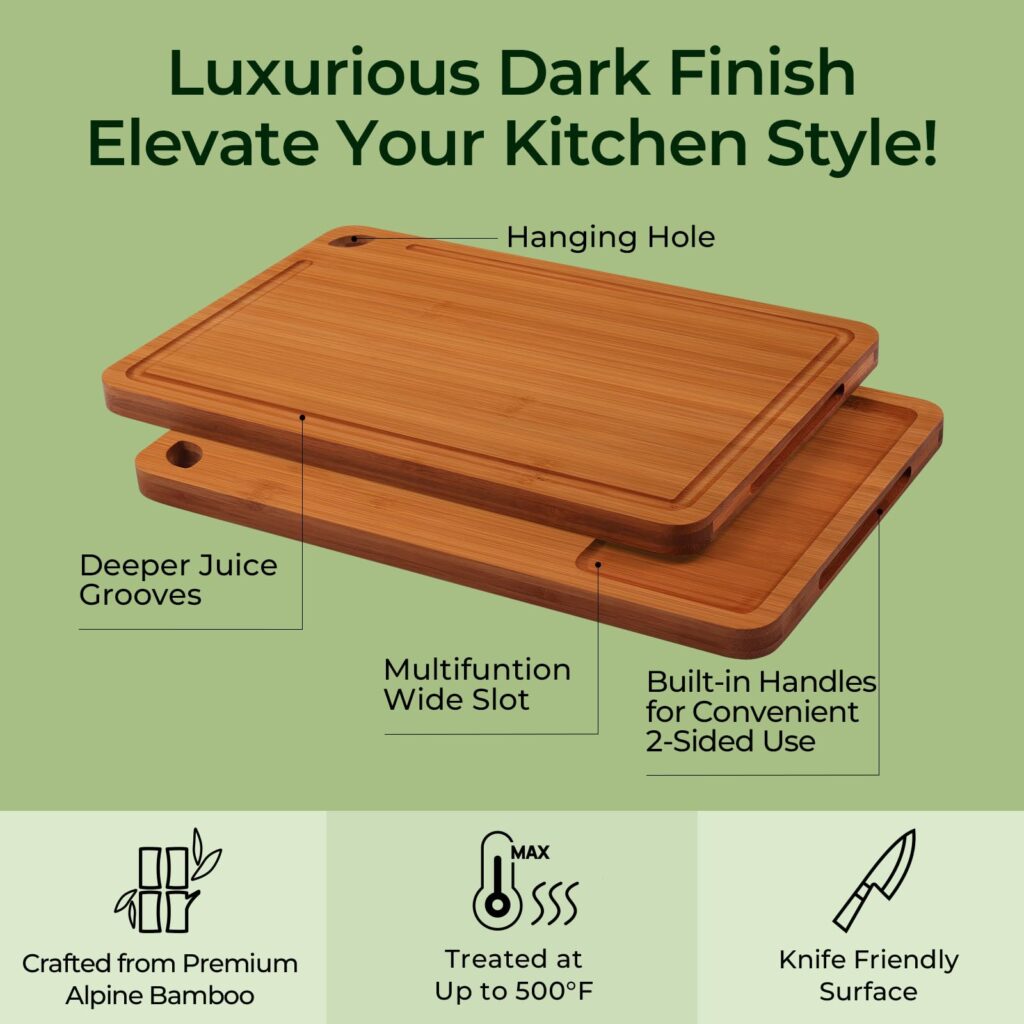
The layout is shared across most of the range: a deep groove on one face for juices from meat and fruit, a flat face for bread, cheese or plating, cutout handles on the sides and, on classic boards, a teardrop-shaped hole in one corner that lets a board hang or stand while it dries.
Specs versus claims
Product pages for these boards blend measurable specs with marketing language, so it helps to sort them into three piles.
- Concrete specs: board sizes, thickness, the 500°F heat step and the washing rules.
- Brand claims: water absorption of about 5%, a 95% reduction for the dishwasher-safe line, lab testing cited as “217” on packaging, and the first-of-its-kind label.
- Left unsaid: which glue holds the strips together, and whether an outside body has certified the bamboo as organic, although a few packages use the phrase organic bamboo. Its images also label the boards BPA free.
None of that makes the claims false. It simply means the brand’s care guidance and your own habits will tell you more than the figures printed on a box.
Which Keechee Board Line Fits
Carbonized bamboo
The strips of carbonized bamboo are heated to 500°F (260°C) before gluing, which shifts the color from pale blond to caramel brown. Keechee says the shade runs through the whole strip and that water absorption falls to roughly 5%, a change that should, in principle, make cracking and mold less likely.
There is a trade-off. Flooring makers usually describe carbonized bamboo as somewhat softer than natural bamboo. That can be easier on knife edges, though cut marks may appear sooner.
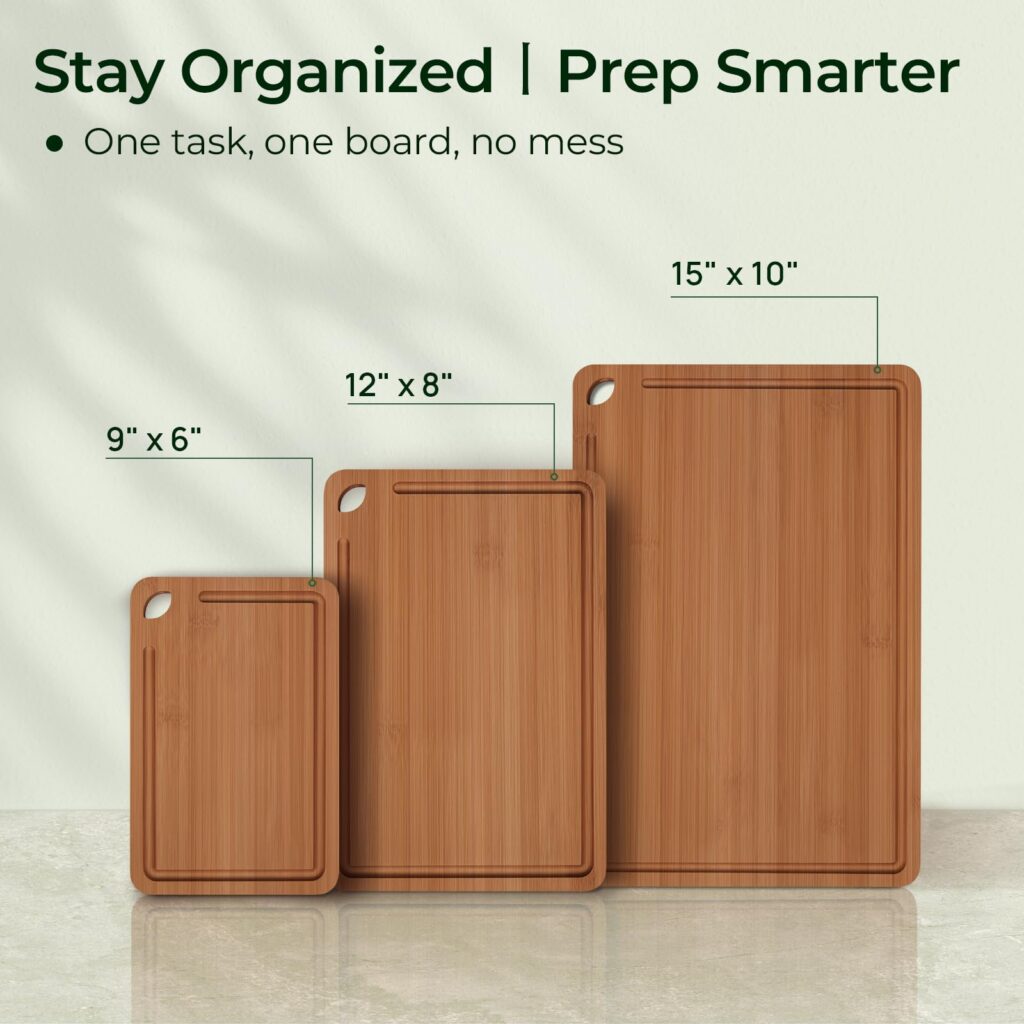
The three-piece set has boards of 9 x 6, 12 x 8 and 15 x 10 inches, each about 0.6 inches thick. For a closer look, read our full verdict on Keechee’s three-piece carbonized set.
Natural bamboo
Natural boards are the untreated version: the same shape and layered build, without the heat step, so the bamboo stays its original pale yellow-blond. Keechee offers a two-piece natural set, a 15 x 10 inch board plus a 12 x 8 inch board, for anyone who prefers a light kitchen look.
Dishwasher-safe bamboo
This line works differently from the rest. The boards are 0.4 inches thick, compared with roughly 0.6 for the classic sets, and Keechee says a proprietary pressing and polishing process fuses the fibers into a smooth surface free of splinters. The 500°F heat treatment applies here too.
The brand also cites 95% less water absorption and lab testing that its packaging puts at 217 tests. Neither figure comes with independent verification. Even so, Keechee advises the quick-wash setting for long-term use, so the dishwasher-safe line comes with limits of its own.
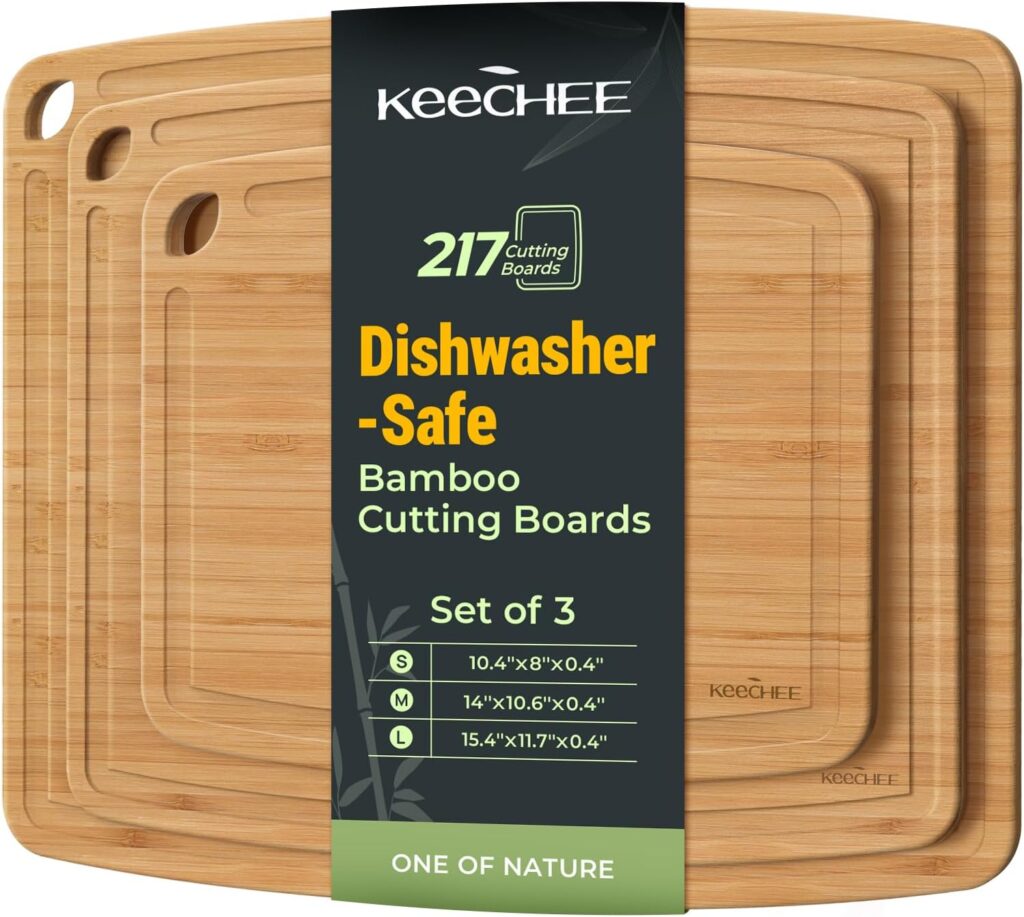
To tell the lines apart, check thickness and labeling. Dishwasher-safe boards are the thin ones and say so on their packaging, while a listing that says hand wash only means the machine is off limits. Keechee pitches the slim boards at small kitchens, first apartments and RV life. They come as single boards in a medium size of 14 x 10.6 inches and a larger 15.4 x 11.7 inches, plus sets.
Pick by Size and Number of Boards
Four quick questions narrow the choice.
Will you wash by hand?
This question outranks the others, because the answer sorts the whole range. The classic carbonized and natural lines are for hand washing and need periodic oiling. A household that will put boards in the dishwasher whatever the label says should pass on the classics and look at the dishwasher-safe line.
How many boards do you need?
- One board: the 18 x 12 inch carbonized XL offers the largest surface for carving roasts or prepping in batches.
- Two boards: a natural duo or a carbonized pair fits a small household, with one board set aside for raw ingredients.
- Three boards: the smallest board takes fruit, cheese and garnishes, so each kind of task can have its own board.
- Four boards: a carbonized set that adds the XL board, which suits large households and heavy meal prep.
For the three-piece set, Keechee’s own listing proposes dividing the work by size: meat prep or serving on the large board, vegetables and fruit on the medium one, and bread, cheese or a quick slice on the small one. Having several boards also makes it easy to keep strongly flavored ingredients such as garlic and onion on a board of their own.
Does your board slide around?
A board can drift while you chop, especially on smooth stone or laminate counters. Keechee sells sets bundled with a silicone mat that goes underneath. According to the brand, the boards in those sets are 0.47 inches thick and roughly 20% larger than the original set. The mat can go in the dishwasher, but the boards still need a hand rinse.
For boards you already own, Keechee itself suggests laying a damp kitchen towel beneath them on very smooth counters.
Prep tool or serving piece?
Every Keechee board can be flipped for serving. For presentation first, the Atelier herringbone set comes with a stand, and the charcuterie gift set joins two boards with magnets and adds a chalkboard edge for writing labels.
Storage counts too. Measure your counter, sink and the spot where boards will live before you commit. The slim dishwasher-safe boards are pitched at small kitchens, and the hanging holes on classic boards let you hook them on a wall instead of using a drawer.
Mistakes worth avoiding
- Running a classic set through the dishwasher, since the heat is hard on bamboo.
- Using one small board for every task, which leaves little room to work.
- Overbuying: the XL single board is the entry point to the range, the three-piece set is the middle tier and the Atelier set is the premium pick, so match the tier to how often you cook.
Premium and Specialty Options
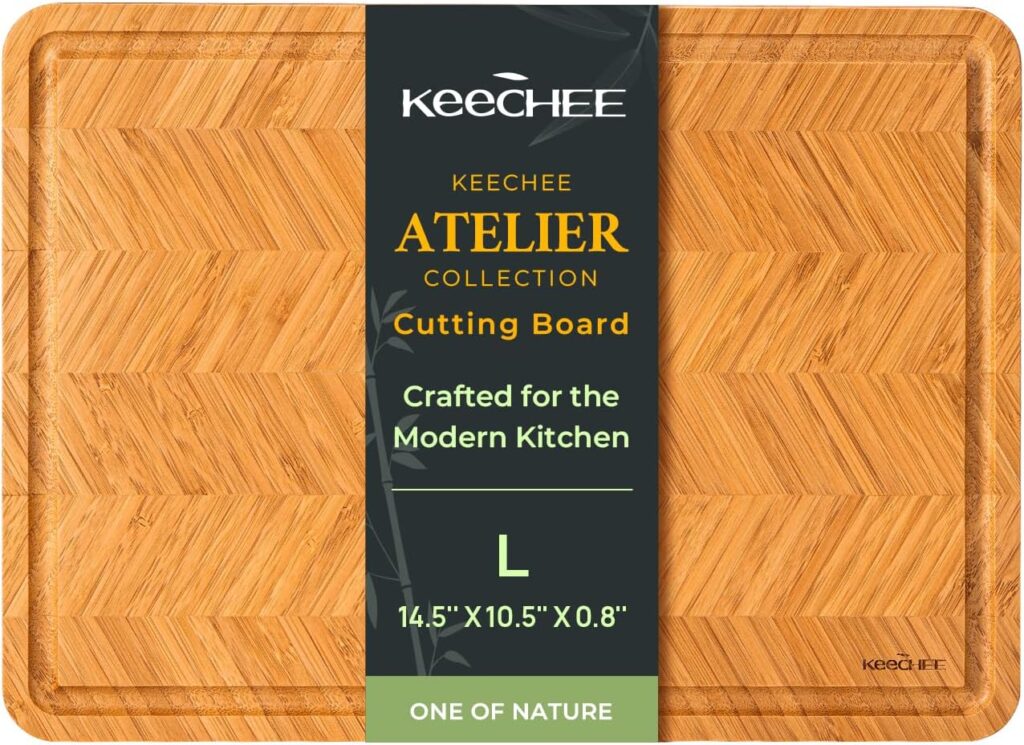
Atelier is Keechee’s premium collection. The boards run from 0.6 to a full inch in thickness and carry a fine-grain finish. Rather than long strips, Keechee joins short bamboo pieces in a herringbone pattern, which the brand credits with extra structural strength and which gives the boards a furniture-like look.
The set of three has an XL board of 17 x 12.4 inches, a large of 14.5 x 10.5 inches and a medium of 12 x 8.7 inches, and it ships with a bamboo stand that holds the boards upright while they dry. Even drying matters with bamboo, because warping starts when one face stays wetter than the other.
Beyond boards, the lineup includes bamboo drawer organizers, salt cellars and the Bread Pilot slicer. You can browse the boards and the Bread Pilot slicer in the Keechee storefront on Amazon, where each item shows its current price.
Care That Keeps Bamboo Flat
Most bamboo trouble traces back to moisture, so a short routine pays off. The steps below come from Keechee’s care guide and FAQ.
Oil before the first use
Keechee’s care guide starts with oil. Put several drops of a food-safe oil on the center of a clean, dry board and rub outward with a soft cloth or paper towel until a thin, even film covers the faces and the edges. Let it soak in until morning, or for a few hours at the least, then wipe off the surplus.
The brand accepts either mineral oil or cooking oil. Food-grade mineral oil keeps better on the board, since some cooking oils turn rancid over the months and start to smell.
How often to re-oil
Keechee’s FAQ scales the schedule with workload, and its rule of thumb is simple: a board that looks parched, has lightened or feels rough needs oil now.
| How you use it | Oil again |
| Light, a few hand-washed uses each week | every 3 to 4 weeks |
| Moderate, daily use | every 2 to 3 weeks |
| Heavy, daily use plus dishwasher cycles on the dishwasher-safe line | every 7 to 10 days |
Washing and drying
For classic boards, Keechee’s instructions are warm water and mild dish soap, with no soaking and no dishwasher.
Warping is a drying problem as much as a washing one. A board that sits flat on a wet counter keeps one face damp while the other dries, and uneven moisture between the faces is how warping starts. Towel both faces, hang the board by its corner hole or stand it on edge, and store it where air circulates rather than in a closed, humid cabinet.
Habits that shorten a board’s life
- Storing a board beside the stove, an oven vent or a sunny windowsill.
- Leaving a board to soak in the sink, which lets water into the seams.
- Putting a classic board in the dishwasher.
- Letting a board dry flat so its underside stays damp.
- Going for months without oil, which leaves the surface pale and dry.
Put together, the routine is short: rinse and dry, stand the board up, and oil it when the surface turns dull. An evening coat of oil, wiped off the next morning, is an easy way to fit the oiling in. The dishwasher-safe boards follow the same logic, and Keechee suggests oiling them every seven to ten days if they go through the dishwasher daily.
How Keechee Compares With Royal Craft Wood
Royal Craft Wood is another bamboo board brand, and its natural three-piece set matches Keechee’s sizes exactly. It offers more colors and sets of up to five boards.
The two are close on paper. Both make reversible boards with deep juice grooves and side handles, and both ask for hand washing on classic sets. Compare the carbonized three-piece sets and the work surface barely differs: about 300 square inches for Keechee’s boards against about 309 for Royal Craft Wood’s.
Finish is where they part ways. Keechee’s pages stress 500°F carbonization, a three-layer build and regular oiling, and each Keechee board has a hanging hole in a corner. Royal Craft Wood’s listings refer to a protective surface coating.
Keechee also lists two options that Royal Craft Wood’s board sets do not appear to match: the thin dishwasher-safe board and the Atelier collection with its storage stand. Royal Craft Wood is the pick for natural bamboo in more colors or a five-piece set, while Keechee fits anyone who wants carbonized boards, a dishwasher-safe option or a premium herringbone look.
Returns, Warranty and Where to Buy
Who handles a problem depends on where the order was placed. Amazon orders go through Amazon’s return process, whereas the terms below belong to Keechee’s own online store and are the maker’s published policy.
Returns
On the brand’s store, a return has to start within 30 days of delivery, and the item must be unused, in its original packaging and backed by proof of purchase. Ask for the brand’s approval first, because parcels sent back without it may be refused. Return postage is on you unless the product was faulty, damaged or not what you ordered.
Gift cards, final-sale products and used goods that are not defective cannot be returned, and there are no exchanges, so a swap means sending the item back and placing a new order. Approved refunds go back to the original payment method.
Damage has a tighter clock. If something arrives broken, faulty or wrong, the brand wants to hear within 7 days of delivery, with your order number and clear photos of the product and its box. Inspect the boards for cracks the day they arrive.
Warranty
Coverage lasts one year from delivery. What counts: defects in materials or workmanship. What does not: normal wear, misuse, improper care and accidents. Who is covered: the original buyer only. If a claim is accepted, Keechee picks between a replacement and a refund.
A claim needs an order number, close-up photos of the defect, a photo of the whole board and a brief account of what happened. Since improper care is excluded, it helps to describe your washing and oiling routine. Good habits protect the board and the claim together.
Spotting the real thing
Many sellers offer grooved bamboo boards with side handles, and some generic sets use the same trio of sizes: 9 x 6, 12 x 8 and 15 x 10 inches. Look for Keechee as both the brand and the seller on the listing. A classic Keechee board has a teardrop-shaped hole near one corner, and its packaging carries the Keechee logo. Marketplace resellers may sell real boards too, but buying from them can cut off the brand’s warranty path.
The simplest place to start is the official Keechee storefront on Amazon, where each item shows its current price.
Keechee Board FAQ
Can Keechee boards go in the dishwasher?
It depends on the line. Carbonized and natural boards are for hand washing only, while the dishwasher-safe line can go in the machine, preferably on a quick cycle.
How thick are the boards?
Atelier boards are the thickest, from 0.6 up to a full inch. Classic boards sit at about 0.6, mat sets at 0.47 and the dishwasher-safe line at 0.4.
How much oil do the boards need?
Regularly. For light use, the brand suggests a coat every three to four weeks, and daily use shortens that to two or three. Dry-looking wood should get oil sooner.
Can I cut raw meat on them?
Keechee’s FAQ says the boards suit meat, and it advises giving proteins one face and produce the other. With a multi-board set you can go further and assign each board a single job.
Will bamboo dull my knives?
The brand describes its surfaces as knife-friendly. Compared with softer woods such as maple, bamboo is usually considered slightly harder on edges, and glass or stone is harsher than either, so regular honing is a good habit.
Are the boards non-toxic or organic?
Keechee’s images label the boards BPA free, and a few packages mention organic bamboo. The adhesive is not named in the published specs, and no outside organic certification is shown, so contact the brand if that matters to you.
What comes in the box?
Sets arrive in Keechee’s branded gift-style box with a care guide inside.
Which Keechee board should I start with?
If you are unsure, the three-piece carbonized set is a sensible place to start, since its three sizes cover a wide range of tasks. If washing by hand is your biggest headache, the dishwasher-safe line is the better fit. Either way, keep a bottle of food-grade mineral oil nearby.