Custom curtains sound like a luxury until you see what a made-to-measure shop charges. Joydeco is one of the brands trying to change that, with panels cut to your exact window at prices that start around $20 a panel.
The catch is choice. Joydeco offers several fabrics, three lining levels and four header styles, and its product pages assume you already know what those words mean. This guide explains each one, shows how to measure, compares the main panels and walks through the shipping and return rules that matter most when an order is cut to size.
I have not hung these curtains myself. Everything below comes from the brand’s published details, plus a few general home habits that work for any curtain.
Who Is Behind Joydeco
On paper Joydeco is a 2022 launch. Behind it sits a factory that, according to the brand’s own materials, has been making home textiles for more than a decade and employs over a thousand people.
For a made-to-measure product that background matters. The brand describes a manufacturing base that was already in place, with its online store as the layer that lets shoppers order custom panels without visiting a showroom.
Joydeco’s pitch is affordable luxury for windows, and its tagline reads “designed to feel right, effortlessly.” The fabric range covers linen, faux linen, velvet, chenille and sheer weaves, all of which the brand says are OEKO-TEX® certified.
Before opening joydeco.com, the brand sold through a large online marketplace. Its own site changed one thing in particular: shoppers type in their rod width and drop, and the panel is cut to those figures, rather than picking from a short list of fixed sizes.
Curtains are only part of the range. Beyond them Joydeco sells window shades in six styles (motorized, solar, zebra, cellular, roller and roman), plus rugs, throws, ready-made curtains and rod hardware such as hooks.
Match the Curtain to the Room
Start by deciding what the room needs from its curtains, then let that choice dictate the fabric and lining.
A bedroom that stays dark
For a bedroom, faux linen or velvet with the full blackout liner is the combination to look at. Joydeco’s Custom Faux Linen Blackout Curtain is built that way and listed as 100% blackout, and the details are in our full verdict on the Joydeco Custom Faux Linen Blackout Curtain.
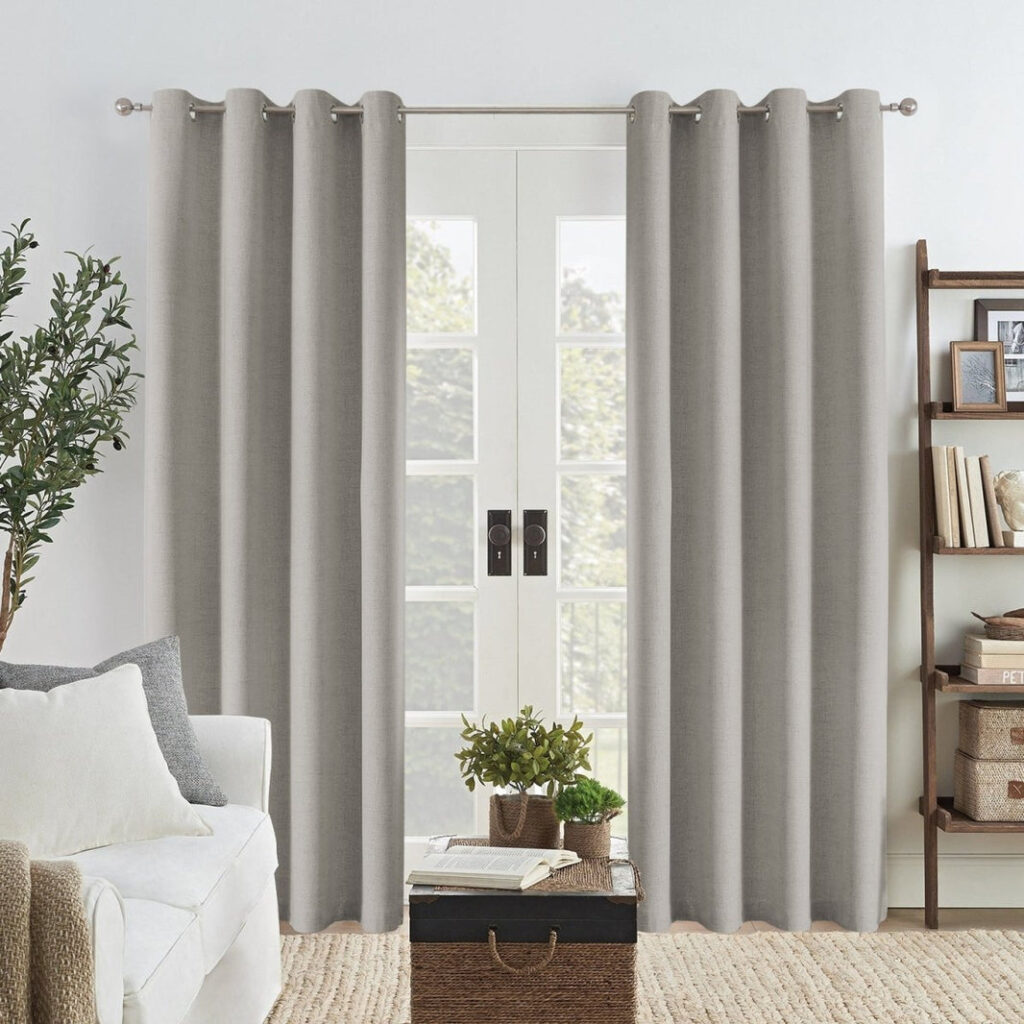
A grommet top suits a room like this. Gaps along the top edge let light in even through heavy fabric, and a grommet header tends to close the most cleanly and quickly at night.
A living room that keeps its daylight
A sheer or a light-filtering linen with no blackout liner keeps a living room bright. When you want some extra dimming, the lighter 50% liner is the one to add: Joydeco’s lining guide estimates roughly 60 to 90 percent light reduction with it, depending on the base fabric, which cuts glare and adds privacy while the room stays well lit by day.
Hanging a sheer ahead of a thicker blackout panel is another classic move. It gives you soft daytime light and real darkness at night from the same window.
A tight budget
Two panels keep the cost per window down: the Custom Sheer Curtain, from about $20, and the Custom Blackout Curtain, a basic grommet polyester panel from about $25. Either one is worth a look when several windows need dressing at once.
A more formal look
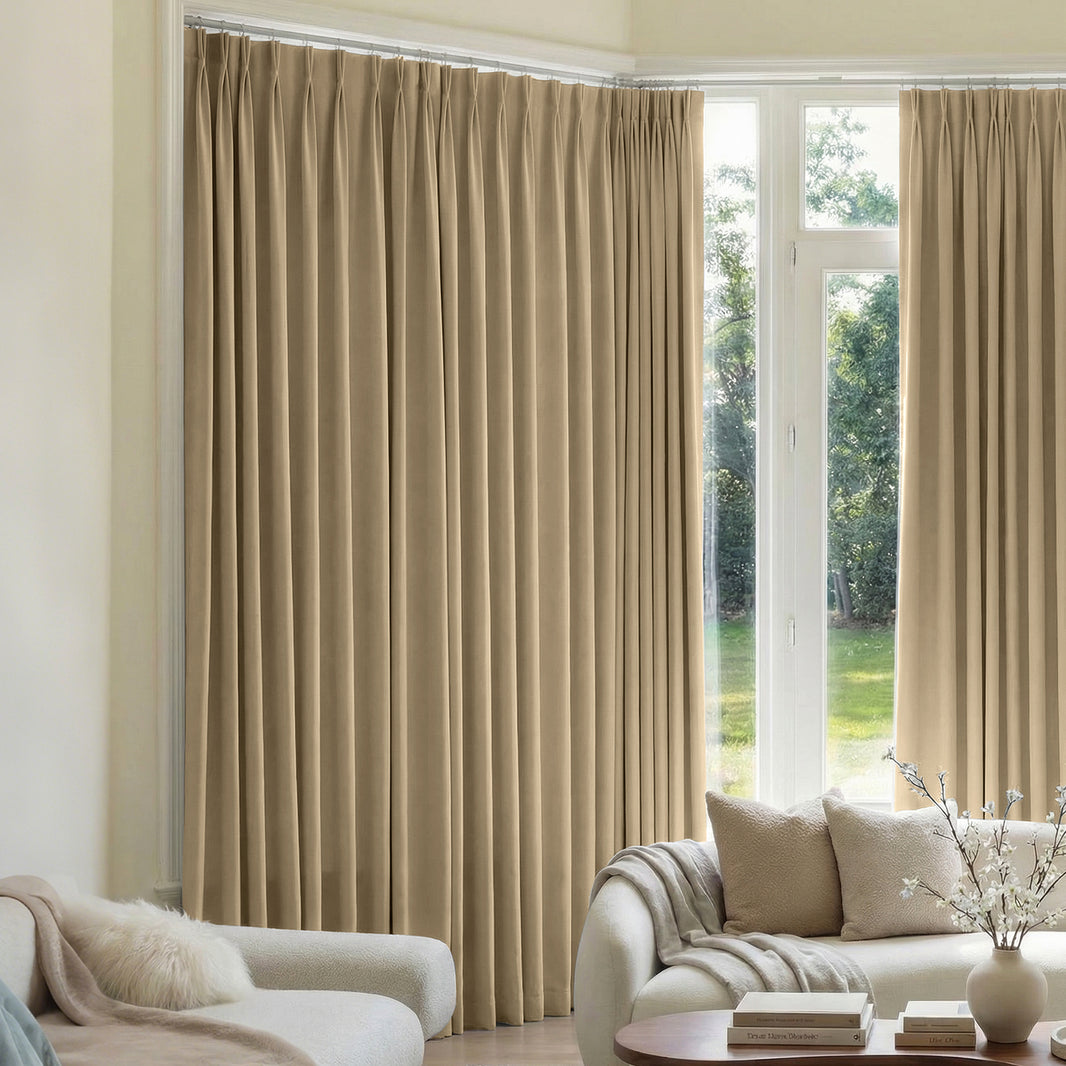
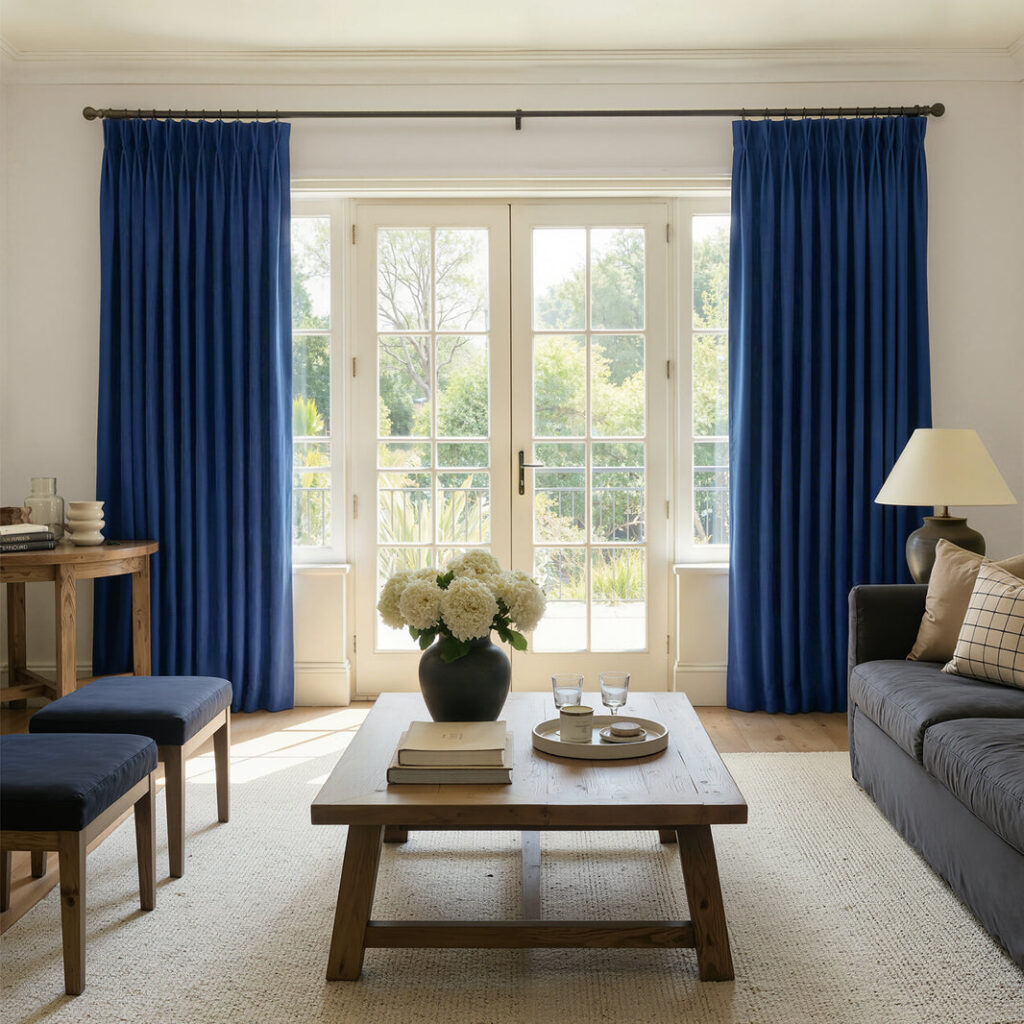
Velvet or chenille with a pinch pleat header is the most tailored combination in the range. Pinch pleats use more fabric, so the cost per window rises. A triple pleat asks for 2.5x fullness where the standard is 2x.
Whatever you pick, think about how the room is used across the whole day and which way the window faces. Those two facts say more about how much light control you need than any product description.
Fabrics and Linings Explained
Listings reuse the same few labels, such as blackout, thermal insulated, light filtering and faux linen. Learn them and shopping gets faster.
The fabric families
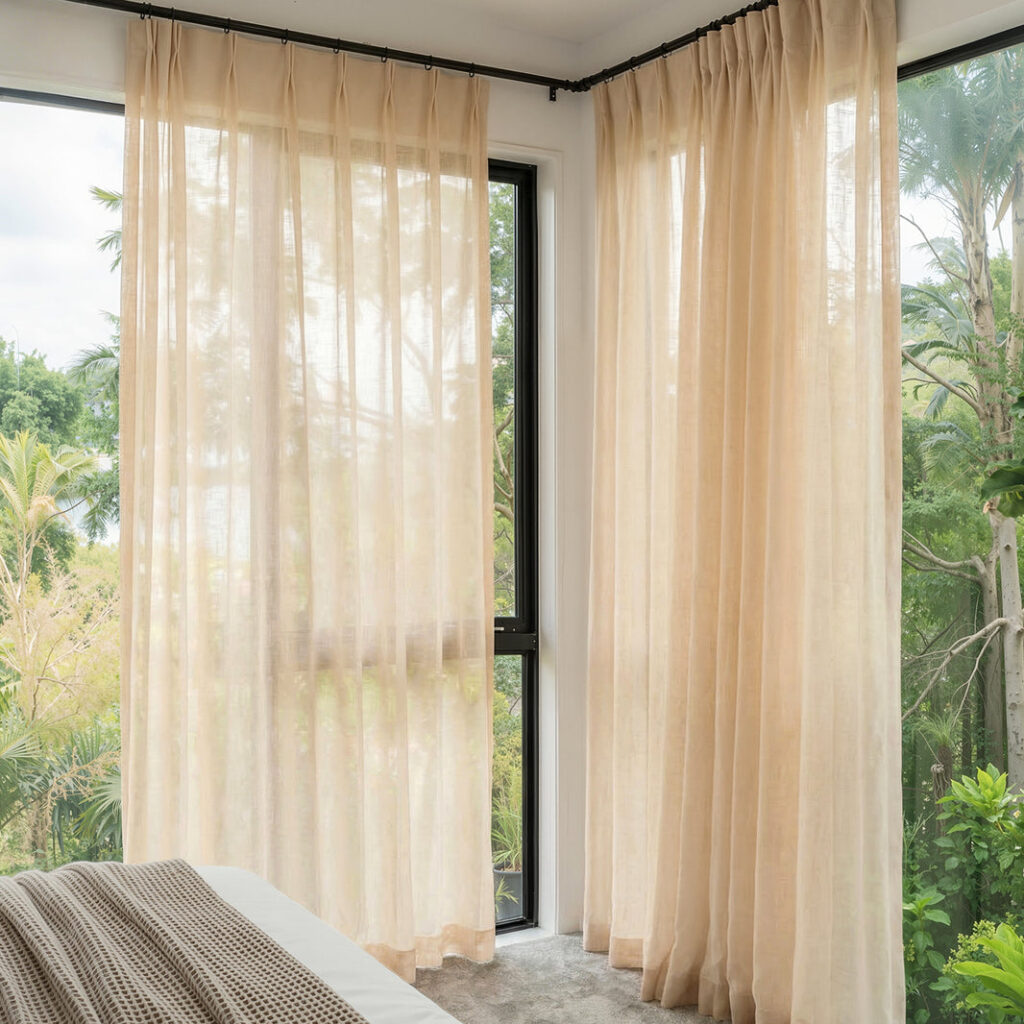
The range uses five main fabrics. Linen and its faux cousin share a natural, textured look, though Joydeco’s notes say the faux version generally takes a blackout coating more reliably. Velvet and chenille are thicker and softer, which the brand links with extra insulation and a dressier drape. Sheers and polyester weaves are the light-filtering choices: daylight comes through and you still get some privacy.
The brand says all of its fabrics are OEKO-TEX certified, a third-party textile standard, so the certification is not tied to one product line.
The three lining levels
This is the part shoppers skip, and it decides whether a curtain actually darkens a room. Joydeco’s lining guide describes three tiers.
- No liner: meant for sheers and for fabrics that already block light by themselves. It adds very little light control.
- 50% blackout liner: a 125GSM polyester layer. With a sheer fabric the brand puts light reduction at roughly 60 to 80 percent, and with a standard drape fabric at 70 to 90 percent.
- 100% blackout liner: a 250GSM polyester layer for full darkness, with better insulation and privacy. The trade-off is that machine washing is not recommended, and tiny pinholes at the seams can let faint slivers of light through.
Header Styles and Rod Fit
The header is the top edge that attaches the curtain to the rod. It changes how the panel looks and how easily it slides open and shut.
| Style | Look | Rod fit and details |
| Grommet | Even, structured folds | Suits rods under 1.5 inches |
| Rod pocket | Gathered, tailored top | Pocket is 2.8 inches tall and suits rods under 1.78 inches |
| Pinch pleat | Formal, with bold folds | Double pleat needs 2x fullness and triple needs 2.5x, with pleats spaced 5 inches apart |
| Back tab | Softer, with the hardware hidden | Tabs measure 4 by 1.5 inches, one every 6 inches, and suit rods up to 2 inches |
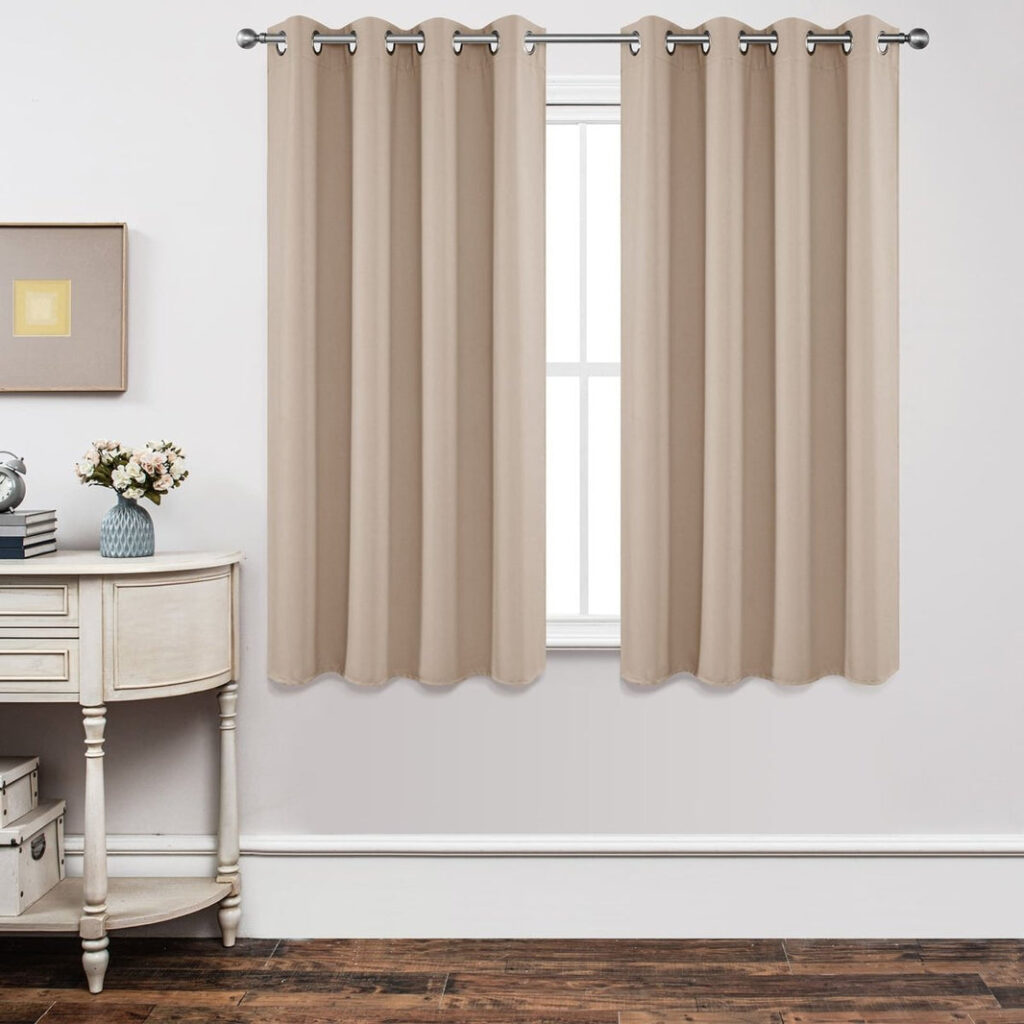
Grommet is generally the easiest header to slide by hand, and it is the default on several Joydeco panels, the Custom Velvet Curtain among them. Pinch pleat looks the most polished but needs the most cloth.
Pinch pleats attach with clip rings or hooks, so they do not depend on rod thickness the way the other styles do. Back tabs can stretch to a 2.5 inch rod, but the panel is harder to slide that way.
Already own a chunky decorative rod? Back tab is typically the safest match. Measure the rod before you choose a header, because a custom panel is hard to send back if the hardware does not match.
Measuring Before You Order
A made-to-order panel cannot be swapped for another size, so the measuring step carries more weight here than with ready-made curtains.
Start with width. Joydeco’s formula multiplies your rod or track width by the fullness you want, then splits the result across the panels, and the answer is the width of each panel. The brand treats 2x fullness as standard, so a 72-inch rod hung with two panels at 2x needs panels 72 inches wide each (72 x 2 ÷ 2).
Next comes the drop. For grommet, rod pocket and back tab headers it is measured from the rod’s top edge down to the floor, and with a decorative pole you measure between the finials. If you are putting up a new rod, a common guideline is to extend it 6 to 15 inches beyond the window frame on each side so open panels stack clear of the glass, and to set it about 6 to 10 inches above the frame.
Two habits help with any custom order. Measure the opening in more than one spot, because walls and frames are rarely perfectly square. Then write the numbers down and check them a second time before you press the order button.
Remember that panels are sold one at a time. If you want a pair for one window, order two.
The Panels Worth Knowing
Joydeco lists many styles, and these are the ones worth knowing. You can browse all of them on Joydeco’s store. Where a price appears below it is an approximate starting point per panel; for the rest, check the current price at Joydeco.
- Custom Faux Linen Blackout Curtain: faux linen listed as 100% blackout, with a grommet top and ten colors. Suited to bedrooms that need full darkness.
- Custom Classic Blackout Curtain, from about $25: plain polyester with the same full blackout build. A good fit for several windows on a budget.
- Custom Linen Light Filtering Curtain: a linen blend with no blackout coating. It softens direct sun and outside views while letting daylight in, which suits living rooms and home offices.
- Custom Velvet Curtain: a plush velvet with a broad palette that includes navy, orange, purple and forest green. The heavier cloth typically adds insulation, so it can also serve as a thermal curtain in colder rooms.
- Custom Textured Thermal Insulated Blackout Curtain, from about $25: textured polyester with insulation built in. It sits between the classic and the faux linen and suits rooms where temperature matters as much as light.
- Custom Boho Curtain: a linen styled for a relaxed, textured look that suits boho and farmhouse rooms. It comes in fewer colors than the faux linen panel.
- Custom Sheer Curtain, from about $20: the cheapest and lightest panel, with no blackout ability. It is an easy way to finish a window that needs softening rather than darkening.
One more point about the numbers behind these panels. Joydeco’s own store shows more than 4,700 reviews across the whole catalog, with about 85 percent at five stars, and nearly 200 on the faux linen blackout panel alone. Those are the seller’s own figures, so treat them as a general indicator from the brand rather than an independent test of any single panel.
Joydeco Next to NICETOWN
NICETOWN sells in the same budget blackout space, which makes it a fair yardstick. Here is how the two compare on the points that matter.
Price and sizing
NICETOWN’s ready-made panels land in a similar price range to Joydeco’s. Its own custom line costs noticeably more per panel, and it starts above the top of Joydeco’s range, going by the prices NICETOWN publishes.
Custom sizing does not separate the two brands. NICETOWN’s site advertises curtains tailored to your exact window size, so shoppers at either brand can key in their own rod width and drop. The difference lies in what the custom option costs, not in whether it exists.
Blackout performance
Both brands sell a full blackout tier. NICETOWN’s ready-made blackout panels have a black liner sewn across the back of the fabric. Joydeco splits fabric and lining into tiers, with the heavier 250GSM liner for full blackout and a lighter 125GSM liner for partial light reduction.
Independent testing of NICETOWN has generally backed up its blackout claims. Joydeco’s full blackout listings use that heavier liner weight, so on paper each is meant to shut out light, not merely soften it.
Returns
Returns are where the two differ most. Joydeco’s window is 7 days from arrival, open only for damage, wrong items or its own errors and backed by photos, so a correctly cut panel that merely misses the mark in the room stays with you. NICETOWN advertises 30 days instead.
If you trust your measurements and your color choice, Joydeco’s lower price on a custom panel makes it the better value. If you would rather have a safety net, NICETOWN’s longer window is worth paying more for. On stock sizes, where prices are close, pick the fabric you like.
Shipping, Returns and Care
Shipping and payment
| Stage | Typical time |
| Production | 2 to 5 business days |
| Standard shipping | 7 to 12 business days |
| Faster shipping, for an extra fee | 3 to 7 business days |
Tracking numbers can take a day or two to show up once the order ships, so an empty tracking page at first is not a warning sign. If nothing has arrived after 24 business days, contact support.
Orders of $99 or more ship free, and below that a flat standard fee applies. Deliveries go worldwide through DHL, FedEx, UPS and TNT, and only to street addresses, so PO boxes and military addresses are out. International orders may face import duties that are not part of the listed price.
At checkout you can pay with PayPal or a major card such as Visa, Mastercard or American Express. Checkout also shows Google Pay, Afterpay and Affirm as options. Your card is charged as soon as the order goes through, not when it ships, and the brand says card details are encrypted with SSL during checkout.
Returns and cancellations
Read this part before you order. Joydeco takes returns only for items that arrive damaged, orders where the wrong item was sent and cases where the mistake is its own, and the photos must reach it within 7 days of delivery. When the box arrives, open it promptly and photograph any damage so you can meet that window.
- Not covered: a correctly made panel that does not fit your expectations, a fabric weight you dislike, or a color that looks different on screen.
- Restocking fee: 10% is deducted from eligible returns.
- Return shipping: you pay it, and it is not refunded once items have shipped.
- Refund timing: roughly five business days once the returned parcel has arrived and been inspected.
- Authorization: required before anything goes back, since unauthorized returns are not accepted or refunded.
Cancellation is possible only in the first 24 hours after purchase, by email to customer service, and once that window closes the order is locked for production. Given how narrow the return rules are, ordering a fabric swatch first is a low-risk way to confirm color and texture.
Caring for the fabric
Joydeco’s standard routine for its blackout panels comes down to four rules.
- Washing: cold water
- Drying: tumble on low
- Ironing: low heat, and only if needed
- Bleach: avoid it
The heavy 100% blackout liner is the exception. Joydeco’s lining guide does not recommend machine washing it, since the thick backing holds water and wrinkles differently from the lighter 50% liner. The Custom Faux Linen Blackout Curtain uses that heavy liner, so spot cleaning or a careful hand wash is the safer choice for it, even though the top fabric alone could go in a machine.
Where to Buy Safely
Custom panels are cut and sewn only after you submit your measurements, so the store you order from decides your sizing options, your fabric choices and who handles a problem. For made-to-measure curtains that store is the brand’s own site, joydeco.com, where custom sizing, the full range of fabrics and linings, and the return and support process all sit.
If you buy anywhere other than Joydeco’s own site, make sure the seller is authorized. A reseller has no custom stock to sell, so a listing elsewhere that promises a custom Joydeco curtain is probably a stock size under a similar name, or not Joydeco at all.
Spotting a lookalike site
- Domain: the address bar should show joydeco.com, with no extra words or swapped letters.
- Certification wording: any OEKO-TEX language on a product page should line up with what the brand says about its fabrics.
- Contact details: a direct email and phone line that match Joydeco’s official ones are a good sign, and a bare contact form with no direct line is not.
- Price: a number far below Joydeco’s own for the same fabric and size is a cue to re-check the domain.
Frequently Asked Questions
How do I place an order?
Everything happens on the product page: choose the fabric, color and size, add the panel to the cart and pay. Ordinary custom orders skip any quote or consultation.
Are curtains sold as a pair?
No. One unit in the cart is one panel, so a window that needs a matching pair needs a quantity of two.
Can I cancel after ordering?
Only during the first 24 hours, and by emailing customer service. After that production has begun and the order cannot be cancelled.
Which panel suits a first-time buyer best?
Any panel works for a first order if you measure carefully. The Custom Faux Linen Blackout Curtain is a straightforward spec to start with: ten colors, a grommet top and a 100% blackout listing. Joydeco’s own store also shows it with the highest review count among its curtain panels, a figure that comes from the seller.
Does Joydeco ship outside the United States?
Yes, it ships worldwide. Import duties and customs fees are not part of the listed price and vary by country, so budget for them when ordering from abroad.
Are the fabrics certified?
The brand says every fabric in its catalog is OEKO-TEX certified, which is a third-party textile standard.