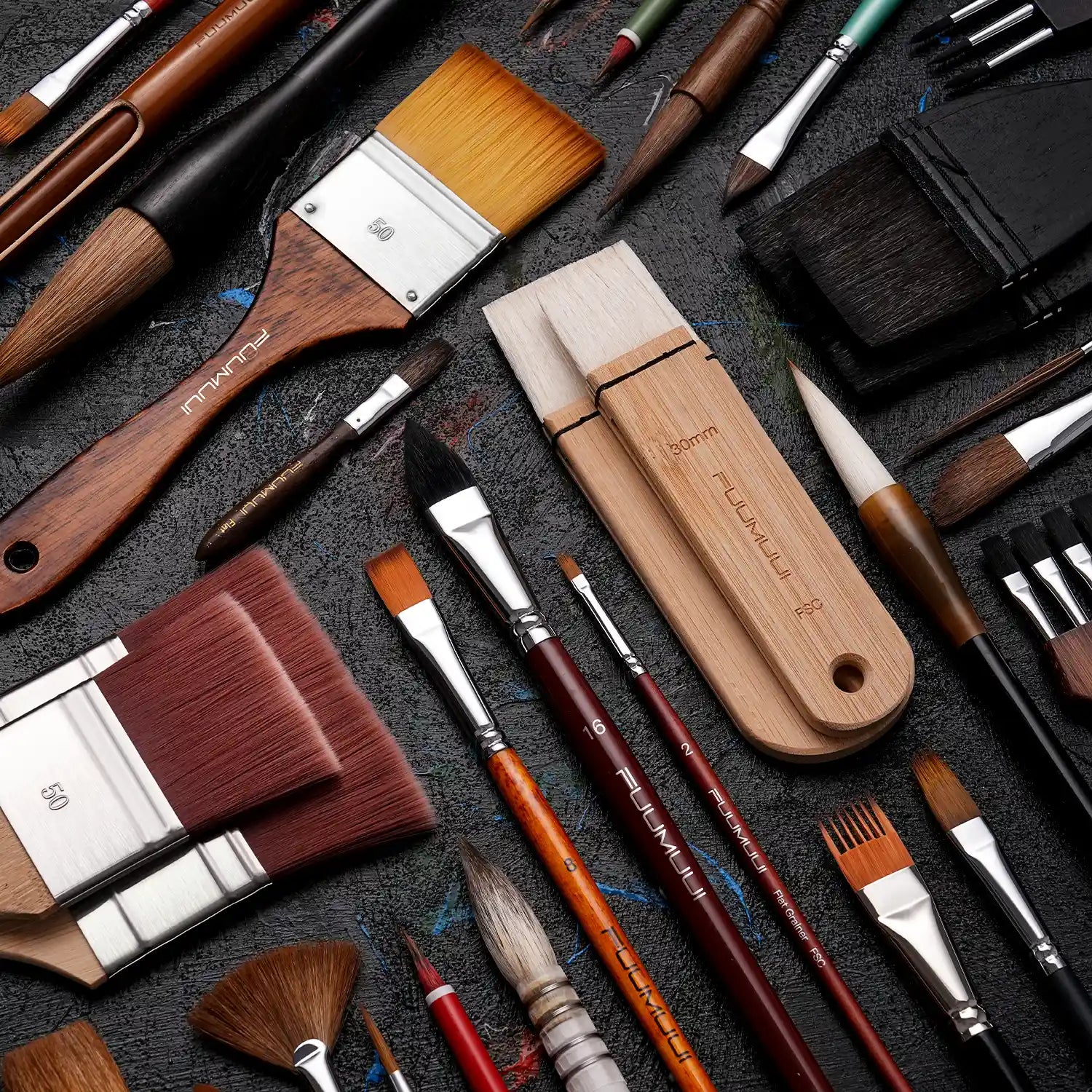
Fuumuui sells well over a hundred products, from sable travel brushes to cotton paper and palettes. A catalog that size helps once you know what you need, and it can feel like a maze on a first order.
This guide sorts the catalog by what each piece is for. It covers who is behind the brand, what the hair types and paper specs mean, how to choose by medium, space, skill and budget, how Fuumuui stacks up against Princeton, how to look after natural hair, and what the brand’s shipping and return terms say.
It is built from the brand’s own product details and policies, plus independent artist feedback. Where a claim comes from Fuumuui, the guide says so. Where the details run thin, it says that too.
Who Is Behind Fuumuui
Start with the gap the founder says the brand was built to fill. According to the brand’s about page, art brushes tended to land in one of two camps: tools that performed well and were priced for professionals, or cheaper ones that let you down. Little sat in between.
The brand ties its answer to the founder’s household. A father who painted kept meeting tools that fell short of what he wanted on the page. A mother ran a brush-making business of her own, and over roughly three decades she learned to choose hair, fit ferrules and build handles. Even the name carries that story: F for Father, M for Mother, and I for the narrator who grew up between them. The site’s tagline is “Paint with Warmth,” and the company calls itself a three-generation family business.
With production already in the family, the brand says it can use the hair types and construction methods of premium labels without paying an outside factory’s margin. That is the foundation of its value pitch. It is also a claim from the brand itself, not something an independent audit has confirmed.
The backstory helps you read the catalog. Product pages lean on hair type and build detail, closer to a manufacturer’s spec sheet than to ordinary retail copy. The artist collaboration lines fit a founder who comes from painting. And the low-price positioning depends on that in-house manufacturing.
What the Catalog Covers
The range falls into four groups.
- Brushes: watercolor, acrylic and oil lines, plus travel, miniature and face-painting options
- Paint sets: watercolor and acrylic kits, including a semi-solid range called Creamora
- Paper: cotton watercolor sheets, sketch pads and travel pads
- Accessories: palettes, easels and brush cleaners to round out a kit
Fuumuui says every brush is made by hand and inspected before it ships. It also says its handles are wood from FSC-certified, responsibly managed forests, paired with metal ferrules.
Beyond the core lines sit the artist collaboration collections, including one made with the watercolor painter Svetlin Sofroniev. These occupy the upper end of the range, and the budget section below returns to them.
Brush Hair and Paper Explained
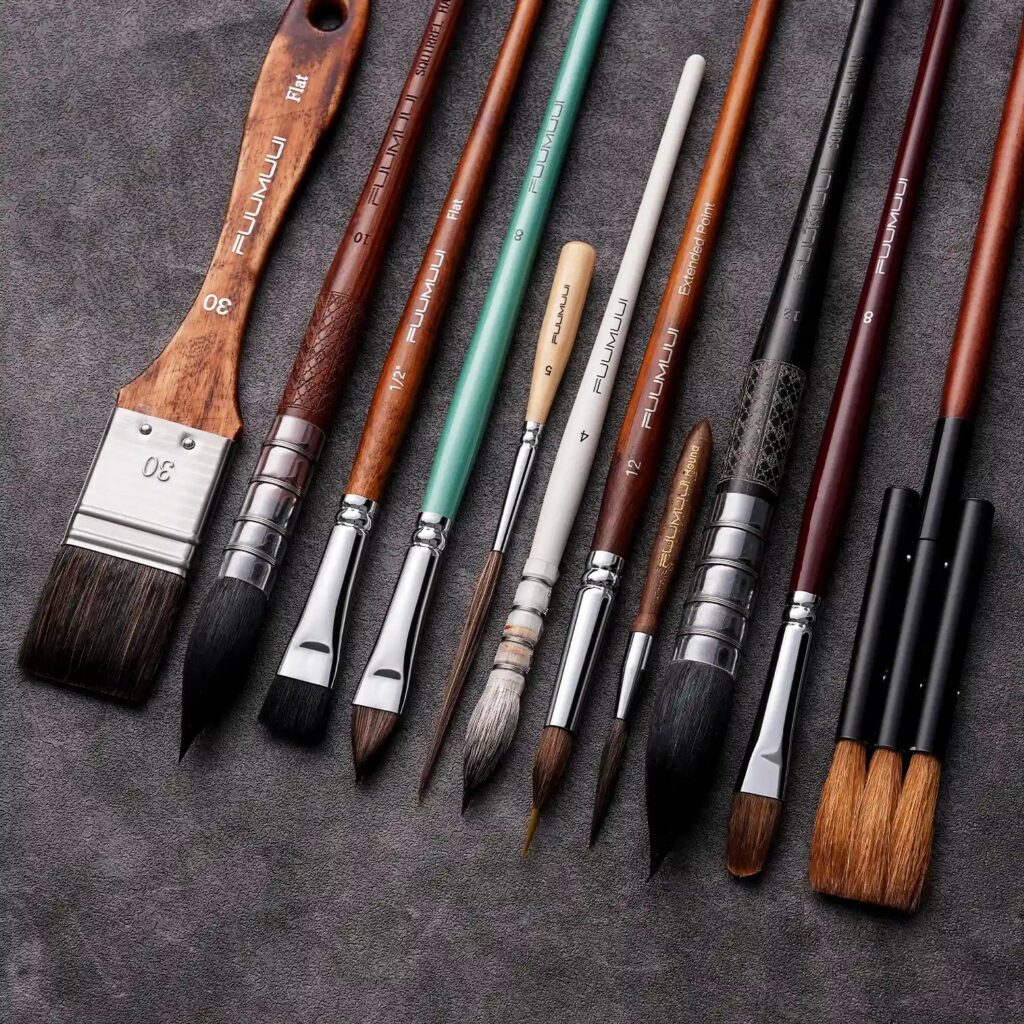
Product pages use terms like Kolinsky sable, squirrel, synthetic nylon and hog bristle. They are not interchangeable, so a hair that mismatches your medium can make a perfectly good brush feel wrong. The table sums up how the brand’s product specs and the artist reviews behind this guide describe each one.
| Hair | How it is described | Suits | Where Fuumuui uses it |
| Kolinsky sable | Holds a lot of water and pigment, returns to a fine point, resists fraying with age | Detailed watercolor | Its sable travel line and studio sets |
| Squirrel | Softer and thirstier, with a less sharply pointed tip | Loose washes and mop-style blending | Mop brushes and a few dual-tip travel sets |
| Synthetic nylon | Economical, holds its shape, rinses clean quickly, carries less water | Low-upkeep painting and acrylic | Acrylic brushes and some travel lines |
| Hog bristle | Stiff and coarse, pushes thick paint and leaves visible texture | Oil and heavy acrylic | Its hollow hog bristle sets |
The cost of sable is attention. The advice is cool or warm water, never hot, and bristle-up storage once the brush is dry. Synthetic hair also skips the early shedding that natural hair can show, but you will reload more often during big washes.
The brand markets its fiber collections as vegan and cruelty-free alternatives to animal hair.
On sourcing, Fuumuui’s statements say the natural hair is a by-product of routine farming or livestock management, that no animal is harmed solely for brush production, and that endangered species are not tolerated, in line with CITES.
Paper follows a single core spec: 100% cotton, 140lb (300gsm), cold press, used for the brand’s blocks, books and postcards. Cotton is described as standing up to repeated layering and lifting better than wood-pulp stock, and that weight as coping with wet-on-wet washes without heavy buckling.
How to Choose Your Set
Start with your medium
- Watercolor: the sable, squirrel or synthetic watercolor ranges
- Acrylic: the long- or short-handled acrylic sets, whose stiffer synthetic bristles are made for thick paint
- Oil: the hog bristle sets
- Miniatures and models: the fine-point detail lines
Think about where you paint
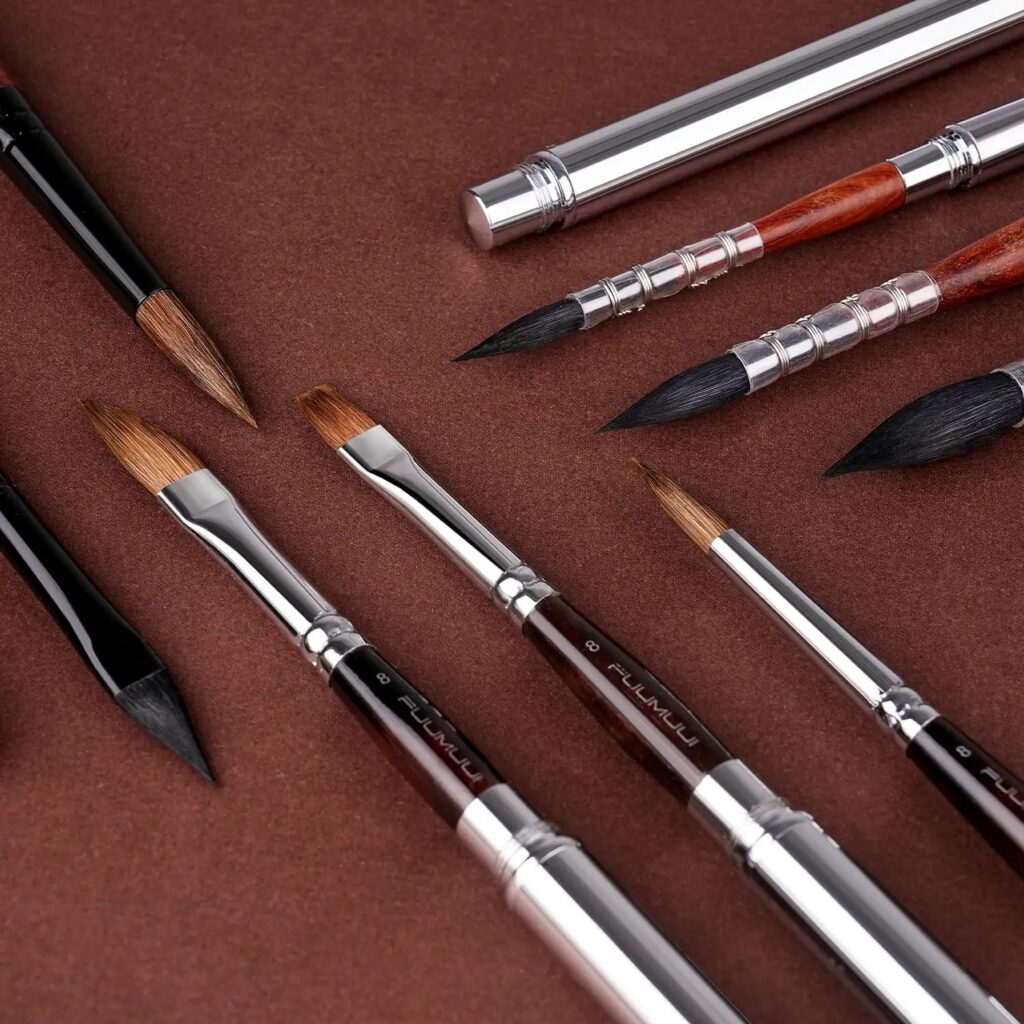
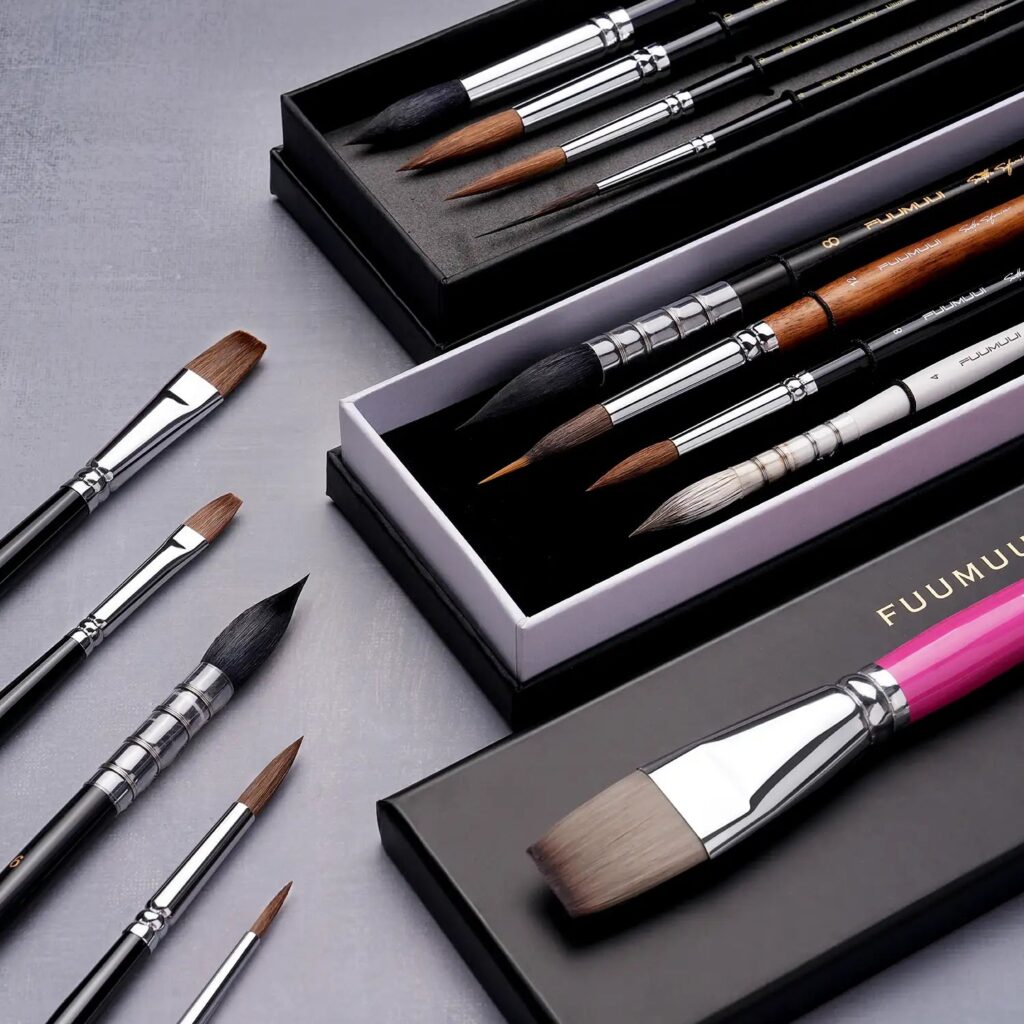
Desk and studio painters can use a bigger multi-brush set, such as the Professional Watercolor Brushes line, which puts extra shapes into one order. Painting outside, on the road or in a sketchbook tilts the choice toward travel sets. The brand equips those with protective caps and a carrying pouch that studio brushes do not include.
Four shapes, one small leather pouch: that is the appeal of the brand’s sable travel set. You can browse Fuumuui’s range at its own store, which is where the link opens, and find it alongside the rest of the catalog.
Match your skill level
Synthetic or mixed sets are the usual suggestion for newcomers, since synthetic hair tolerates uneven water control and rinses clean easily. Once you know how much water and paint you like to load per stroke, sable and squirrel hair give you finer control and more capacity.
One habit helps at any level. Try a new brush on scrap paper before it touches a finished piece, so you learn how it holds paint and how it lifts a line.
Set a budget
- Entry level: starter sable and synthetic travel sets, plus single items such as squirrel mop brushes
- Middle of the range: bigger sets of seven to nine shapes, plus the bulk of the natural sable studio range
- Top of the range: collaboration sets with named artists, such as the Svetlin Sofroniev collection, plus premium sketchbook or palette kits with extra accessories
Prices on the brand’s site can change, so check the current price at Fuumuui for any set before you plan around a figure.
Products by Need
A few pieces suit particular jobs. These notes come from the brand’s product details, grouped by the job each one does.
For a first natural-hair set
The four-piece sable travel set, which the brand lists as 4pcs Natural Sable Hair Travel Watercolor Brushes, puts real Kolinsky sable in four shapes inside a leather pouch. For a closer look at the specs, shipping window and who should skip it, read our full verdict on the Fuumuui 4-piece sable travel brush set.
For a studio set
The 8pcs Professional Watercolor Brushes use natural sable hair in flat, pointed round and cat’s tongue shapes, with birch handles and nickel-plated ferrules. It fits work that happens at a desk when you want shape variety.
For an artist collaboration
The Svetlin Sofroniev Professional Artist Watercolor Brush Set belongs to the brand’s Ultimate Collection Series, made with the watercolor artist of that name. It is the brand’s highest-end option for painters who want to try its top range.
For a travel palette
The 24-Well Portable Watercolor Palette is solid wood with 24 empty half-pan wells and two metal brush cups. A dual-tip travel brush with a built-in graphite sketching cap comes with it. Choose it if you already own paints and want a dedicated home for them on the road.
For opaque color
The 24-Color Opaque Semi-Solid Watercolor Set is described as finely milled, high-opacity paint with strong pigment coverage. It is aimed at painters who prefer a flat, saturated look to the glow of traditional transparent washes.
For an all-in-one sketchbook
The Watercolor Travel Sketchbook Set packs a PU leather cover, 300gsm cotton pages, a set of paints and a dual-tip brush into one refillable, ring-bound kit. It is for painters who want a single kit for everything.
For better paper
The Cold Pressed 100% Cotton Watercolor Block holds 22 sheets of 300gsm (140lb) paper, at about $19 to $36 at Fuumuui depending on size. If you already order brushes and paint from the brand, it is an easy way to make sure paper is not the weak link.
How Fuumuui Compares to Princeton
The short version: Princeton is the longer-established name, and Fuumuui is the younger brand pitching natural hair from in-house manufacturing. Which matters more depends on whether you value history or want to try natural hair from a smaller maker.
Princeton has made brushes for decades, and its Neptune series is a useful reference point. Neptune uses a synthetic fiber engineered to copy the water capacity of squirrel hair while being easier to clean than the real thing. Fuumuui’s lines overlap with it: real Kolinsky sable in sets like its travel line, actual squirrel hair in its squirrel lines, and synthetic versions as well.
Cost is where Fuumuui makes its case. It says in-house manufacturing lets it skip an outside factory’s margin. Princeton brushes are usually sold singly, so a four-brush kit is assembled piece by piece from art suppliers instead of bought as a set. Neither fact amounts to a price comparison, so look at current prices on both sides before you decide.
Track record favors Princeton, which has been on the market longer and has a longer public record. Fuumuui is younger, and review counts for any single product are modest. An independent watercolor artist who tested several Fuumuui sets praised their water and pigment retention, and reviewers on the brand’s own product pages have compared the sable brushes favorably with professional Winsor & Newton rounds.
If history and the widest possible evidence matter most, Princeton is the safer pick. If you want natural hair from a younger maker and can live with a shorter record, Fuumuui’s sable and squirrel ranges deserve a look, mainly as a first set you feel free to experiment with.
Care and Cleaning
Care decides how long a brush lasts, and natural hair can fray within a season when it is cleaned badly. These steps follow Fuumuui’s own FAQ, with extra notes for travel sets.
Routine for watercolor and acrylic brushes
- Rinse gently in warm water after every session. Hot water is best avoided, because it can loosen the glue that holds the hair in the ferrule over time.
- With acrylic, do not let paint dry on the brush. Once it cures in the bristles it is very hard to remove.
- Reshape the tip with your fingers before you set the brush down.
- Let it dry, then store it bristle-up. Avoid leaving brushes bristle-down or flat for long stretches, and never rest one on its hair in the rinse jar. Water pooling around the ferrule is a common reason for early loss of shape.
- On a travel set, recap only after the hair has air-dried. Then touch the tip to water, roll it to a point and slide the cap on, since forcing a dry tip in tends to go badly.
Oil brushes
Oil takes two stages. A brush cleaner or solvent made for the job breaks the paint down first, and warm water with mild soap clears what is left. Going straight to soap and water seldom removes oil that has soaked into natural hair.
Early shedding
Natural-hair brushes from any maker can shed a few loose hairs in the first sessions, and normal washing and use usually settles it. If shedding carries on well past that, contact Fuumuui’s customer service within the brand’s 7-day damage-claim window.
Buying Direct, Shipping and Returns
Fuumuui’s own site is where the full catalog, the rewards program and the brand’s return terms apply. Buying there also removes any doubt about who you are dealing with.
The brand ties its 30-day return window and its 7-day damage-claim process to purchases made from the brand itself or its verified sellers. An unverified reseller may leave you without them, and authenticity can be a question too. If you buy anywhere other than Fuumuui’s own site, make sure the seller is authorized. A short checklist helps.
- Read the seller name. It should be Fuumuui’s own storefront, not a generic seller borrowing similar photos.
- Compare with Fuumuui’s own listing. A figure far below it is a reason to slow down.
- Look for exact material detail. Genuine listings name the hair type and handle material, and a vague “premium brush” is a warning sign.
- Treat wholesale offers with caution. Fuumuui runs its own bulk and custom-branding service directly, so other parties offering the same are not official.
Shipping and return terms
| Step | What the brand states |
| Order processing | 2 to 4 business days |
| Delivery after shipping | 10 to 15 business days, through carriers that include Yanwen, DHL eCommerce, USPS and local partners |
| Shipping cost | Free worldwide above the brand’s stated order minimum, with a flat fee at checkout below it |
| Return window | 30 days from receipt, for unused items in the original packaging with tags and accessories |
| Refund | 3 to 7 business days after inspection, to the original payment method |
| Wrong, damaged or incomplete order | Report within 7 days, with your order number and photos or a video, for a free replacement |
Plan around the delivery window if you are buying for a class or a gift, since processing and delivery together run close to three weeks. The brand asks you to email customer service before you send anything back. You cover return shipping for a change of mind, while Fuumuui pays it in the damage and wrong-item cases. It does not publish a separate long-term warranty, so treat that first week as your main quality check.
Rewards and wholesale
The Fuumuui Art Club is free and switches on when you create an account. Each dollar spent earns 2 points, and extra points come from following the brand on social media, referring friends and birthdays. Points convert to discounts on later orders. Bulk orders and custom branding go through a separate channel, handy for stocking a classroom or studio.
Frequently Asked Questions
Which brush line fits which medium?
Each medium has its own line. Watercolor covers sable, squirrel and synthetic brushes, acrylic uses stiffer synthetic bristles, oil leans on hog bristle, and there are separate options for model painting and face painting.
Is the wood used for handles certified?
The brand says it holds FSC certification and takes the wood for its brush handles from responsibly managed forests that carry that certification.
Could I owe import duties on an international order?
Possibly. The shipping policy notes that buyers in places such as Mexico, Chile, South Africa, Indonesia, Argentina and Brazil can face import duties or VAT that Fuumuui’s checkout does not include.
Does Fuumuui offer a long warranty?
The brand does not publish one beyond the 7-day damage-claim window, so check your order soon after it arrives.
What are the synthetic brushes made for?
They suit low-upkeep painting and acrylic work. The brand also markets its synthetic fiber collections as vegan and cruelty-free alternatives to animal hair.
Where to Start
Pick the medium first, then the hair type, then the budget tier. Painters who travel will probably be happiest with a sable travel set, studio painters with a larger multi-shape set, and anyone still finding their style with a synthetic or mixed set that forgives mistakes.
Whatever you choose, allow for the shipping window, keep the packaging until you are sure, and look after the hair so it lasts. When you are ready, browse the range at Fuumuui’s own store, which is where that link opens.