Frizzlife offers a lot of different ways to filter water. Under-sink carbon block systems, tankless reverse osmosis units, an electric pitcher, a fridge filter and a faucet filter all sit under one name, and the product pages lean on a dense vocabulary of microns and NSF numbers.
This guide sorts it out. It covers where the brand came from, what each filter type does and does not do, what the certification labels mean, how to match a model to your sink and your water, and how to look after the cartridges once they are installed.
It is built from the brand’s own spec and policy pages and from independent commentary. Where a source goes quiet, the guide says so instead of guessing.
Who Is Behind Frizzlife
On the company’s about page, the founder, who goes by Robin, describes a visit to Madagascar, where many families lacked dependable access to clean drinking water. Most filter brands open with specs. Frizzlife opens with that story.
The brand presents the visit as the reason the company exists. The mission it states is clean water that is affordable and easy to add at home, with no plumber, no large budget and no agonizing over the choice.
How the catalog grew
Frizzlife calls itself a young, fast-growing brand. Under-sink filters were the starting point, and the range now reaches reverse osmosis systems, countertop pitchers, filters for refrigerators and faucets, plus gear for RVs and campsites. Public detail is thin on company size and the exact founding year, so this guide gives neither.
Mission beyond the product page
Environmental messaging runs alongside the health angle. Frizzlife pitches a home filter as a way to buy fewer single-use plastic bottles, and it ties the Madagascar story to a wider message that clean water is a right.
Read against that background, two product choices look consistent with the stated mission: installs that need no tools, and certification work such as NSF/ANSI 372 for material safety.
What Frizzlife Sells
The range splits into a handful of families. Under the sink you get direct-connect carbon filters, sold in lines named FK, MK, SK, DW, TW and SW. Tankless reverse osmosis units come in PD, PX and M800 lines. Away from the sink there are countertop RO machines, electric pitchers, fridge filters, faucet-mounted filters and gear built for RVs and camping.
Seven models give a fair picture of the range:
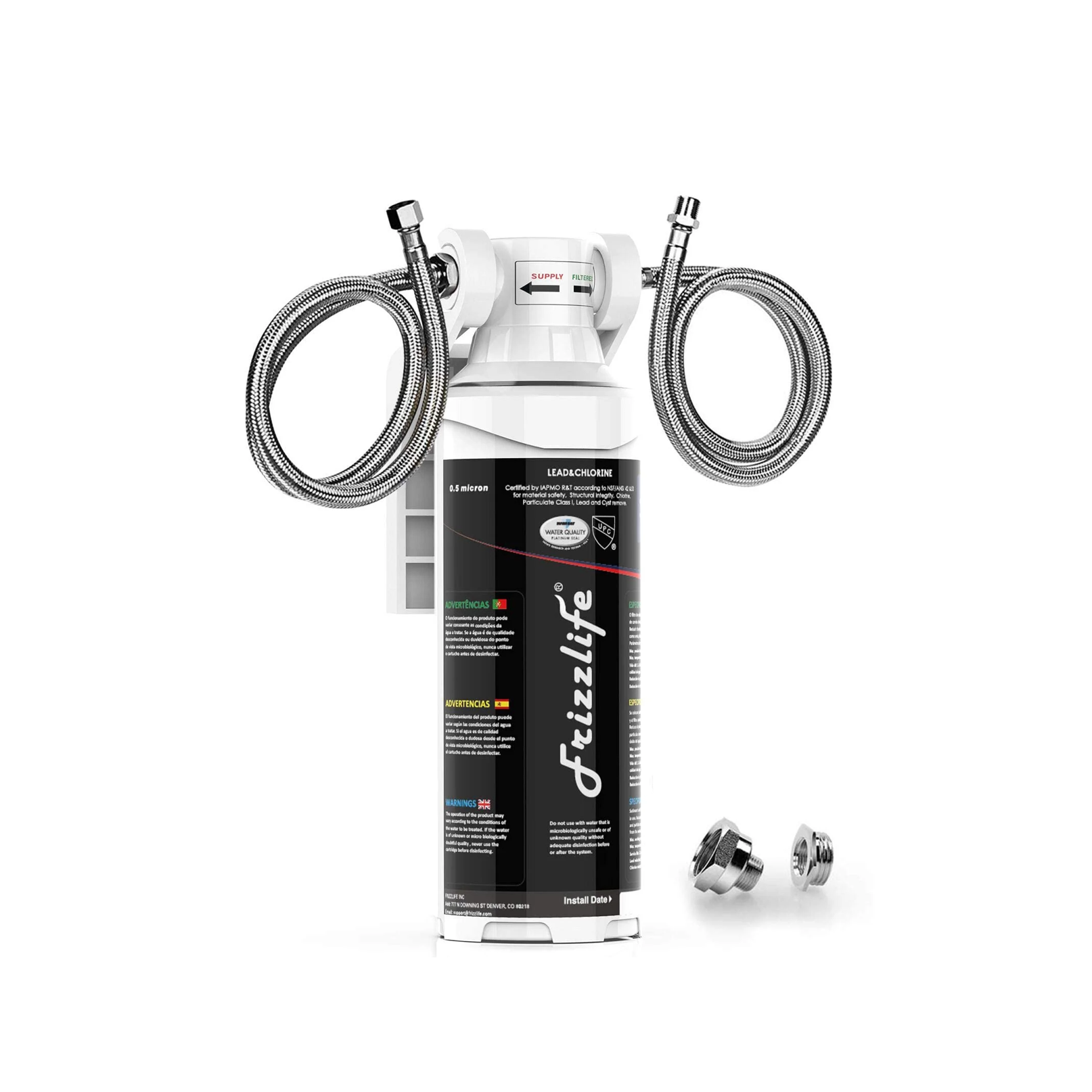
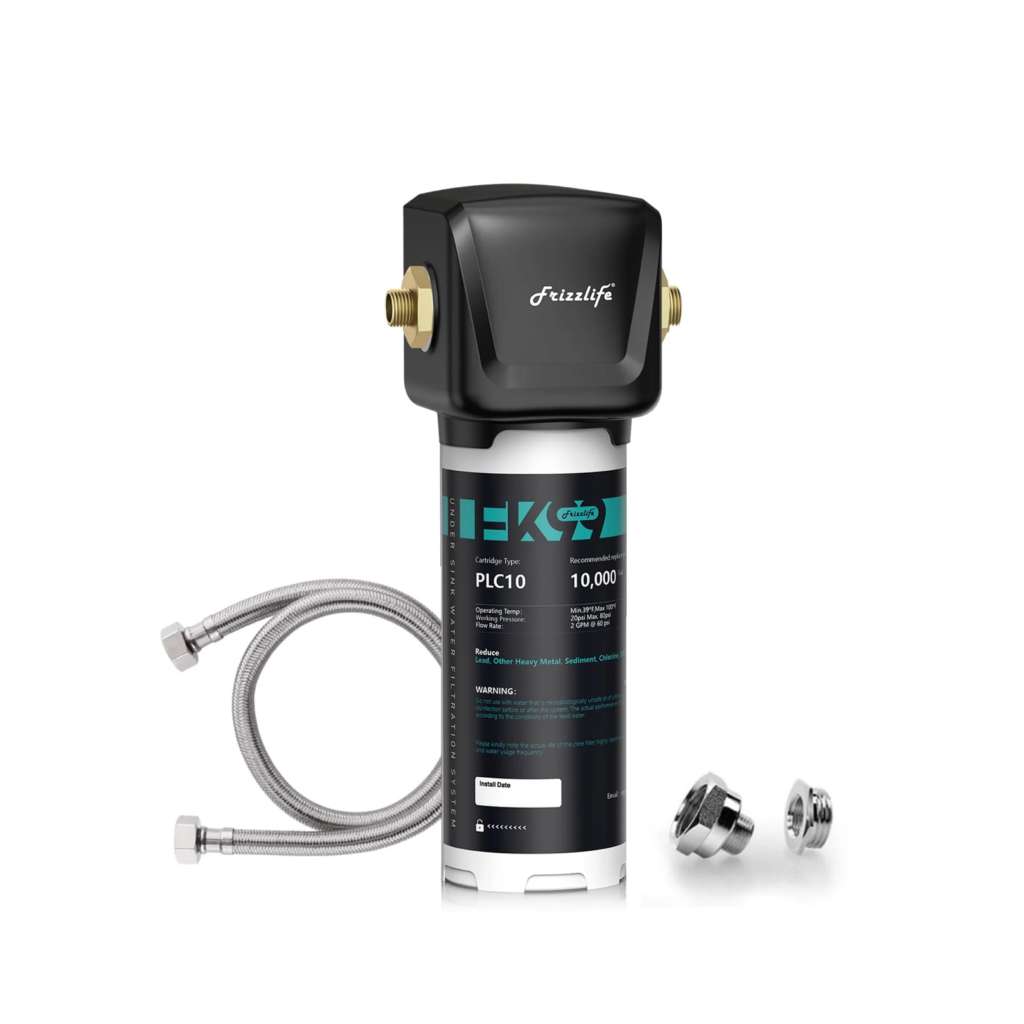
- FK99: the under-sink model our verdict covers, a two-stage 0.5 micron carbon block system with a cartridge life of 10,000 gallons, brass fittings and a tool-free install of around five minutes.
- MK99: the entry-level under-sink option, also two-stage and 0.5 micron, with a 2 GPM flow figure and a housing that measures 5 x 5 x 13.5 inches.
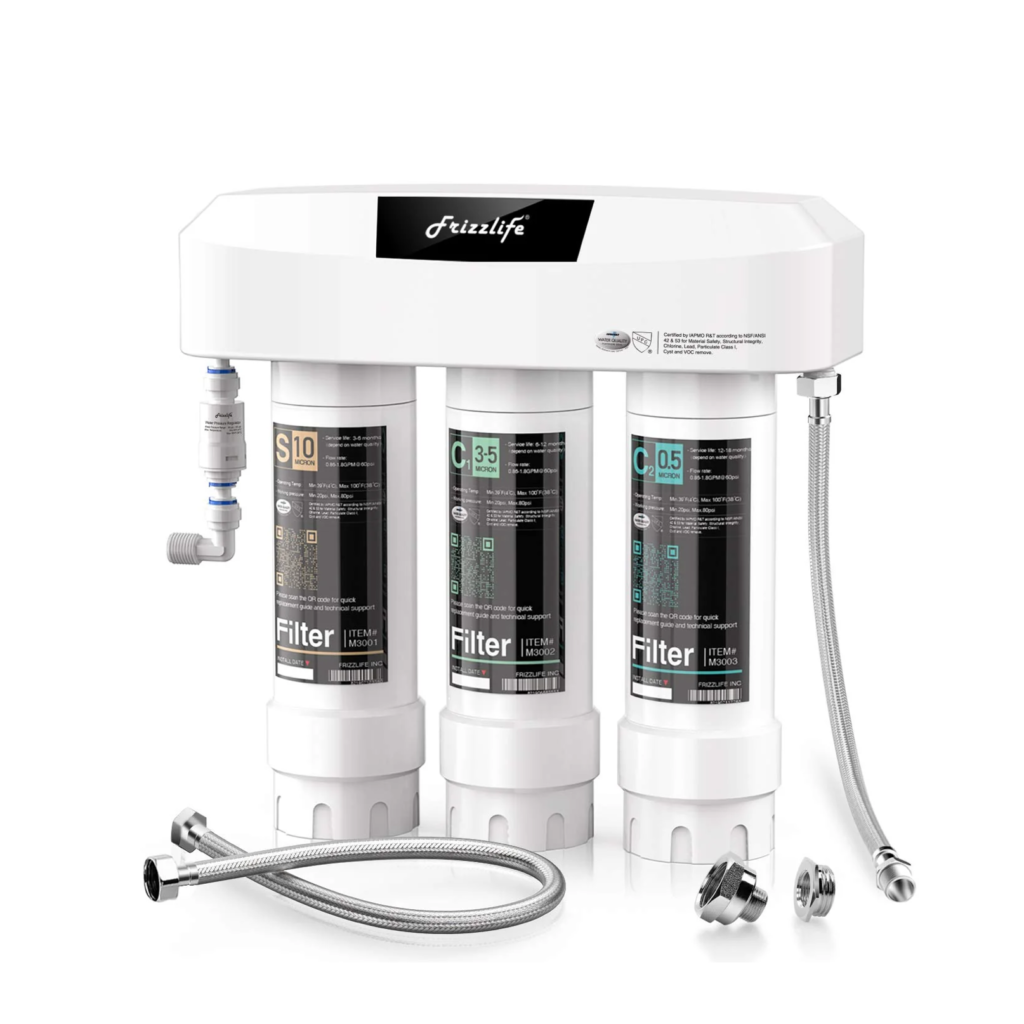
- SK99-NEW: adds a third filtration stage, with a separate replacement schedule for each one.
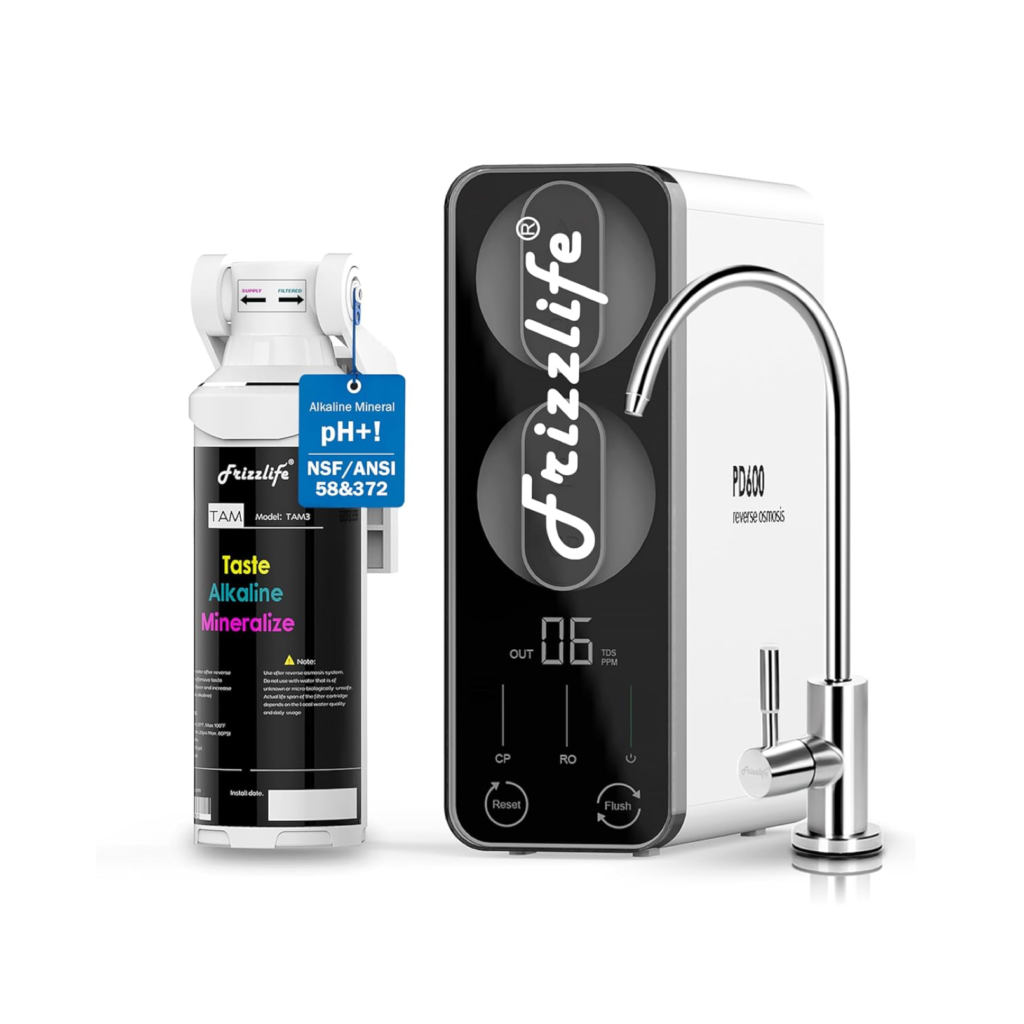
- PD600-TAM3: the flagship reverse osmosis system, with eight stages, a membrane with a 0.0001 micron rating, an alkaline remineralization cartridge and a TDS readout that updates live.
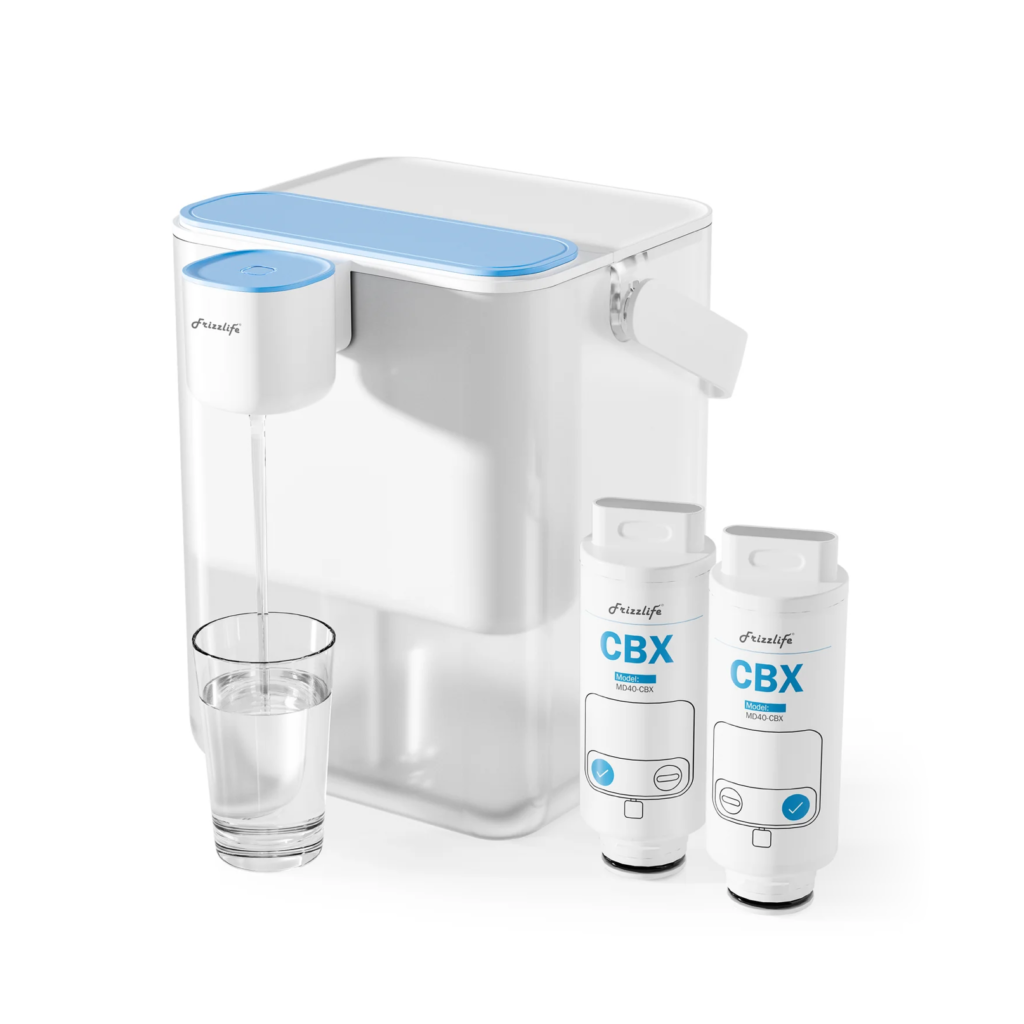
- MD40: an electric countertop pitcher that needs no installation.
- MS99: a refrigerator filter aimed at replacing the original filter in a fridge for ice and dispenser water.
- FF1080: a faucet-mounted filter, the simplest way in and more of a stopgap than a long-term replacement for an under-sink system.
If you want a single model to start with, the FK99 is the one this guide uses as its running example. To see what Frizzlife lists, you can browse the brand’s storefront on Amazon and compare the details with what this guide covers.
Carbon Block and Reverse Osmosis
Spec sheets for Frizzlife filters quote ratings such as 0.5 micron and 0.0001 micron. Those figures describe two very different kinds of filtration, and the difference decides which model suits you.
Carbon block under the sink
Three of the models, the FK99, MK99 and SK99-NEW, are built around carbon block cartridges. Each one is a block of compressed activated carbon with a 0.5 micron rating. Frizzlife says it catches particles of that size and up, while the carbon itself adsorbs chlorine, some heavy metals and VOCs.
The design is pitched at taste, odor, chlorine and lead. Total dissolved solids, or TDS, sit outside that remit. Hard water stays hard after a carbon block, and the dissolved minerals and salts that RO removes are not meaningfully reduced.
Reverse osmosis
Reverse osmosis works with a far finer barrier: a membrane rated at 0.0001 micron. At that scale the system can take out dissolved solids as well as larger particles, which is what separates water that simply tastes better from water that shows a lower TDS reading.
The PD600-TAM3 is the RO example here: eight stages, tankless, and rated for 600 gallons a day, roughly 0.41 gallons a minute. Once the membrane has stripped out minerals, an alkaline remineralization cartridge returns some. On the paperwork side it is listed with NSF/ANSI 42, 53 and 58, 372 for lead-safe materials, and SGS testing, a much deeper stack than the carbon line has.
Countertop and pitcher filtration
The MD40 skips plumbing altogether. Its eight stages and 1 micron dual filter sit inside an electric pitcher with a rechargeable battery, and Frizzlife claims about five times the speed of a gravity pitcher. The brand lists chlorine, lead, fluoride and PFAS or PFOA as its targets, with the same 42, 53 and 372 labels as the carbon units.
What the NSF Numbers Mean
Certification labels are easy to misread, so here is what each one covers.
- NSF/ANSI 42 is about aesthetic effects, such as chlorine taste and odor.
- NSF/ANSI 53 is the health-related contaminant reduction standard, with lead and certain VOCs as examples.
- NSF/ANSI 58 applies only to reverse osmosis systems and measures TDS reduction.
- NSF/ANSI 372 covers the lead content of the materials themselves, not how well a filter removes anything.
Applied to the FK99, the labels split in two. The finished system holds 372. The cartridge media inside is described as meeting 42 and 53, backed by an IAPMO verification report, but that is not a system-level 42 or 53 certification. Frizzlife’s own product page warns against reading 372 as a performance standard.
The PD600 is different, because it carries full system-level testing. It pays to read the labels carefully rather than assume every Frizzlife product comes with the same depth of paperwork.
Matching a Model to Your Situation
A simple way to narrow the field is to start with your water and your sink, then work toward a model.
Start with the problem
If the complaint is a chlorine-heavy taste, a slight metallic edge or a city-water smell, carbon block is the fit and RO is overkill. If a home test shows hard water or high TDS, or you rely on well water, the logic flips, because carbon block does not meaningfully lower TDS.
Renting or want the simplest install
For a rental, the FK99 is the easiest place to begin. Its install is direct-connect and tool-free, with the guide putting it near five minutes, and both 1/2-inch and 3/8-inch lines are covered. It also leaves the faucet setup untouched, which suits anyone who might move and would rather not commit to plumbing changes. For a closer look, read our full verdict on the Frizzlife FK99 under-sink filter.
The MK99 tackles the same everyday complaints, taste, chlorine and lead, with an equally quick install. The catch is that its cartridges come due more often.
Want more filtration stages
The SK99-NEW adds a third stage and staggers the changes: the first cartridge every three to six months, the second every six to twelve, the third every twelve to eighteen. That extra layer can make sense if your utility’s water report shows higher contaminant levels, or if you simply want more filtration.
If your water is hard
Skip carbon block here and look at the PD600-TAM3. It is an eight-stage tankless RO system, and its alkaline remineralization means the result is not flat-tasting, stripped water. Choose it when a test shows a genuine dissolved-solids problem, not when the complaint is only about flavor.
No plumbing access
The MD40 needs no installation, which makes it the natural pick for apartments, dorms and anyone who does not want to open the cabinet under the sink.
Before you order anything
A few practical checks save headaches whichever model you pick.
- Open the cabinet and look at the space. Make sure the unit will fit and that you can still reach it when a cartridge needs changing.
- Locate your cold water shut-off valve and note which line size you have.
- Check what else lives under the sink, such as a disposal or storage bins, so the hoses have a clear route.
- Keep the install guide and the box somewhere easy to find.
Frizzlife and Waterdrop Side by Side
Waterdrop is a useful comparison, since it follows a similar direct-to-consumer model. Both brands market under-sink and reverse osmosis systems with words such as tankless, alkaline and NSF-tested, and the advertising makes the flagships sound further apart than the specs do.
Reverse osmosis
On the Frizzlife side, the PD600-TAM3 is listed with 42, 53, 58 and 372 certification, SGS testing and an output of 600 gallons a day. Comparable Waterdrop RO systems are independently certified to 58 and 372 for TDS reduction, and a few models are rated a little faster.
Both flagships carry real certification rather than marketing claims alone. For flow at the tap, compare the gallons-per-day figure of the exact model instead of assuming either brand is faster across the board.
Under-sink carbon filters
Under the sink is where the two brands diverge. The FK99 holds 372 for material safety, with media that meets 42 and 53, yet the finished unit lacks the system-level certification the PD600 has. Certain Waterdrop under-sink units come with fuller system-level certification on the carbon filter.
That is a statement about documentation, not about how the Frizzlife carbon line performs. It simply gives you less paperwork to lean on if certification depth is your deciding factor.
Buying the Real Thing
Filter cartridges are small and easy to imitate, which makes them a natural target for knockoff listings. A little care helps you end up with a genuine system.
The official channels
Frizzlife sells through its own store at frizzlife.com and runs separate regional sites for the US, Canada, the UK and Germany. The brand also operates official storefronts on large retail platforms, Amazon among them, and those are run by Frizzlife rather than by unrelated resellers.
Why the seller name matters
One Amazon listing can be served by several sellers, and not every one is Frizzlife. Find the ships-from and sold-by line before you buy. If it names someone unfamiliar instead of Frizzlife or Amazon, take a closer look at the photos and details on the listing.
Frizzlife’s distributor and dropship program means legitimate resellers exist, so a reseller alone is not a red flag. A listing whose photos do not match the packaging or model name on frizzlife.com is a better reason for suspicion.
Why authenticity affects your warranty
Extended coverage typically depends on registering the product after you buy it, and the registration is linked to the unit itself. That is where a gray-market purchase or a superseded version of the model can cause trouble, whether at registration or later when you file a claim.
In practice that means three habits: buy from frizzlife.com or a storefront the brand has verified, read the seller name before you pay, and register the unit as soon as it is delivered. Together they protect the warranty terms and the compatibility of replacement cartridges.
Care, Cartridges and Warranty
Check every fitting early
The FK99 is listed with lead-free brass fittings rather than plastic, but no new install is exempt. Joints can weep a little as they settle, so check beneath the sink when you finish and again a day later.
Replace on a schedule
Flow is a late warning: by the time it visibly slows, the media may already be spent. Frizzlife rates the FK99 cartridge at 10,000 gallons or about a year of typical household use, whichever arrives first, while the SK99-NEW’s three stages each follow their own schedule. Put the dates in a calendar and do not rely on taste or flow to tell you.
Buy genuine cartridges
Both the FK99 and the MK99 take the FZ-2 cartridge. When you replace it, buy from frizzlife.com or a storefront the brand has verified, since compatibility and certification only apply to genuine cartridges. Replacements are a running cost, so check the current price on Amazon for the cartridge as well as the system.
Watch the drain on an RO system
Frizzlife gives the PD600-TAM3 a pure-to-drain ratio of 2:1 and presents that as more water-efficient than older RO designs, which send several gallons down the drain for each gallon produced. Two things are worth watching: a drain that runs longer than usual, and a TDS display reading higher than normal. Either can point to a membrane that needs attention before the taste changes.
Register right after install
The base warranty is one year. Registering the product lifts it to 150 percent of that, around 18 months, and costs nothing. Because it is simple to postpone once the filter is running, file the registration on the day you finish setup.
Returns and shipping
Returns on Frizzlife’s own store must be unused, in the original packaging and back within 30 days of receipt. Return postage is deducted from your refund unless the brand shipped the wrong item or a damaged one. No restocking fee applies, final-sale items are not refundable, and the store does not deliver to Puerto Rico, Guam, Hawaii and the Northern Mariana Islands.
Frizzlife FAQ
Do I need a plumber to install one?
Not for the under-sink carbon models. Frizzlife describes them as direct-connect and tool-free, with roughly five minutes of work on 1/2-inch or 3/8-inch cold lines.
Does Frizzlife remove fluoride?
The MD40 is listed for fluoride reduction, along with PFAS and PFOA. The standard carbon filters, FK99 included, are not listed with that capability, so confirm on the exact product page if fluoride is your priority.
What is the difference between the FK99 and MK99?
Both use two stages and a 0.5 micron rating. The FK99 sits a step higher, with a cartridge good for 10,000 gallons. The MK99 is the entry-level pick, in a more compact housing with a 2 GPM flow figure.
Can Frizzlife make alkaline water?
Yes, the PD600-TAM3 is the model for it. After the membrane removes minerals, its alkaline remineralization cartridge returns some to the water.
Will a Frizzlife filter work with an ice maker?
Yes, for the FK99 and MK99. Frizzlife lists them as compatible with refrigerators and ice makers when installed with its IMC-2 kit.
The Bottom Line
Frizzlife covers a wide range, from a simple faucet filter to a full reverse osmosis system, and the best choice depends on what is actually in your water and how much work you want to do under the sink. For households that mainly want better taste and less chlorine, an under-sink carbon block filter is the quick, low-effort route, which is what Frizzlife’s tool-free line is built around.
Go in knowing which certification sits on which part of the product, register your warranty on day one and keep a cartridge date on the calendar. If the FK99 sounds like your match, you can browse Frizzlife’s storefront on Amazon and confirm what is listed there.