Solid wood storage is easy to like and hard to choose. Bread boxes, coffee shelves and small furniture come in similar shapes, and a piece that looks perfect in a photo can still be wrong for the space you actually have.
CheerNest is a small home-storage brand that builds its pieces around one main material, solid pine. The range is made up of bread boxes in three designs, coffee stations in two versions, a rotating bookshelf and a side table, so the whole catalog fits into a single guide.
This guide helps you narrow it down. It covers how to size up your space, which piece suits which job, what the spec terms mean, how the brand stacks up against Sunhoo and how to care for the wood. Everything comes from the brand’s published details and not from hands-on testing.
What CheerNest Makes
The range is organized into a kitchen collection and a living room collection. The kitchen side holds the bread boxes and the coffee station organizers, and the living room side holds a tall rotating bookshelf and a narrow side table.
Every piece follows the same recipe. The brand builds in solid pine, adds acrylic accents with a fluted or wave texture, and pairs them with adjustable hardware. The look sits somewhere between farmhouse and industrial, and it carries across the whole catalog.
The brand sells through its own online store at cheernest.store and through an official storefront on Amazon. To see the full lineup in one place, open the CheerNest storefront on Amazon, which is where the link on this page leads.
The brand describes its aim as tidy, warm rooms in the kitchen, the living room and the bedroom, built from natural and durable materials. That helps explain why the catalog reaches past the kitchen.
Start With Your Space
Before you compare features, measure. A piece that does not fit the spot you chose will frustrate you, however well it is made.
For a bread box, check three things: the width and depth of the counter area, the height between the counter and the cabinet above, and how much room you need in front to open the door fully.
CheerNest publishes most of its sizes, which makes planning easier.
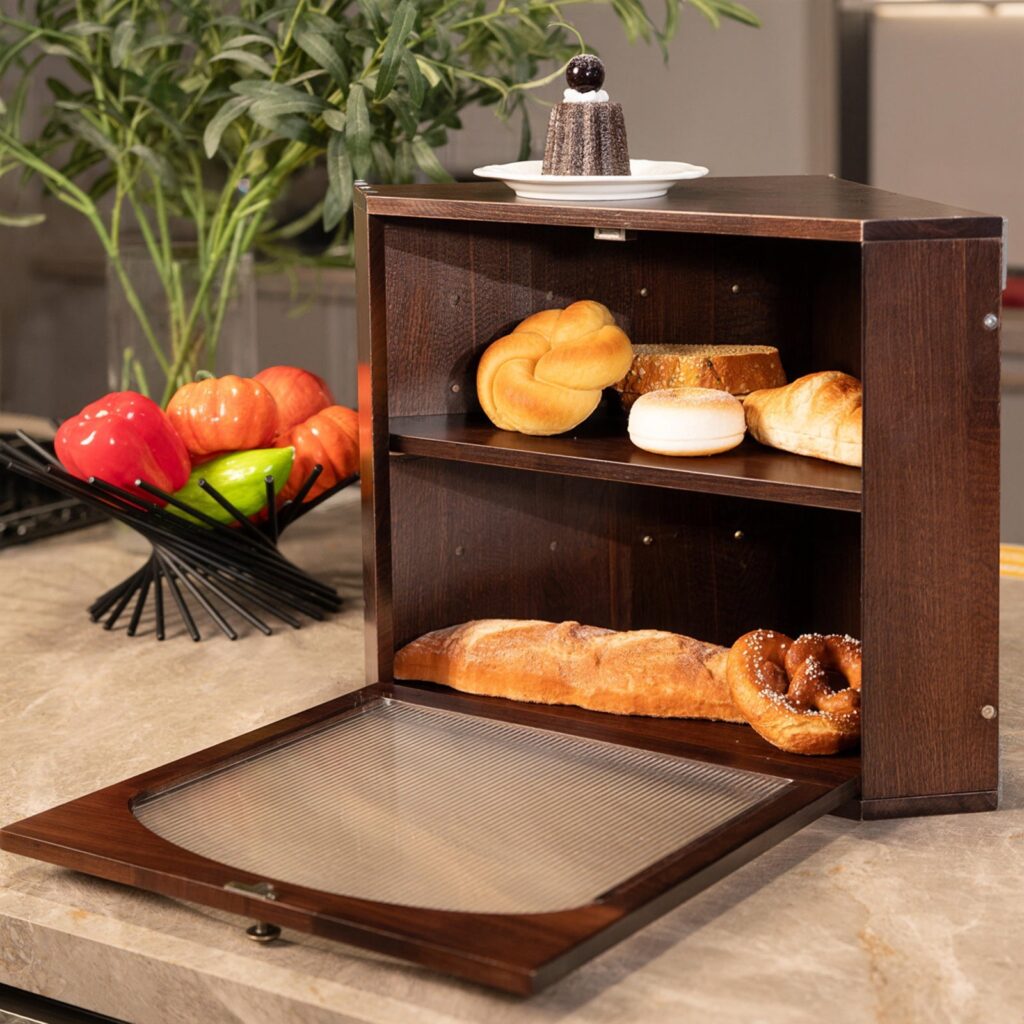
- Corner Bread Box: 13.4 inches long, 8.7 inches wide, 12.6 inches tall
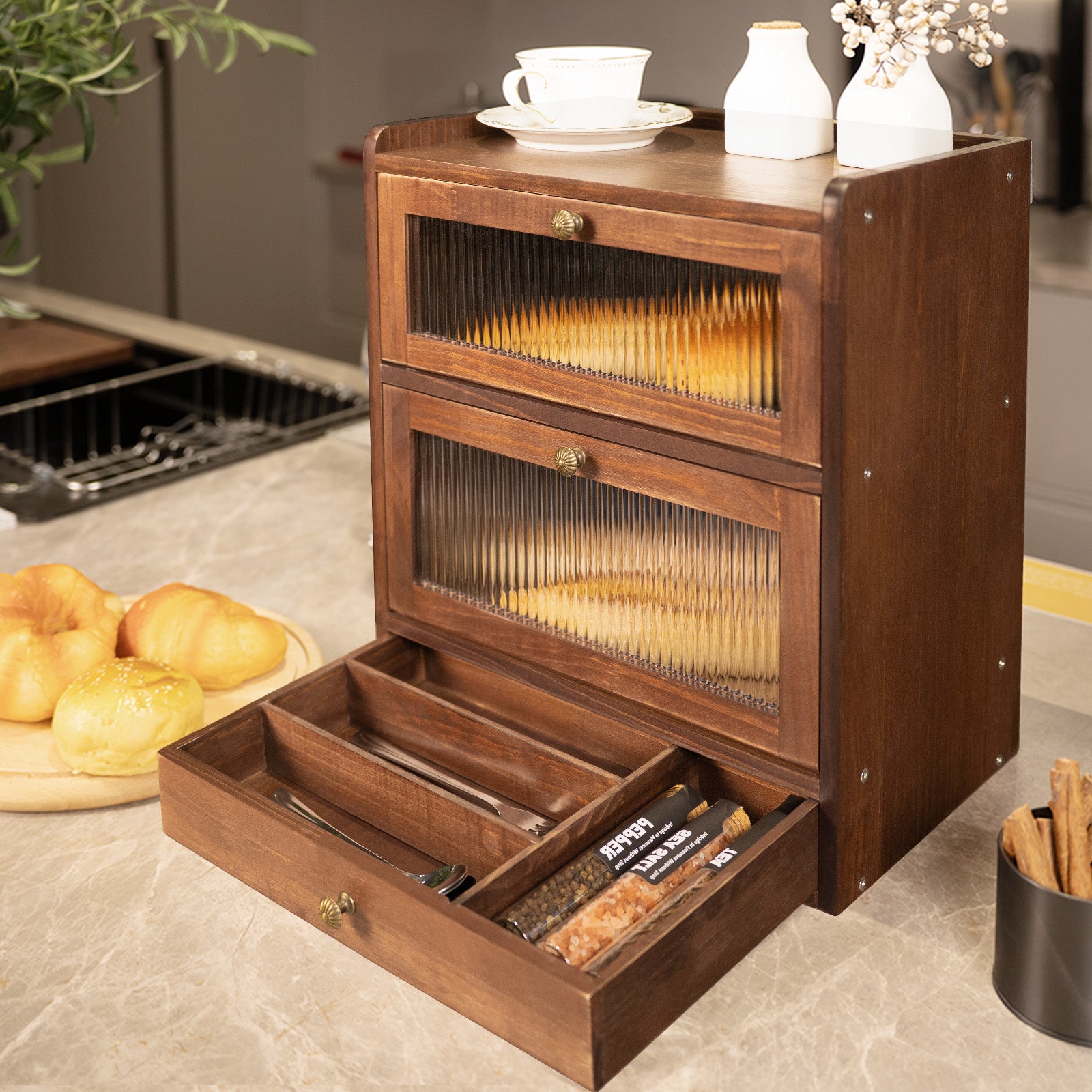
- Bread Box with Drawer: 14.4 inches long, 9.5 inches wide, 16 inches tall
- Side table: 15.75 inches long, 11.8 inches wide
- 6-tier rotating bookshelf: 16.5 inches across, 79 inches tall
The drawer bread box is tall, so make sure it clears the cabinets above your counter before you order it.
Plan for the vents too. Every CheerNest bread box has them at the back, and they only help if air can reach them, so a small gap between the box and a wall or appliance is worth leaving. On the corner model, that means not forcing the box hard into the angle.
Think about the neighbors too. Wood and water do not mix well, so a spot away from the sink’s splash zone is kinder to a pine piece. Place a coffee station near the machine you use, and leave room for the tallest item you plan to put on it.
For the living room pieces, measure the floor and the ceiling. The bookshelf turns on a 360-degree base, so it needs clear floor around it, and at 79 inches tall it needs matching headroom.
Pick the Right Piece
Once you know your space, match the piece to the job. The catalog is small enough that each model has a clear role.
For Bread and Baked Goods
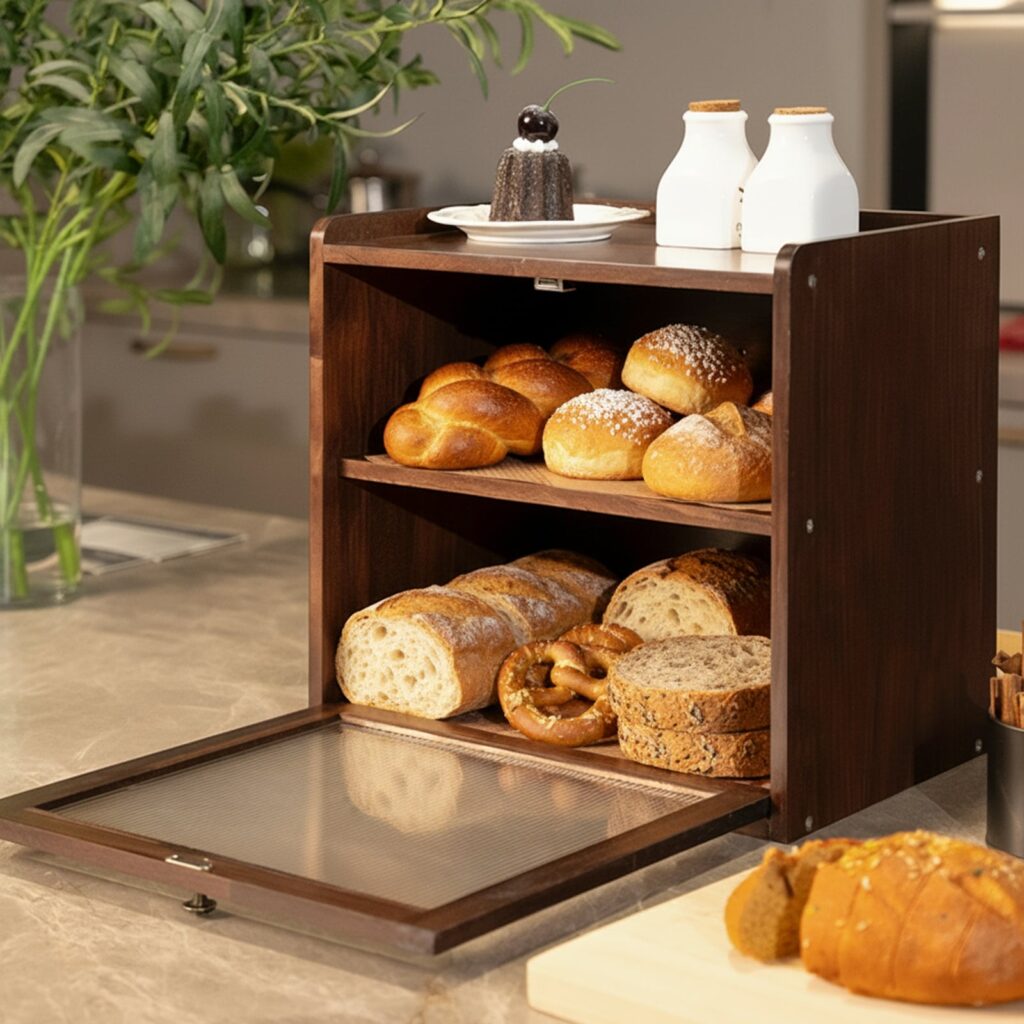
Three designs make up the bread box range. Each is solid pine, and each has an acrylic window and rear vents.
The Corner Bread Box is the one for an awkward counter corner. Its 90-degree back panel fits the angle, and its footprint is the smallest of the three. For the specs in detail, read our full verdict on the CheerNest Corner Bread Box.
The Bread Box with Drawer suits a kitchen that is short on cutlery storage. It stacks a two-level bread compartment above a bottom drawer for knives and utensils, and it comes with a pack of deli paper (50 sheets, food-grade and oil-proof) plus an assembly manual.
The Bread Box with Acrylic Window is the standard model. It is a double-layer box for plain counter placement, and its window lets you see how much bread is left without opening the door.
For a Coffee Corner
Both coffee station organizers use 304 stainless steel threaded rods in place of fixed pegs under the shelves. The rods let you set each shelf at the height you want, in small steps, which helps when your tallest item is a grinder and your shortest is a mug.
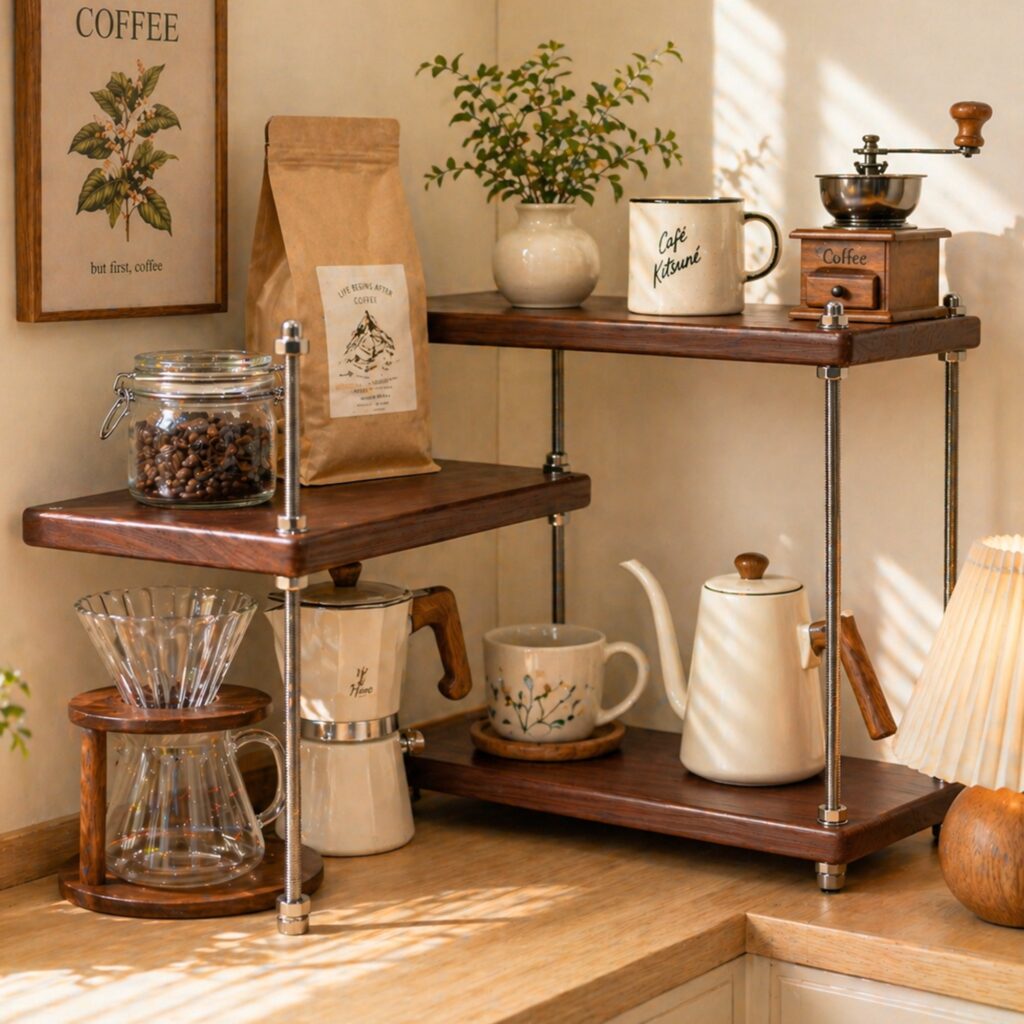
The standard Coffee Station Organizer and Spice Rack is the lighter option. It has three adjustable tiers, and the brand lists mugs, syrups and spice jars as natural fits.
The Ultra-Thick 24mm model is the heavy-duty version. It uses 24mm pine planks on four 10mm rods, and the brand positions it for a serious coffee or espresso setup with heavier gear such as a grinder or a scale. A bubble level comes in the box, which helps you set the shelves evenly on a counter that is not quite flat.
Between the two, you are mainly choosing how much weight the setup needs to carry. A few mugs and jars suit the standard version. Heavier equipment is what the ultra-thick model is built for.
For the Living Room
The 6-Tier Rotating Bookshelf Tower is the biggest piece in the catalog. It uses 15mm solid pine and turns 360 degrees on a base with five lockable caster wheels, and it holds roughly 120 standard books. It makes sense when you have a real collection to show and a corner that needs vertical storage.
The side table is the small accent piece. It has a solid pine frame with a top made of fluted acrylic, plus leg sections that swap in and out to change the height of its shelf, and it supports up to 50 lbs. Its slim footprint suits the space beside a couch or an armchair.
What the Specs Actually Mean
Spec sheets love jargon. Here is what the main terms on a CheerNest listing tell you, and what they leave out.
Solid pine
Solid pine means the piece is cut from real timber and not from a composite. The brand argues that pine is sturdier and more moisture-stable than bamboo, and that it keeps fasteners tighter than particle board or PVC foam. Those are the brand’s claims, and this guide has not tested them.
Real wood also looks like real wood. Expect knots and shifts in color from one unit to the next, which CheerNest says on its product pages. A piece with perfectly uniform grain would be the thing to question.
304 stainless steel threaded rods
The 304 label names a stainless steel grade known for corrosion resistance and widely used in kitchen hardware. CheerNest uses it for the rods that hold the shelves on its coffee organizers. The ultra-thick model has four of them, each 10mm thick.
Acrylic windows and tops
Where other makers might reach for glass, CheerNest uses acrylic: a fluted window on each bread box and a fluted top on the side table. Treat it gently with a soft cloth, because scouring pads can dull the finish.
Rear vents
Vents at the back mean the bread boxes are not sealed. CheerNest chose airflow on purpose, so if you would rather keep bread in an airtight container, this is not the design for you.
Casters, level and latch
Small details add up. The bookshelf has five lockable caster wheels, the ultra-thick coffee organizer includes a bubble level, and the Corner Bread Box closes with a magnetic latch that the brand markets as pet-proof.
How CheerNest Compares With Sunhoo
Sunhoo is the most natural comparison for CheerNest’s bread boxes, since both brands chase the same shopper.
The two make nearly the same pitch. Both lead with solid wood over bamboo composite or painted MDF, and both sell double-layer bread boxes meant to hold several loaves plus smaller baked goods. With the pitch so close, the details decide the choice.
CheerNest goes further in a few directions. It makes a dedicated corner model, which is not a standard part of Sunhoo’s range. It offers a drawer model with an integrated cutlery compartment, and Sunhoo’s core lineup does not build one in. It also extends past bread boxes into coffee organizers, a bookshelf and a side table, so you can assemble matching pieces from one brand.
Sunhoo has been on the market longer, which counts if a long history is your main buying signal. CheerNest is the newer, smaller brand.
| Point of comparison | CheerNest | Sunhoo |
| Wood | Solid pine throughout (100%) | Solid New Zealand pine |
| Corner-fit model | Yes, a dedicated model | Not a standard offering |
| Built-in cutlery drawer | Yes, on one model | Not in the core lineup |
| Other products | Coffee organizers, a bookshelf and a side table | Mainly bread boxes |
| Time on the market | Newer, smaller brand | On the market longer |
If you need a corner fit, built-in cutlery storage or matching pieces, CheerNest is built for that. If a longer time on the market matters most and you need none of the extras, Sunhoo is the brand to compare.
Setup, Care and Everyday Use
Solid pine is forgiving in some ways and fussy in others. Most of the upkeep comes down to water, alignment and weight.
Water and crumbs
Moisture is the main thing to manage. A cloth that is only lightly damp suits the wood, a soaking does not, and any wet spot is best dried straight away. Pine takes in water over time, and swelling or warping near the joints is the usual result.
In a bread box, add a quick crumb clear-out to the routine and keep the rear vents open. A soft cloth is all the acrylic needs.
Assembly
CheerNest’s listings repeat one tip: thread every screw in loosely, check that the panels line up, and only then tighten. The goal is to keep the frame square so doors and drawers close smoothly.
The corner bread box deserves the most care here, since a frame that starts slightly off is harder to correct on that shape than on a plain rectangle. If your coffee organizer came with a bubble level, use it to set the shelves even while you build.
Weight limits and wood character
Respect the stated limits: 50 lbs for the side table, and kitchen gear rather than heavy appliances for the coffee organizers. A shelf that is loaded and emptied daily is where those limits matter most.
Knots and uneven color are part of buying real wood. The brand tells buyers to expect them, so there is no reason to sand them out.
The Brand Behind the Wood
Do not expect a founder story here. CheerNest’s site names no founder, gives no founding year and has no about page, and the blog in its navigation is empty.
The closest thing to a mission is the tagline, “Nurture Space, Nurture Life,” along with the brand’s description of pairing natural, durable materials with smart design. That is positioning rather than history, but the catalog follows it: real pine, plus practical details such as vents, rods and levels.
What can be verified is a paper trail. The privacy policy page lists a street address in Houston, Texas, together with an email address and a phone line for support. Published contact details are a modest reassurance that a real business sits behind the storefront.
Where the brand is vague about itself, its product pages are specific about materials, dimensions and assembly. That is a reason to judge each piece by its own page instead of by the brand name.
It is also a young, small catalog, which means long-term durability is hard to verify. Everything in this guide rests on published specs, and none of it rests on years of use. Weigh that honestly, especially for the larger pieces.
Where to Buy and What to Check
The brand has two official channels: its own online store at cheernest.store and its Amazon storefront. Both carry the same main range of products. The CheerNest storefront on Amazon is a quick way to browse everything, and the link opens Amazon.
Before you order on Amazon, read two lines of the listing. The brand under the product title should be CheerNest, and the seller line should match CheerNest’s storefront. If a listing borrows CheerNest’s wording but names a different seller, treat it as another company’s product.
On the brand’s own site, the domain is cheernest.store, product pages sit under a products path, and the tagline Nurture Space, Nurture Life runs in the header.
Plenty of brands make look-alike double-layer wood bread boxes, among them Sunhoo, Goozii, Kitsure and JANSNIMEN. They are independent competitors, not copies of CheerNest, so their sizes, materials and included accessories can differ from CheerNest’s specs.
Delivery details are thin on the brand’s own site, which has no shipping policy page and no delivery estimate in its homepage banner. If you order direct, expect shipping cost and timing to appear at checkout. On Amazon, the listing carries Amazon’s standard delivery estimate.
Returns follow a similar pattern. CheerNest’s site publishes a privacy policy and no returns or warranty page, which says nothing about how returns are handled, only that the terms are not posted. Through Amazon, Amazon’s standard return terms apply to eligible items and Amazon handles the process, so read the listing’s return details before ordering.
If you buy from the brand’s site and need help, the support email and phone number on the privacy policy page are the places to start.
Frequently Asked Questions
What materials does CheerNest use?
Pine is the base for every piece, and the brand lists it as 100% solid. Acrylic appears on the bread boxes and the side table, and the coffee organizers add 304 stainless steel threaded rods.
Is CheerNest only a bread box brand?
No. Bread boxes lead the range, which also includes two coffee station organizers, plus a bookshelf that rotates and a side table.
Which bread box suits a small kitchen?
The Corner Bread Box has the smallest footprint of the three and fits a counter corner. Measure first, because the drawer model is the tallest.
What is included with the drawer model?
Besides the box, you get a pack of deli paper (50 sheets, food-grade and oil-proof) and an assembly manual.
How many books fit on the rotating bookshelf?
The listing states roughly 120 standard books across its six tiers.
How much weight can the side table take?
Up to 50 lbs, according to its listing.
Can I use a coffee organizer for spices?
Yes. The standard Coffee Station Organizer and Spice Rack is named for that use, and the brand lists mugs, syrups and spice jars as good fits.
Where are the return terms?
CheerNest’s own site has no stand-alone returns page. Amazon purchases follow Amazon’s standard return terms for eligible items, so check the listing before you buy.
Is there a founder story?
No. The brand has published no founder bio and no founding year.
Where to Start
If you are buying your first CheerNest piece, let your space decide. A spare counter corner points to the Corner Bread Box, a need for cutlery storage points to the Bread Box with Drawer, and a serious coffee setup points to the Ultra-Thick 24mm organizer.
For anything bigger, measure twice. The bookshelf and the drawer bread box both need headroom, and the side table suits tight spots.
Whichever piece you choose, buy from a listing that shows CheerNest as the brand, read the return details and enjoy the real wood, knots included.