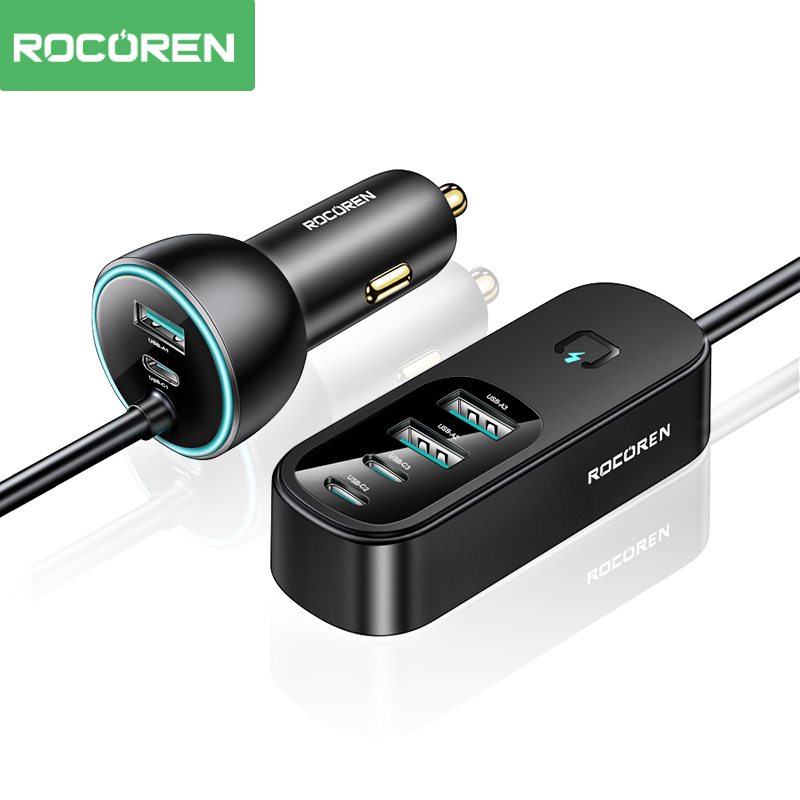
Rocoren’s 105W 6-Port Multiport Car Charger is built around one idea: a single 12V socket should not decide how many people can charge on a drive. One head sits in the socket, and a 5-foot cable carries a second set of ports back to the rear seat.
This page is a research-based read of Rocoren’s spec sheet and the brand’s own claims, not a bench test of my own. When a number comes from Rocoren’s marketing, the text says so.
In short, the spec sheet lists wide fast-charging protocol support, six ports split between the front and back of the car, and a set of protective features. It cannot say how the charger holds up after years of daily use, and this page does not pretend otherwise.
A Two-Part Design for Every Seat
Two pieces make up the charger. The head goes into the car’s 12V socket and carries the driver’s ports: one USB-C port, labeled C1, and one USB-A port. Running from it is a 5-foot (1.5 m) cable that ends in a rear-seat station that adds a further pair of USB-C ports and a further pair of USB-A ports. In total that makes three USB-C and three USB-A.
A clip for the back seat is included. Anchoring the cable with it keeps the cable off the floor, where it could be stepped on or caught in a door.
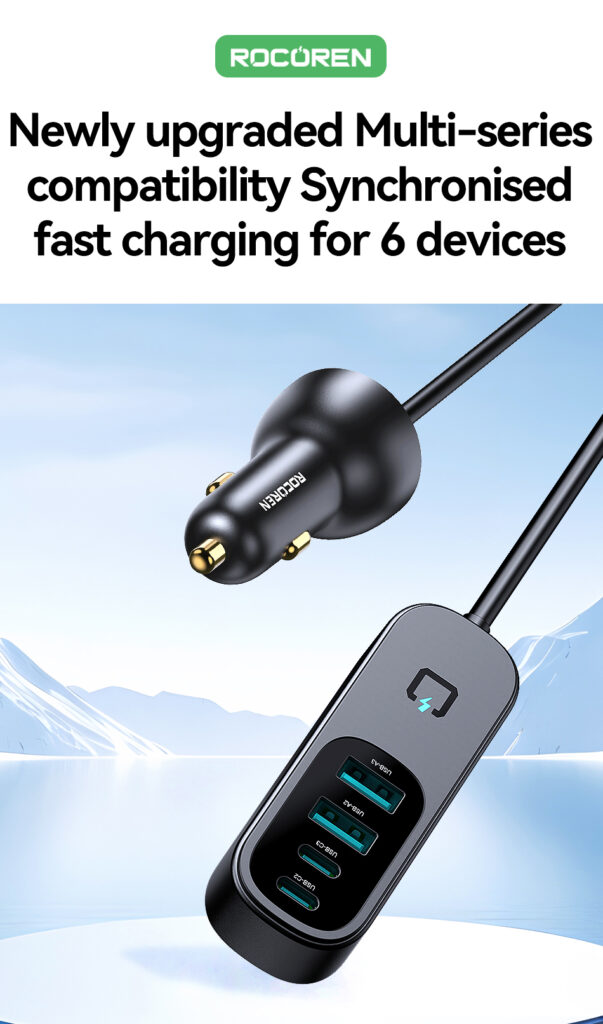
The layout aims to let the driver and two rear passengers charge from one socket, without cords stretched across the cabin. For the current listing, browse Rocoren’s storefront on Amazon, and check the current price on Amazon before you decide.
Ports, Watts and Protocols
Here is the spec sheet in one place.
- Ports: 3 USB-C and 3 USB-A, split between a front head and a rear station
- Per-port output: up to 35W on each USB-C port, up to 30W on each USB-A port
- Total output: 105W shared across all six ports
- Rear cable: 5 feet (1.5 m)
- Vehicle power: built for 12V to 24V systems
- Housing: PC anti-flame retardant plastic
- Protocols: Apple’s 2.4A spec, BC1.2, DCP, AFC, FCP, QC3.0, QC4.0+, PPS and PD 3.0
- Certifications: FCC, CE and RoHS, listed for this charger
Read the per-port figures as ceilings. The six ports share 105W overall, so one device can reach its port’s maximum, but all six cannot hit theirs at the same moment.
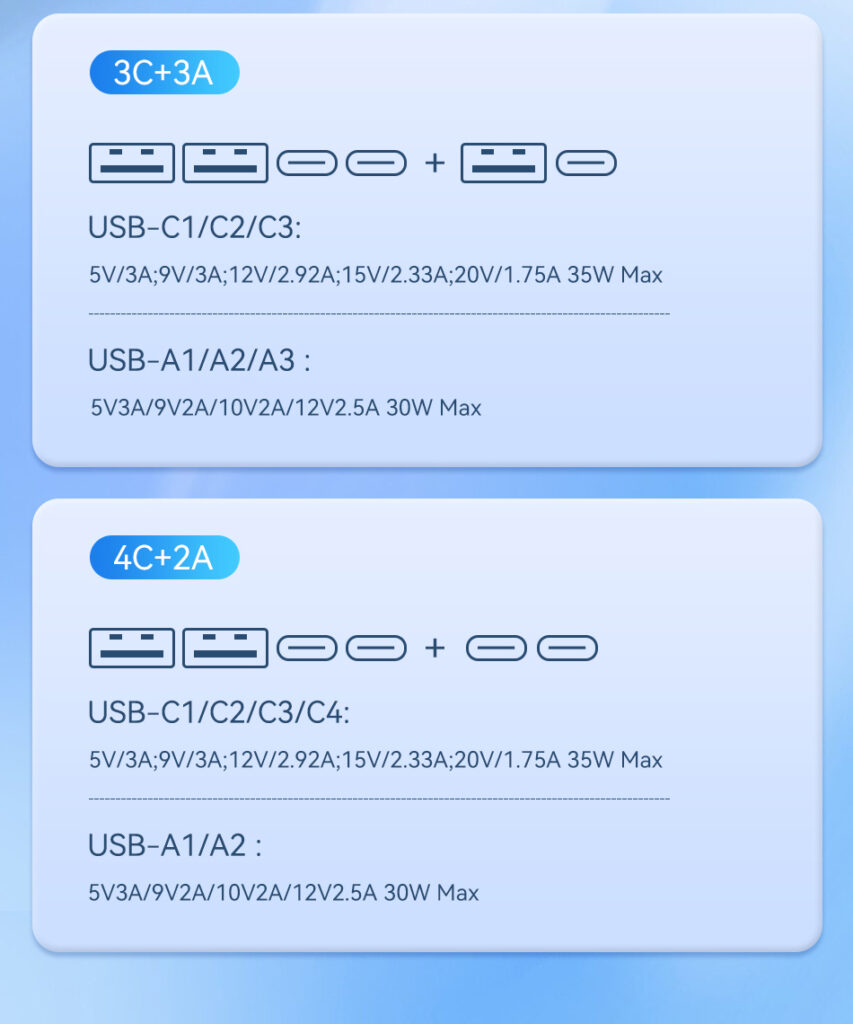
Why list so many protocols? Devices ask for power in different ways, and the charger is meant to recognize each request and answer in kind. PD, short for Power Delivery, is the fast-charging standard used by phones, tablets and many laptops. QC, or Quick Charge, is Qualcomm’s older system and still turns up on some Android phones. PPS lets a charger vary its voltage in fine steps, which certain Samsung and other Android phones use for their fastest modes.
Speed Claims and Safety Features
Rocoren’s marketing puts an iPhone 16 at 60% after half an hour and a Samsung Galaxy S25 Ultra at 65% in the same time. Those are the brand’s figures. No test of mine backs them up, so read them as claims and not as measured results.
On protection, Rocoren says a chip inside the unit identifies each connected device, manages how power is shared out and handles over-voltage and over-current protection. That is relevant in a car, because the 12V to 24V system the charger plugs into can vary.
Rocoren lists the housing as flame-retardant PC plastic, and this model lists FCC, CE and RoHS. Across its wider catalog the brand cites CE, RoHS, FCC, UL and UKCA, but those marks appear on individual product pages and not as one blanket statement. Check the details for the exact model you are buying.
One factor sits outside the charger: the 12V socket. If you have had charging trouble in an older car, try another device in that socket first, because a loose socket can look like a charger fault.
Who It Suits, and Who Can Skip It
This model is built for families and road-trippers. The driver is covered at the front, and back-seat passengers charge from the rear station instead of passing cables between seats.
A solo commuter with a single phone can skip it. A simpler two-port charger covers that case, and Rocoren’s entry-level models are made for it.
For a laptop, look elsewhere in the range. The USB-C ports on the 105W unit top out at 35W each, so Rocoren points laptop owners to its 165W PD 3.1 model, whose main port is rated up to 140W.
Against Anker and Other Rocoren Tiers
Anker has been in the category longer, and it comes out ahead on paperwork. It backs the PowerDrive III Duo and similar products with an 18-month warranty, a support team of its own and a set process for replacements. Rocoren does not publish a warranty length on its official site, and support runs through direct email and WhatsApp instead of a warranty portal.
On product overlap, Anker does not make a direct match for this charger. Its six-port 200W Prime Charger is a wall unit for a home or office, and its car chargers carry one or two ports, like the PowerDrive III Duo. A front-and-rear split in a car charger is ground Anker largely leaves alone.
The choice therefore comes down to priorities. A documented warranty and a longer record point to Anker. A front-and-rear port split points to Rocoren.
Inside Rocoren’s own range, the 135W model is a close relative. It still has six ports, but two retractable cables take the place of the 105W’s single fixed cord, with 60W combined for the driver’s side and 75W more at the rear station. Separately, the 105W charger is sold in a bundle with six magnetic cable clips.
Buying, Returns and Support
Returns on anything bought through Amazon follow Amazon’s own policy. For most electronics that Amazon sells and ships, the usual window is 30 days from delivery, with the item unused and in its original condition, though your order page has the final word. Hold on to the packaging until the charger has worked over several trips, and try it in a second vehicle before calling it faulty, since a socket problem can mimic a dead charger.
To avoid a look-alike, start from Rocoren’s official storefront on Amazon: listings sold by that store are the surest route to a genuine unit with working support. On any listing, confirm that Rocoren is the actual seller or brand and not just a word in the product title. A “Visit the Rocoren Store” link near the title is the thing to look for.
When the charger arrives, look on its body for the FCC, CE and RoHS marks Rocoren lists for this model, and check that the ROCOREN wordmark is crisp on both the unit and the box. Blurry lettering, a misspelling or a logo in an odd spot can point to a mislabeled unit.
For help beyond a return, Rocoren’s support team takes email at [email protected] and messages on WhatsApp. You can see what is listed on Rocoren’s Amazon storefront at any time.
Frequently Asked Questions
Can the 105W model charge a laptop?
Rocoren points laptop users to its 165W PD 3.1 charger, whose main USB-C port is rated up to 140W. The 105W model tops out at 35W per USB-C port.
Does it work in a truck or SUV?
Rocoren rates it for 12V to 24V vehicle systems, a span that takes in cars, SUVs and trucks.
Does Rocoren offer a warranty?
No warranty length is published on Rocoren’s official site. You reach the brand through email or WhatsApp, and Amazon purchases go back under Amazon’s own return policy.
How do I avoid a counterfeit?
Start at Rocoren’s official storefront on Amazon, look for Rocoren as the seller or brand, and inspect the unit on arrival for certification marks and a clean wordmark.
Is Rocoren the same company as ROJECO?
No. The two brands come from the same parent company, yet ROJECO sells pet products and arrived in 2020, while Rocoren is a separate electronics label that launched between 2021 and 2023.
The Verdict
On paper, the 105W 6-Port holds up. The spec sheet lists six ports rated for fast charging, wide protocol support and certifications, arranged for a car with passengers in the back.
Long-term durability is the open question, and a spec sheet cannot answer it. Treat the brand’s speed numbers as claims, check your car’s socket and keep the rear cable out of harm’s way. If that fits your drive, take a look at the Rocoren storefront on Amazon and check the current price on Amazon.