A stainless steel box is a serious option for a home with several cats, and PTLOM builds its whole range around that idea. The catch is choice: the catalog holds eight or more size and shape combinations, so landing on one can take longer than you would like.
This guide sorts the range into a few clear decisions: how many cats share the box, how much floor space you have and how much lid you want. It also covers the brand’s background, how it compares with a close rival, the cleaning rules that keep steel in good shape and the return terms.
Everything here is research-based. It draws on the brand’s FAQ, product pages and policies, plus owner feedback from the brand’s own reviews page and from third-party review sites, and it says so whenever a claim comes from PTLOM itself.
The Brand Behind the Boxes
PTLOM’s stated mission is “Upgrade life through simplicity,” and the product line follows it. Where other pet brands add sensors, apps and self-cleaning motors, PTLOM stuck with a bigger pan, taller walls and metal in place of plastic.
Who is behind the company is unclear, because the brand’s site gives no founder name and no founding year. What the site does spell out, again and again, is the problem it says it set out to fix: constant cleaning, squabbles over shared resources and the stress of making do with inadequate supplies in homes with many cats.
A second theme is the brand’s case against automatic boxes. Its position is that scooping by hand is a built-in health check, since changes in clumps, appetite or bathroom habits show up before they turn into a vet visit. To back that up, PTLOM cites cat behaviorist Jackson Galaxy, who cautions that automated boxes carry a potential risk of malfunction and make it harder to keep an eye on a cat’s health.
PTLOM’s about page admits that the range did not start out all steel. Early products paired stainless steel with recycled plastics, and the brand says it plans to move entirely to metal, arguing that a box that lasts means fewer cracked plastic ones to throw away every year or two. Today’s range is described as one-piece, food-grade stainless steel.
On scale, the brand says it has served more than 100,000 homes with several cats and collected over 5,000 five-star reviews for its steel boxes. Those are PTLOM’s own figures, not independent counts, but they come from a company that has stayed in one product category. You can browse the full range at PTLOM’s own store to see how it fits together.
Why Steel Instead of Plastic
PTLOM’s case for steel is the brand’s own argument, and it has three parts. The first is lifespan: its blog puts a steel box at five years or longer and a plastic one at one or two. The second is the surface: a non-porous metal wall, the blog says, gives ammonia no scratches to settle into, which is where worn plastic is said to hold odor. The third is seams: a single piece of steel leaves no joins where litter, urine or bacteria can gather.
Less waste is the reason the brand gives for its move away from recycled plastic parts. None of these points is an independent finding, so weigh them as claims.
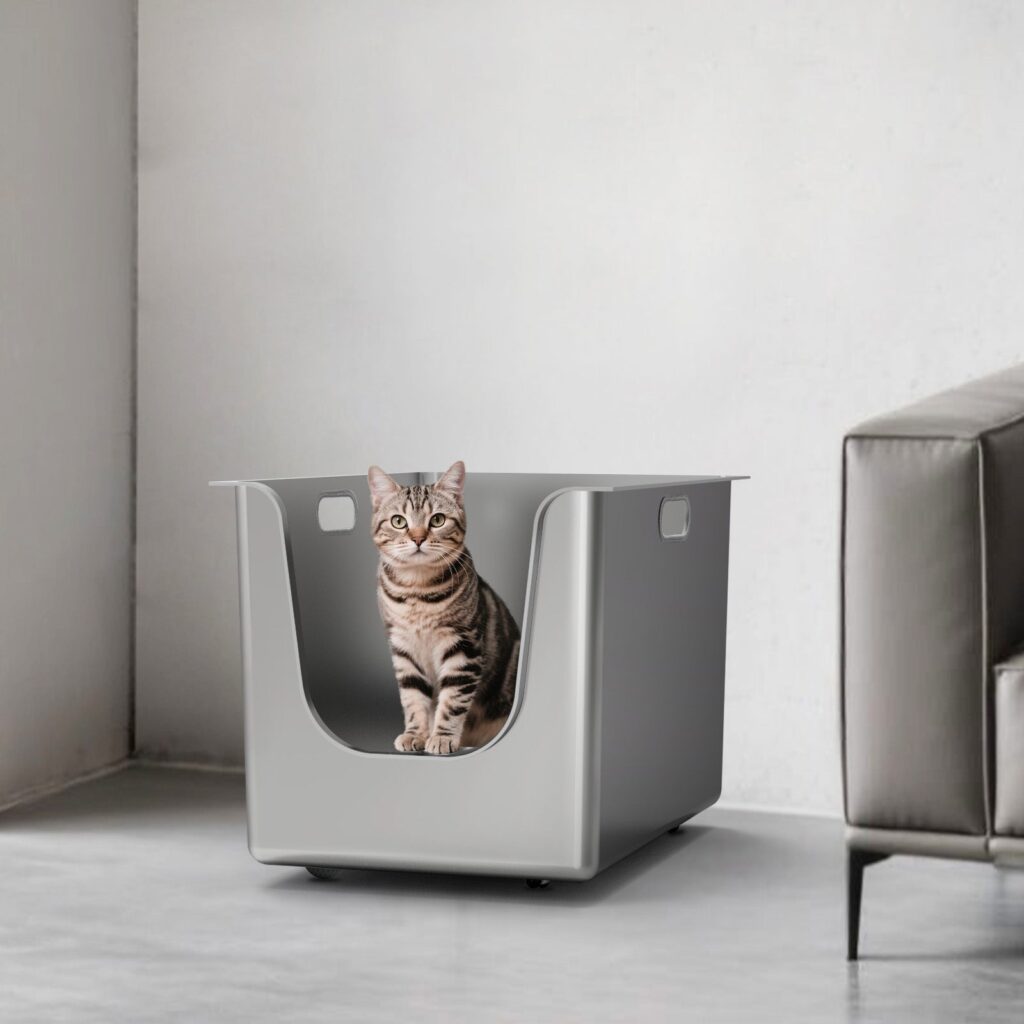
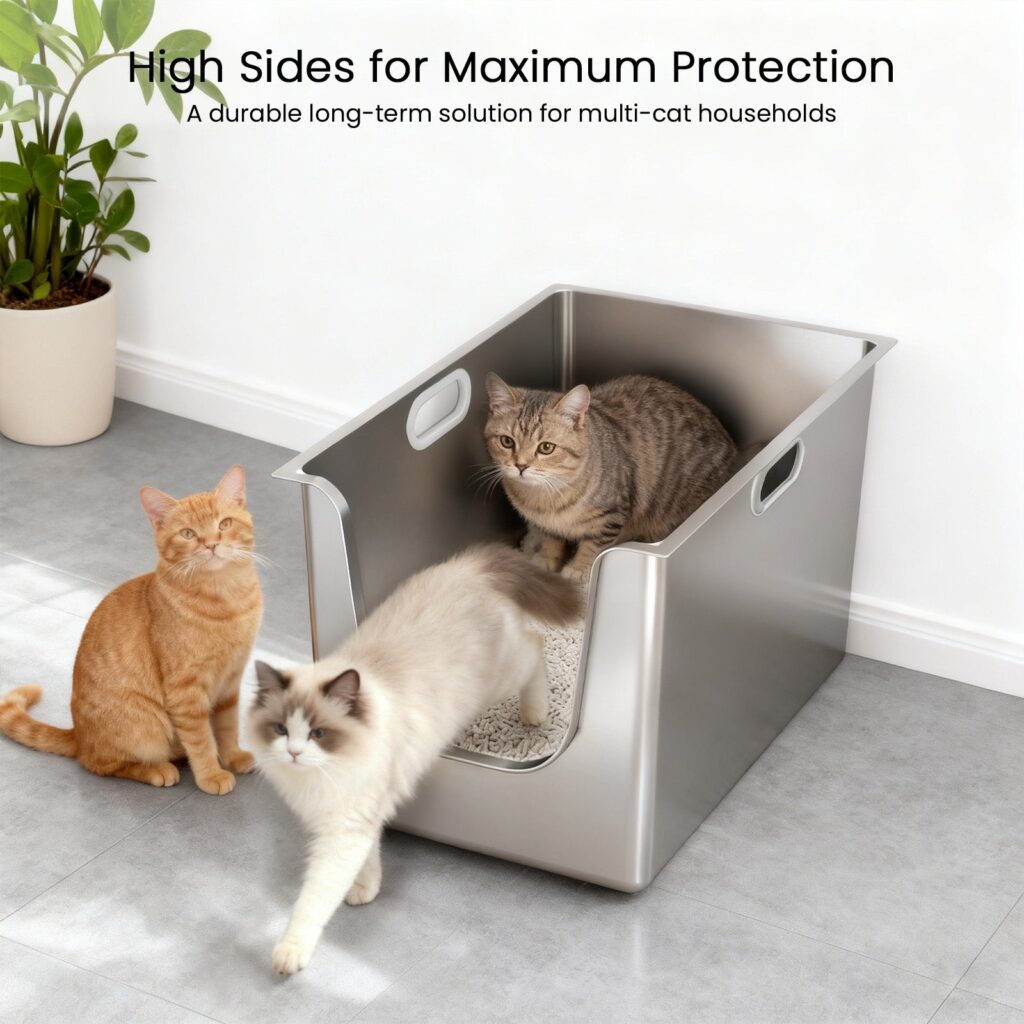
The tall walls are the other half of the design. Take the Front Entry XL, whose walls rise 13.7 inches around a 6-inch curved entry. The brand pairs those numbers to keep kicked litter inside the box rather than on the floor.
Steel is not magic. It asks for a particular cleaning routine, which gets its own section below, and it costs more than a basic plastic tray. For one easygoing cat on a tight budget, a basic plastic box may be all you need.
The Lineup at a Glance
Sorted by entry style and lid, the range falls into two groups.
Open models with tall walls
Open boxes form the core of the range: tall walls, no lid and a cut-out entry. The Front Entry XL, about $130, measures 22.8 by 14.9 inches with 13.7-inch walls and a low curved opening in the front. The Side Entry XL shares those dimensions and sells for about the same, with the entry moved to the side wall, which PTLOM markets as the choice for splash-prone, hard-digging cats.
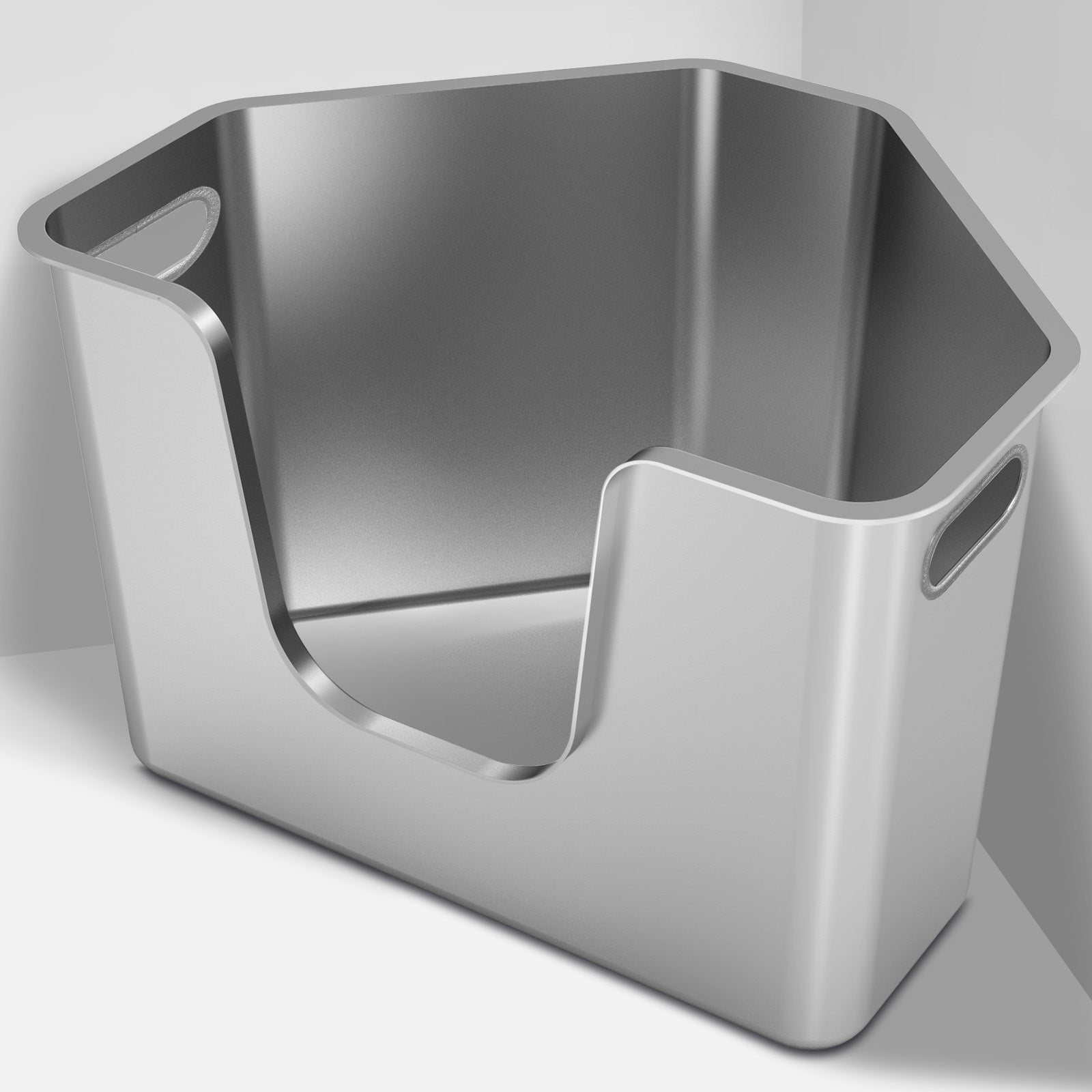
The Corner Entry line, offered in L and XL, replaces the rectangle with a triangle that fits into a corner. The XL costs about $140 and stands 14.5 inches tall. For the L, check the current price at PTLOM.
Lidded and enclosed models
Privacy is the reason to look at the lidded models. The Metal Half Enclosure is the cheapest way into the range at about $80 to $90, depending on size. The Semi-Enclosed XXXL, about $140, covers part of the top and keeps the rest open for ventilation. The Flip, about $150, goes further with a hinged lid designed to lift upward for full-box cleaning.
The Extra-Large XXL is the nearest the catalog gets to a fully closed box, and it is the lidded model PTLOM features on its homepage. For its price, check the current price at PTLOM.
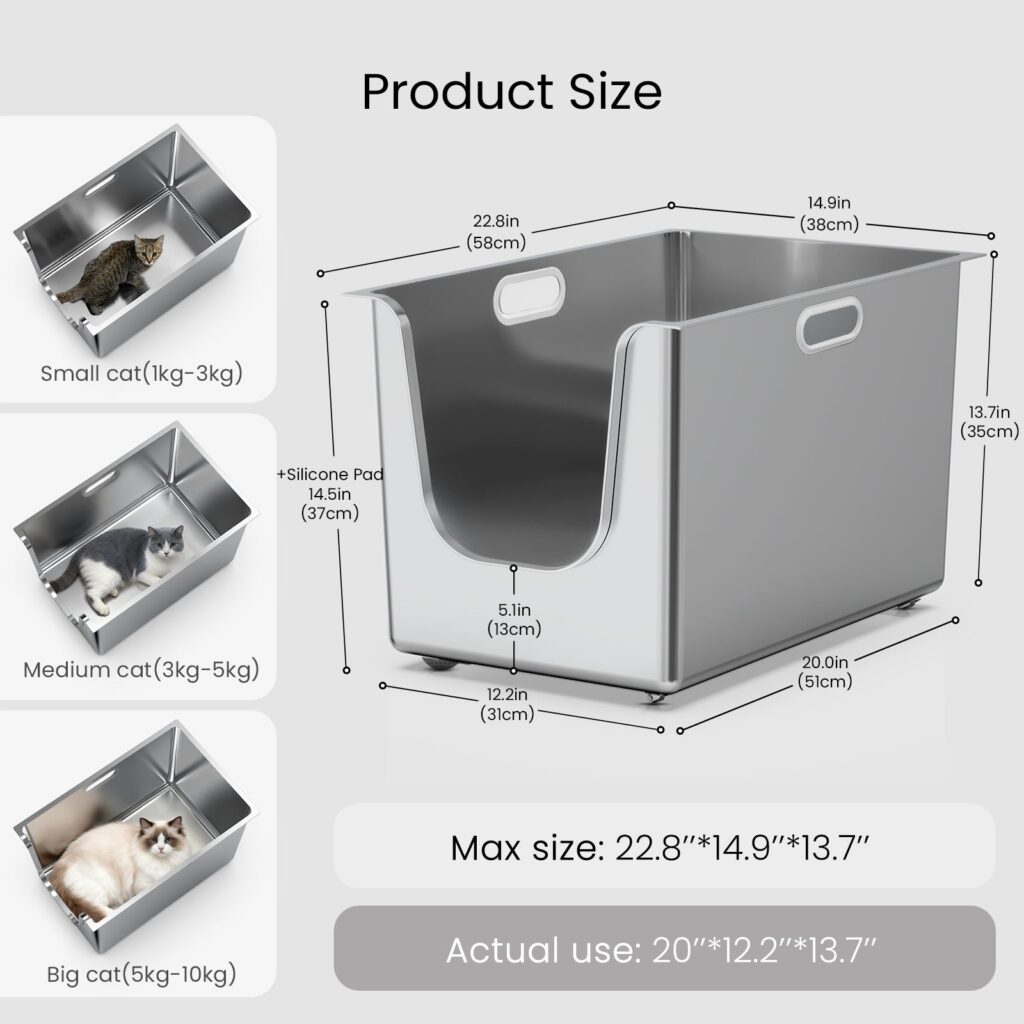
Do not trust photos for size. PTLOM’s own comparison page lists wall heights of 13.7 to 15.7 inches, while lengths span 22.8 to 27.3, so compare the numbers. Across the catalog, prices run from about $80 to about $170, depending on size and on whether a lid or scoop kit comes included.
How to Choose by Cats and Space
How many cats share the box
With two or three cats on a single box, a sensible default is the Front Entry XL: it is high-sided, open and straightforward to scoop. It is also the model covered in depth in the companion review linked at the end. On PTLOM’s reviews page, an owner with 22 cats and four of these boxes singled it out for large male cats.
Vets generally advise one box for every cat, plus a spare. If you plan to run several stations, the lower-priced Metal Half Enclosure helps the budget, because not every station needs to be the biggest model.
Then look at your floor plan
Space decides the entry style. Corner Entry models are made to tuck into a corner instead of using a straight run of wall, which saves floor area, but you will be reaching in at an angle to scoop. If floor space is not the constraint, a Front Entry or Side Entry box gives you straight-on access with no corner geometry to work around.
Then decide on privacy
Open boxes leave the litter in view. A lid changes that: the Flip and the Semi-Enclosed XXXL add one on top of the same tall steel walls, at a higher price that reflects the extra material and hardware. The Half Enclosure sits between open and lidded.
Put simply, entry style answers a layout question for your bathroom or laundry room, and the amount of lid answers a question about privacy and cleaning routine.
If you still cannot decide
If you are still torn, start with the Front Entry XL. It is built for several cats, and with no corner angle to reach around, scooping is straightforward. PTLOM’s own store carries it, and it is also listed on Walmart’s marketplace.
How PTLOM Compares With Yangbaga
Yangbaga is PTLOM’s nearest competitor in the same niche. Both brands make seamless, one-piece steel boxes for multi-cat homes, both claim a surface that does not soak up odor or scratch easily, and neither relies on motors or electronics.
Where they differ is wall height. PTLOM’s high-sided boxes stand between 13.7 and 15.7 inches tall. Yangbaga’s tallest model is roughly 12 inches, and several of its sizes are only 6 to 8 inches. For cats that dig hard, a few extra inches of wall may decide whether litter stays in the box.
Yangbaga costs less, at roughly $71 to $91 across its sizes. PTLOM starts at about $80, so its cheapest boxes sit near Yangbaga’s most expensive, and its largest lidded models cost well above that.
Yangbaga lists non-slip rubber feet as standard on every size, which is worth checking on whichever PTLOM model you consider.
Choosing between them is mostly a question of how messy your cats are. A calm household watching its budget can reasonably go with Yangbaga’s lower price, while cats that dig, kick or spray hard are where PTLOM’s taller walls look like the more direct fix, at least on paper.
What Owners Say on PTLOM’s Site
PTLOM’s own reviews page lists about 800 reviews, and roughly 78% of them are five-star. That is strong without being flawless. Price is the complaint that recurs on the brand’s page, and rust is the one raised on third-party review sites.
The praise on the page takes a few forms. An owner with seven cats called the box a perfect solution to messy cats and added that cleanup is easy and the cats like it. Another reviewer called it very pricey but easy to clean, good looking and long lasting. A third, with 22 cats and four PTLOM boxes, said it suits large male cats especially well.
Price is the recurring complaint there. Several reviewers used the word pricey and still said they would buy the box again.
Rust is the other theme, raised by a smaller number of reviewers on third-party review sites who report spots appearing over time. PTLOM’s FAQ addresses it, saying the acidity of urine can erode the coating, particularly when harsh cleaners are added.
None of this is a surprise for a box at this price. The examples above lean toward easy cleanup and neat litter containment, while the cost and the cleaning rules are the things to be comfortable with before you order.
Cleaning and Care Without Rust
Why plain water
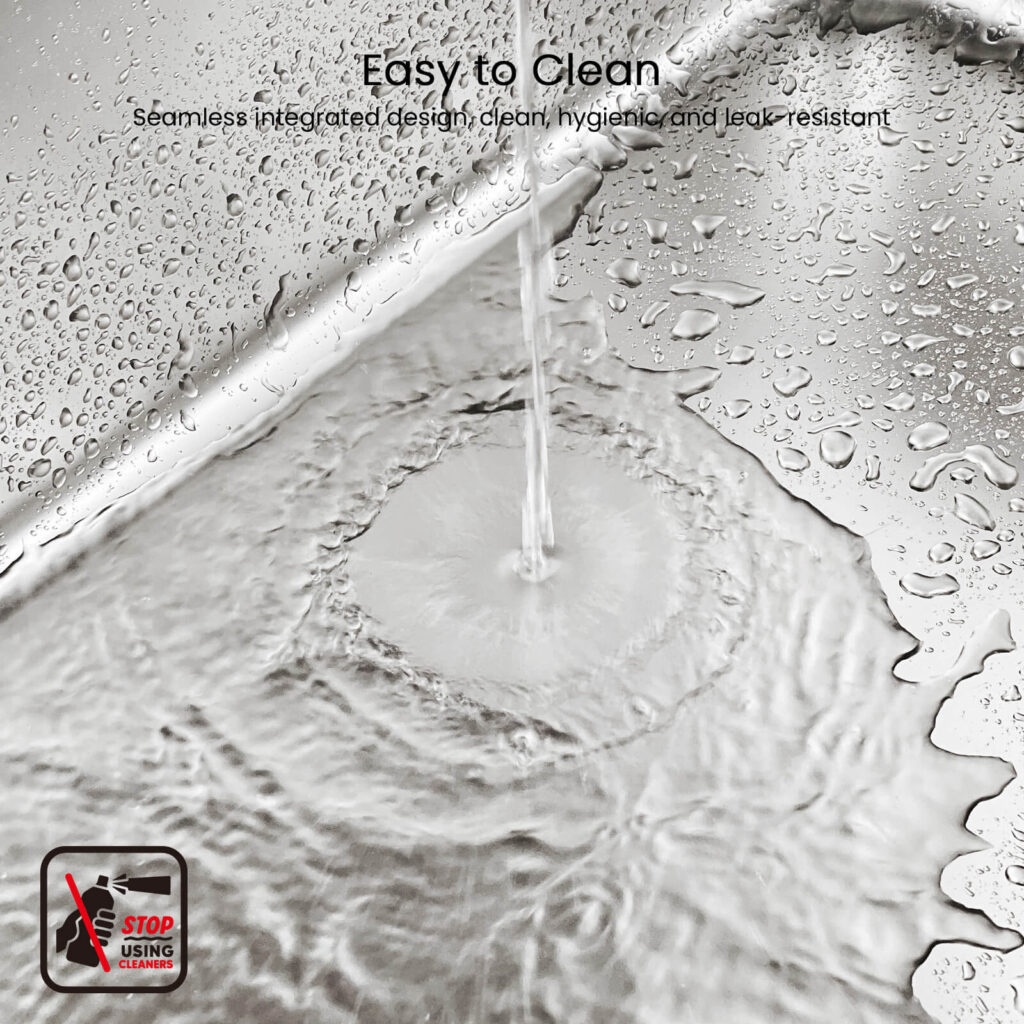
After scooping, give the pan a rinse and a wipe with plain water, and leave soap, sprays and chemical cleaners out of it. PTLOM’s FAQ gives the reason: chemical products can thin the coating that protects the steel from rust, and urine is acidic enough that it should be rinsed off regularly instead of sitting on exposed metal.
Keep litter deep enough
PTLOM recommends keeping the litter more than 2 inches deep. The logic is straightforward: a shallow layer puts scratching right on the metal base and leaves less litter between the urine and the metal.
A simple routine
Putting those rules together gives a simple routine: scoop every day, rinse once a week with plain water and let the box air dry completely before adding fresh litter. That routine lines up with the five-year-plus durability claim PTLOM makes for steel.
If rust spots show up
PTLOM’s FAQ ties rust to wear on the coating, so the sensible reaction is to tighten the routine: plain water only, a fully dry box between cleanings and a steady litter depth. That is meant to slow further wear. It is not a promise that existing spots will fade. A box that arrived defective is covered by the 30-day return window.
Returns, Warranty and Where to Buy
Returns and exchanges
The return window is 30 days from delivery. The box needs to be unused, still in its packaging and in a condition PTLOM can resell. To start, email PTLOM’s support team with your order number and the reason.
PTLOM covers the return shipping when an item is defective or wrong. If you need a replacement after damage, contact the team within the same 30 days. Once the returned box is in PTLOM’s hands and has been inspected, the refund takes 3 to 5 business days.
What the warranty covers
PTLOM publishes no separate multi-year warranty document. The only written promise in the sources is the 30-day window for defects and returns. For anything that appears later, such as rust spots, the plain-water routine is the practical response.
Buying direct and spotting lookalikes
Generic, unbranded steel boxes can show up in search results beside PTLOM’s real products, so where you buy matters. PTLOM sells direct through its own store, where the return policy and shipping terms apply automatically, and the Front Entry XL also appears on Walmart’s marketplace.
Both routes deliver the same product. The risk is with listings that have no clear tie to the PTLOM name.
- Check the seller. On any marketplace, confirm that PTLOM is named as the brand or seller, not an anonymous third party.
- Match the model name. PTLOM’s products carry specific names such as Front Entry XL and Corner Entry XL, so a listing that uses only broad terms is more likely a lookalike.
- Compare the price. PTLOM’s catalog runs from about $80 to about $170, so a listing priced well above or below that band calls for a closer look.
Returns are the main reason to care. The 30-day guarantee is PTLOM’s own, so it does not automatically pass to a reseller that is not the brand, and a lookalike could leave you with nowhere to turn if the box shows up damaged or starts rusting soon after. Starting at PTLOM’s own store sidesteps the question.
FAQ
What sizes and shapes are available?
There are three open designs, Front Entry, Side Entry and Corner Entry, and three with lids, Half Enclosure, Semi-Enclosed and Flip. The smallest is a compact L, and the range climbs to an XXXL.
What is PTLOM made of?
The brand describes its current boxes as one-piece, food-grade stainless steel. Its about page says earlier products also used recycled plastic, and PTLOM states that it plans to go all steel.
Will my cat accept a metal box?
PTLOM says most cats settle in somewhere between a few days and a week. To help, it suggests putting the new box beside the old one, keeping the litter type the same and adding a little used litter so the scent feels familiar.
Is the Front Entry XL only for cats?
The brand pitches it for cats of any size and for rabbits too.
Where does PTLOM ship?
PTLOM delivers inside the United States only. If you live elsewhere, its FAQ says to write to the support team and ask about options.
How long will an order take?
Plan on roughly 4 to 6 business days in all: about 1 business day of processing, then 3 to 5 in transit, depending on your location. A tracking link is emailed when the order ships, and your order number also works on PTLOM’s site.
What does shipping cost?
The price depends on your location and the delivery method you pick at checkout. Orders above $25 ship free.
How do refunds work?
Email support with your order number and send the box back inside the 30-day window. PTLOM then needs 3 to 5 business days to process the refund once the box has reached it and passed inspection.
Does PTLOM make an automatic box?
No, and by design. The brand argues that manual scooping doubles as a health check, and it points to Jackson Galaxy’s caution about malfunctions in automatic boxes.
Putting It All Together
Choosing a PTLOM box comes down to three questions. How many cats use it, how much floor space do you have and how much lid do you want? Answer those and the range narrows to one or two models.
For a multi-cat home, the Front Entry XL is a sensible starting point. If you want the model-level detail, read our full verdict on the PTLOM Front Entry XL before you decide.
Whatever you choose, plan for two trade-offs: a higher price than plastic and a plain-water cleaning routine. PTLOM says a steel box can last five or more years, and its care rules are aimed at protecting the coating that makes that possible.