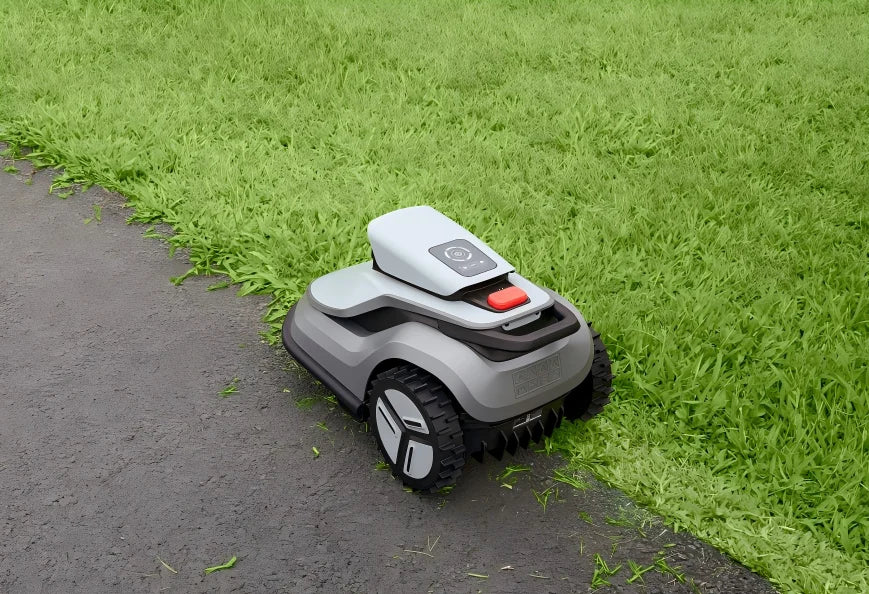
The TerraMow V1000 is a robot mower built to skip the groundwork. Boundary-wire mowers need a cable laid around the lawn, and RTK mowers need a satellite antenna plus a walk along the edge. TerraMow’s V Series replaces both with three front-facing cameras.
This is a research-based review. It draws on TerraMow’s published specs and policies and on findings from independent testers, not on hands-on use, so you can weigh the details before clicking anything.
In short, testers found it easy to set up and good at avoiding obstacles. They also found that it leaves a strip along raised edges, needs daylight to navigate and is not suited to every grass type.
The Specs in Plain English
These figures come from TerraMow’s own spec sheet. The notes after the list explain what they mean in a real yard.
- Cutting: an 8 in (203 mm) swath, with the height set in the app from 1 to 3 in
- Battery: 4.5 Ah, good for up to 150 minutes per charge and about 120 minutes to refill
- Navigation: TerraVision 2.0, a three-camera system with no wire and no RTK antenna
- Lawn size: up to 1,200 m² (about 0.3 acre)
- Heft: 26 lb (11.8 kg)
- Slope: up to 18° (32.5%)
- Staying in touch: Wi-Fi, Bluetooth and a 4G link with GPS anti-theft tracking
- Weather and noise: IPX6 water resistance and a claimed level under 54 dB
- Coverage: three years on the robot, base station and adapter, two on the battery
TerraMow quotes the V Series at roughly 80 to 120 m² mowed per hour, depending on how intricate the lawn is. A yard close to the 1,200 m² rating leaves little slack, because a rained-off day is hard to make up.
The box holds the mower, a docking base with a garage-style roof, a power adapter, a dozen spare blades and a screw kit. The blades are small razor-style pieces fixed to a spinning disc, and TerraMow sells a 15-piece refill set that fits its models.
To see the listing yourself, you can check the current price on Amazon, which opens the V1000 page there.
How Camera Navigation Works
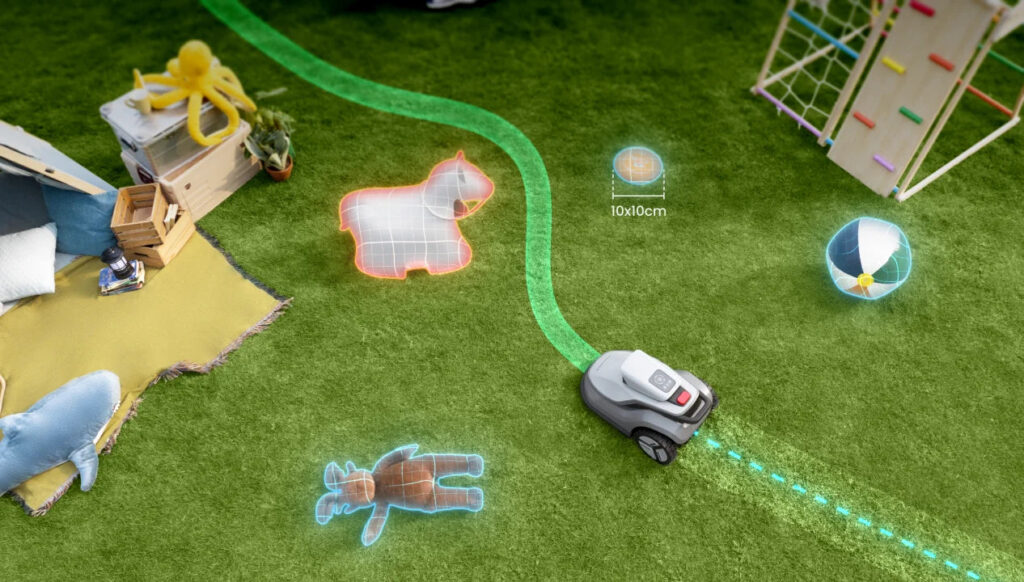
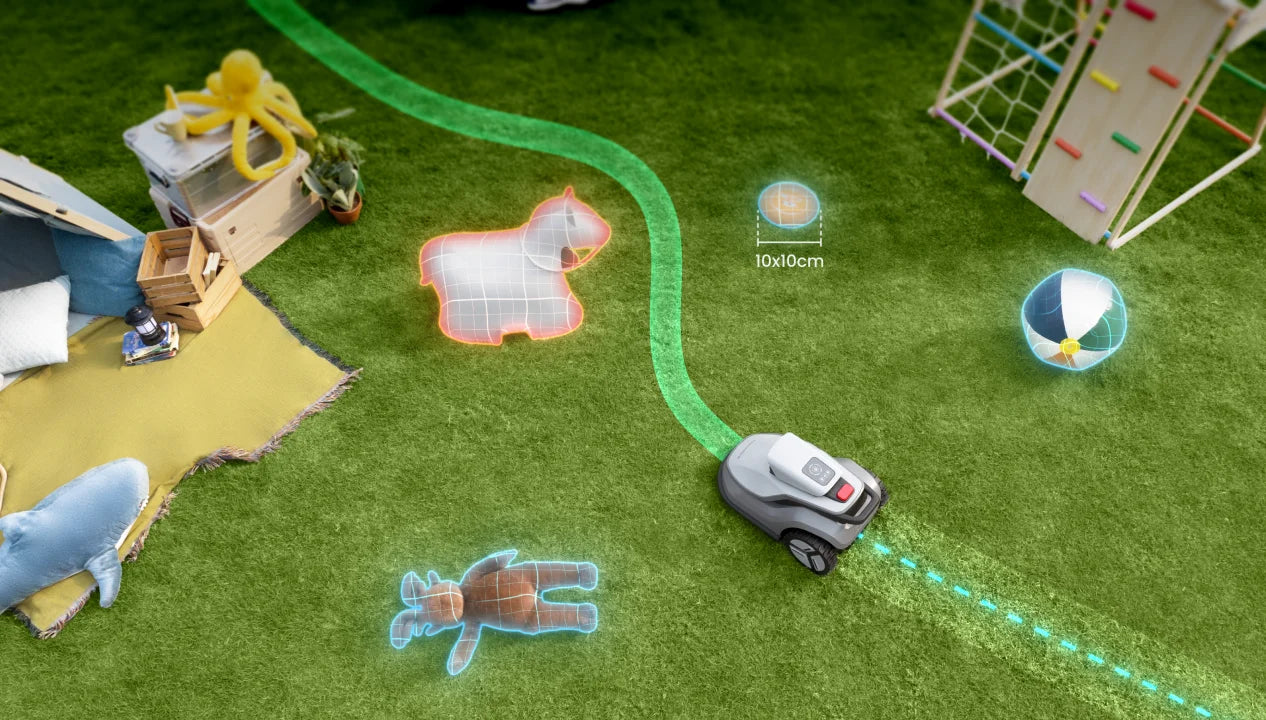
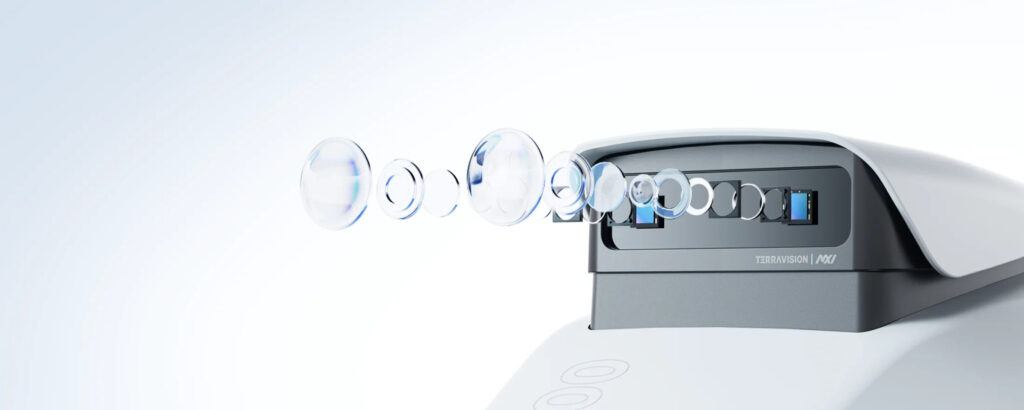
TerraMow calls its system TerraVision 2.0. Three cameras on the nose of the mower combine into a 3D view of the yard, much like depth perception from two eyes. According to TerraMow, the mower uses that view to map the grass, plan routes and steer around whatever is in the way.
Setup starts with the Mapping button in the app. After that the mower explores alone, works out where the grass ends, returns to its dock and saves the result. On one independent tester’s 250 m² lawn, the V1000 needed a little over an hour to finish its map.
The dock must sit on or beside the lawn for that first pass. Once the map is saved, a pathway drawn in the app lets you move the dock up to 60 m away.
Mowing then runs in parallel stripes in a direction you choose. Docking is visual as well: the cameras line up on a QR-style marker on the base station.
With no satellites involved, tall trees and house walls cannot cause signal dropouts. Light is the trade-off. TerraMow says the mower returns to its dock in rain or low light, and one tester suggests scheduling it for daytime.
What Independent Testers Report
The notes below come from independent testers rather than from the brand, and they are grouped by what worked and what did not.
What worked well
- Obstacle avoidance. In one V1000 test the mower cleared a dummy hedgehog, a hose lying on the grass and a tennis ball with no contact, and the tester scored detection as perfect. TerraMow claims it avoids over 99% of obstacle types. That is a marketing figure, though the test points the same way.
- App depth. Zones, no-go areas, timers, a live camera feed and many edge-cutting controls are all on offer.
- Energy use. One test estimated roughly 4 kWh for a hypothetical 500 m² lawn cut three times weekly.
- Setup. A tester guided a family member through a remote installation, and the mower worked without trouble.
Where it fell short
- Raised edges. One test found a gap of just under 10 cm beside a raised edge. The cause is geometry: the 8 in disc sits mid-body under a chassis close to 16 in wide, so about 4 in of grass stays out of reach next to walls and raised beds.
- Map drift. After heavy rain, one mower treated a puddled spot as off limits and kept skipping it even once the grass there had grown tall. Cutting that patch once by remote control cured it.
- Overhanging plants. Branches and stems reaching over the lawn caused swerves. Edge obstacle sensitivity can be lowered but not switched off.
- Slopes. An 18° test ramp was manageable, though the tester called it no mountain goat.
- Darkness. The cameras need light, so night mowing is a poor fit.
Who It Suits and Who Should Skip It
Grass type and terrain decide most of this, so the table starts there.
| It fits if | Look elsewhere if |
| Your lawn is cool-season grass | Your grass is a coarse or warm-season type |
| The turf is about a quarter acre or less | Hills dominate the yard |
| Trees, walls or the house block satellite signals | You want mowing after dark |
| You want the simplest setup, with front and back lawns as separate zones | You expect to never touch a string trimmer |
On grass, TerraMow advises against tall fescue over 3 in, Zoysia, Buffalo grass and St. Augustine. Those varieties are widespread in the southern states, so identify yours first. If you are unsure, ask TerraMow support before you order.
Once you know your lawn fits, see the V1000 on Amazon and compare that page against the specs above.
How It Compares
A natural comparison is the eufy E18, a camera-based mower of similar size. One independent tester found eufy’s first two mowers, the E15 and E18, a close match for TerraMow’s original S Series, and reported that Anker does not hide its work with TerraMow. So the better question is which generation and package suits you.
| Spec | TerraMow V1000 | eufy E18 |
| Rated area | 1,200 m² | 1,200 m² |
| Runtime | Up to 150 min | About 120 min |
| Battery | 98.55 Wh | 93 Wh |
| Mass | 11.8 kg (26 lb) | 12.5 kg (about 27.5 lb) |
| Vision system | TerraVision 2.0 (second generation) | TrueVision (camera-based) |
On paper the V1000 has the longer runtime and the newer camera system. Its map edge lock also confines the mower to the saved map. The same tester said this answers a problem seen on the eufy, whose map kept creeping into a neighbor’s grass.
If you already use other eufy products, a single app ecosystem may count for something. The sources do not cover eufy’s US warranty terms, so compare them yourself before choosing.
Within TerraMow’s own range, the V600 shares the cameras, app and core features. It drops to a 3.8 Ah battery, a 600 m² rating and about 120 minutes of runtime. The Mini 500 is meant for 500 m² gardens, while the all-wheel-drive X AWD adds six cameras and nRTK for properties of 0.5 to 2.7 acres.
Warranty, Returns and Where to Buy
With this mower, the seller you choose decides who handles repairs. This is how TerraMow’s policies split by channel:
| Where you buy | Repairs and warranty | Returns |
| TerraMow’s own website | TerraMow pays for parts, labor and two-way shipping on a valid claim serviced in the country of purchase | Request within 30 days of delivery, with approval |
| TerraMow’s official store on Amazon | Same TerraMow cover | Follows Amazon’s own return policy |
| Any other retailer | The seller handles repairs, refunds and shipping; TerraMow still gives technical support | That store’s own policy |
The V Series carries three years on the robot, base station and power adapter, and two years on the battery. Blades, screws and cosmetic wear are excluded. A claim needs a receipt plus the robot’s ICCID number, and TerraMow describes its technical support as free for life.
A change-of-mind return to TerraMow’s website is the strict case. The mower must be unused and never activated, return postage is yours, and TerraMow keeps a 15% restocking fee. A defect reported within the same 30 days earns a free return, exchange or replacement.
Quick Answers
Does it need a boundary wire or satellite antenna?
No. The V Series navigates by camera alone. The larger X AWD differs: nRTK joins its six cameras for big, open spaces.
Does it need an internet connection all the time?
No. Once its maps and schedules are saved, the mower follows them on its own. A connection is only needed for first setup, changing settings, firmware updates and the live camera, and the Wi-Fi can be on either the 2.4 GHz or the 5 GHz band.
Can it mow in rain or at night?
TerraMow rates the body IPX6 but still advises against mowing in the rain, to protect the lawn. A rain sensor sends the mower back to its dock. After dark the results are unreliable, since the cameras need light.
Can it cover a front and a back lawn?
Yes, if the route linking them is flat and clear. App pathways up to 60 m long can join separate lawns, and TerraMow says the V1000 supports up to 20 zones across 3 independent maps.
How steep a slope can it climb?
TerraMow rates the V Series for slopes up to 18° (32.5%). For steeper or bumpier ground, it points to the all-wheel-drive X AWD.
The Verdict
The V1000 delivers on its central promise. It learns a yard without a boundary wire or an antenna, and testers found it steered around the obstacles they put in its way. Reported setup experiences are the strongest point in the sources.
Cutting is competent rather than flawless. Raised edges still need a trimmer, and the grass type can rule the mower out entirely. If your lawn is cool-season grass of about a quarter acre or less, with trees and beds, the specs and test findings line up well with what this mower offers.
If that matches your yard, check the TerraMow V1000 on Amazon and confirm it comes from TerraMow’s official store, so the warranty stays simple.