Flatware looks like a simple purchase until you start comparing listings. Piece counts, finishes and steel grades blur together, and a set that photographs beautifully can still feel wrong in the hand.
KINGSTONE makes a good case study. Its range is easy to read, its finishes are clearly different from one another, and almost everything rests on a single core material.
This guide covers the brand, the steel, the finishes, set sizes, the lineup, a head-to-head with Hiware, how to avoid knockoffs, and care and returns. It is a research-based guide built on the brand’s published details, and it is not a hands-on test.
Who Is Behind KINGSTONE
KINGSTONE presents itself as a modern cutlery brand rather than a heritage flatware house, and nearly every set in the range rests on 18/10 stainless steel.
What the brand leaves out
Plenty of flatware makers put a founding year or a family name front and center. KINGSTONE does neither. Its homepage describes a mission to shake up high-end tableware, with luxury, function and design as the pillars, yet it names no founder, gives no founding year and lists no headquarters city. For a name you might trust with a wedding registry, that gap deserves weight before you buy.
The manufacturer lead
The best clue to production is a company that shares the name: Zhejiang Kingstone Housewares Co., Ltd, in Ruian, Zhejiang Province, China. A trade profile says it has traded as Kingstone since 1999 and makes stainless steel cutlery and related housewares.
ISO 9001 and ISO 14001 certificates, BSCI and GSV social-compliance audits, and a list of housewares and retail companies as manufacturing partners all appear on that same profile. These are claims from a profile, not a statement from the brand, and they do not add up to a heritage story. The practical takeaway is to judge a set on its steel, its finish and its fit.
The range and where it sells
The range reads in layers. The base is plain mirror-finish flatware. Hammered handles, matte black and gold tone sit on top of it, and the brand also sells steak knife sets in German stainless steel, kitchen knife blocks and a small porcelain dinnerware line.
There are no KINGSTONE shops to visit. Sets are sold through marketplace listings on Amazon, Walmart and eBay and through the brand’s own online store, which suits a brand without physical stores. To look around the range, open the KINGSTONE storefront on Amazon. The link goes to Amazon.
Steel and Finishes Explained
Four finishes, one steel
Every KINGSTONE finish sits on the same 18/10 base. What changes is the surface.
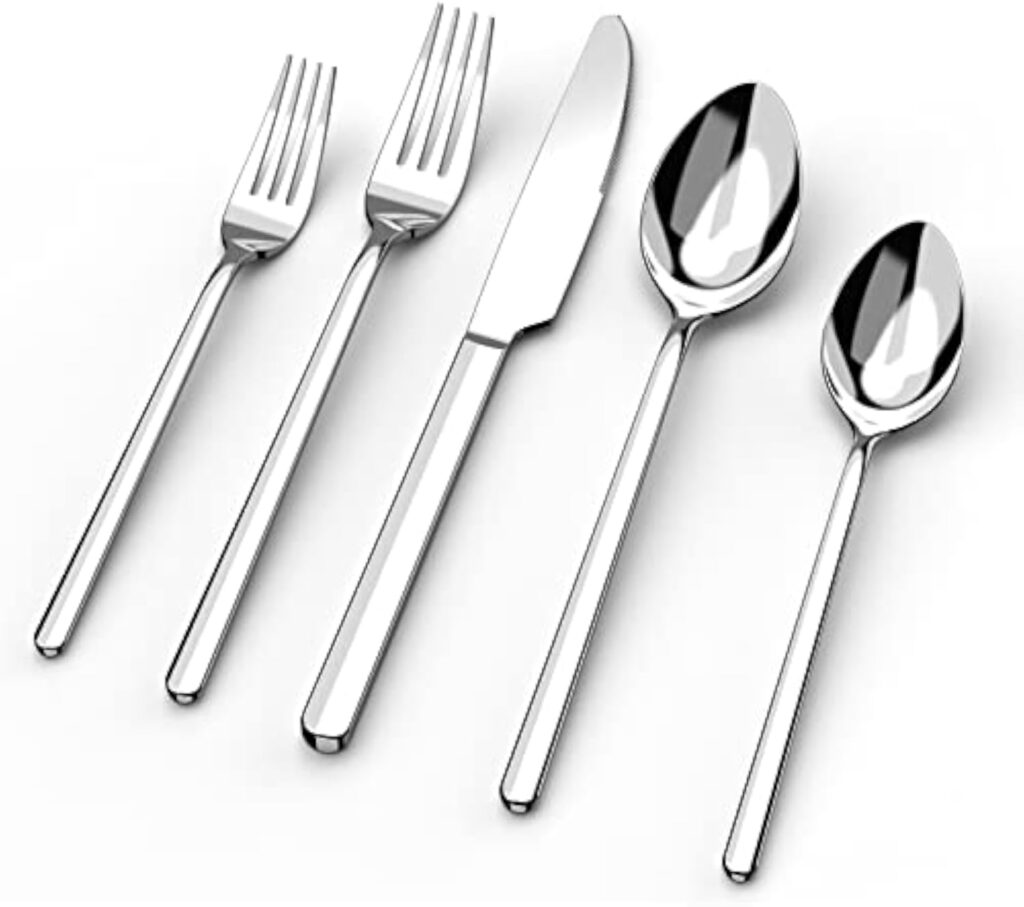
- Mirror polish: smooth and reflective, the brand’s baseline.
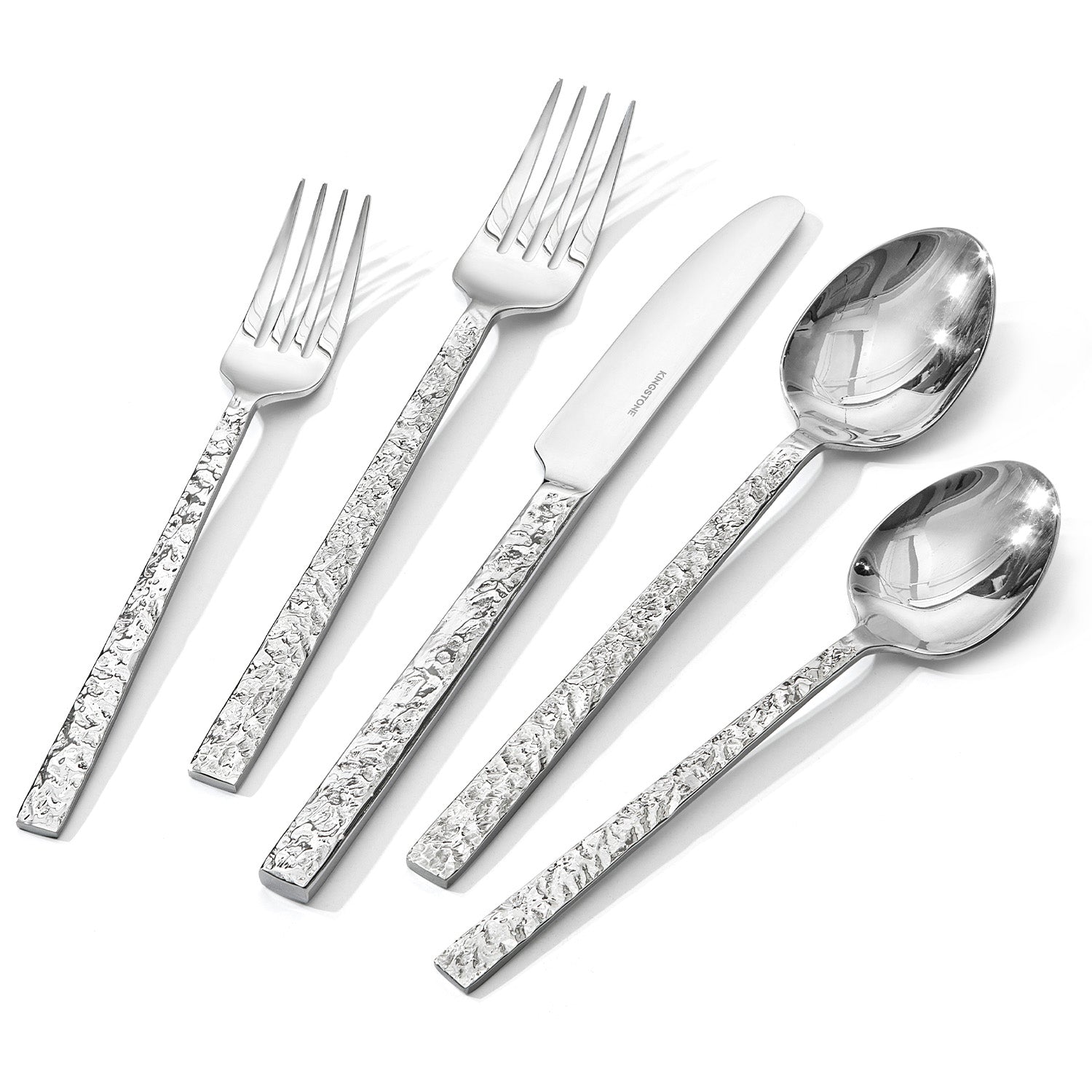
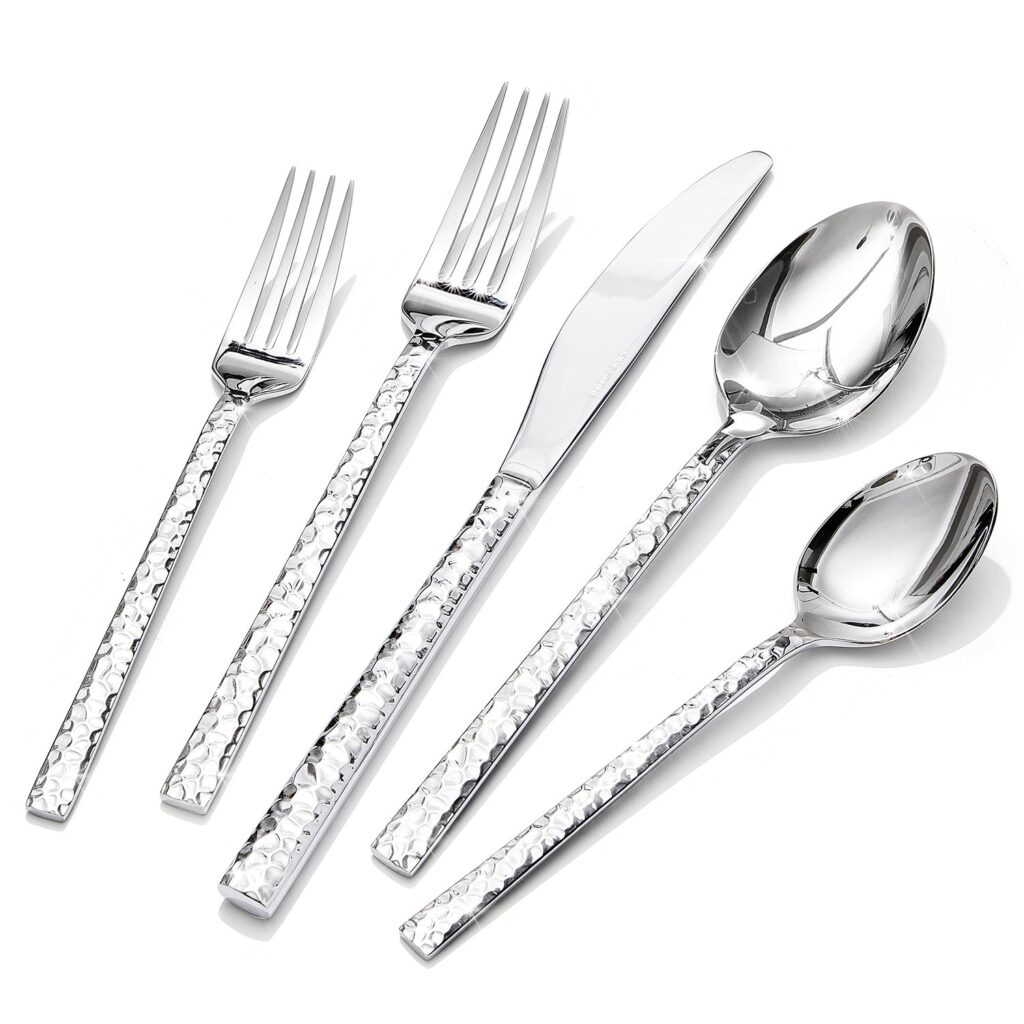
- Hammered: a rippled handle with a mirror-polished working end.
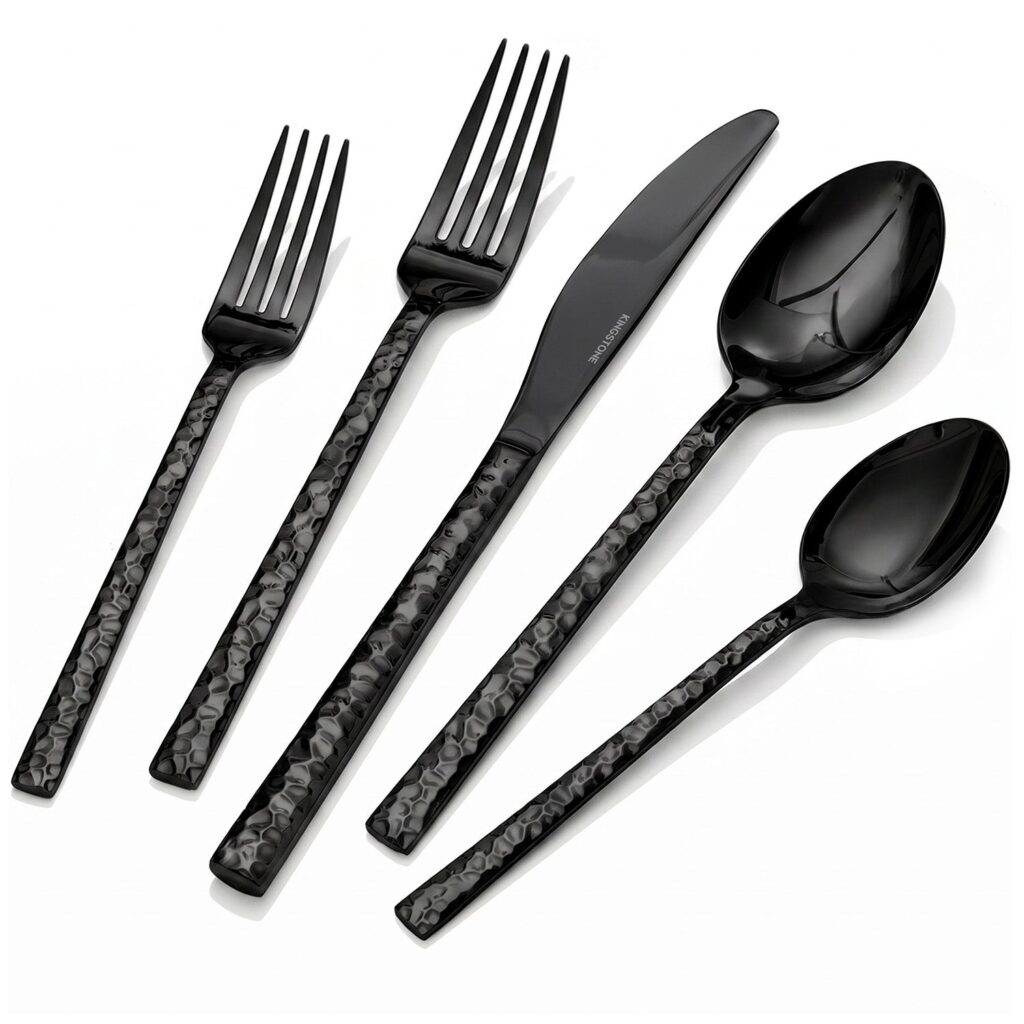
- Matte black: a coating over the steel, with a modern, dramatic look.
- Gold tone: a coating over the steel, warmer and more formal.
Mirror polish is the most neutral choice for most tables. With no texture to hold water spots or food residue, it should be the easiest finish to keep looking fresh.
What 18/10 means
The ratio describes the alloy: chromium makes up 18 percent of the mix and nickel 10 percent, blended into the base steel. Chromium is the element credited with rust and corrosion resistance, while nickel is credited with a warmer shine and with resistance to pitting over the years.
Lower-nickel grades such as 18/0 can look identical when unboxed, so the grade printed on the listing tells you more than the photos do. It is the first line to check on any set you plan to run through the dishwasher.
Hammered up close
On a hammered set the ripple stays on the handle, while the knife blade, fork tines and spoon bowl keep their mirror polish. Per the brand’s product notes, the hammering is applied the same way to every piece to echo a hand-forged look, and it is not hand-finished one piece at a time.
The texture is meant to add visual depth and a little grip. In return, it is worth drying the handle thoroughly after washing so water spots do not settle.
Coated finishes
Matte black and gold tone are coatings over the same 18/10 steel, and hand washing is recommended for both. A coating sits on top of the steel, so repeated strong-detergent cycles are the thing to avoid.
Matching a finish to your table
Start with the plates. Plain or neutral plates give a hammered handle room to show, while busy patterned plates already carry the table, so a calmer mirror polish sits better beside them.
Matte black and gold behave like statement pieces. They work when the whole table is built around a color scheme, and hand washing is part of the deal.
Choosing the Right Set Size
Start with how many people you seat, not with the number on the box. KINGSTONE sells flatware in size tiers, and the labels give a quick guide to who each one suits.
| Size tier | Table it suits | Worth knowing |
| 20 pieces | Service for four: a couple or a small household that rarely hosts | The entry size into the brand |
| 30 to 36 pieces | Anyone who wants steak knives in the box | Adds steak knives to the usual five tools |
| 40 pieces | Service for eight: a typical dinner party or a small registry | Eight each of five tools |
| 60 to 65 pieces | Service for twelve: big gatherings and frequent hosts | Some versions include serving utensils |
The 40-piece math is easy to verify: dinner knife, dinner fork, dinner spoon, salad fork and teaspoon, eight of each. Because other sets can inflate their totals with extras, that breakdown is a useful yardstick.
Check the exact breakdown on the listing before you order. KINGSTONE offers several similarly named 40-piece variants, so a name alone does not tell you which one you are getting.
If you are torn between two sizes, think about how often you really host your biggest gathering. Buying for the rare crowd leaves a drawer of pieces you seldom touch, while buying for the everyday table means borrowing from another set when guests arrive.
Buying for a gift or registry
Presentation packaging makes KINGSTONE easy to gift, and a 40-piece set or larger fills a registry line better than a 20-piece box. Unless you know the recipient’s colors, mirror polish or hammered is the lower-risk finish. Matte black and gold are for someone whose kitchen you know.
When you order ahead of an occasion, leave room for delivery and for a return if the set is not right. The terms are covered further down.
The Lineup at a Glance
Beyond the 40-piece set, the catalog splits into three groups: hammered sets, other handle shapes and a set bundled with an organizer.
The hammered family
The 40-piece set, in 18/10 steel with mirror-polished heads, is the one covered in depth here. For a closer read, see our full verdict on the KINGSTONE Hammered Silverware Set.
- Gold hammered set: the same texture under a gold-tone coating, placed in the luxury collection and suited to formal occasions.
- Black hammered set, 20 pieces: service for four with matte black over hammered handles, a way to try the texture without committing to the larger size.
- Hammered set with serving utensils, 65 pieces: service for twelve plus serving spoons and forks, so no separate serving pieces are needed.
Other handle shapes
The teardrop set belongs to the modern collection and pairs a teardrop-shaped handle with a 20-piece service for four. The retro rope pattern set also serves four and has a rope-textured grip, a more traditional, slightly vintage look beside the modern designs.
Flatware with a storage tray
One set pairs plain mirror-polished 18/10 flatware with a fitted waterdrop organizer, which keeps the drawer tidy. It makes sense if you do not already own an organizer.
KINGSTONE Versus Hiware
Hiware is a comparable flatware brand, which makes it a useful yardstick for KINGSTONE.
On the basics the two match: core sets in 18/10 stainless steel, mirror polish as the starting finish and an online-first approach with no heritage story.
Where they split
Finish is the first split. KINGSTONE adds hammered, matte black and gold tone on the same steel, while Hiware leans toward plain polished and rose gold, with no textured-handle option. Steak knives are the second. Hiware’s larger sets often include them as standard, for example a 48-piece configuration with eight place settings and eight steak knives, whereas KINGSTONE puts knives in a separate 30 to 36-piece tier.
Size is the third. KINGSTONE reaches 60 and 65 pieces for twelve place settings, some with serving utensils, which suits larger households and frequent hosts.
Which one to choose
Both list 18/10 steel, so decide by the table in front of you. Steak knives in the box point toward Hiware. A distinct look, such as hammered texture or a matte black setting, or a bigger group points toward KINGSTONE.
Buying a Genuine Set
A set of plain forks and spoons is easy to photograph and relist under another name, so it pays to check where and how you buy.
Where the brand sells
The brand’s own online store carries the whole catalog, dinnerware and knife sets included. Amazon lists a wide spread of sizes and finishes, and Walmart a narrower selection drawn from the same core sets. Listings on eBay come from individual resellers, not from an official store.
Comparing sets side by side is simpler inside one marketplace than across several, and the KINGSTONE storefront on Amazon is one place to do it. The link opens Amazon.
How to spot a knockoff
- Check the seller field. Marketplaces host many third-party sellers, so the name should be KINGSTONE or an authorized retailer.
- Compare with the brand’s own pages. Piece count, finish and steel grade should agree with what KINGSTONE publishes for the same set.
- Count what the photos show. If a 40-piece listing pictures fewer pieces than it claims, the images may belong to a different set.
- Look for 18/10 in writing. A bare “stainless steel”, or a grade such as 13/0, points to a different product, whatever the photos suggest.
Care and Cleaning
Storage and scratches
Pieces that slide around loose in a drawer scratch one another, and the marks show most where a textured handle sits beside a reflective head. A fitted organizer prevents that, and it is easier to buy one with the set than after the first scratch. Steel wool and rough scrubbers can leave permanent scratches on the polished heads, so keep them away too.
Water spots
Water spots are the main cosmetic risk, and mirror-polished heads show them first. Empty the dishwasher soon after the cycle ends, because pieces left sitting in leftover moisture tend to spot. For hand washing, use a soft sponge and dry with a towel straight away instead of leaving pieces on a rack. A set going to a special dinner is worth washing by hand that same day.
Residue and detergent
Rinse acidic food such as tomato sauce or citrus off before loading, since dried-on residue can slowly pit stainless steel. Choose a mild detergent without chlorine, because repeated use of chlorine-based formulas can pit the steel too. Skip soaks in a wet sink or a damp dishwasher overnight, especially with other metals nearby.
Coated finishes and stubborn marks
Hand washing is the recommended routine for matte black and gold tone. For a mark that survives an ordinary wash, a non-abrasive stainless steel polish on a soft cloth is the gentler fix. Long vinegar soaks are best avoided, since acids can make pitting worse.
Shipping, Returns and Gifts
The brand’s own online store sets the terms below, and a marketplace seller may set different ones. Keep the invoice either way, because returns and warranty claims both ask for it.
| Topic | What the brand’s store says |
| Return window | Standard items: 90 days, counted from the purchase date |
| Condition | Unused, in the original packaging, with the invoice included |
| Return postage | Paid by the buyer, unless the company made the error |
| Exchanges | Not handled online or by mail; return the set for credit and place a new order |
| Refund timing | Plan on 4 to 6 weeks for the return to clear after it is sent |
| Delivery | 3 to 7 business days by standard ground in the contiguous states |
| Coverage | The U.S. and select Canadian addresses, with no other international shipping |
| Military addresses | Sent by USPS; allow 4 to 6 weeks |
For a damaged delivery, the brand’s process runs through an email to its support team. The subject line should begin with “Damaged in Shipping” followed by your order number, and a group photo should accompany the email when several pieces are affected.
Gift buyers can count back from the occasion: subtract the delivery estimate first, then leave enough days afterward to send a set back.
FAQ
Which KINGSTONE set should I start with?
Match the size to your table first and the finish second. A couple who rarely host can begin with the 20-piece service for four, and a household that seats eight fits the 40-piece hammered set covered in this guide.
What set sizes does KINGSTONE offer?
The range runs from 20 pieces (service for four) through a 30 to 36-piece tier with steak knives and 40 pieces (service for eight) up to 60 or 65 pieces (service for twelve).
How does hammered differ from mirror polish?
Mirror polish is smooth and reflective all over. Hammered puts a rippled texture on the handle only and leaves the heads mirror-polished, which adds grip and depth in exchange for a little more drying.
What does 18/10 mean on a listing?
The two numbers are the chromium and nickel shares of the alloy, 18 and 10 percent. Chromium is credited with resisting corrosion, and nickel with adding shine and durability.
Can KINGSTONE flatware go in the dishwasher?
The brand rates its mirror-polished and hammered lines as dishwasher safe. For the matte black and gold tone coatings, hand washing is recommended.
Who makes KINGSTONE flatware?
The clearest lead is a trade profile for Zhejiang Kingstone Housewares Co., Ltd, a stainless steel cutlery maker in Ruian, China, that has used the Kingstone name since 1999. It is a lead, not a statement from the brand.
How long is the return window?
On the brand’s own store, 90 days from purchase for standard items, provided the set is unused, in its original packaging and sent back with the invoice. Return postage is yours unless the company made the error.
Can I exchange a set?
Not in one step. The brand’s store takes the set back for credit, and you place a fresh order for the replacement.
Does the warranty apply everywhere?
Not necessarily. Cover depends on who sells the set, so read the terms on your listing, and keep the invoice because a claim needs it.
Does the brand’s store ship outside the U.S.?
Its own store delivers within the U.S. and to select Canadian addresses, and nowhere else.
Is KINGSTONE a good choice for a wedding registry?
It can be. Presentation packaging suits a gift, and a set of 40 pieces or more fits a registry list.
The Bottom Line
KINGSTONE is easiest to understand as a modern flatware brand with a clear formula: a stated 18/10 steel, several distinct finishes and size tiers that map neatly onto how people actually set a table.
Its main weak spot is a thin public story. Its strengths are the steel, the finish choice and the range of sizes. Pick the finish for how you live, the size for how you host and a care routine you will honestly keep, and the rest follows.