IKAPE sells two kinds of coffee gear, and they answer two different questions. One group is espresso tools for people who already own a machine and want steadier shots. The other is the Kapo line, a set of portable makers for people who want espresso away from the kitchen.
This guide gathers the brand’s published details in one place. It explains what each tool does, how to decide what to buy first, how the portable makers differ, how the range compares with Wacaco and what to expect from shipping and returns.
It is a research-based buyer’s guide, not a hands-on report. The details come from IKAPE’s own pages and from independent testing of its portable maker.
Who Is Behind IKAPE
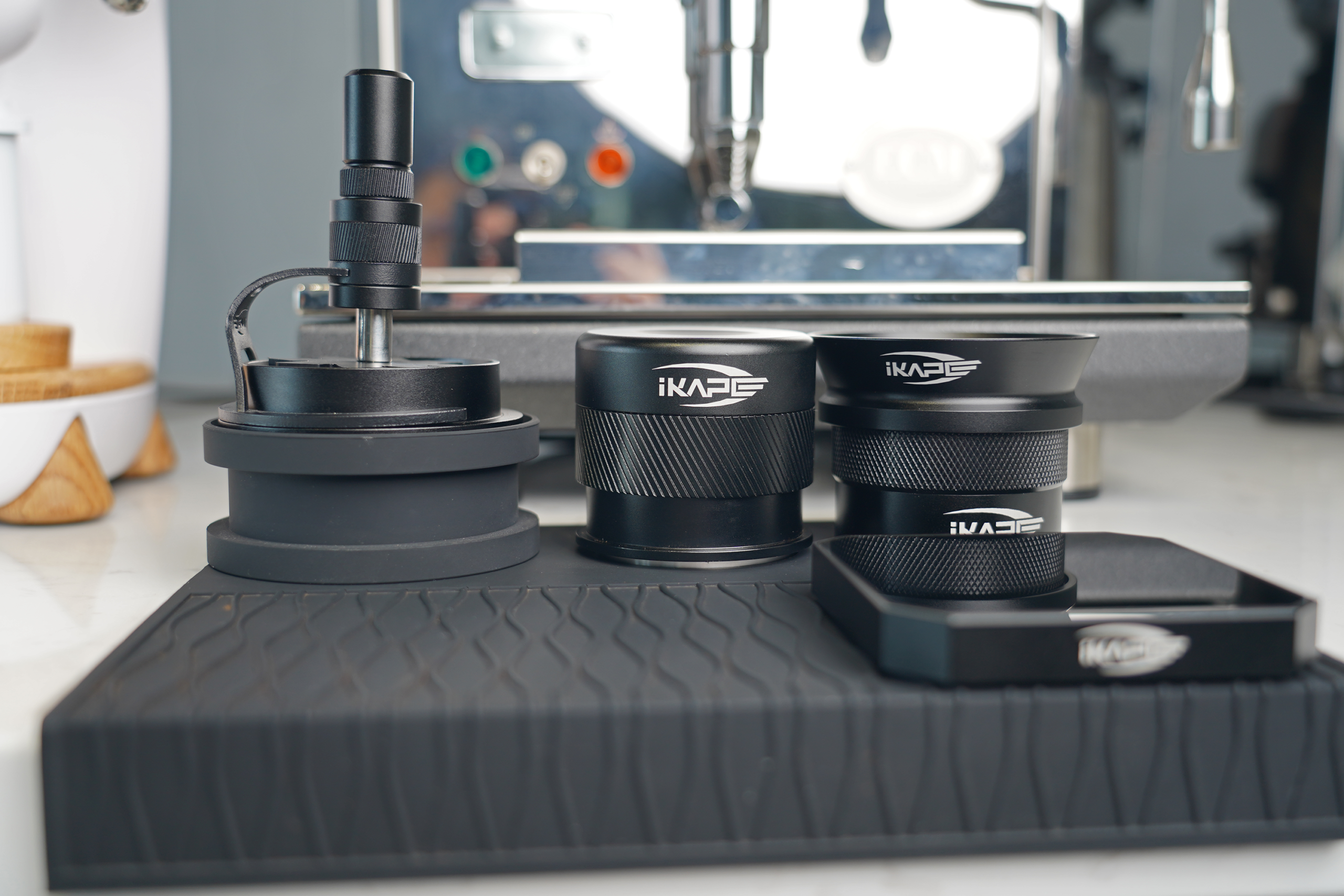
IKAPE’s range splits into two product families. The first is espresso tools: tampers, WDT tools, distributors, bottomless portafilters, baskets, milk pitchers, scales and knock boxes. The second is Kapo, the brand’s portable makers.
The company traces back to 2020. A few friends who enjoyed coffee began meeting in cafes to trade brewing tips. Espresso machines were easy to find, they felt, while thoughtful accessories were scarce, because machine makers tended to treat tampers, distributors and baskets as extras. Designing the missing tools themselves became the business.
The name is a blend. IKAPE says the first letter stands for the pronoun and, at the same time, for a Chinese word meaning love, while “Kape” means coffee. Its own marketing also reads the name as “I Keep A Perfect Espresso.”
On its about page, the brand describes a mission of helping coffee drinkers notice what makes each coffee taste distinct, through inventive design and sound products. It also pitches coffee as something to share rather than guard.
IKAPE says it ships to more than 80 countries, and its own site shows close to 1,000 reviews with about 85% at five stars. Both figures come from the brand, so treat them as claims rather than verified totals.
Founded in 2020, IKAPE is young next to long-running equipment makers, and its portable range is small: two Kapo models.
How the Espresso Tools Work
Espresso gear comes with its own vocabulary, such as WDT, puck prep, convex baskets and bar pressure. Each term maps to one step in a short routine that happens before water meets the coffee. Once you know the order, the whole catalog is easier to read.
Weigh: scales
Espresso strength and flavor hinge on a ratio between the dry coffee that goes in and the liquid that comes out. IKAPE’s Smart Electronic Coffee Scale connects over Bluetooth, follows dose and output as you brew, and times the shot. Check its current price at IKAPE.
Stir: WDT tools
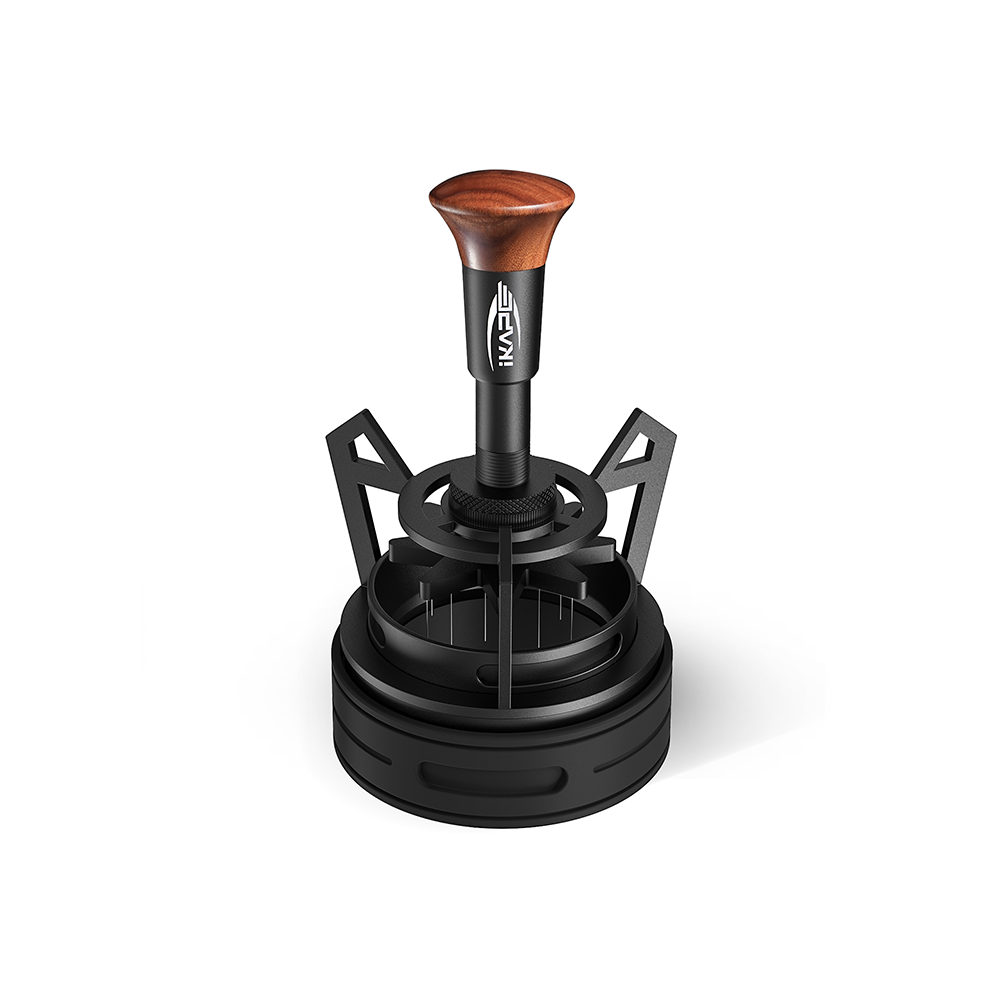
The letters WDT mean Weiss Distribution Technique. Freshly ground coffee tends to clump, and water skirts around those clumps, which can leave sour or bitter patches in the cup. A WDT tool is a handle with fine needles that you stir through the grounds.
IKAPE’s V3 Espresso Rotary Springback WDT Tool uses a spring-loaded rotary motion instead of a plain stick. The brand positions that as quicker and tidier than stirring by hand.
Level: distributors
Even after stirring, the bed of grounds can settle unevenly. A distributor is a disc you spin across the top to level it before the tamp.
IKAPE offers a simple gravity version and a double-bearing one built to turn more smoothly. There is also the All-in-One Distributor-Tamper, which merges leveling and tamping into one tool for anyone short on counter space or travel weight.
Press: tampers
Tamping packs the leveled grounds into a flat puck. When pressure is uneven, water can channel, racing down one easy path instead of flowing through the whole puck.
IKAPE’s tampers run from the V3 to the V6 Impact. The Impact uses a spring, so each press applies the same pressure and does not depend on your hand.
Extract: baskets and portafilters
Most baskets have a flat floor. IKAPE’s convex baskets taper from 58mm down to 32mm, a shape the brand says changes how water pressure spreads through the puck and softens the effect of small slips in tamping or distribution.
A bottomless portafilter, such as IKAPE’s Openwork model with a high-precision basket, exposes the extraction so you can watch it happen. That makes channeling easier to catch in the moment than guessing from the finished shot.
Clean up: knock boxes
A knock box, such as the V2 ABS model, gives spent pucks somewhere to go besides the counter or the sink drain. It is a small add-on that keeps the workflow tidy.
What to Buy First
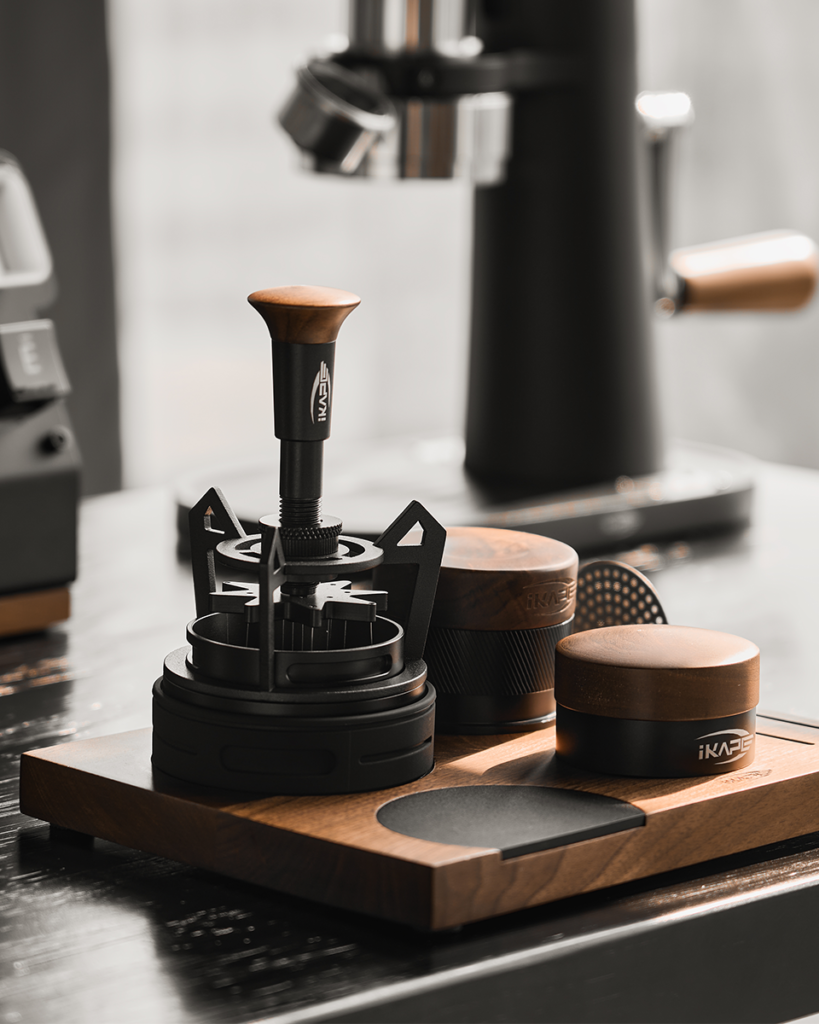
Begin with the machine you already own. If its shots come out uneven, a new machine is rarely the first answer. A WDT tool and a distributor target clumped grounds and an uneven puck, two likely causes of channeling, and the pair together costs less than either Kapo maker.
A sensible upgrade order
- First: a WDT tool and a distributor, or the combined distributor and tamper if space is tight.
- Second: the Bluetooth scale, once your shots are steady, because it turns guesswork into a recipe you can repeat.
- Third: a better tamper, or a bottomless portafilter paired with a basket that fits it.
- Last: a Kapo portable maker, if you want espresso away from the counter.
Check basket size and fit
Fit comes before size. Portafilters differ from one machine brand to another, so confirm that a basket suits yours before ordering, especially when your current basket is small or old-style.
On size, IKAPE’s guidance recommends baskets from 51mm to 58mm that hold 16 to 20 grams, over older designs that hold 5 to 7 grams. The brand says the larger ones extract more evenly and rinse out faster.
When a listing leaves the basket diameter vague, read the FAQ or ask support before buying. It also helps to add new tools one at a time, so you can tell which change did what.
Choosing a Portable Maker
Portable means different things to different people. For some it is a hotel room, for others a campsite or a flight. Start with where you expect to brew, because that decides which of the two Kapo models fits.
Near a kettle, such as at home, the base Kapo K2 covers the basics for less. It has a 51mm basket, leaves out the self-heating features and costs about $190 at IKAPE.
Far from any hot water, on a hike or a flight, the Kapo K2 Pro is the one built to work on its own, thanks to its heater and larger battery. Moving up also gets you a 58mm basket and Bluetooth app control. Check the Pro’s current price at IKAPE.
What the K2 Pro numbers mean
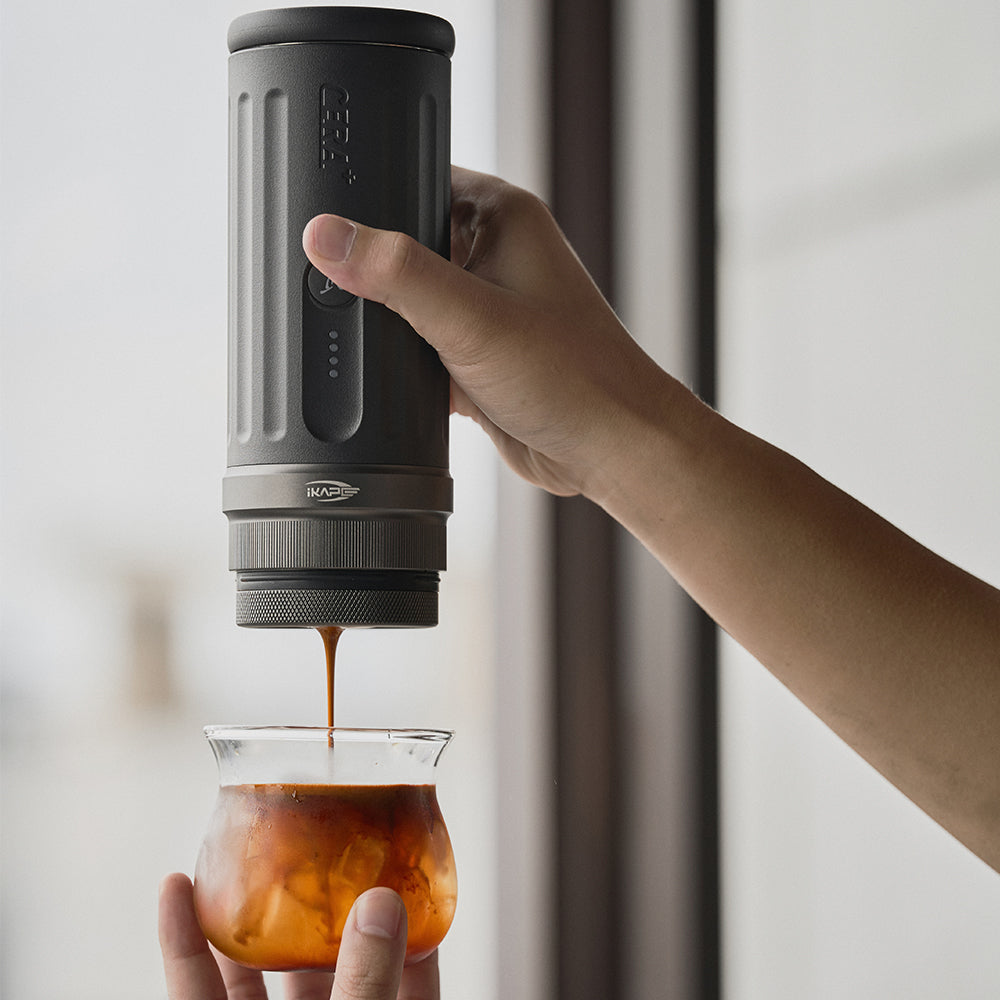
The basket is the headline spec: 58mm, holding 18 to 20 grams of coffee, a bigger puck than older portable designs allow. The body weighs 820 grams and measures 22.4 cm by 7.6 cm, slim enough for a backpack side pocket.
Power is where the heater matters. IKAPE rates one charge at 6 to 8 shots when the unit heats 50ml of cold water to 93°C for each one, which takes about three minutes. Pour in water you heated yourself and the brand claims more than 400 shots, because heating is the biggest drain on the 13,500 mAh battery.
The app and the controls
Pair the K2 Pro with the Happygo Cera app to set water temperature, pre-infusion time for your roast and extraction time, with a live readout on your phone. You never need it for basic use, though, because the unit has three button controls of its own:
- One click: powers the unit on.
- Two clicks: start a brew.
- A three-second hold: begins heating.
Think of the app as a tuning aid for people who like to experiment.
Travel and limits
The 49.95Wh battery sits below the 100Wh figure airlines cite for carry-on batteries, and IKAPE lists CE, FCC and CCC certifications for air travel. Rules differ by airline, so check yours before packing.
Capsule support is not available yet, and IKAPE lists it as in development. Reviews on the brand’s own site also mention one gap: the missing pressure gauge on the K2 Pro.
For a deeper look at that model, including the rating its product page shows, read our full verdict on the IKAPE Kapo K2 Pro.
IKAPE and Wacaco Side by Side
Wacaco makes the Nanopresso, Picopresso and Pixapresso, all manual portable espresso makers. The K2 Pro competes with the higher end of that range, so the comparison below uses those manual models.
Brew time
The difference is largest here. Independent testing timed the K2 Pro’s full cycle, heating included, at about 3 minutes 21 seconds. The Pixapresso needed roughly 9 minutes for a comparable cycle.
The heater explains most of that. Wacaco’s manual models skip heating, which is quick if hot water is already on hand and slower if you must boil water first.
Battery and power
In the same testing, the K2 Pro delivered about six shots on one charge, while a competing portable maker gave out after roughly two and a half. That shows how hard heating works a small battery.
The Nanopresso and Picopresso sidestep the issue by using no battery at all. You pump by hand, so no charging is needed and no battery can die on you mid-trip.
Basket and control
The K2 Pro’s 58mm basket matches commercial machine sizing. The Picopresso uses a smaller footprint by design, favoring compact size over a commercial-style puck. If extraction consistency matters more to you than pocketability, that tilts toward IKAPE.
On control, the K2 Pro relies on app tuning. Wacaco’s pumps give direct feedback through your hand as you press, which suits anyone who values that tactile feel over a screen.
Price
Wacaco’s manual models are the cheaper way in, at roughly $159 for the Pixapresso and $129 for the Picopresso. The K2 Pro costs more, and the extra covers the heater and the app. Check its current price at IKAPE before you decide.
Choose the Kapo route when speed, a bigger basket and app tuning matter most and the higher price is acceptable, and browse IKAPE’s range at its own store to see the models. Pick a Wacaco if the cheapest, lightest, no-battery route appeals more.
Care and Daily Habits
Oils, fine grounds and daily handling wear espresso gear down over time. A few short habits keep each piece working. They split neatly into what to do after every session and what to do now and then.
After every session
- Basket: rinse it as soon as the puck is out. Coffee oils harden quickly, and small baskets are awkward to scrub once residue has set.
- Tamper: wipe the face while the grounds are still damp. A spring-loaded model like the V6 Impact needs the same wipe, since only its mechanism is sealed, not its contact surface.
- WDT needles: give them a brush or a rinse, because coffee dust collects between needles this thin.
- Kapo makers: rinse the basket and the brew chamber. The body holds a battery, so keep it out of water and wipe the outside with a damp cloth. Let the unit cool fully after heating before it goes into a bag.
Now and then
Every week or two, depending on how often you brew, soak baskets in an espresso machine cleaner made for the job. It reaches oil in the tiny holes that a rinse alone will not.
Store bearing distributors dry. Moisture trapped beside the bearing can leave the spin less smooth over time.
Water, grind and dose
IKAPE’s FAQ asks for at least 50ml of water in the Kapo tank whenever the machine runs. For richer crema, the brand suggests medium-dark roast beans. Keep your grind setting steady between brews instead of changing it each time, and store your beans in an airtight container.
The brand’s starting point on the Kapo line is to pull a 30 to 35ml shot from about 50ml of water. Weighing the dose instead of scooping it is the simplest way to make results repeatable, and writing down what worked saves guessing next time.
Buying Direct, Shipping and Returns
The simplest route is IKAPE’s own store. Orders placed there come with the brand’s stated return window and its support team for warranty-style questions, and the newest releases tend to appear there before other sellers list them.
Signs of an authentic listing
If you buy anywhere other than IKAPE’s own site, make sure the seller is authorized. These checks help:
- Sensible pricing. Compare any outside listing with what IKAPE’s own store asks for the same item. A price far below it deserves a closer look.
- Specific details. Genuine listings name specs such as battery capacity, basket diameter and certifications. Thin or recycled descriptions are a warning sign.
- A clear seller. The seller should be IKAPE or a reseller it works with, not a generic storefront using its product photos.
- Reviews that fit. Generic review text repeated across unrelated listings is a red flag.
The K2 Pro holds a lithium battery, and the brand lists CE, FCC and CCC certifications for it. If a seller is not clearly IKAPE or one it works with, you cannot tell whether those certifications apply to the unit you receive, so buying from IKAPE directly removes that doubt.
Shipping
- Dispatch: orders are processed within one to two business days, Monday through Friday. An order placed after 11am Beijing time waits an extra day, and Chinese holidays pause processing.
- US delivery: 5 to 8 days from the China warehouse, or 4 to 6 days when a US warehouse fills the order. Alaska, Hawaii and Puerto Rico are left out of standard US delivery.
- Cost: $5.99 on orders under $45.99 in most countries, and free from $45.99 up. Expedited shipping is $29.99 through FedEx, UPS or DHL.
Returns and warranty
- Window: 30 days from receiving the order.
- Condition: unused, in its original packaging and as it arrived.
- Process: email IKAPE your order number and photos before sending anything back. The brand says returns nobody requested will not be accepted.
- Who pays: IKAPE covers return shipping for items that arrive damaged, defective or wrong. After a simple change of mind, you pay shipping and a 15% deduction comes off the refund.
- Exchanges: reserved for broken, faulty or mismatched items.
A one-year warranty badge appears on the homepage, but the written refund policy dwells on the 30-day period. For anything beyond that, ask support to confirm the cover and get the answer in writing.
Frequently Asked Questions
What does the IKAPE name mean?
It pairs “i” with “Kape”, a word for coffee. The brand also reads it as short for “I Keep A Perfect Espresso.”
When did IKAPE start?
In 2020. Its founders were coffee lovers who swapped brewing ideas in cafes before they began designing accessories of their own.
How do the K2 and K2 Pro differ?
The base K2 has a 51mm basket and costs about $190 at IKAPE. The Pro moves to a 58mm basket and adds a bigger battery and Bluetooth app control. Check the Pro’s current price at IKAPE.
Is the K2 Pro suitable for flights?
Its 49.95Wh battery is under the 100Wh figure airlines cite, and the brand lists certifications for air travel. Confirm your airline’s rules before you go.
Can the Kapo makers use capsules?
Not yet. IKAPE describes capsule support as still under development.
Are the materials food-safe?
The brand states that its materials are food-grade, with certification in the US, EU, Korea and Japan.
Is there a warranty?
The homepage shows a one-year badge, but the policy text concentrates on returns within 30 days. Ask support what is covered after that.
Where to Start
If you already own an espresso machine, begin with the least expensive fix, usually a WDT tool and a distributor, and add a scale once your shots are steady. Take it one purchase at a time.
If you want espresso on the move, decide whether the base K2 covers how you brew or whether the Pro’s heater and battery are worth the extra cost. You can compare the models at IKAPE’s own store before you decide.
Whichever route you take, buying direct and reading the return terms first are two habits worth keeping.