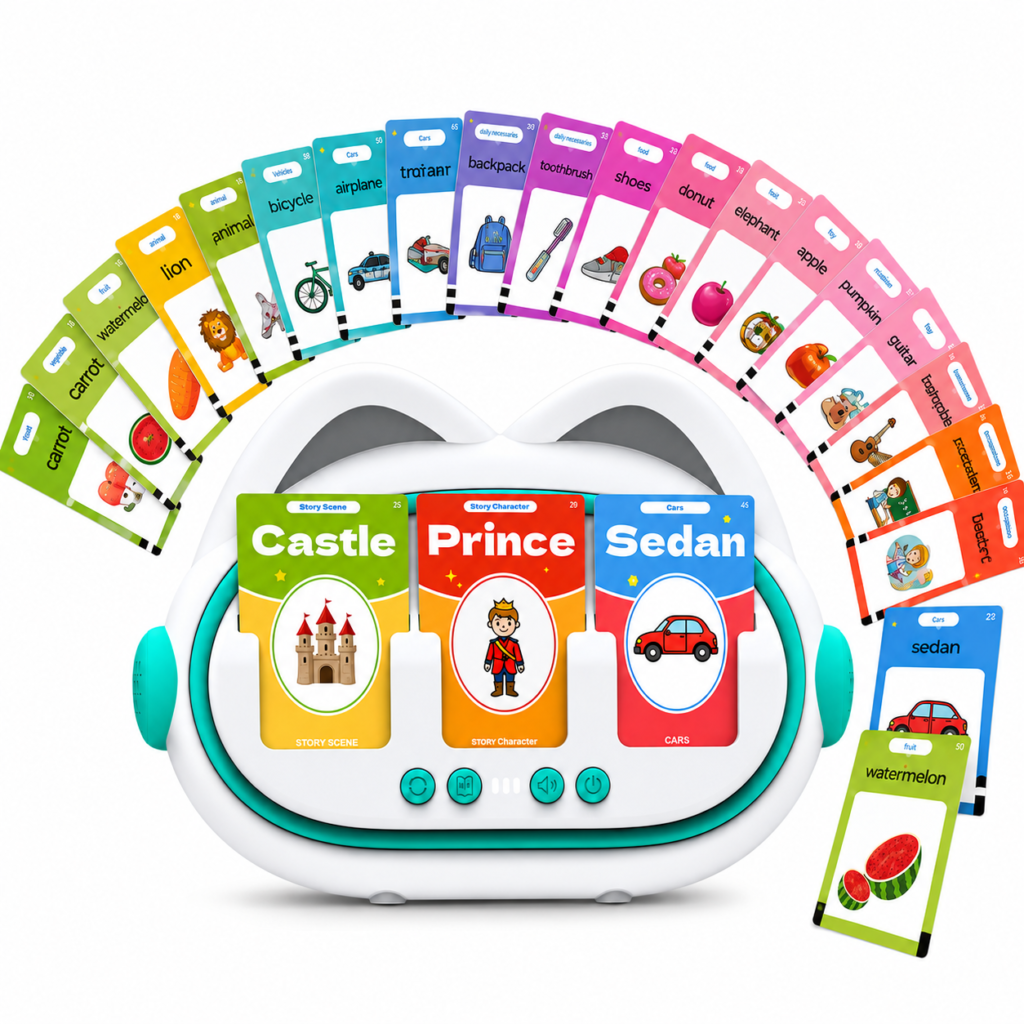
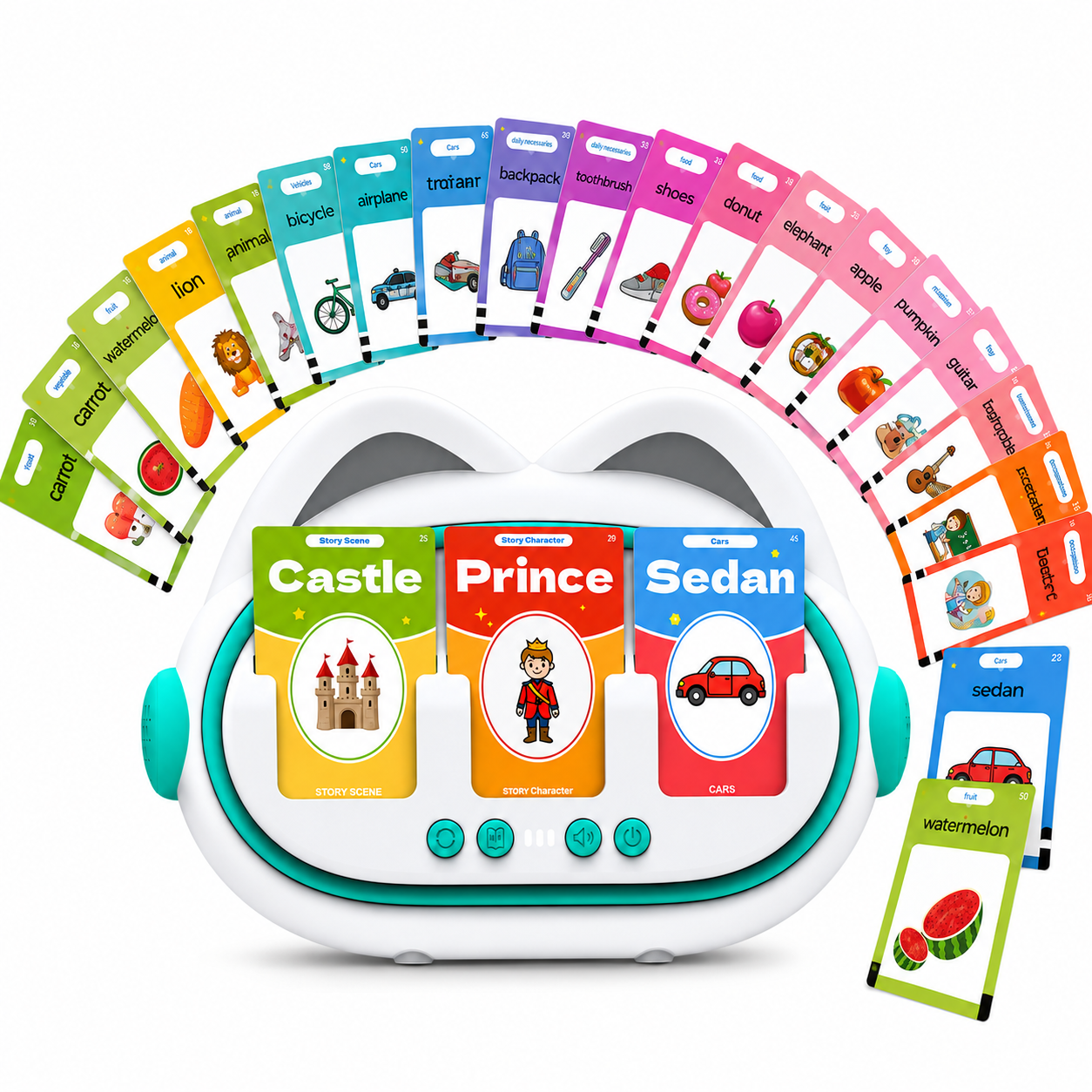
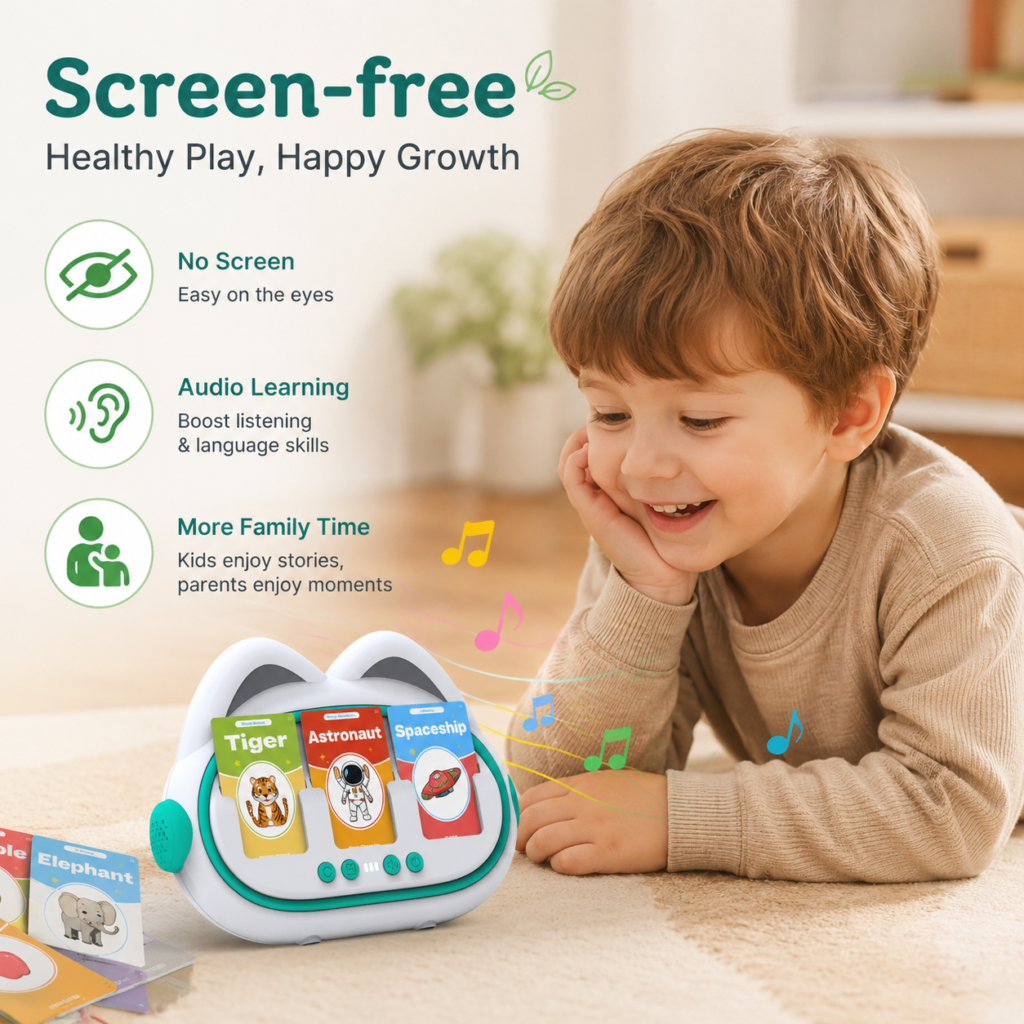
Moreximi’s AI Storytelling Machine is a small white card reader for young kids. Slide in up to three picture cards, press the book-shaped button, and the toy narrates a short story built around those three words.
This verdict rests on the spec sheet, the brand’s own pages and a third-party hands-on unboxing, not on weeks of play at home. It covers what the toy does well, where it asks more of a household than the box suggests, and which families will get the most from it.
The short version: a creative, vocabulary-friendly toy for ages 3 and up, as long as your home has a 2.4 GHz Wi-Fi band and you are comfortable putting a kids’ gadget on your network.
What You Get in the Box
The machine is a rounded white unit with turquoise trim and a pair of ear-shaped bumps on top. Three card slots run across the front, with a row of buttons and a tiny indicator light underneath. There is no screen at all.
- Price: check the current price at Moreximi’s own store, which lists free standard shipping in the US
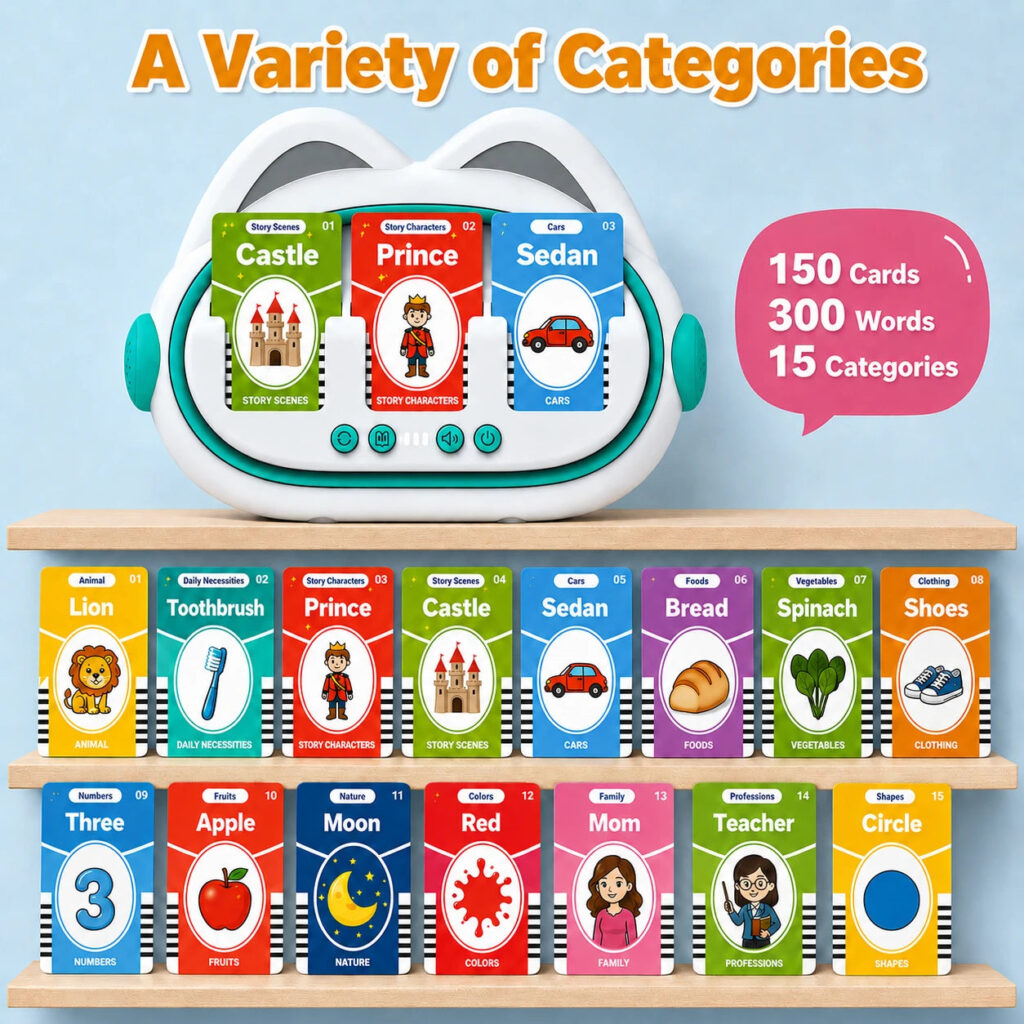
- Cards: 150 double-sided cards, which adds up to 300 English words in 15 categories
- Story mode: up to three cards at once, then a press of the Story button
- Word mode: one card at a time, and the machine says the word aloud
- Battery: 1800mAh lithium-polymer, rated by the maker for over 16 hours of use
- Charging: USB-C at 5V/1A, taking up to 6 hours for a full charge
- Setup: install the app, link it over Bluetooth, then join your 2.4 GHz Wi-Fi
- Age: for children aged 3 and older, per the manufacturer
- Also in the box: a USB-A to USB-C charging cable and a printed user guide
Every card carries a large illustration, the printed word and a category label, and the corners are rounded. The cards are color-coded by category, which makes sorting them into piles easy.
The unboxing notes that there is no wall plug in the package, so plan on using a USB charger you already own. To check the current price, see Moreximi’s range at Moreximi’s own store.
How the Cards and Stories Work
Word mode is the simple half of the toy. Put one card in a slot and the toy speaks its word, and the Repeat button plays it back.
Story mode is the headline feature. Insert up to three cards, press Story, and the machine tells a short tale that weaves in all three words. Press Story once more after it finishes and a different tale begins from the same cards.
Pull a card out partway through and the story stops. Pressing Story during a tale pauses it instead.
The brand’s own diagram shows four steps: power on, insert three cards, the AI generates a story, enjoy it. Inside the app, each story is kept as text for 30 days, and you cannot replay one from there.
What Stands Out
A big word set comes with it. The full 150-card deck is in the box, so there is no extra pack to buy before the toy does its job. The product page also promises no subscriptions or hidden fees.
It really is screen-free. Everything happens through audio and physical cards, and the only light is a small indicator. That is a real pivot for the brand, since its earlier camera and toy phone both had screens.
Two toys in one. Word mode behaves like talking flash cards and needs no internet. Story mode adds the creative layer on top, so the same cards can serve a quiet vocabulary session or a story-time round.
Simple controls. The main buttons are Story, Repeat, Volume and Power, and the volume has three levels. After the first setup, a child can run the toy without a phone.
Where It Asks More of You
Story mode needs the internet
Setup is a parent’s job: download the app, connect over Bluetooth, and give the toy your home’s 2.4 GHz Wi-Fi. Once that is done the phone is no longer needed, yet a third-party unboxing is clear that stories still depend on being online.
Word mode works without any of this. The brand’s site describes the design as app-free, so the app is the first surprise and the connection requirement is the second. Count on stories only where your Wi-Fi reaches, which rules them out for a flight or a long drive.
Privacy details are thin
The brand states that its AI toys are encrypted and meet COPPA. Beyond that claim, the public pages say little: the AI service behind the stories goes unnamed, and nothing describes how content is screened for young listeners.
The privacy page itself was drafted around the brand’s teddy bear and its voice inputs, and an unfinished template note remains on it. That does not prove a problem, but it hints that the paperwork lags behind the product. If data matters to you, email the brand with your questions before you buy.
Therapy-style wording
Some product copy for this toy leans on therapy-style labels. Nothing in the research behind this page supports treating it that way. Think of it as a word-and-story toy, and let a speech-language pathologist guide any plan for a child with a speech delay.
The age rating
Some product copy says toddlers, yet the maker’s age guidance starts at 3. Follow that rating, and supervise play if a younger sibling joins in, because small hands can bend or chew the cards.
Moreximi vs the Yoto Mini
A comparable screen-free player is the Yoto Mini, which also runs on cards. The two work in opposite ways. Each Yoto card points to finished audio such as an audiobook, an album or a podcast, while Moreximi’s cards are single words and the machine invents the story.
| Moreximi | Yoto Mini | |
| What the cards do | Hold one word each, and up to three seed a story | Each one links to finished audio |
| Cards included | 150 | One Welcome Card, which can also be reused |
| Offline | Word mode yes, stories no | Yoto says most listening works offline after download |
| Display | No screen, just a status light | A compact pixel screen |
| Battery | Rated over 16 hours | Up to 14 hours |
| Age | 3 and up | 3 and up |
Moreximi puts the whole deck in the box. Yoto’s player arrives with a single card, so families who want more audio add cards over time, though its app does include no-cost podcasts, radio and sleep sounds.
Yoto wins on travel and on privacy messaging, since its product page states there is no microphone and no camera. Moreximi wins on creativity, because the child chooses the ingredients of every story. Some families will want both, since the two do different jobs.
Who It Suits, and Who Should Skip
- Buy it if your child is between 3 and 6, enjoys stories, and your home has a 2.4 GHz Wi-Fi band you are happy to share with a toy.
- Buy it if screen-free quiet time is the goal.
- Buy it if a large set of talking flash cards appeals to you as much as the stories do.
- Skip it if travel play has to work without internet, in the car or on a plane.
- Skip it if you would rather not connect a kids’ device to your network until the maker publishes clearer data policies.
- Skip it if you want a therapy tool rather than a play toy.
Buying it as a gift? Warn the parents first, since they will do the app setup and Wi-Fi pairing themselves.
Frequently Asked Questions
Does it need Wi-Fi and an app?
Both are needed for setup, and story mode keeps needing Wi-Fi afterward. Word mode works without a connection once the toy is set up.
How long does one charge last?
The spec label gives the 1800mAh cell a rating above 16 hours, and refilling it through USB-C needs as much as 6 hours, so an overnight charge fits.
Is there a subscription?
Moreximi’s product page says no. It promises that the toy has no subscriptions and no hidden fees.
Can I return it?
Returns are open for 30 days after delivery, but support has to approve the return by email before anything is sent back. The item should be unused, in its original packaging and accompanied by proof of purchase. A refund goes to the original payment method within 10 business days, whereas an exchange means returning the item and placing a new order.
One wrinkle: the policy page was written with the brand’s plush toy in mind and says sale items cannot be returned, while the About page promises a full refund within 30 days for an undamaged product. Before ordering, get support to put this toy’s return terms in writing. That same page refers to a one-year quality promise, though no separate warranty document spells out what it covers.
Where should I buy it?
Moreximi’s About page points buyers to its own store for genuine products and warns against unauthorized resellers and counterfeits. If you buy anywhere other than Moreximi’s own site, make sure the seller is authorized. Support and returns only cover purchases made from Moreximi itself, so buying direct keeps things simple. To see what is on offer, browse Moreximi’s range at its official store.
The Verdict
Moreximi’s story machine has a clever core idea. Three picture cards go in, a fresh story comes out, and no screen is involved. The spec sheet backs that up with a large word set, simple controls and a battery rated above 16 hours.
It is worth buying for a child between 3 and 6 in a home with steady 2.4 GHz Wi-Fi and a parent who is comfortable with a connected toy. It is a poor match for families who want an offline travel toy, a therapy tool or a device with detailed, published data policies.
Check the current price and shipping terms on the brand’s own store before you order.