ChoiceQuill is reader-supported. When you buy through links on this page, we may earn a commission. You pay the same price either way.
A car parked outdoors faces sun, rain and wind day after day. Kayme’s all-weather cover is built to take that on.
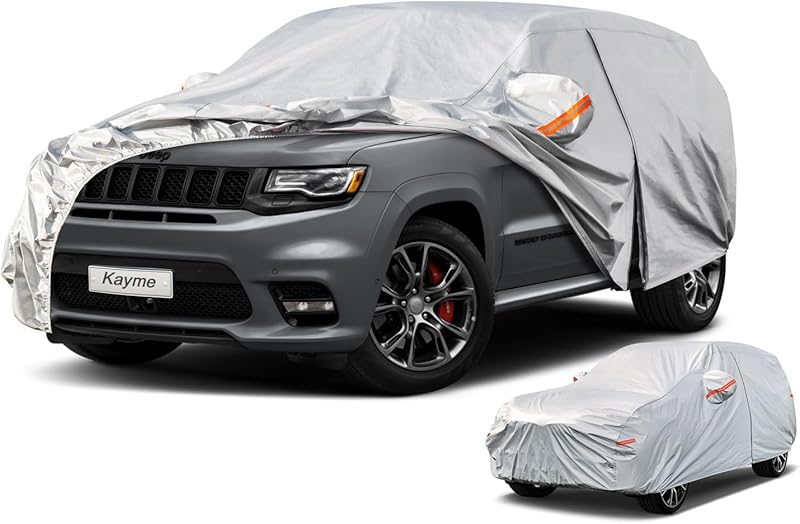
This cover is the piece that the rest of Kayme’s sedan and SUV lineup is built around. It comes in 6, 7 and 10-layer versions, and in several lettered size classes.
Every version shares one core design. Outside is a waterproof shell, in the middle is a reflective layer, and against the car sits a soft liner.
We read the listing specs for each layer tier, along with independent buying guides that covered Kayme next to other budget car cover brands. The aim was to see where this cover earns its place in a driveway.
Three Layers, Three Jobs
The exterior is a PE and PEVA film, which is a plastic blend. It is genuinely waterproof rather than merely water-resistant.
Beneath it sits a layer of reflective aluminum. That layer gives the cover its light gray sheen.
Its real job is to reflect sunlight off the paint, so heat does not build up under the cover.
Closest to the car is a soft lining made of cotton or fleece. It is meant to rest on the paint without scratching it when the wind blows or the cover shifts.
The 10-layer version adds extra padding between these core layers. It does not bring in new materials.
That is a fairly standard way for budget brands to advertise “more layers” without changing the basic build.
Sizing and Built-In Features
This is a universal-fit cover, not a custom pattern cut for your exact make and model. Sizing follows overall vehicle length and a lettered class such as A4, H4 or H6.
Every version includes the same set of features:
- A zipper on the driver’s side, which gives you cabin access without taking off the full cover
- An elastic hem
- Windproof straps at the front and the rear
- A cutout that forms a pocket for the mirror
Sewn-on reflective strips help drivers see the car at night, which matters if it is parked near the edge of a road or driveway.
The hem also has a lock hole. You can use it to secure the cover to a fixed point with a cable lock, a small detail that many covers at this price skip.
Strengths and Weak Spots
The layering is sound engineering for this price tier. Premium brands follow the same basic recipe: waterproof on the outside, reflective in the middle and soft on the inside.
Independent buying guides that reviewed Kayme call it a solid budget option because of that construction.
Fit is where it gives ground. A universal cover will feel looser around the mirrors and bumper edges than one cut for your exact vehicle.
The same guides also note that the waterproof material ages less gracefully than premium custom covers. Over many years of nonstop outdoor use, those pricier covers hold up better.
Picking Your Size and Layers
Start by measuring the total length of your vehicle. Then compare that number with the size chart on the specific listing, rather than guessing from the lettered class name.
A car that lives outdoors all year, especially in a harsher climate, is better served by the 10-layer version.
If you park outside only now and then, or want a backup for the garage, the 6 or 7-layer versions handle the basics. They are also less bulky.
Our Take
We see this as a sensible pick for drivers who want real protection from the weather without spending much. The catch is accepting a universal fit instead of a custom one.
Check the listing’s size chart before you order. If the car stays outside all year, choose the 10-layer version.
It is smart to hold on to the receipt in case the fit needs adjusting.